
A Clear Guide to UK Annual Leave Policies for Employers
Posted by Robin on 26 Dec, 2025 in
An annual leave policy is far more than just a document outlining time off; it’s the strategic framework that establishes clear, fair, and consistent rules for everyone. It’s the official guide for how holiday is requested, approved, and tracked, acting as a crucial protection for both the business and its people. A well-thought-out policy is, without a doubt, a cornerstone of a positive workplace culture.
Why a Clear Annual Leave Policy Is a Business Essential
Imagine trying to play a game without knowing the rules. It would be chaos. That's exactly what running a business without a formal annual leave policy feels like. This policy is the rulebook everyone needs to operate fairly and effectively, and not having one opens the door to a whole host of preventable problems.

When the rules are unwritten, inconsistency quickly becomes the norm. One manager might be fine with last-minute requests, while another demands a month’s notice. This inevitably leads to feelings of favouritism and can seriously damage team morale.
The Risks of Operating Without a Policy
Operating without a formal policy is like navigating without a map—the potential consequences can be costly and disruptive. The key risks you're running include:
- Inconsistent Approvals: When managers apply their own informal rules, it creates employee frustration and can lead to claims of unfair treatment.
- Legal Disputes: Ambiguity around holiday entitlement is a common cause of legal challenges, especially when calculating final pay after an employee leaves.
- Operational Disruption: Without clear guidelines on notice periods or how to handle clashing requests, you risk being short-staffed during critical business periods.
- Decreased Morale: A lack of transparency and fairness in how leave is handled is a fast track to a disengaged and unhappy workforce.
A formalised policy transforms leave management from a source of potential conflict into a pillar of stability. It sets clear expectations for everyone, from new hires to senior leadership, ensuring the entire process is consistent and equitable.
A well-defined annual leave policy is a strategic tool. It protects business continuity by ensuring adequate staffing while championing employee wellbeing through fair and predictable access to rest.
The Legal Foundation for UK Businesses
Beyond just being good practice, having a solid policy is crucial for legal compliance. In the UK, the statutory minimum annual leave entitlement is 5.6 weeks. For a typical full-time employee working five days a week, this translates to 28 days of paid holiday.
This requirement, established under the Working Time Regulations 1998, has been updated over the years to cover all sorts of employment types, including agency staff, irregular-hours, and part-year workers.
To give you a clearer picture, here’s a quick breakdown of the statutory minimums.
UK Statutory Minimum Holiday Entitlement
| Days Worked Per Week | Statutory Leave Entitlement (Days) |
|---|---|
| 5 | 28 |
| 4 | 22.4 |
| 3 | 16.8 |
| 2 | 11.2 |
| 1 | 5.6 |
As you can see, the entitlement scales down for part-time staff. If you want to dive deeper, you can learn more about how UK holiday entitlement is calculated on LeaveWizard.com.
Ultimately, a strong policy provides a definitive reference point that protects your business from legal claims and ensures all employees receive their legal dues. It acts as both a shield against disputes and a guide for fair practice.
Here’s the rewritten section, crafted to sound completely human-written and natural, following the style and tone of the provided examples.
The Core Components of a Robust Annual Leave Policy
A truly effective annual leave policy is much more than a simple number on a contract. Think of it as the operating manual for your company's time off. Each component is crucial for keeping things clear, fair, and running smoothly for everyone involved.
When you nail the details, you prevent a world of headaches. Without them, you’re left with ambiguity, which quickly leads to inconsistent decisions, frustrated employees, and managers wasting time answering the same questions over and over. A solid policy gets ahead of these problems by providing the answers upfront.
Defining the Leave Year
First things first, you need to establish your leave year. This is the 12-month window during which your team accrues and takes their holiday. The law doesn't dictate when this period should start or end, giving you the flexibility to choose what makes the most sense for your business.
A few common approaches pop up time and again:
- January to December: This is the most popular choice for a reason. It aligns with the calendar year, making it incredibly straightforward for everyone to track.
- April to March: You'll often see this in organisations whose financial year follows the same pattern. It can make life a lot easier for the accounts department when dealing with leave liabilities.
- Employee's Start Date: This method personalises the leave year for each team member, running for 12 months from their work anniversary. While it feels fair on an individual level, it can create a real administrative tangle compared to a fixed, company-wide leave year.
Whichever path you take, state it clearly in the policy. This simple step stops any confusion about when entitlements reset and how your carryover rules kick in.
Request and Approval Procedures
Next up is the practical stuff: how people actually book their time off. This section is all about removing the guesswork and setting clear expectations for both employees and their managers. It’s the engine room of your annual leave policies.
You’ll want to specify a few key things:
- How to Request Leave: Tell people exactly how to do it. Is it through an HR platform like Leavetrack, a dedicated email, or a specific form?
- Who Approves Requests: Clarify the chain of command. Does the request go to their direct line manager, the department head, or maybe both?
- Response Times: Set a reasonable timeframe for managers to respond to requests, something like within five working days. This avoids leaving people in limbo.
Getting these procedures down on paper is the foundation of a fair system. It guarantees every request is handled the same way, no matter the team, which is vital for keeping morale high and building trust.
"A great policy isn’t just about what you're entitled to; it's about how you access it. Clear procedures for requests and approvals are the difference between a policy that works on paper and one that works in practice."
Managing Notice Periods and Peak Times
Your policy also needs to tackle the real-world logistics of scheduling. That means setting fair notice periods for leave requests. A good rule of thumb is to ask for notice that’s at least double the length of the holiday. So, for a one-week break, you’d ask for two weeks' notice.
You also need a transparent plan for busy spells like the summer holidays or Christmas. If you don't, you risk a mad dash of conflicting requests that could leave you short-staffed. Your policy should explain how you handle these situations. It could be:
- A simple first-come, first-served system.
- A rota to make sure everyone gets a fair shot year on year.
- Temporary freezes on leave during business-critical periods.
Carryover Rules and Payment in Lieu
Finally, a comprehensive policy has to cover what happens to any leftover leave. You need to be crystal clear about whether employees can carry over unused days into the next leave year. UK law has rules about this, but you can choose to be more generous. For instance, you could allow up to five days to be carried over, provided they’re used by the end of March.
Your policy also needs to touch on Payment in Lieu of Holiday (PILOH). It’s important to state that, by law, you can't pay employees for their statutory holiday instead of them taking it—the only exception is when they leave the company. Your policy should reflect this, confirming that any accrued but untaken leave will be paid out in their final payslip.
Mastering Holiday Accrual and Carryover Rules
Two of the biggest headaches in any annual leave policy are the rules around accrual and carryover. Nail these, and you’re well on your way to a fair, compliant, and easy-to-manage system.
Think of holiday accrual like a piggy bank. For every month an employee works, they pop a few holiday ‘coins’ into their bank, steadily building up their total entitlement over the year.
This gradual build-up is especially fair for new starters or anyone on a variable-hours contract. Rather than giving them a full year's holiday from day one, an accrual system makes sure the leave they've earned is directly in line with the time they've actually worked.
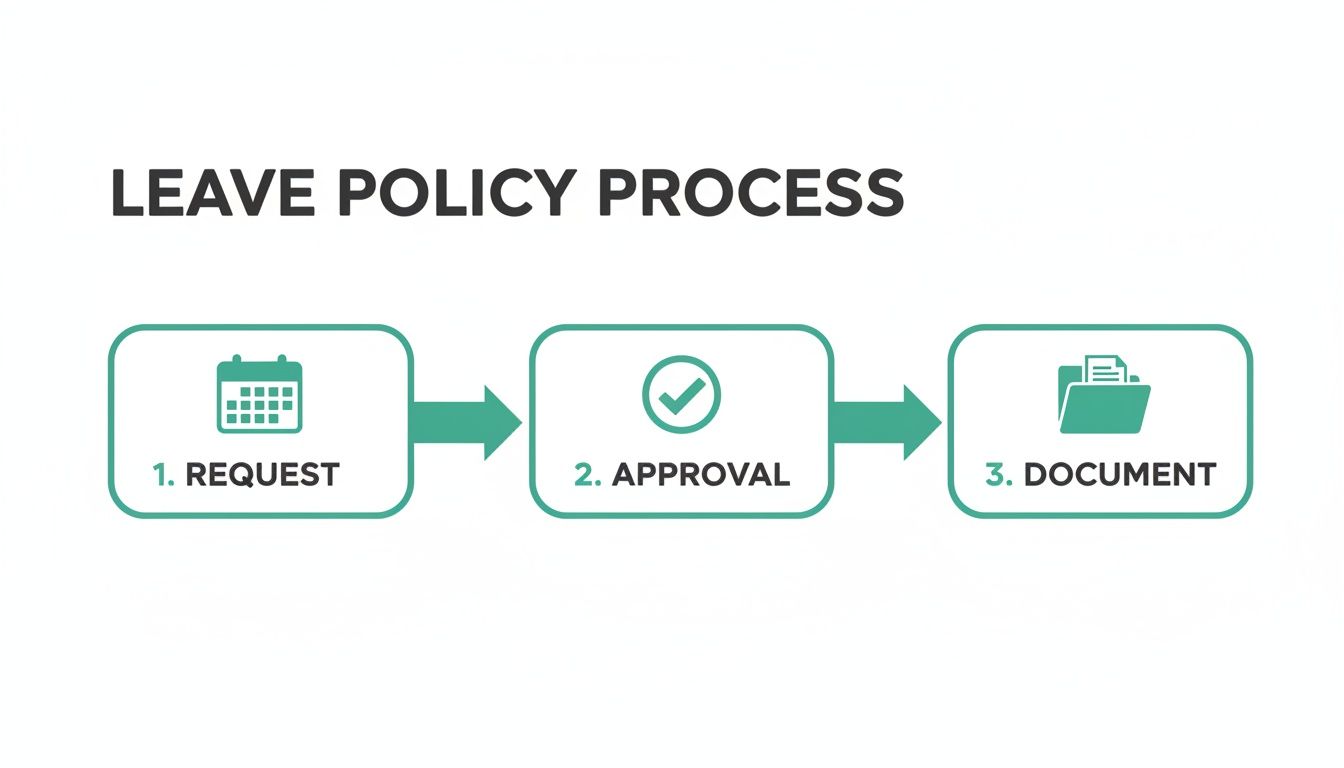
This simple journey from request to record-keeping highlights why having rock-solid accrual and carryover rules is so vital for keeping things running smoothly at every stage.
Calculating Holiday Accrual Correctly
For your full-time, salaried staff, the maths is usually pretty simple. If your leave year runs from January to December and they get 28 days off, they’ll accrue about 2.33 days for each full month they work (that's just 28 days ÷ 12 months). By the end of March, for instance, they'll have earned a solid seven days.
Things get a bit different for part-time or variable-hour workers. Here, the standard UK approach is to use 12.07% of the hours they’ve worked. This number isn't random—it comes from the fact that the statutory 5.6 weeks of holiday is exactly 12.07% of the remaining working weeks in a year (5.6 ÷ 46.4 weeks).
Let’s say a team member worked 80 hours in one month:
- 80 hours x 12.07% = 9.66 hours of holiday accrued.
This method keeps everything proportional and fair, no matter how many or how few hours someone works. If you want to dive deeper into the numbers, check out our ultimate guide to UK statutory holiday allowance.
Setting Clear Carryover Rules
Just as critical as how holiday is earned is what happens to it at the end of the year. This is what we call carryover. While there are some legal minimums you have to let people carry over in specific cases (like long-term sick leave), you have a fair bit of flexibility in your own policy.
A common-sense approach is to let employees carry over a limited number of days.
Permitting employees to carry over up to five days of unused leave is a popular choice. It gives staff some breathing room if they couldn't take all their time off, but it stops a massive leave liability from building up on the company's books.
If you don't set a limit, you risk people hoarding huge amounts of holiday. This can become a real financial headache and a scheduling nightmare when they eventually decide to take it all in one go.
Why Carryover Deadlines Are Crucial
Alongside a limit, you absolutely need a firm deadline for when this carried-over leave must be used. A vague "use it sometime next year" policy is a recipe for disaster. It almost always leads to a mad dash of requests in the first few months, creating the exact operational strain you were trying to avoid.
A clear deadline, on the other hand, adds structure and nudges people to plan ahead.
- Specify a Cut-Off Date: The end of the first quarter (e.g., 31st March) is a popular and practical deadline. It gives everyone a reasonable window to use up their remaining days.
- Communicate Clearly: Make sure this date is stated plainly in your policy. It's also a great idea to send out reminders as the deadline gets closer so no one gets a nasty surprise and loses their leave.
By combining a sensible carryover limit with a firm deadline, your annual leave policy can strike that perfect balance. You give your team valuable flexibility while protecting the business from the risks of out-of-control leave balances. It’s how you turn potential chaos into a predictable, manageable process.
How to Draft Your Policy with Practical Clauses
This is where the rubber meets the road. A great annual leave policy isn't just theory; it’s a practical, living document. Drafting the clauses is all about clarity, foresight, and thinking about how they'll actually work day-to-day. The aim isn't to create a rigid set of rules, but a supportive framework that everyone in the team gets.
Ambiguity is your worst enemy here. Vague phrases like "reasonable notice" or "requests are subject to availability" just create confusion and lead to managers applying the rules differently. On the other hand, specific and clear clauses take the guesswork out of the equation. They empower managers to make fair calls and give employees the confidence to actually plan their time off.
Crafting a Clear Request Procedure Clause
First up, the leave request process. This part of your policy needs to be a simple, step-by-step guide on how an employee officially asks for holiday time. It has to be crystal clear and easy for anyone to follow.
Think of this clause as the "how-to" manual for booking leave. It should spell out the exact channel for requests—is it through a dedicated system like Leavetrack, an online form, or a specific email? It also needs to define the required notice period with total precision.
Here’s how you can turn a wishy-washy statement into a solid instruction:
- Vague Wording: "Please provide advance notice for holiday requests."
- Clear Wording: "All annual leave requests must be submitted through the Leavetrack portal. For leave periods of three consecutive days or more, a minimum of four weeks' notice is required. For shorter periods of one or two days, a minimum of one week's notice is required."
That level of detail leaves no room for doubt about what’s expected.
Wording for Managing Conflicting Requests
It happens every year. Multiple people want the same week off during the summer holidays or over Christmas. This is one of the biggest headaches for managers, so your policy needs a clause that outlines a fair and transparent way to sort it out.
A well-written clause here stops any feelings of favouritism dead in their tracks and makes sure the business can keep running smoothly. It sets out the "rules of engagement" so everyone knows how decisions are made when not every request can be green-lit.
A fair process for managing clashing holiday requests is vital for team morale. When employees understand the criteria for approvals, they are more likely to see the outcome as equitable, even if their own request is denied.
Here are a couple of sample clauses you can adapt to manage these common situations:
- First-Come, First-Served: "In the event of conflicting leave requests for the same period, approval will be granted on a first-come, first-served basis, provided the required notice period has been met."
- Rotational System: "During peak periods (July-August and December), a rotational priority system will be used to ensure fair access to leave. Priority will be given to employees who did not take leave during the same peak period in the previous year."
Sample Policy Clause Comparison
The difference between a policy that causes friction and one that works smoothly often comes down to the wording. A few small tweaks can make a world of difference in how your policy is understood and received by your team. Here’s a quick comparison to show you what we mean.
| Scenario | Unclear Wording (To Avoid) | Clear Wording (Recommended) |
|---|---|---|
| Notice Periods | "Provide reasonable notice for leave." | "Request leave of 1-2 days with 1 week's notice. For 3+ days, provide 4 weeks' notice via Leavetrack." |
| Conflicting Requests | "Holiday requests are subject to business needs." | "Approvals for popular dates are granted on a first-come, first-served basis." |
| Carryover Rules | "Unused leave may be carried over." | "A maximum of 5 days can be carried over and must be used by 31st March of the following year." |
As you can see, specificity is key. Clear wording removes ambiguity, sets fair expectations, and helps everyone plan more effectively.
Setting Definitive Carryover Limits
Finally, every good policy needs a clear clause on carrying over unused annual leave. This is non-negotiable for managing leave liabilities and stopping that mad rush of absences at the start of a new leave year.
Be totally specific about how many days can be carried over and the absolute deadline for using them. Leaving this open-ended can create massive financial and scheduling headaches down the line. To get a head start on this, you can check out our template annual leave policy for more solid examples.
Sample Carryover Clause:
"Employees may carry over a maximum of five days of unused annual leave into the next leave year. Any carried-over leave must be taken by 31st March. Leave not used by this deadline will be forfeited. This clause is subject to statutory provisions for leave accrued during long-term sickness or family leave."
By using language that is clear, positive, and specific, you can transform your annual leave policy from just another document into a practical tool that genuinely supports both your people and your business.
Handling Complex Leave Scenarios and Exceptions
A standard annual leave policy works beautifully when your whole team works a classic nine-to-five. But let's be realistic—modern workforces are a rich tapestry of different working arrangements. A one-size-fits-all approach just won't fly when you're juggling part-time staff, variable-hour contracts, and all the unexpected life events that come with being human.
This is where a good policy becomes a great one. It’s all about having clear, fair, and legally sound answers for the "what if" scenarios that you know will pop up. Getting this right prevents confusion, ensures everyone is treated fairly, and protects your business from potential disputes down the road.
Calculating Leave for Atypical Work Patterns
The first hurdle is often figuring out holiday entitlement for people who don't work a standard week. The key here is to shift your thinking from counting 'days' to counting 'hours'. It’s the only way to maintain fairness and accuracy for everyone.
Part-Time Workers: The principle is simple: their holiday entitlement is directly proportional to the time they work. If a full-timer gets 28 days, someone working three days a week gets 60% of that (3 ÷ 5), which works out to 16.8 days. Your policy needs to spell out this pro-rata calculation clearly.
Variable-Hour or Zero-Hour Workers: For these more flexible roles, the standard industry method is to use the 12.07% accrual rate. This means their holiday entitlement is simply 12.07% of the hours they’ve actually worked. So, if an employee works 100 hours in a month, they’ve earned 12.07 hours of paid leave.
Term-Time Workers: This group can sometimes cause a bit of a headache. They are still legally entitled to the full statutory 5.6 weeks of holiday per year, even though their work is concentrated during term time. This leave has to be taken during the school holidays, and their pay is often averaged out across the year to ensure they get paid consistently.
The Interplay Between Annual Leave and Other Absences
It’s crucial to remember that an employee's right to accrue their statutory holiday doesn't just pause when they're away from work for other reasons. This is a non-negotiable legal point your annual leave policy must cover, particularly for long-term absences.
An employee on sick leave, maternity leave, or paternity leave continues to accrue their statutory annual leave entitlement as if they were still at work. This is a fundamental protection under UK employment law.
What this means in practice is that if someone is off sick for six months, they will come back to work with half a year's worth of holiday waiting for them. That can be a significant amount of leave to manage, so it pays to be prepared.
How to Manage Accrued Leave During Long Absences
- Encourage Leave During Sickness: An employee is perfectly entitled to take annual leave while on sick leave. This can be a practical option if they’re on statutory sick pay and would prefer to receive their full holiday pay instead for a period.
- Plan for their Return: Chat with the employee as they prepare to come back. You can work together to schedule their accrued leave, whether that’s an extended break right after their return or spreading the days out over the following months.
- Understand Carryover Rules: If an employee simply can't take their holiday because they’ve been on long-term sick leave, they have a legal right to carry over up to four weeks (20 days) into the next leave year. This carried-over leave must be used within 18 months from the end of the leave year it was earned in.
Addressing Other Unique Leave Scenarios
Beyond sickness and family leave, a few other unique situations can crop up. Addressing these edge cases in your policy adds another layer of clarity and helps everyone know where they stand.
Sabbaticals: During an unpaid sabbatical, an employee generally does not accrue holiday entitlement. This is because it’s an authorised break where the employment contract is effectively on hold. This should always be explicitly confirmed in the sabbatical agreement itself.
Garden Leave: When an employee resigns and is placed on garden leave, they are still technically employed. This means they continue to accrue annual leave as normal right up to their last day. As an employer, you can require them to use up any outstanding holiday entitlement during this time.
By tackling these complex scenarios head-on in your annual leave policies, you create a framework that's both robust and fair. It gives managers the confidence to handle exceptions consistently and shows your team that you’ve considered their individual circumstances, which goes a long way in building a culture of trust.
Using Technology to Automate Your Annual Leave Policy
A carefully written annual leave policy is a brilliant start, but it's only as good as its execution. Many businesses still find themselves stuck with spreadsheets and manual tracking, and frankly, that's a recipe for disaster. This old-school approach isn't just a time sink; it’s wide open to human error, which can easily lead to bungled accrual calculations and inconsistent rule-following.
The biggest headache with manual systems is the complete lack of real-time visibility. A manager might green-light a request, completely unaware it leaves a critical gap in the rota, only to find out when it’s far too late to fix. This turns leave management into a constant firefighting exercise instead of a smooth, predictable process.
Shifting from Spreadsheets to Software
It’s time to move on from the spreadsheet. Modern absence management software is designed to take your static policy document and turn it into a living, breathing system that just works. These platforms lift the administrative weight from your shoulders, swapping guesswork for precision and clarity.

Think of it this way: a centralised calendar gives everyone an instant, at-a-glance view of team schedules. This simple change helps managers spot potential clashes immediately, ensuring the business always has the cover it needs.
These systems are the engine that truly powers effective annual leave policies. They handle all the fiddly calculations that cause so many headaches. For instance, the software can automatically work out pro-rata holiday for part-timers or apply the 12.07% accrual rate for staff on variable hours. It ensures every employee gets exactly what they're entitled to by law, without anyone having to touch a calculator.
For a deeper dive, our guide to https://blog.leavetrackapp.com/articles/a-guide-to-employee-leave-management-systems explores these benefits in more detail.
By automating accruals and approvals, you free up countless hours for HR and managers. This allows them to focus on strategic tasks rather than getting bogged down in repetitive administration.
The Benefits of an Automated System
Bringing technology into the mix does more than just save time; it fundamentally changes your policy from a document into a tool. And to get the most out of it, it's worth exploring how various workflow automation tools can connect and streamline different parts of your HR process.
The advantages are crystal clear:
- Streamlined Approvals: Managers can approve or deny requests with one click, straight from an email or a Slack notification. The whole process becomes faster for everyone.
- Total Transparency: Employees can check their remaining holiday balance and see the team calendar whenever they want. This empowers them to plan their leave without endless back-and-forth.
- Consistent Application: The system applies the rules—like notice periods or carryover limits—the same way for every single request. This completely removes any risk of inconsistency or perceived favouritism.
- Improved Reporting: Need to know about absence trends, holiday liabilities, or staffing patterns? You can generate reports in seconds, giving you solid data to plan ahead.
Ultimately, technology is what closes the gap between a well-written policy and its fair, consistent application day-to-day. It makes sure your annual leave process isn't just compliant on paper, but efficient, transparent, and user-friendly for your entire team.
Common Questions About UK Annual Leave Policies
Even the most carefully written annual leave policy will spark a few questions. It’s just the nature of the beast. Let's tackle some of the most common queries we see from managers and their teams, so you can handle them with confidence.
Can an Employer Refuse an Annual Leave Request?
In short, yes. You can turn down a holiday request, but you absolutely need a solid business reason for doing so. This isn’t about being difficult; it’s about keeping the business running smoothly.
Good reasons might include making sure you have enough cover during a critical project, avoiding a situation where half the team is off at the same time, or if the employee simply hasn’t given enough notice. The key is to be fair and clear in your communication. Top-tier policies often list potential reasons for refusal, which makes the whole process transparent and consistent for everyone.
What Happens to Holiday Entitlement When an Employee Leaves?
When an employee moves on, you're legally required to tot up any statutory holiday they've accrued but haven't taken up to their last day. This outstanding amount has to be paid out to them in their final payslip. No ifs, no buts.
Now, what if they've taken more leave than they've earned? You might be able to deduct the value of those extra days from their final pay. However, you can only do this if you have a specific clause in their employment contract that gives you permission. Without that, you're out of luck.
By law, the only time you can pay an employee for statutory annual leave instead of them taking it is when their employment ends. This rule exists to make sure people get proper rest and downtime while they're working for you.
Are Bank Holidays Automatically Part of Annual Leave?
Surprisingly, no. There’s no automatic legal right for employees to have bank holidays off. Whether they're included as part of their paid leave all comes down to what's written in their contract of employment.
Many employers do include them in the total package. For example, a contract might state an entitlement of 20 days plus the 8 standard bank holidays. This brings the total to 28 days, neatly meeting the statutory minimum for a full-time employee.
Want to simplify your entire leave management process and make sure your policy is applied fairly every single time? Leavetrack automates accruals, centralises requests, and gives you total visibility, freeing you from spreadsheet headaches for good. Discover how Leavetrack can transform your absence management today.