

A Complete Guide to Day Off in Lieu for UK Businesses
Posted by Robin on 22 Jan, 2026 in
Ever heard of a day off in lieu? You’ve probably seen it shortened to TOIL, which stands for Time Off In Lieu. Think of it like a company time bank. When your employees work extra hours—maybe covering a bank holiday or pushing hard to finish an urgent project—they deposit that time. Later on, they can withdraw it as paid time off.
Unpacking the Day Off in Lieu Concept

At its core, a day off in lieu is just deferred compensation, but the currency is time, not money. Instead of paying an overtime premium, you agree to give an employee the equivalent amount of paid leave to take at a later, mutually agreed-upon date. It’s a powerful, flexible alternative to simply paying for extra hours.
The exchange is straightforward: an employee works beyond their contracted hours to meet a critical business need, and in return, you give them the gift of time. This approach is especially common in professional roles where workloads ebb and flow, demanding occasional bursts of extra effort.
Why Is TOIL a Win-Win Solution?
For your team, the biggest win is a better work-life balance. Instead of a small financial top-up from overtime, they get a full day to rest, sort out personal admin, or just recharge their batteries. That can be far more valuable than the cash, helping to prevent burnout and boost job satisfaction.
For employers, TOIL is a smart way to manage resources. It lets you handle peak workloads and unexpected demands without immediately hiking up your payroll costs. A well-run TOIL system also sends a clear message: you value your employees' contributions and respect their personal time. This fosters a culture of mutual respect and acknowledges extra effort without setting a precedent for constant overtime payments.
A key benefit of offering a day off in lieu is its impact on company culture. It shifts the focus from purely transactional (hours for money) to a more balanced, give-and-take relationship that values employee well-being alongside productivity.
Time Off in Lieu vs Overtime Pay At a Glance
Choosing between TOIL and paid overtime isn't always straightforward. Each has its place, and the right choice often depends on your company culture, cash flow, and the nature of the work. Here’s a quick comparison to help you see the key differences.
| Aspect | Day Off in Lieu (TOIL) | Overtime Pay |
|---|---|---|
| Compensation Type | Time-based (paid leave) | Monetary (extra wages, often at a premium rate) |
| Financial Impact | Cost-neutral in terms of payroll; deferred productivity cost | Immediate increase in payroll expenses |
| Employee Benefit | Promotes work-life balance and rest | Provides immediate financial reward |
| Administrative Load | Requires robust tracking and a clear policy | Involves payroll calculations and processing |
| Best For | Salaried roles with fluctuating workloads; promoting rest | Hourly roles with predictable extra hours; rewarding urgent work |
Ultimately, the best approach depends on what your team values most and what your business can sustainably offer. While overtime pay addresses an immediate financial need, TOIL invests in your employees' long-term well-being and loyalty.
TOIL in the UK Context
In the UK, TOIL has become a cornerstone of flexible leave management. While UK workers are entitled to 28 days of statutory paid annual leave, there's no automatic legal right to have bank holidays off. Many employers need staff to work on these public holidays and, in turn, offer a day off in lieu as fair compensation instead of extra pay.
If you're curious about how paid time off works in different countries, you can learn more from the experts at Moorepay.co.uk.
Getting the Legal and Payroll Rules Right for TOIL
Offering a day off in lieu might feel like a straightforward swap, but you need to be careful you’re on the right side of UK employment law. Think of it less like an informal favour and more like a formal policy that needs proper structure. While TOIL isn't a legal right for employees, how you offer it is governed by some pretty important rules.
The big one to watch is the Working Time Regulations 1998. This is the legislation that caps the maximum weekly working hours and dictates rest periods. The key rule here is that your staff can’t work more than an average of 48 hours per week over a 17-week period, unless they’ve signed an opt-out agreement.
Any extra hours worked to earn TOIL absolutely count towards that 48-hour weekly average. This makes meticulous tracking a must-have, not a nice-to-have. If you let untracked overtime push an employee over that limit without an opt-out, you could be heading for a legal headache.
Compensatory Rest and Your Contractual Obligations
The idea of ‘compensatory rest’ is also a crucial piece of the puzzle. If an employee has to miss out on their daily or weekly rest breaks because of work demands, you’re legally required to make sure they get that rest later on. TOIL is the perfect way to do this, ensuring you’re meeting your duty of care.
Because TOIL isn’t a statutory entitlement, you have to spell it out clearly in the employment contract or in a company-wide policy. This document is your safety net. Without it, you’re opening the door to confusion over how time is earned, when it can be used, and what happens to any leftover TOIL when someone leaves.
A crystal-clear TOIL policy turns a potential minefield into a transparent, fair system that works for everyone. It gives employees clarity and keeps the business compliant with UK employment law.
The Financial Side of TOIL
On the surface, TOIL looks like it costs nothing. You're simply swapping extra hours for paid time off, rather than paying cash for overtime. But that isn't the whole story. Every hour of TOIL an employee clocks up is actually a financial liability on your company’s books.
That banked time represents a future cost—it’s paid time you owe them. If you let this liability snowball, you can run into two major problems:
- Operational Headaches: Imagine several people cashing in their TOIL at the same time. You could suddenly find yourself short-staffed, struggling to keep things running smoothly.
- Financial Shocks: If an employee leaves with a mountain of unused TOIL, you might have to pay it out in their final paycheque, leading to an unplanned cash expense.
Proper management is the only way to avoid these pitfalls. Untracked extra hours can quickly morph into a significant financial and compliance issue. It’s a common struggle; a recent UK annual leave report found that on average, 5 days of annual leave go unused, often because rigid systems can’t handle flexible arrangements like TOIL. For finance teams, good software can automate the whole process—tracking accruals, flagging risks, and logging TOIL seamlessly to keep that liability under control.
How to Create a Fair and Effective TOIL Policy
A casual chat and a nod about a day off in lieu just won't cut it. In fact, it’s a recipe for confusion, misunderstandings, and future disputes. If you want TOIL to be a genuine perk for your employees and a manageable system for the business, you need a formal, written policy. It needs to be clear, fair, and applied the same way for everyone, every time. This policy is the bedrock of a successful system, setting firm expectations and protecting everyone involved.
Think of your TOIL policy as the official rulebook for your company's 'time bank'. Without it, staff are left guessing how to make deposits (accrue time) or withdrawals (take their earned day off). Managers are left without clear guidelines to run the system fairly. A solid, well-thought-out policy removes all that guesswork and makes the entire process transparent from the get-go.
This visual guide breaks down the basic flow of how TOIL is managed within a properly structured policy.
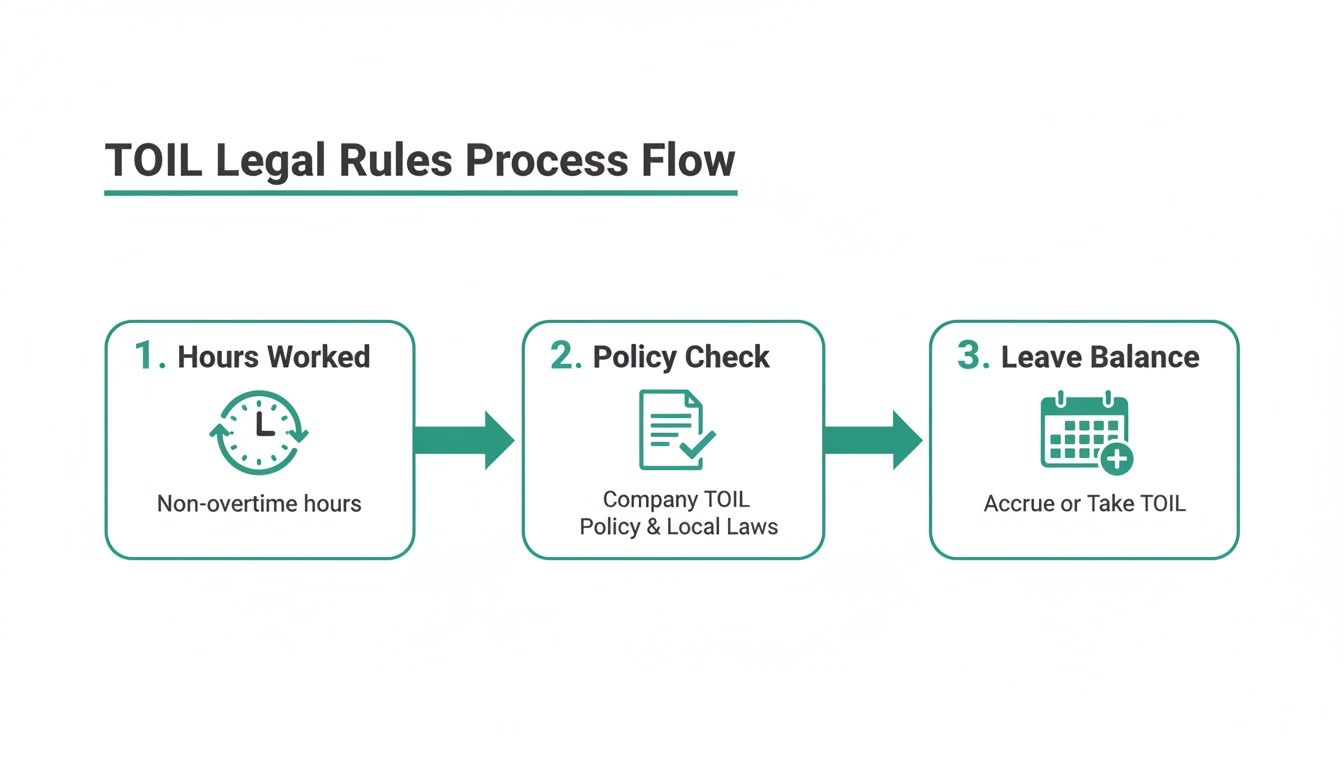
As you can see, every step—from working those extra hours right through to seeing that leave balance updated—needs to be governed by the clear rules laid out in your company policy.
Defining Your Accrual Rules
First things first: you need to decide exactly how employees earn their day off in lieu. The most common and simplest method is a straight hour-for-hour swap. An employee works two extra hours, they get two hours of TOIL in their bank. It’s clean, transparent, and easy for everyone to track.
Some companies, however, choose to offer an enhanced rate, like time-and-a-half, as a bigger thank you for work done on weekends or bank holidays. In that case, working two hours on a Sunday might earn an employee three hours of TOIL. This can be a fantastic way to reward staff for giving up precious personal time, but you absolutely must spell out these premium rates in your policy.
Your policy also has to be crystal clear on what actually counts as overtime. Is it only time worked after a full 8-hour day is complete? Does staying late for 30 minutes to finish a report count? Get specific to stamp out any ambiguity.
Setting Expiry Dates and Usage Limits
One of the biggest pitfalls of a TOIL system is letting staff hoard a massive amount of leave. This quickly becomes an operational nightmare and a growing financial liability on your books. The simple fix? Set clear expiry dates.
A common and perfectly fair approach is to state that all accrued TOIL must be used within three to six months of being earned. This nudges employees to take regular breaks and stops a huge bank of leave building up that could cripple a department if taken all at once.
You should also think about putting a cap on how much TOIL an employee can have in their bank at any given time. For instance, you could limit the total to a maximum of two or three days. This helps keep the whole system manageable and encourages people to use their time off sooner rather than later. You can dive deeper into these strategies in your guide to a fair Time Off in Lieu policy.
To help you structure these rules, here's a table outlining the essential components every TOIL policy should contain.
| Policy Component | Key Questions to Answer | Example Clause Snippet |
|---|---|---|
| Eligibility | Which employees are eligible for TOIL (e.g., full-time, part-time)? Are senior managers excluded? | "This policy applies to all full-time and part-time employees up to and including Team Leader level." |
| Accrual Rate | How is TOIL earned? Is it hour-for-hour? Is there an enhanced rate for weekends or bank holidays? | "Time off in lieu is accrued on an hour-for-hour basis for all pre-approved overtime. Work on a public holiday will accrue at 1.5x the hours worked." |
| Approval | Does overtime need pre-approval? How do employees request to use their TOIL? | "All overtime must be approved in writing by your line manager before it is worked. TOIL leave must be requested via the company's leave management system." |
| Expiry & Caps | How long is accrued TOIL valid for? Is there a maximum amount an employee can bank? | "Accrued TOIL must be used within 3 months of the date it was earned, after which it will expire. The maximum TOIL balance permitted at any time is 15 hours." |
Having these core elements clearly defined will prevent the vast majority of potential issues down the line, ensuring the system runs smoothly for everyone.
Establishing a Clear Approval Process
A TOIL system without a rock-solid approval process is just organised chaos. Your policy must lay out every single step in plain English.
Pre-Approval for Overtime: This is non-negotiable. Require employees to get their manager's green light before they work the extra hours. This gives managers control over workloads, budgets, and prevents staff from racking up time unnecessarily.
Requesting TOIL Leave: Define how employees should book their earned time off. Ideally, this should follow the exact same process as requesting annual leave—preferably through a central system—to ensure records are accurate and cover is arranged.
Blackout Periods: Be upfront about any times when taking a day off in lieu just isn't possible. These "blackout periods" usually fall during your busiest seasons, like year-end for an accounts team or the run-up to Christmas in retail.
Communication and Documentation
Once you've drafted your masterpiece of a policy, your work isn't done. Communication is everything. Don't just save it on a shared drive and hope for the best; make sure every single employee reads and understands it. It should be a living document that’s easy for anyone to find.
- Employee Handbook: Your TOIL policy needs a permanent home in your employee handbook.
- Employment Contracts: A simple reference to the policy in your employment contracts makes it a formal part of your terms and conditions.
- Regular Reminders: Send out a quick reminder about the policy now and then, especially ahead of busy periods when overtime is likely on the horizon.
For a broader perspective on organising company policies, resources like the Open Policy Index can show you how your TOIL rules fit into a bigger governance structure. By creating a comprehensive and well-communicated policy, you're building a system based on trust and transparency, making a day off in lieu a true win-win for everyone.
Calculating and Tracking Employee TOIL Accurately
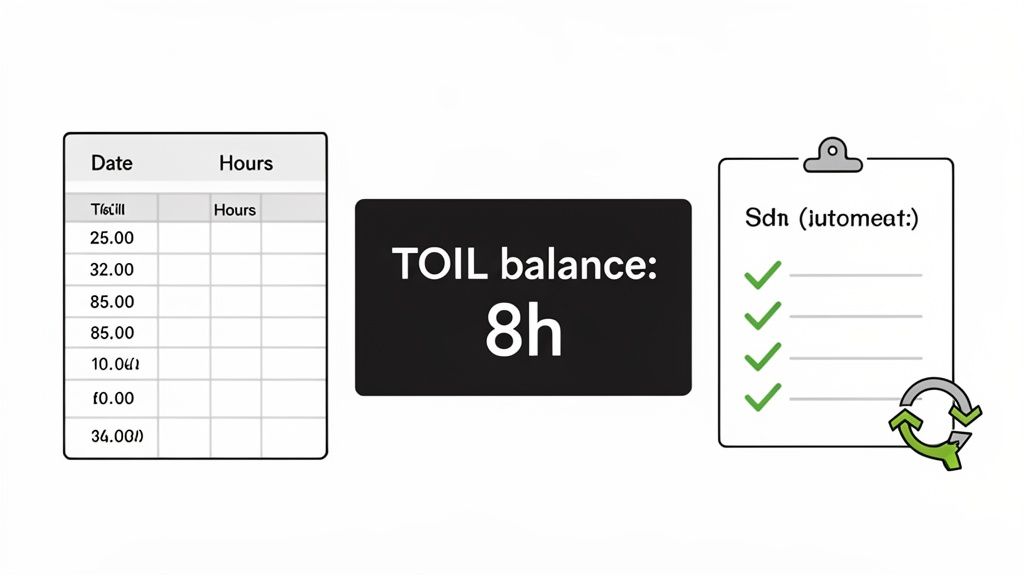
With a solid policy in place, the next challenge is putting it into practice. Accurately calculating and tracking a day off in lieu is where many well-intentioned systems fall down, often leading to confusion for both employees and managers. Getting the numbers right isn’t just an admin task; it’s fundamental to maintaining fairness and trust.
At its core, TOIL calculation is simple arithmetic, guided by the rules you've already defined. Let’s walk through how this works in a couple of common scenarios.
Practical Calculation Examples
Imagine your policy states that TOIL is accrued on a straight hour-for-hour basis. This is the most common and easiest approach to manage.
Scenario 1: Staying Late for a Project
An employee, Alex, stays three hours late on a Tuesday evening to help meet a tight project deadline. Critically, the overtime was pre-approved by his manager.
- Calculation: 3 extra hours worked x 1.0 (hour-for-hour rate) = 3 hours of TOIL accrued.
- Result: Alex now has 3 hours in his TOIL bank, which he could use for a late start one morning or combine with other accrued time.
Scenario 2: Working a Bank Holiday
Now, let’s say your policy offers a premium for working on public holidays. Your accrual rate might be time-and-a-half (1.5x) for these days.
- Calculation: An employee, Priya, works a full 8-hour day on a bank holiday.
- Formula: 8 hours worked x 1.5 (premium rate) = 12 hours of TOIL accrued.
- Result: Priya has earned one and a half days off in lieu for her work—a fair reward for giving up a public holiday.
These examples show how straightforward the maths can be, provided the rules are crystal clear and applied consistently. The real difficulty doesn't come from the calculations themselves, but from the method used to track them.
The Pitfalls of Manual Tracking
For years, the default tools for managing a day off in lieu were spreadsheets, scribbled notes, and a chain of easily lost emails. While it might seem simple enough, this manual approach is notoriously unreliable and creates a heap of problems.
Manual TOIL tracking is a hidden time drain and a major source of errors. A forgotten entry or a miscalculation can quickly lead to disputes, damage morale, and create payroll liabilities that catch you by surprise.
Think about the typical manual workflow. An employee emails their manager about overtime, the manager makes a mental note, and someone in HR is eventually meant to update a central spreadsheet. This fragile process is riddled with potential points of failure:
- Human Error: Simple typos or forgotten entries can lead to incorrect balances.
- Lack of Visibility: Employees often have no idea what their current TOIL balance is without asking HR, creating endless admin work.
- Inconsistency: Different managers might track time differently, leading to unfairness across teams.
- Reporting Nightmares: Pulling together an accurate report on accrued TOIL liability becomes a time-consuming forensic exercise.
Understanding the broader impact is crucial, which is why we explore the importance of accurate absence tracking in another guide. Manual methods just can't provide the reliability needed for a modern workplace.
The Modern Automated Approach
The solution is to ditch the disconnected manual systems and move to a single, automated platform. Specialised leave management software completely changes how you handle a day off in lieu.
Instead of relying on memory and spreadsheets, the entire process becomes automated. When a manager approves a request for three hours of overtime, the system automatically calculates the corresponding TOIL and adds it to the employee’s balance in real-time.
This automated approach delivers immediate benefits:
- Eliminates Errors: Calculations are done automatically based on your policy rules, removing the risk of human error.
- Creates Transparency: Both employees and managers can see the current TOIL balance at any time, which gets rid of guesswork and disputes.
- Saves Administrative Time: HR no longer has to chase managers for timesheets or manually update spreadsheets.
- Ensures Fairness: The rules are applied consistently to everyone, creating a fair and equitable system.
By automating the calculation and tracking of TOIL, you transform it from a risky administrative burden into a seamless and effective employee benefit. This shift not only guarantees accuracy but also frees up valuable time for HR and managers to focus on more strategic work.
Streamlining Your TOIL System with Leave Management Software
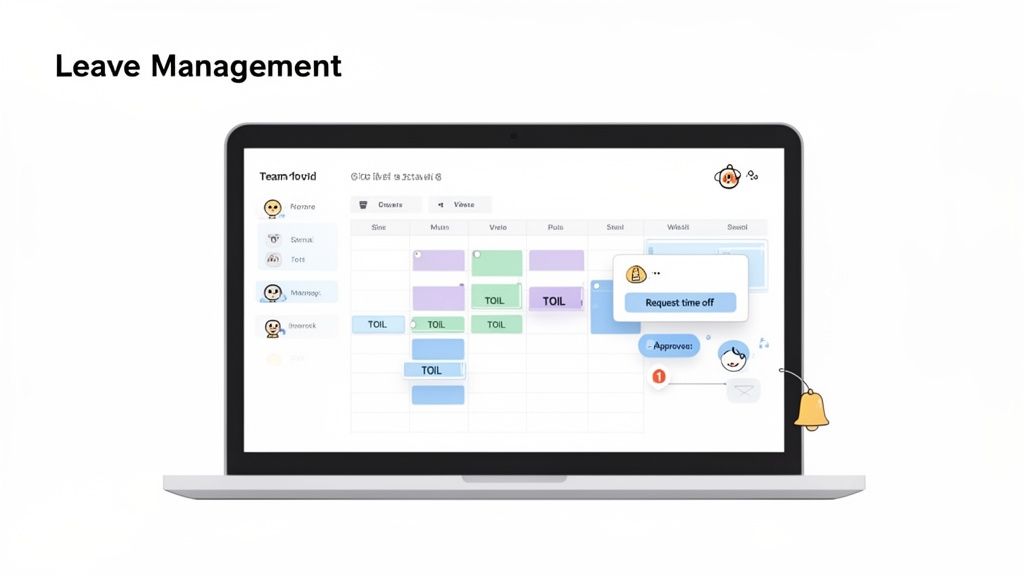
Let’s be honest, trying to manage TOIL manually is a headache. Spreadsheets quickly become a tangled mess, approval emails get lost in crowded inboxes, and pretty soon, nobody—not you, not the manager, not the employee—is sure how much day off in lieu has actually been accrued. This kind of confusion doesn’t just create admin work; it chips away at the trust your TOIL policy is meant to build.
There's a much better way. Moving away from these shaky, disconnected methods and into dedicated leave management software automates the whole process. From the moment overtime is worked to the day the leave is taken, you create a simple, transparent workflow that makes life easier for everyone involved.
Setting Up a Custom TOIL System
The first step is to give TOIL its proper place within your system. Good software lets you create custom leave types, which means you can officially define a day off in lieu as its own category, completely separate from annual leave or sick days.
This isn’t just about changing a label; it’s about building the foundation for smart, automated rules that perfectly match your company’s policy.
- Custom Leave Type: Start by creating a new leave category. Call it "Time Off in Lieu" or simply "TOIL".
- Accrual Rules: Next, tell the system how time is earned. You can set it to accrue automatically when approved overtime is logged, whether you follow an hour-for-hour model or a time-and-a-half policy.
- Approval Chains: Set up a clear workflow for who signs off on requests, from an employee's direct line manager right up to the head of department.
This level of customisation means the software becomes your policy enforcer, making sure the rules are applied consistently every single time, without HR having to manually intervene.
Eliminating Friction with Automation
Once you’ve set the rules, a leave management system gets to work in the background, making sure everything runs like clockwork. It tackles all the usual pain points that come with managing a day off in lieu by introducing some beautifully simple automation.
The real game-changer with automation is having a single source of truth. When an employee, their manager, and HR all look at the TOIL balance, they see the exact same real-time number. Disputes and confusion just vanish.
This centralised approach brings clarity to every step. For businesses looking to finally digitise their leave processes, a good employee time off app can offer a blueprint for modernising these old-school workflows.
Here are the key features that make it all so smooth:
- Central Team Calendar: Everyone gets a clear view. Managers can see at a glance who has booked time off, preventing clashes and making sure there’s always enough cover, even during the busiest periods.
- One-Click Approvals: No more chasing emails. Managers get a notification for a TOIL request and can approve or deny it instantly, often right from their inbox or a Slack message.
- Automated Notifications: The system keeps everyone in the loop. Employees get a confirmation the moment their request is approved, and their TOIL balance updates on its own.
This kind of automation turns TOIL management from a chore into a seamless, proactive process. To get a better handle on how these systems work from the ground up, have a read of our complete guide to online leave management systems.
From Requests to Reporting
The advantages don’t stop at just managing requests. With all your TOIL data neatly stored in one place, pulling reports for payroll and HR becomes incredibly simple. You can see how much TOIL has been accrued across the entire company, spot usage trends, and identify any significant leave liabilities that might be building up. This data is pure gold for financial planning and for ensuring you're sticking to working time regulations.
By moving your TOIL system onto a proper platform, you swap guesswork for certainty, reclaim countless hours of admin time, and give your team a fair, clear, and easy way to manage their well-earned time off.
Frequently Asked Questions About Day Off in Lieu
Even with a perfectly clear policy, you'll still get questions about how a day off in lieu works in practice. Real-world situations involving contracts, people leaving the company, and legal limits always pop up. Here, we'll tackle the most common queries that land on the desks of HR managers and team leaders, giving you the confidence to manage your TOIL system fairly.
Think of this as your go-to troubleshooting guide. It's designed to help you handle the day-to-day realities of your policy, making sure you're being fair to your employees and staying on the right side of UK employment law.
Can an Employee Be Forced to Take TOIL Instead of Overtime Pay?
This is a big one, and the answer is found in one place and one place only: the employment contract. The contract is the legally binding agreement that spells out exactly how an employee will be compensated for any extra hours they work.
If the contract clearly states that overtime is handled with a day off in lieu, then that's the deal. The employee agreed to those terms when they signed on the dotted line, and the company is simply following the procedure that was set out.
However, if the contract says overtime will be paid at a certain rate, you can't just decide to offer TOIL instead. To change that, you'd need to properly consult with the employee and get their formal agreement to amend their contract.
The employment contract is the ultimate source of truth. If it doesn't mention TOIL as the way to compensate for extra hours, an employer can't force it on an employee who has a contractual right to paid overtime.
What Happens to Accrued TOIL When an Employee Leaves?
This is a critical point your TOIL policy needs to address head-on. When someone leaves, any unused day off in lieu they've built up is a form of earned compensation that needs to be settled. Getting this wrong can lead to arguments and even legal headaches.
Your policy should spell out one of two clear options:
- Payment in Lieu: The most straightforward approach is to pay out the value of any unused TOIL in the employee's final payslip. This is usually calculated based on their standard hourly rate.
- Usage During Notice Period: Alternatively, you can require employees to use up their accrued TOIL during their notice period. This can actually be helpful for the business, as it keeps the person around for a bit longer to ensure a smooth handover.
Whichever route you take, it must be written plainly in your policy and applied consistently for everyone who leaves. This ensures there's no room for claims of unfair treatment.
Can We Set an Expiry Date on Accrued TOIL?
Yes, and you absolutely should. Setting an expiry date is a vital best practice for keeping your day off in lieu system manageable. Without one, you could have employees stockpiling huge amounts of leave over several years.
That creates a couple of big headaches. Firstly, it becomes a growing, unpredictable financial liability on your books. Secondly, it’s an operational risk – imagine if several people with huge TOIL balances all decide to take their time off at once. You could be left seriously short-staffed.
To avoid this, it's standard to include a "use it or lose it" clause.
Common Expiry Timeframes:
- Three Months: A popular choice that nudges employees to take their well-earned rest soon after they've put in the extra hours.
- Six Months: This offers a bit more flexibility, which is great for roles where the workload comes in peaks and troughs.
- End of the Financial Year: Some companies tie TOIL expiry to their holiday or financial year to keep the admin simple.
The trick is to pick a reasonable timeframe, state it clearly in your policy, and have a system in place that can flag to employees when their expiry dates are getting close.
Does TOIL Count Towards the 48-Hour Working Week Calculation?
This gets into a crucial bit of legal compliance with the UK's Working Time Regulations. It’s important to understand the difference between the hours worked to earn TOIL and the time taken off as TOIL.
The extra hours an employee works to build up a day off in lieu absolutely count towards their average weekly working hours. The law cares about the actual time spent on the job. That’s why it’s so important that your tracking system records all overtime accurately, ensuring nobody’s average hours creep over the 48-hour limit across the 17-week reference period (unless they’ve signed an opt-out agreement).
On the flip side, the time an employee takes off using their accrued TOIL does not count as working time. It's treated just like annual leave or any other day they aren't working.
Proper tracking is non-negotiable here. It's the extra hours worked that matter for the 48-hour week calculation, not the day off they take later. Failing to monitor this properly can lead to a breach of the Working Time Regulations.
By getting ahead of these common questions in your policy and communications, you can run a TOIL system that's transparent, fair, and legally sound—turning it from a source of confusion into a genuinely valued perk.
Trying to manage a day off in lieu system with spreadsheets is a recipe for mistakes and headaches. With Leavetrack, you can automate the whole thing—from tracking accrued hours based on your policy to handling requests with one-click approvals. You'll ensure fairness, stay compliant, and give your team the clarity they need. See how easy it can be by exploring Leavetrack.