

A Guide to the Sickness Bradford Factor
Posted by Robin on 01 Dec, 2025 in
The Sickness Bradford Factor is an HR formula, but don't let that fool you into thinking it's just about numbers. At its heart, it’s a tool for measuring the impact of employee absence, giving extra weight to frequent, short-term sickness spells over single, long-term periods off. It’s all about spotting patterns of disruption, not just counting up the days someone is away from their desk.
Unpacking the Sickness Bradford Factor

Let's imagine a classic scenario. You have two employees, and both have been off sick for a total of ten days this year. Employee A took two full weeks off for a planned operation. Employee B, on the other hand, has taken ten separate Mondays off throughout the year.
Which one causes more operational chaos? Most managers would point to Employee B without a moment's hesitation. This is exactly the problem the Sickness Bradford Factor was designed to highlight.
It’s not just about counting days; it’s about measuring disruption. The central idea is that frequent, unplanned absences are far more difficult for a business to manage than a single, continuous period of leave. You can often plan for a long-term absence and arrange temporary cover. But those constant, last-minute adjustments for short-notice absences? They create logistical headaches and can really drag down team morale.
Why It Matters to UK Businesses
The Bradford Factor gives you a consistent, mathematical way to flag attendance patterns that might need a closer look. Instead of relying on a manager's gut feeling that someone is "off a lot," the score provides objective data. It’s designed to be a trigger point—not for punishment, but for a conversation.
This data-led approach is widely used across the UK, particularly in sectors where having the right number of people on shift is critical, like manufacturing, healthcare, and education.
A survey from the Chartered Institute of Personnel and Development (CIPD) found that around 60% of UK employers use a scoring system like the Bradford Factor to monitor and manage sickness. You can dig into more UK absence management trends on the CIPD's website. This really shows its role as a standard tool in the modern HR toolkit.
The real purpose of the Bradford Factor isn't to penalise illness. It’s to highlight patterns of absence that could point to an underlying issue—whether that’s related to health, wellbeing, or even job satisfaction.
In practice, the system helps organisations to:
- Identify Patterns Early: It excels at spotting those recurring, short-term absences that might otherwise go unnoticed.
- Ensure Consistency: By applying the same formula to everyone, it creates a fair and level playing field for managing absence across the entire business.
- Prompt Supportive Conversations: A high score should be the cue for a manager to sit down with their team member and understand the reasons behind the absences, not an automatic disciplinary action.
How to Calculate the Bradford Factor Score
The Bradford Factor might sound like something out of a science lab, but the maths behind it is actually quite simple. It’s a formula that takes basic absence data and turns it into a score that shines a light on disruptive, frequent sickness patterns.
The formula is S² x D = B. Let’s quickly break that down:
- S stands for Spells of absence. Think of a 'spell' as any single, continuous period of sickness.
- D represents the total number of Days an employee was absent over a set period, which is usually a rolling 52 weeks.
- B is the resulting Bradford Factor Score.
The most important thing to get your head around is the idea of a 'spell'. It doesn't matter if an employee is off for one day or for two solid weeks—it still only counts as one spell. This is the secret sauce of the Bradford Factor, as it’s designed to heavily penalise the frequency of absence, not just the duration.
Putting the Formula into Practice
To see how this works in the real world, let’s compare two employees. Both have taken a total of 10 days off sick over the past year, but their absence patterns couldn't be more different.
Employee 1: Liam Liam was off sick for one continuous period that lasted for two working weeks (10 days).
- Spells (S): 1 (because it was one unbroken period)
- Days (D): 10
- Calculation: 1² x 10 = 10
- Liam's Bradford Factor Score: 10
Now, let's look at Chloe, who had the same total number of days off.
Employee 2: Chloe Chloe had ten separate, single-day absences dotted throughout the year, also adding up to 10 days in total.
- Spells (S): 10 (each day off counts as a new spell)
- Days (D): 10
- Calculation: 10² x 10 = 1000
- Chloe's Bradford Factor Score: 1,000
The difference is huge. Both employees were off for the same amount of time, but Chloe’s score is a whopping 100 times higher than Liam's. The formula isn't making a judgement on how genuinely ill they were; it's simply giving a number to the operational headache caused by frequent, unplanned absences.
The core idea is that squaring the number of spells gives it an outsized impact on the final score. This is what makes the Bradford Factor such a useful tool for spotting attendance patterns that might need a closer look.
Bradford Factor Score Calculation Examples
The power of this simple calculation really comes to life when you compare a few different scenarios side-by-side. The table below shows just how quickly the score can escalate, even when the total number of days off remains the same.
| Employee Scenario | Number of Spells (S) | Total Days Absent (D) | Calculation (S² x D) | Bradford Factor Score |
|---|---|---|---|---|
| One 10-day absence | 1 | 10 | 1 x 1 x 10 | 10 |
| Two 5-day absences | 2 | 10 | 2 x 2 x 10 | 40 |
| Five 2-day absences | 5 | 10 | 5 x 5 x 10 | 250 |
| Ten 1-day absences | 10 | 10 | 10 x 10 x 10 | 1,000 |
As you can see, the score climbs dramatically with each additional spell. This gives managers and HR a way to move beyond just counting sick days. It opens the door to a more meaningful conversation about the pattern of absence, which is always the first step toward better, more supportive absence management.
Interpreting Scores and Setting Absence Thresholds
Figuring out an employee's Bradford Factor score is only half the story. A number on its own is just data; its real power comes from understanding what it means and what you should do next. A score of 50 might be business-as-usual, but a score of 500 points to a pattern that probably needs a supportive conversation.
Without clear thresholds, the Bradford Factor is just an abstract number. Setting defined trigger points is what turns this metric into a practical, fair management tool you can use across the whole organisation. These triggers aren’t designed to be punitive; they're there to prompt the right conversation at the right time.
This diagram helps to show how we identify a single "spell" of absence, which is the core part of the whole calculation.
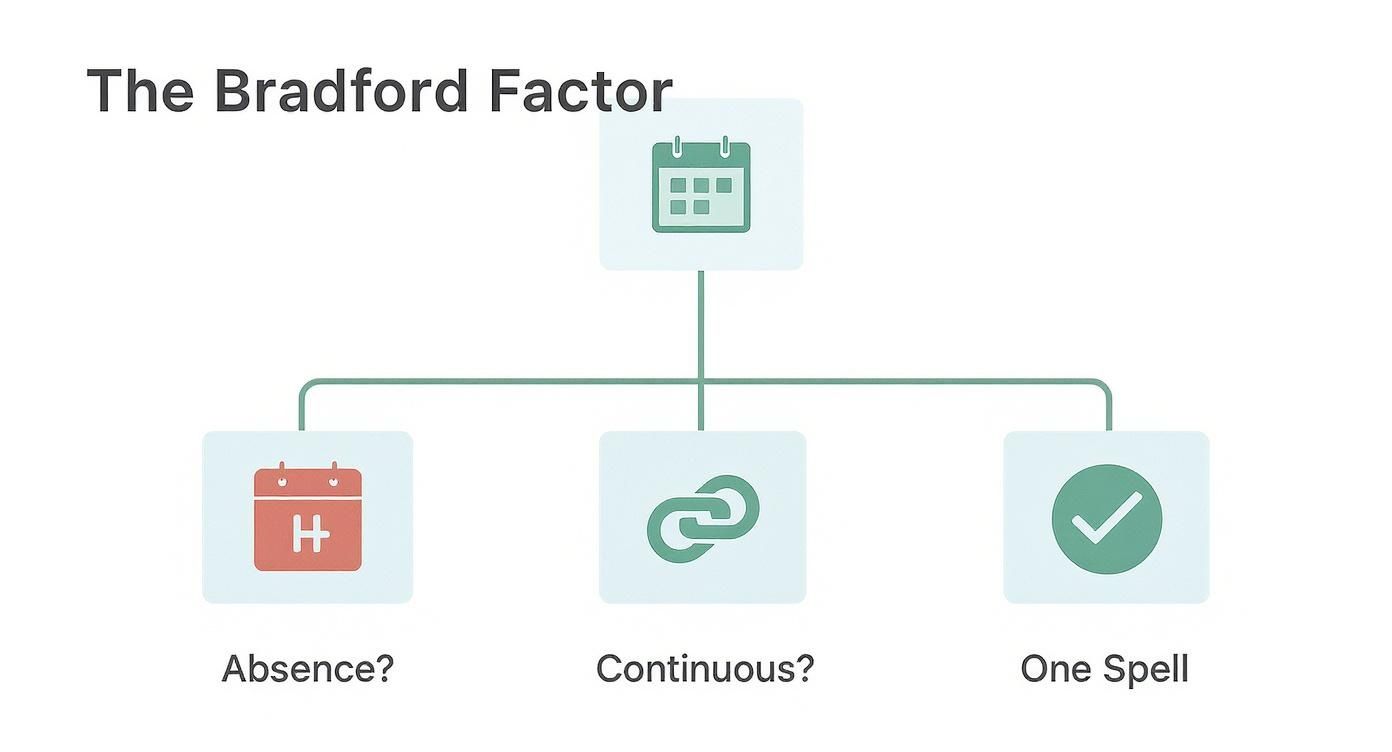
As you can see, any continuous period of absence—no matter how long—is treated as just one "spell".
Establishing Your Trigger Points
There’s no universal, legally mandated set of Bradford Factor thresholds in the UK. Every organisation has to figure out its own trigger points based on its unique operational needs, industry norms, and company culture. That said, a common tiered approach has emerged as a solid best practice.
A typical framework often looks something like this:
- Score 0-50: No Action Needed. This is generally considered a low score, suggesting minimal disruption from sickness absence.
- Score 51-200: Informal Conversation. This score acts as the first nudge. A line manager might have a supportive chat during a return-to-work interview to see if there are any underlying issues or if any support is needed.
- Score 201-400: Formal Meeting & First Warning. At this level, the pattern of absence is becoming more disruptive. A formal meeting is usually scheduled to discuss the impact, review the absence record, and perhaps issue a verbal or first written warning.
- Score 401-600: Final Written Warning. A score in this range signals a serious attendance issue that requires a final warning and a clear plan for improvement.
- Score 601+: Consideration of Dismissal. A persistently high score could lead to further disciplinary action, which might include dismissal, but only after a full and fair process has been followed.
It is absolutely crucial to remember that these scores should trigger a process, not an automatic outcome. A high score is a reason to investigate and talk, never a standalone justification for disciplinary action.
Transforming Data Into Action
The key to using the Bradford Factor effectively is to treat it as a management information tool. It should shine a light on where managers need to focus their attention, prompting them to look beyond the numbers and understand the human story behind them.
This proactive approach helps you tackle potential issues before they escalate, cutting down on the serious disruption that absenteeism can cause. You can get a better sense of the financial impact by understanding how much absenteeism costs employers in lost productivity.
Putting a clear, well-communicated policy in place around these thresholds is vital. Your employees should know what the trigger points are and what process will kick in if they are met. This kind of transparency builds trust and helps ensure the system is seen as fair and consistent, rather than a secretive tool for catching people out. Modern absence management systems are a huge help here, as they can automate the tracking and alert managers when scores cross your predefined thresholds.
The Pros and Cons of Using the Bradford Factor
No HR metric is a perfect solution, and the Bradford Factor is certainly no exception. While it offers a standardised, mathematical way to spot disruptive absence patterns, its rigid nature comes with some serious limitations. For any organisation wanting to use it fairly and effectively, understanding both its strengths and weaknesses is absolutely essential.
On the one hand, the formula gives you an objective, data-driven starting point. It helps shift absence management away from subjective feelings and gives managers a consistent tool to identify potential issues that might otherwise fly under the radar. But on the other, it’s a blunt instrument. It completely lacks context, which can risk unfairly penalising employees with complex personal circumstances.
The Advantages of the Bradford Factor
One of the biggest plus points of the Bradford Factor is how it uses simple maths to highlight disruptive patterns of absence. Imagine two employees who have both taken the same number of days off over a year. The formula will immediately distinguish between the person who had a single long-term absence and the one who had multiple short, unconnected spells off work. This helps managers focus their attention where it's needed most.
Other key advantages include:
- Objective Measurement: The score is based on a clear formula (S² x D), which removes managerial bias from the initial stage of identifying a potential issue. Everyone is measured by the same yardstick.
- Early Intervention: It acts as an early warning system. A rising score can prompt a supportive conversation with an employee long before an attendance issue spirals into a serious operational problem.
- Consistency Across the Business: When used with clear, well-communicated thresholds, it helps ensure a fair and consistent approach to absence management across all departments and teams.
This data-driven approach can also act as a deterrent for non-genuine absences. When employees understand that frequent, single-day spells of sickness will have a greater impact on their score than a single, longer period, it can discourage casual absenteeism.
The Disadvantages and Criticisms
Despite its benefits, the Bradford Factor faces a lot of criticism, mainly because it completely fails to consider the human element behind the numbers. The formula treats every single absence identically, no matter the cause. This lack of context is its single biggest flaw and can lead to some really negative consequences if it isn't managed with care and common sense.
A major concern is that it can unfairly penalise employees with chronic health conditions, disabilities, or mental health struggles. These individuals might have intermittent, unpredictable flare-ups that result in frequent short-term absences, causing their score to escalate rapidly through no fault of their own.
You can see this issue play out in large organisations like the NHS, where sickness absence rates have often been higher than the national average. Many NHS trusts use the Bradford Factor, but its application has been criticised for potentially penalising staff with chronic conditions. Research shows that mental health-related absences, which are often short-term and frequent, can lead to disproportionately high scores, creating even more stress for employees who are already struggling.
The Bradford Factor can tell you what is happening with employee absence, but it can never tell you why. A high score should always be the beginning of a conversation, never the end of one.
Further disadvantages include:
- Risk of Discrimination: Rigidly applying the formula without making reasonable adjustments for employees with disabilities could easily lead to claims under the Equality Act 2010.
- Encourages Presenteeism: A fear of triggering a high score might pressure employees to come to work when they are genuinely ill. This not only risks their own health but also the health of their colleagues.
- Erodes Morale: If it's seen as a punitive tool rather than a supportive one, it can damage trust, kill employee engagement, and foster a culture of fear.
To help you weigh things up, here’s a quick summary of the main arguments for and against using the Bradford Factor.
Bradford Factor Advantages vs Disadvantages
| Advantages | Disadvantages |
|---|---|
| Provides an objective, data-driven measure. | Lacks human context and ignores the reason for absence. |
| Highlights disruptive, short-term absence patterns. | Can unfairly penalise those with chronic illness or disabilities. |
| Ensures a consistent approach across the organisation. | May encourage 'presenteeism' (coming to work while ill). |
| Acts as an early warning system for potential issues. | Risks damaging employee morale and trust if used punitively. |
| Can deter non-genuine, casual absences. | Rigid application could lead to discrimination claims. |
Ultimately, the Bradford Factor is just a tool—its impact, whether positive or negative, depends entirely on how it is used. When thinking about its effectiveness, it’s also useful to compare it with more modern approaches like unlimited PTO policies, which operate on a foundation of trust rather than strict tracking. Any use of the Bradford Factor must be balanced with managerial discretion, empathy, and a robust, supportive absence management process.
Legal Guidelines for UK Employers
While the Bradford Factor gives you a mathematical way to spot absence patterns, using it isn't a simple numbers game. Here in the UK, applying this tool means you have to tread carefully around employment law to stay fair and sidestep some serious legal traps. A rigid, automated approach can easily wander into discrimination claims, turning a helpful metric into a major liability.
The most critical law to keep in mind is the Equality Act 2010. This act legally requires employers to make 'reasonable adjustments' for employees with disabilities. A disability, under the Act, is a physical or mental impairment that has a 'substantial' and 'long-term' negative effect on someone's ability to do normal daily activities.
This duty isn't optional. If an employee's frequent short-term absences are a direct result of their disability, applying the Bradford Factor without any flexibility could be seen as discriminatory.
The Duty to Make Reasonable Adjustments
You simply cannot treat a high Bradford Factor score caused by disability-related absences the same way you'd treat one from non-genuine sickness. If you insist on the same attendance standards for a disabled employee whose condition causes intermittent absence, you could be facing a claim for indirect discrimination or a failure to make reasonable adjustments.
So, what does a reasonable adjustment actually look like in this situation? It can take a few different forms:
- Discounting Absences: You might agree to disregard some or all absences directly linked to an employee's disability when you calculate their Bradford Factor score.
- Adjusting Thresholds: Another practical step is to set higher, more lenient trigger points for disabled employees, giving them more breathing room before any formal process kicks off.
- Focusing on Individual Circumstances: The most crucial adjustment is to ditch the one-size-fits-all policy. Look at each case on its own merits, and make sure your focus is on support, not sanctions.
A high Bradford Factor score should never lead to automatic disciplinary action. It must always be a trigger for a supportive, confidential conversation to understand what's really going on.
Best Practices for Legal Compliance
To use the Bradford Factor fairly and legally, it has to be part of a wider, more human absence management policy. The numbers can give you a starting point, but human judgement and empathy are non-negotiable. Investigating the reasons behind an absence pattern is far more important than the score itself.
Keeping your policy transparent is also vital. Your employees should know exactly how the Bradford Factor is used, what the trigger points are, and that disability-related absences will be considered separately. This transparency builds trust and shows you're committed to being fair. For more on this, our guide explains why accurate absence tracking is crucial for compliance and meeting your legal duties.
Ultimately, the key is to remember what the Bradford Factor is for: it's a management information tool, not a disciplinary weapon. By using a high score as a prompt to investigate, support, and make necessary adjustments, you can manage attendance effectively while upholding your legal and ethical responsibilities. Getting this wrong doesn't just damage morale; it opens your organisation up to costly and damaging legal challenges.
Automating Bradford Factor Tracking with HR Software

Let's be honest: nobody enjoys manually updating spreadsheets. Tracking every single spell of absence and constantly recalculating Bradford Factor scores is tedious, time-consuming, and worst of all, prone to human error. It’s the kind of admin that pulls HR teams and line managers away from what they should be doing – supporting their people.
This is where modern HR software changes the game entirely. It takes Bradford Factor management from a reactive chore into a proactive, strategic tool. These systems automate the entire workflow, saving huge amounts of time and ensuring the numbers are always right.
The Power of Automated Workflows
The biggest win with automation is getting instant, error-free calculations. Every time a new sickness absence is logged, the system recalculates the employee’s Bradford Factor score in real-time. No more messing about with formulas or manual data entry.
This automated approach guarantees that:
- Scores are always current: The calculations reflect the very latest absence data, giving you a completely up-to-date picture.
- Data integrity is maintained: By removing manual input, you eliminate the risk of typos, missed entries, and other common mistakes.
- Consistency is a given: The same rules and formulas are applied to every single employee across the organisation, which is crucial for fairness.
When you automate the number-crunching, managers can stop being data analysts and start having meaningful, supportive conversations with their team members. This is where real absence management begins.
This shift couldn't be more timely. Recent data from the Office for National Statistics (ONS) shows that UK sickness absence rates are on the rise. The average sick days per employee have climbed from 81 days in 2019 to 128 days in 2023. With more absence data to manage, automated systems have become essential.
Beyond Calculation: Proactive Alerts and Insights
The best HR systems don't just calculate scores; they turn that data into something you can act on. Managers can get automatic alerts the moment an employee’s score crosses a trigger point, prompting a timely and consistent conversation.
To get the most out of this, look for solutions offering solid HR technology integration so your absence data can connect with your other people systems. This technology can also generate powerful reports, revealing absence patterns across different departments or the entire business. Our guide on how dedicated absence management software can streamline UK compliance dives deeper into this.
Ultimately, this data allows you to use the Bradford Factor not as a stick to beat people with, but as a starting point for creating a more supportive and productive place to work.
Of course. Here is the rewritten section, crafted to sound like an experienced human expert and match the provided examples.
Your Bradford Factor Questions Answered
Even when you get your head around the formula, putting the Bradford Factor into practice throws up a lot of questions. For managers and employees alike, knowing how these scores are actually used is key to making sure the system is fair and not just a numbers game. Let's tackle some of the queries I hear most often.
What Is Considered a Good Bradford Factor Score?
There’s no magic number here. A "good" score is completely relative to the thresholds your own company sets in its absence policy.
That said, most businesses would see any score under 50 as absolutely fine and nothing to worry about. A 'good' score is simply one that doesn’t hit the first trigger point for action. This first trigger, which usually just prompts an informal chat, often lands somewhere between 100 and 200. The goal for any employee is just to stay below whatever levels your company has clearly laid out.
A "good" score isn't about hitting a specific target. It’s about maintaining an attendance pattern that doesn't trigger your company's predefined intervention stages. It’s all about the context of your internal policy.
Thinking about it this way helps frame the score as a helpful guide for managing attendance, not some kind of pass-or-fail exam.
Can You Be Fired for a High Bradford Factor Score?
Let’s be crystal clear on this one: in the UK, a high Bradford Factor score, on its own, is not a valid or legal reason for dismissal. It absolutely cannot be used to automatically fire someone.
Think of a high score as a red flag, not a final verdict. It’s a trigger for a manager to start a fair, formal, and supportive absence management process.
This process has to include a few crucial steps:
- Investigation: The manager needs to sit down with the employee to talk about the score and try to understand the reasons behind their absences.
- Support: That conversation should explore what help might be needed. Could flexible working make a difference? Is an occupational health referral appropriate?
- Formal Warnings: If attendance doesn't get better after support has been offered and considered, a formal warning procedure (verbal, then written, then final written) would typically be the next step.
Dismissal is only ever the last resort after this entire, documented process has been followed properly. Trying to use the score to skip these steps would almost certainly be judged as an unfair dismissal.
Do Disability-Related Absences Count Towards the Score?
This is a really critical point for UK employers, and it's a legal minefield if you get it wrong. Under the Equality Act 2010, you have a legal duty to make 'reasonable adjustments' for employees with disabilities. If you just apply a standard Bradford Factor policy to everyone without thinking about this duty, you could easily find yourself facing a discrimination claim.
A very common—and necessary—reasonable adjustment is to discount some, or all, disability-related absences from the calculation. For instance, if someone has a chronic condition that flares up now and then, counting those days would unfairly penalise them for something directly linked to their disability.
The key is to discuss and document any adjustments with the employee. If you’re ever in doubt, getting advice from an HR professional or a legal expert is essential to make sure you're being both compliant and supportive.
Juggling absence policies, calculating scores, and applying them consistently across the board is a lot of work. Leavetrack automates the whole thing for you—from logging leave to tracking scores against the custom thresholds you set. It helps you manage attendance fairly and efficiently, without the headache. Discover a simpler way to handle absence at https://leavetrackapp.com.