

A UK Employer's Guide to Day in Lieu
Posted by Robin on 16 Nov, 2025 in
Ever heard the phrase ‘a day in lieu’ and wondered what it’s all about?
It’s a simple concept that can make a huge difference in how you manage extra hours. Essentially, a day in lieu is paid time off an employee earns for working hours they aren't normally contracted for, like a bank holiday or a weekend.
Think of it as a ‘time bank’. Your team member works extra hours to hit a deadline, and instead of getting paid overtime, they ‘deposit’ that time. Later on, they can ‘withdraw’ it as a day off. It’s a flexible and fair way to acknowledge their extra effort.
What a Day in Lieu Means for Your Business

Time Off In Lieu, or TOIL as it’s commonly known, is a really popular way to handle overtime in the UK. It’s a practical alternative to paying out cash when your people go the extra mile. Rather than paying a premium for those extra hours, you offer them the equivalent time off to take later.
This can be a win-win. It’s often more cost-effective for the business, and many employees really value the extra flexibility to improve their work-life balance.
Let’s say an employee, who usually works Monday to Friday, pulls a full Saturday to get a critical project over the line. Under a TOIL system, they’ve just earned one day in lieu. They can then book this day off in the future, just like normal holiday, once their manager gives it the nod. It’s a brilliant solution for covering bank holidays, too.
Day in Lieu At a Glance
To quickly recap, here are the key things to know about how TOIL works in practice.
| Concept | Primary Purpose | Common Scenarios | Legal Status |
|---|---|---|---|
| Time Off In Lieu (TOIL) | To compensate employees for working beyond their contracted hours with time off, rather than overtime pay. | Working on a bank holiday, staying late to meet a deadline, or working on a weekend. | Not a statutory right, but a common contractual arrangement. Must be clearly defined in the employment contract or company policy. |
As you can see, while TOIL isn't a legal requirement, it's a widely accepted practice that needs a solid framework to work properly.
The Foundation of Fairness
A good day in lieu policy is all about trust and transparency. It shows your staff you recognise their commitment and want to compensate them fairly. But—and this is a big but—it only works if you have a clear, documented system in place.
Without one, you’re opening the door to confusion, arguments, and an administrative nightmare. To build a fair system, you'll need:
- A Clear Policy: A written document that explains exactly how TOIL is earned, tracked, and taken.
- Accurate Tracking: A reliable way to log those extra hours so everyone gets the credit they’re due.
- Defined Rules: Clear guidelines on when TOIL can be used, and if it has an expiry date.
The core idea behind TOIL is simple reciprocity. It’s an agreement where an employee’s extra time is treated as a valuable asset they can exchange for personal time later on. This fosters a great culture where flexibility works for everyone.
In the UK, this fits neatly with statutory leave rules. Most workers are entitled to 5.6 weeks of paid holiday a year, which works out to 28 days for someone full-time. Whether bank holidays are included in this allowance comes down to the employment contract. That's why offering a day in lieu is such a common and effective solution when staff have to work on those days.
Managing these entitlements is crucial. For a much deeper dive into your legal obligations, check out our guide on UK statutory holiday allowance. By setting up a robust TOIL system, you’re not just following good practice—you’re showing your team you truly value their dedication.
Getting to Grips with Your Legal and Contractual Duties
It’s tempting to see offering a day in lieu as a simple, informal handshake deal. "Work this Saturday, take a day off next week." Easy, right? Not quite. In the UK, the legal and contractual side of things demands a much more solid approach to keep both your business and your people protected.
While Time Off In Lieu (TOIL) isn't a statutory right like paid holiday, the moment you offer it, you’re stepping into an area governed by some crucial employment laws.
The big one is the Working Time Regulations 1998. This is the legislation that sets the ground rules for maximum weekly working hours, rest breaks, and annual leave. A well-run TOIL system can be a manager’s best friend for staying compliant, but a sloppy one can land you in hot water fast.
For instance, the regulations say employees can’t work more than an average of 48 hours a week over a 17-week period—unless they've specifically opted out in writing. TOIL is a brilliant way to manage this. It lets people balance out those hectic, long-houred weeks with some well-earned time off, keeping their average hours safely within the legal limit.
The Employment Contract is Non-Negotiable
The absolute foundation of any TOIL system that won't give you headaches is the employment contract. Ambiguity here is your worst enemy; clarity is your best friend. Without a written agreement, you’re creating a grey area that’s just asking for disputes over what was promised versus what was actually delivered.
Your employment contracts must spell out that TOIL is an option for extra hours worked. Think of this clause as non-negotiable.
A quick chat or an informal nod isn't going to cut it. A clear, written policy, baked right into the employment contract, gets rid of any doubt. It sets firm expectations from day one and gives your TOIL system a proper, legally sound footing.
This written policy is your chance to define the rules of the game before any problems crop up. It takes what could be seen as an informal perk and turns it into a structured, fair, and transparent process.
Defining Your TOIL Agreement
So, what goes into this agreement? Just saying "TOIL is available" is nowhere near enough. You need to get into the nuts and bolts to prevent confusion and conflict down the line.
Your agreement or policy needs to clearly outline:
- The Accrual Rate: How do people earn a day in lieu? Is it a simple hour-for-hour swap? Or do you offer a better rate for unsociable hours, like 1.5 hours off for every hour worked on a bank holiday?
- The Approval Process: Who signs off on the overtime before it’s worked? This is vital for stopping TOIL from racking up without any management oversight.
- The Booking Procedure: How do employees actually request to use their accrued time off? Does it go through the same system as their annual leave?
- Expiry Dates: Does the time off expire? It's very common practice to set a deadline, requiring TOIL to be used within a set period, like three or six months. This stops it from building up forever.
Avoiding Common Legal Pitfalls
A watertight TOIL policy does more than just manage expectations—it helps you sidestep some serious legal tripwires. One of the most critical is making sure an employee’s pay never accidentally dips below the National Minimum Wage (NMW).
Think about it: if someone works extra hours but isn't paid for them in that pay period (because they're banking them as TOIL), their average hourly rate could drop below the legal minimum. You have to track hours meticulously to make sure this never happens. For example, if an employee on the NMW works a lot of extra hours one month, their total pay for that month, when divided by all the hours they worked, must still meet that minimum wage threshold.
Also, TOIL should never be a sneaky way to avoid paying for overtime if your contract says you will. If a contract promises paid overtime at a premium rate, you can’t force an employee to take a day in lieu instead. The policy has to be fair and agreed upon from the start.
By being thorough and transparent, you build a system that works for everyone—it's fair, compliant, and genuinely beneficial.
How to Build a Fair and Effective TOIL Policy
Putting together a solid Time Off In Lieu (TOIL) policy is about turning a vague idea into a clear, working framework. Think of a good policy as your blueprint for fairness—it stops misunderstandings before they start, protects the business, and most importantly, shows your people you value their extra time and effort. Without one, you're left with informal chats and hazy memories, and that rarely ends well.
The aim is to create a system that’s transparent, consistent, and dead simple for everyone to follow. It needs to clearly answer the big questions: who can earn a day in lieu, how do they earn it, and what are the rules for taking it? That clarity is the bedrock of a policy that actually feels fair to everyone involved.
Start with the Core Components
Every solid TOIL policy rests on a few essential pillars. These are the non-negotiables that give it structure and stop confusion in its tracks. Getting these fundamentals right from the word go will save you a world of administrative pain later on.
These are the ground rules that ensure everyone is treated the same, right across the organisation.
Your policy must spell out:
- Eligibility: Is TOIL for everyone, or is it limited to certain roles or pay grades? It's common for senior managers on higher salaries to be ineligible, while it's a key benefit for more junior team members. Be specific to avoid any grey areas.
- Prior Authorisation: This is a big one. Employees must get a green light from their line manager before they work the extra hours. This single rule prevents unauthorised overtime and gives managers a firm grip on workloads and budgets.
- Accrual Rates: How is the time actually earned? The simplest route is a straight one-for-one swap—one hour of overtime equals one hour of TOIL. But you might want to offer a bit more, like 1.5x the time for working a bank holiday or a weekend, to properly thank staff for giving up their personal time.
Set Clear Boundaries and Limits
A classic mistake with TOIL is letting it pile up forever. This can lead to employees hoarding massive balances of time off, which becomes a real liability for the business and can easily mask burnout issues. Setting clear boundaries is vital for a system that's healthy and manageable for everyone.
These rules protect both your employees' wellbeing and the company's operational stability.
An effective TOIL policy is proactive, not reactive. By setting limits on accrual and expiry, you encourage regular rest and prevent time off from becoming an unmanageable financial or operational burden.
Consider putting these key limitations in place:
- Maximum Accrual Cap: Set a sensible limit on how much TOIL someone can keep in their "time bank." Capping it at 5 days (or 37.5 hours), for instance, stops balances from spiralling out of control.
- Expiry Dates: TOIL shouldn't last forever. A common and fair approach is to state that accrued time must be used within a certain window, like 3 or 6 months from when it was earned. This gently nudges people to take the breaks they've earned.
Define the Request and Approval Process
So, an employee has earned a day in lieu. How do they actually book it? The process should be as straightforward as requesting any other type of holiday. The most logical way to handle this is to plug it straight into your existing absence management system.
A clean workflow removes friction and makes sure requests are handled fairly and consistently every time. Your policy should detail the exact steps someone needs to take, from putting in the request to getting their manager's approval.
This process is a vital part of maximising employee satisfaction with a clear leave policy, because it shows everyone is being treated the same way.
Before we move on, here's a quick checklist to help you structure your policy. It covers the must-haves and the nice-to-haves that create a truly robust framework.
Key Components of a TOIL Policy Checklist
| Policy Component | What to Define | Importance (Essential/Recommended) |
|---|---|---|
| Eligibility | Which roles/departments are eligible for TOIL? | Essential |
| Prior Authorisation | Is manager approval required before working overtime? | Essential |
| Accrual Rates | How is time earned (e.g., 1:1, 1.5x for weekends)? | Essential |
| Minimum Accrual | Smallest block of time that can be accrued (e.g., 30 mins). | Recommended |
| Maximum Cap | The total amount of TOIL an employee can hold. | Essential |
| Expiry Rules | How long does an employee have to use their TOIL? | Essential |
| Booking Process | How do employees request and get approval to use TOIL? | Essential |
| Sickness Policy | What happens if an employee is sick on a TOIL day? | Recommended |
| Termination Rules | Is unused TOIL paid out or must it be taken? | Essential |
This checklist isn't just about ticking boxes; it's about building a policy that’s clear, fair, and leaves no room for confusion.
Handling Special Circumstances
Finally, a good policy has to cover the "what if" scenarios. Life happens, and your TOIL rules need to account for things like long-term sickness or someone leaving the company. Thinking through these edge cases now will save you from some very awkward conversations down the line.
Your policy should offer clear guidance on:
- Sickness Absence: What if someone is off sick on a day they’d booked as TOIL? A fair policy would usually let them reclaim that TOIL day, just as you would for annual leave.
- Termination of Employment: This is critical. The policy must be crystal clear on what happens to accrued TOIL when someone leaves. The two standard options are either making them take the time during their notice period or paying it out in their final salary. Paying it out is often the cleanest solution for everyone.
By covering these key areas, you'll build a TOIL policy that's not just legally sound, but also a powerful tool for building a culture of trust and respect.
Tracking TOIL Accurately Without the Headaches
A fair Time Off In Lieu (TOIL) policy is only as good as the system you use to track it. Without a reliable way to log every hour earned and taken, even the best policy can fall apart, creating a mess of disputes and admin overload. Nailing the operational side is the key to turning a good idea into a process that just works.
The journey starts with how you calculate it. For many, a simple one-to-one exchange is the cleanest approach: one hour of overtime earns one hour of TOIL. It’s easy to communicate, simple to calculate, and builds a clear foundation for your whole system.
However, some extra hours are more disruptive than others. Asking an employee to work on a bank holiday or a weekend is a much bigger deal than asking them to stay an hour late on a Tuesday. In these cases, offering an enhanced rate, like 1.5 hours of TOIL for every hour worked, is a great way to show you truly value their personal time.
Manual Tracking vs Automated Systems
Once you’ve set your rates, the next hurdle is tracking it all. For years, the trusty spreadsheet has been the go-to tool. And while it seems simple enough, manual tracking is a minefield of potential problems that can completely undermine your TOIL policy.
We’ve all seen the common pitfalls of spreadsheet tracking:
- Human Error: One tiny typo or a broken formula can throw balances out of whack, causing frustration for employees and a headache for managers trying to fix it.
- Lack of Visibility: Employees often have no idea what their TOIL balance is. This leads to endless questions and a general lack of trust in the system itself.
- Administrative Burden: For managers and HR, the endless cycle of updating spreadsheets, checking requests, and manually tweaking balances is a huge time-drain.
These issues show why the importance of accurate absence tracking isn’t just about annual leave; it’s about building a fair and transparent workplace. This is where automated software steps in, getting rid of these headaches by putting all the data in one place, giving everyone instant visibility, and killing the risk of manual errors.
A robust tracking system does more than just count hours; it builds trust. When employees can see their accrued TOIL balance update automatically and accurately, they have confidence that their extra effort is being properly recognised and recorded.
The infographic below shows the typical flow of earning and taking TOIL. It’s a process that becomes infinitely smoother when you have a dedicated system in place.
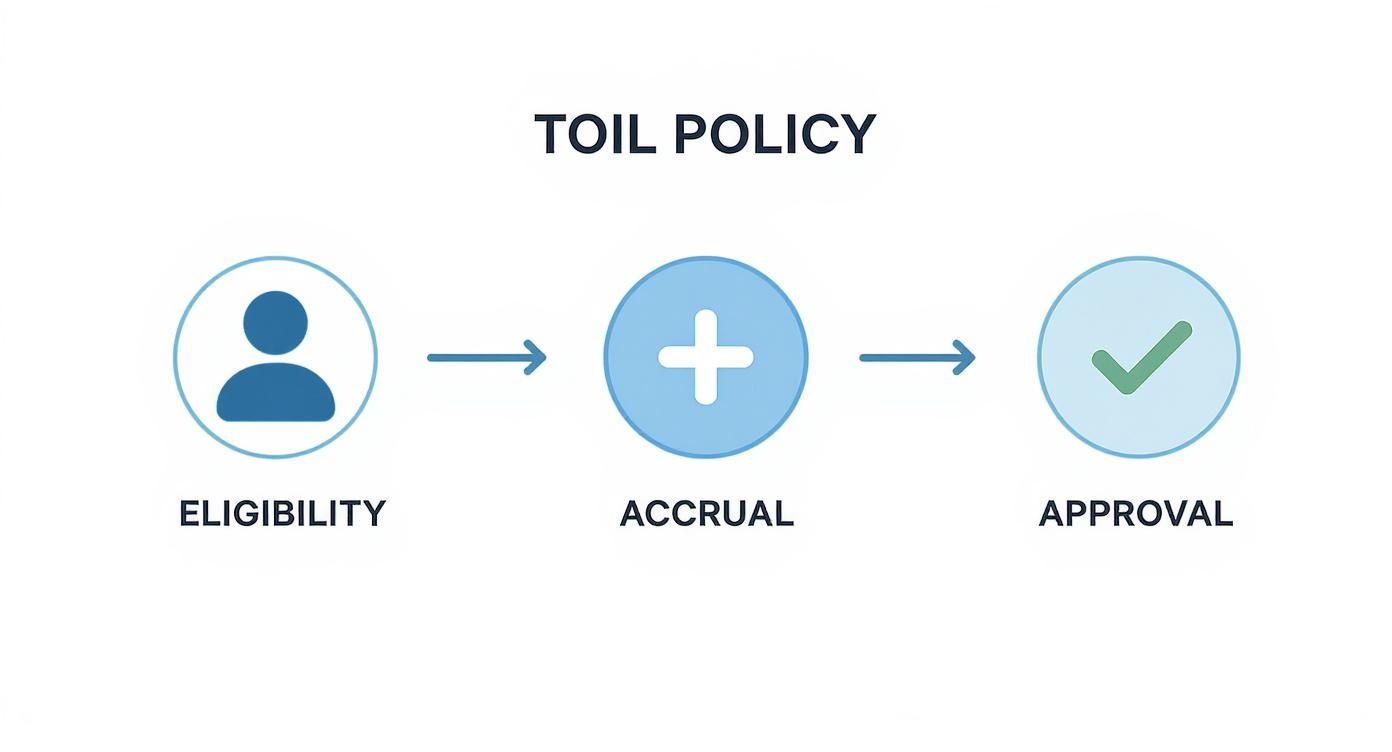
This visualises how a structured process keeps everything consistent—something that's far easier to achieve with automation than with a spreadsheet.
A Practical Example of Calculating TOIL
Let’s put this into a real-world scenario. Imagine Sarah is contracted for 37.5 hours a week. Her manager asks her to work a full 7.5-hour day on a bank holiday to handle an urgent client project.
Her company’s TOIL policy offers an enhanced 1.5x rate for bank holiday work. Here’s how her day in lieu is calculated and managed:
- Authorisation: Before she works the hours, Sarah’s manager approves the overtime.
- Calculation: She works 7.5 hours. At the 1.5x rate, she earns 11.25 hours of TOIL (7.5 hours x 1.5).
- Recording: The system automatically adds this to her TOIL balance. She can log in anytime and see her updated total.
- Redemption: A few weeks later, Sarah requests a full day off (7.5 hours) using her TOIL. Her manager approves it, and her balance is automatically adjusted down to 3.75 hours.
This clean, simple process means Sarah is compensated fairly, and the business has an accurate, real-time record of its liability—all without anyone touching a spreadsheet.
Connecting TOIL to Employee Wellbeing and Retention

Managing your Time Off In Lieu (TOIL) system is much more than an admin headache. In fact, it's one of the sharpest tools you have for protecting your team's wellbeing and boosting staff retention. Get it right, and it sends a clear message: we see your hard work, and we insist you take the time to rest and recharge.
But a neglected system can be a major warning sign. When you see a team member’s TOIL balance creeping up week after week, it’s a red flag for overwork and a direct path to burnout. Ignoring these patterns isn’t just bad admin; it’s risking the health of your people and the stability of your business.
The Real Danger of Unused Leave
Pushing your team to actually take their time off—every last holiday and every single accrued day in lieu—is absolutely vital for a healthy workplace. It sounds obvious, but a worrying number of UK employees simply aren't taking the breaks they're entitled to. The result? A workforce that's always 'on' and teetering on the edge of exhaustion.
This isn't just a hunch; the numbers are pretty stark. A 2023 survey revealed that only around 40% of UK adults used their full holiday allowance in 2022 and 2023. It gets worse in London, where a tiny 22% of workers took all their leave last year. This points to a widespread culture where rest is seen as a 'nice-to-have' that can always be postponed. If you want to dig deeper, you can discover more insights about UK leave trends and see the full picture.
When people don't take their holidays, stress and fatigue build up. A solid TOIL policy acts as a crucial safety net, making sure that extra effort is always balanced with essential downtime.
A proactive approach to TOIL management isn't just about ticking a box. It's a strategic investment in your people. It shows a genuine commitment to preventing burnout, which is the bedrock of long-term employee retention and engagement.
Turning a Policy into a Positive Culture
To really connect TOIL with wellbeing, you need to do more than just track the hours. The key is to be proactive. You need to build a culture where rest isn't just permitted but is actively encouraged. That means weaving TOIL management into your day-to-day conversations.
Here are a few practical steps you can take:
- Set Up Automated Nudges: Use your leave management system to flag high TOIL balances. An automatic alert to a manager when someone hits, say, 15 hours can be the perfect prompt for a supportive chat.
- Discuss Leave in One-to-Ones: Make it a standard part of your regular check-ins. It's as simple as asking, "I've noticed you've built up some TOIL—have you had a think about when you'd like to use it?"
- Lead From the Front: This one's crucial. When managers and senior leaders are seen taking their own days in lieu and holidays, it sends a powerful message that the company genuinely values rest.
By embedding these habits, your TOIL policy stops being a document on a server and becomes a cornerstone of a supportive, sustainable work environment. It shows your team you see them as people, not just resources—and that’s what makes them want to stay and do their best work.
Got Questions About Days in Lieu? We've Got Answers.
As you start putting a day in lieu system into practice, you're bound to run into some specific situations. It’s only natural. This final section tackles the most common questions we hear from UK employers, giving you a quick reference guide to handle those day-to-day queries with confidence.
Can We Force an Employee to Take TOIL Instead of Overtime Pay?
This one comes down to what's in the employment contract. Simple as that.
If the contract clearly states that extra hours are compensated with TOIL under a defined policy, then yes, you can stick to that agreement. It creates a clear, agreed-upon framework from day one, and everyone knows where they stand.
However, if the contract promises paid overtime or doesn't mention TOIL at all, you can't force an employee to take time off instead of cash. This is why having it all spelled out in the signed contract is crucial – it prevents any misunderstandings or disputes down the line.
What Happens to Accrued TOIL When an Employee Leaves?
You absolutely must have a clause in your TOIL policy that covers what happens when someone leaves. If you don't, you're opening the door to payroll headaches and potential legal challenges. It's a critical detail to get right.
Generally, you have two good options:
- Insist that the employee uses their accrued TOIL during their notice period.
- Pay them for any accrued hours in their final payslip, calculated at their normal rate of pay.
Paying out the hours is often the cleanest and fairest approach. It provides a neat and tidy resolution for both the departing employee and your payroll team, leaving no loose ends.
A well-defined exit process for TOIL protects the business from future claims and ensures a professional, fair offboarding experience. It removes all the guesswork during what can already be a sensitive time.
Is There a Legal Limit on How Much TOIL Can Be Accrued?
UK law doesn't actually set a specific cap on how much Time Off In Lieu an employee can build up. But – and this is a big but – allowing an unlimited balance to grow is a huge risk. It can easily clash with your duties under the Working Time Regulations.
The best practice here is to include both a "cap" and an expiry date in your policy. For example, you could cap accrual at 5 days and state that any day in lieu earned must be used within 6 months. This simple rule does three things: it encourages regular rest, helps prevent burnout, and stops a large financial liability from quietly building up on your company's books.
Ready to stop wrestling with spreadsheets and start managing leave with confidence? Leavetrack provides a simple, accurate, and transparent platform to track annual leave and TOIL effortlessly. See how it works by visiting https://leavetrackapp.com.