

average annual leave uk: The Essential Guide for Employees and HR
Posted by Robin on 07 Dec, 2025 in
Right, let's talk about annual leave in the UK. The first number everyone quotes is 5.6 weeks, which works out to 28 days for a full-time employee. But if you’re trying to figure out the real average, that number is just the tip of the iceberg.
Many companies offer more than the legal minimum to attract and keep good people. That official requirement is really just the starting point.
Decoding UK Annual Leave: What You Need to Know
To get a proper grip on UK holiday entitlement, you need to see it in two layers: what the law says you must give, and what the market actually offers.
First up is statutory annual leave. Think of this as the legal safety net for every single worker in the country. It’s the mandatory minimum set by law to make sure everyone gets a baseline level of paid rest. For someone working a standard five-day week, that's 28 days.
Interestingly, data from 2023 showed that the average number of holiday days actually taken was 33.9. That’s a big drop from 38 days back in 2020, which suggests people's habits around taking time off are changing. You can dig into more stats on UK annual leave entitlements on leavewizard.com.
Statutory vs. Contractual Leave
The second layer is what we call contractual annual leave. This is where employers go above and beyond that legal minimum to create a more appealing job offer.
It’s a real competitive edge. In high-demand sectors like tech or finance, offering 30 days of leave plus bank holidays isn't just generous; it's often the standard. This is a common strategy to make sure they stand out from the crowd. This creates a huge gap between the legal floor and the market average.
An employment package that sticks strictly to the statutory minimum is perfectly legal, but it’s not going to win you any awards in the talent race. Enhanced leave policies are a powerful signal that a company cares about employee wellbeing, making them a brilliant tool for recruitment and retention.
To make this crystal clear, let's put the legal baseline side-by-side with a typical enhanced package. This really shows the difference between what's required and what many people actually get.
UK Annual Leave at a Glance: Statutory vs. Enhanced
This table breaks down the difference between the legal minimum and what a more competitive package often looks like.
| Leave Component | Statutory Minimum (5-day week) | Typical Enhanced Package |
|---|---|---|
| Total Days | 28 days (including bank holidays) | 33-38 days (e.g., 25-30 days + bank holidays) |
| Flexibility | Basic entitlement as per law. | Often includes options to buy/sell days or carry over. |
| Market Position | Legally compliant but basic. | Competitive and attractive to top talent. |
As you can see, the enhanced packages don't just offer more days; they often come with added flexibility that modern employees really value.
So, while the statutory figure of 28 days is the crucial starting point, the real-world average annual leave UK employers offer is almost always higher. It's shaped by industry norms, company culture, and the simple, ongoing battle to hire and keep the best people.
Nailing Your Annual Leave Calculations
Knowing the average annual leave figure is one thing, but the real test is calculating it correctly for every single person on your team. It’s not as simple as handing out 28 days to everyone; you’ve got to tailor the calculation to each employee's working pattern to be fair and, crucially, legally compliant.
Think of it like a ‘leave pot’. For your full-time staff, that pot starts the year full. But for your part-time or casual workers, the pot fills up bit by bit, based on the hours they actually work. Grasping this idea of accrual is the key to getting the numbers right across the board.
This visual shows how holiday benefits typically stack up, from the legal floor to what the most competitive employers are putting on the table.
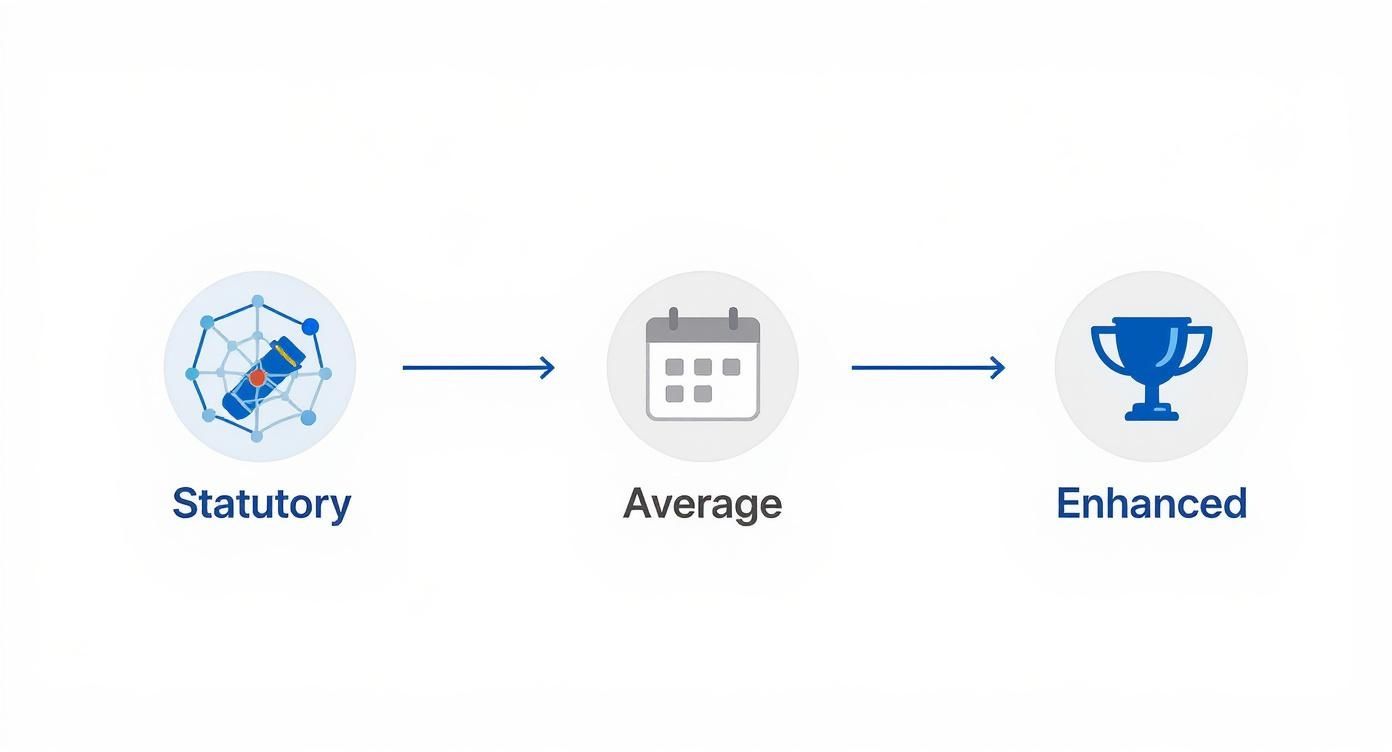
As you can see, the statutory minimum is just the starting line. Many UK companies build on this foundation to create far more attractive packages that help them stand out.
Calculating for Part-Time Employees
When it comes to part-time staff, the guiding principle is pro-rata. It’s a fancy term for a simple concept: their holiday entitlement is proportional to how much they work compared to a full-timer. No guesswork involved, just a straightforward calculation.
Here’s how you work it out:
- Take the full-time entitlement in days (let’s say, 28 days).
- Divide it by the number of days in a full-time week (usually 5).
- Multiply that number by the days the part-time employee works.
So, if a full-timer gets 28 days and your part-timer works 3 days a week, their leave is (28 / 5) x 3 = 16.8 days. Simple.
Calculating for Shift Workers in Hours
Things get messy when you try to calculate leave in 'days' for people who work irregular shifts or variable hours. A "day off" means very different things to someone working a 4-hour shift versus a 12-hour one. The fair and accurate solution is to switch to hours.
The statutory leave entitlement is 5.6 weeks. To turn this into hours, you just multiply 5.6 by the employee’s average weekly working hours. If someone averages 30 hours a week, their annual leave entitlement is 5.6 x 30 = 168 hours.
This ensures that a day off for someone on a 12-hour shift is valued correctly against someone on an 8-hour shift. It’s all about creating a level playing field based on the actual time they put in.
Getting this level of detail right is non-negotiable. It’s not just about keeping employees happy; it’s fundamental to running a smooth payroll. This is why many businesses bring in specialist payroll bookkeeping services to keep everything accurate and above board.
The 12.07% Method for Casual and Zero-Hour Contracts
For workers on casual or zero-hour contracts where hours can swing wildly from one week to the next, holiday is earned as they go. The go-to method for this is the 12.07% rule.
Where does that odd number come from? It’s pretty logical. A year has 52 weeks. Subtract the 5.6 weeks of statutory leave, and you’re left with 46.4 working weeks. That 5.6 weeks of leave is exactly 12.07% of the 46.4 working weeks (5.6 ÷ 46.4 ≈ 0.1207).
To calculate what they’ve earned:
- Add up the total hours the employee has worked over a set period.
- Multiply those hours by 12.07% (0.1207) to find out how many hours of paid holiday they’ve accrued.
So, if a zero-hour worker clocks 100 hours in a month, they’ve earned 100 x 0.1207 = 12.07 hours of paid leave.
If you want to dive deeper, our complete guide includes a free holiday calculator for UK employees. Ultimately, using the right method for each person isn’t just good practice—it’s essential for staying compliant and treating your whole team fairly.
Of course, here is the rewritten section with a completely human and natural tone, following the style of your provided examples.
How Annual Leave Varies Across UK Industries
Not all holiday allowances are created equal. While the statutory minimum gives everyone a baseline, the actual average annual leave UK employees get can swing wildly from one industry to another. A job offer in tech might come with a far more generous holiday package than one in construction, and these differences aren't just random.
These variations are really a mix of factors unique to each sector. Things like intense competition for specialised talent, long-standing industry norms, and the day-to-day demands of the job all play a huge part in shaping what’s considered a standard benefits package. Getting your head around these dynamics is key, whether you’re a job seeker comparing offers or an HR team trying to stay competitive.
The High-Demand Sectors
In industries where the war for talent is fiercest, a better holiday allowance is a powerful weapon. Sectors like technology, finance, and professional services often lead the pack, offering packages that go well beyond the legal minimum.
It's pretty common to see companies in these fields offering 25 to 30 days of leave on top of bank holidays. This isn't just about being generous; it's a strategic play. When you’re trying to attract a highly skilled software developer or a top-tier financial analyst, an extra week of holiday can be the very thing that seals the deal.
These sectors are often characterised by:
- High-Skill Requirements: Companies need to do whatever it takes to attract and keep the best and brightest.
- Intense Workloads: Generous leave is often framed as a way to fight burnout and promote a healthier work-life balance.
- Strong Profit Margins: Simply put, financially successful industries can more easily afford to offer premium benefits.
Industries Closer to the Baseline
On the flip side, some sectors tend to stick much closer to the statutory 28-day entitlement. Industries like retail, hospitality, and construction often face a different set of operational and financial pressures that shape their approach to employee benefits.
For these businesses, managing staff cover is a constant logistical puzzle, especially during peak seasons. Margins can be tighter, which makes it harder to roll out expansive leave policies across a large workforce. While plenty of employers in these areas do offer more than the minimum, the average allowance is usually more conservative than in the high-demand sectors we just talked about.
Interestingly, though, there's been a recent UK-wide trend. Despite these different allowances, the number of leave days employees actually take has been dropping across the board.
In 2023, the average number of annual leave days taken by UK employees was 33.9, a noticeable drop from 38 days back in 2020. This shift was particularly sharp in sectors like agriculture, construction, and finance, which all saw big declines in leave being used.
This data paints a more complex picture that goes beyond just official allowances. Even with a generous policy in place, things like workplace culture and economic pressures can heavily influence whether employees feel they can actually use their full entitlement. You can dig deeper into these trends in the UK annual leave report by People HR.
Here’s a snapshot of how leave taken varies across some key UK sectors.
Annual Leave Taken: A UK Sector Snapshot
The table below shows the average number of leave days taken across various UK industries, highlighting the sectors with the highest and lowest figures.
| Industry Sector | Average Leave Days Taken (Including Bank Holidays) | Year-on-Year Change |
|---|---|---|
| Consulting | 35.5 days | +1.2 days |
| Education | 34.8 days | +0.5 days |
| Technology | 34.2 days | -0.9 days |
| Healthcare | 33.7 days | -1.5 days |
| Finance | 32.9 days | -2.1 days |
| Retail | 31.5 days | -0.8 days |
| Construction | 29.8 days | -2.5 days |
| Hospitality | 29.1 days | -1.1 days |
As you can see, there’s a real spread. While sectors like consulting and education are using more of their leave, others, particularly construction and finance, have seen a significant drop. This often points to underlying pressures within those industries.
Public Sector vs. Private Sector Differences
Another key split is between public and private sector jobs. The public sector, which includes roles in the NHS, the civil service, and education, has a long-standing tradition of offering generous annual leave that often gets better with length of service.
It's not unusual for a public sector worker with a few years under their belt to have an entitlement of 30 days or more, plus bank holidays. This is often positioned as a core benefit to make up for salaries that might not always keep pace with their private sector counterparts.
Ultimately, the average annual leave in the UK isn't one single number but a whole spectrum. It's shaped by a powerful combination of industry pressures, historical norms, and the simple economics of finding and keeping good people. For any organisation, figuring out where you sit on this spectrum is the first step to building a policy that’s both fair and competitive.
Modern Trends Shaping UK Holiday Entitlement
The conversation around the average annual leave UK employees get isn't just about the numbers anymore. It’s shifting, big time. Now, it’s all about company culture and flexibility, revealing a lot about how both businesses and their people see time off in the modern world of work. The data tells a really interesting story.
One of the biggest changes isn't the allowance itself, but how people are using it. While the official number of days has stayed pretty steady, employees are being much more assertive about taking the time they’re entitled to. This points to a huge cultural shift towards prioritising rest and finding a healthier work-life balance.

Fewer Days Left on the Table
For years, a culture of ‘presenteeism’ created a mountain of unused holiday days right across the UK. But recent data shows a dramatic U-turn on that front.
While the average annual leave allowance has hovered around 23 days (plus bank holidays) for the past five years, the amount of that leave going unused has absolutely plummeted. In fact, unused holiday days per employee have dropped by a staggering 71% since 2019, falling from 18.5 days down to just 5.3 days in 2024. This suggests employees feel more empowered to take their breaks, or maybe that companies are finally getting better at encouraging it. You can dig into more stats from the state of annual leave report on timetastic.co.uk.
This isn't just a number; it reflects a much deeper change. People are realising that taking time off isn’t a luxury—it’s essential for preventing burnout and staying productive and well in the long run.
The Rise of Flexible and Purpose-Driven Leave
It’s not just about using the standard entitlement, either. Both employees and employers are getting more creative and experimenting with flexible leave policies. The whole idea is to give people more control over their own time and to recognise that proper rest comes in many different forms.
Some of the most popular new ideas include:
- Unlimited PTO: It’s still quite rare, but some companies, especially in the tech world, are trying out 'unlimited' paid time off. This policy is built on trust, letting employees take the time they need without a set number of days. The focus shifts to results, not hours spent at a desk.
- Wellness Days: These are specific days offered on top of standard annual leave, purely for looking after mental and physical health. They encourage staff to recharge without feeling like they have to be properly sick to take a day off.
- Duvet Days: Think of this as a more informal wellness day. It lets an employee call in at very short notice, no questions asked. It’s a powerful way to build trust and show you support your team's autonomy.
These policies are a clear move away from the old one-size-fits-all approach. They show an understanding that modern work needs a more fluid and responsive attitude to wellbeing, turning a simple benefit into a real statement about company culture and trust.
Common Holiday Booking Patterns
Even with all these new policies popping up, some classic booking habits are as popular as ever. For any HR leader trying to manage team schedules and make sure there’s enough cover, understanding when people want time off is absolutely crucial.
Unsurprisingly, the Christmas break is still the most sought-after time for leave. Year after year, the data shows that the days between Christmas and New Year are the most requested days off in the UK. Many people strategically save up a chunk of their annual leave just to extend this break and get more time with their families.
Another timeless favourite is booking leave around the weekend, tacking it onto a Monday or a Friday. The appeal of a long weekend never fades, offering a quick and easy way to recharge without burning through a huge chunk of your holiday allowance.
These trends paint a pretty clear picture: the UK workforce is getting much more intentional about rest. Whether it’s using every last day of their allowance, trying out new flexible policies, or simply booking a long weekend, the message is obvious. Annual leave is no longer just a line in a contract—it’s a vital part of a healthy, sustainable working life.
Staying Compliant with Annual Leave Regulations
Managing annual leave is far more than just approving time off requests; it's a serious legal and financial responsibility for every UK employer. Get it wrong, and you're not just looking at unhappy staff. You could be facing payroll nightmares and even costly legal battles. The trick is to stop thinking of holiday entitlement as just 'time off' and start seeing it for what it is: a tangible business obligation.
Think of it this way: every hour an employee works, they are earning a small slice of their holiday time. This accrued leave builds up on your company's balance sheet as a financial liability. It's a debt you owe your team, one that has to be paid out eventually, either in time away from work or in cash.

Without accurate, real-time tracking, this liability can easily spiral. Imagine a sudden wave of resignations. You could be left with a surprisingly large bill for all that untaken leave, hitting your cash flow when you least expect it. This is why meticulous record-keeping isn't just good HR practice—it's essential financial management.
Navigating Key Compliance Rules
Several specific rules govern how this 'leave debt' is handled, particularly around carrying over leave and what happens when an employee leaves. Misunderstanding these is one of the quickest ways to land your business in hot water. For any company trying to keep up with the rules, understanding effective compliance management is absolutely vital.
The regulations around carrying over leave are a common tripwire. Generally, employees must take their statutory 5.6 weeks of holiday within the leave year it's earned. But there are exceptions. If an employee is on long-term sick leave, for instance, they can carry over up to four of those weeks.
Your own company policy must be crystal clear about what happens with any additional contractual leave you offer. Can people carry over five days? Ten? Is there a deadline for using them? Leaving any ambiguity here is just asking for disputes down the line.
Calculating Final Holiday Pay
When an employee leaves, you have to settle that final 'leave debt'. This means calculating a payment in lieu of holiday (PILON) for any time they've accrued but not yet taken.
The calculation is based on their entitlement up to their last day. Let's say a full-time employee with 28 days of leave resigns exactly halfway through the year. They would have accrued 14 days. If they'd only taken 10, you’d owe them payment for the remaining 4 days in their final payslip.
Failing to provide the statutory minimum leave or messing up the final pay calculation are serious breaches of employment law. These mistakes can easily escalate to formal grievances or even an employment tribunal, bringing with them significant legal costs and damage to your reputation.
Ensuring you're compliant isn't just about dodging penalties; it's about fulfilling your duty of care as an employer. For a much deeper dive into the legal nuts and bolts, check out our complete guide to statutory holiday entitlement in the UK. It will give you the detailed breakdown you need to manage leave fairly and legally.
Ultimately, protecting your business means treating annual leave with the financial and legal respect it demands. Your best defence against disputes and liabilities is always going to be accurate tracking and a solid grasp of the regulations.
Creating a Competitive Annual Leave Policy
A strong annual leave policy is much more than just a document to keep you compliant; it’s a powerful tool for attracting and keeping the best people. Of course, you have to meet the legal minimums, but if you want to stand out in a competitive job market, you'll need to be a bit more thoughtful.
The goal here isn't just to state the average annual leave UK businesses offer. It’s about building a framework that truly reflects your company culture, shows you care about employee wellbeing, and gives everyone absolute clarity.
You can see in this screenshot from Leavetrack just how much easier it is when everyone has a clear, central dashboard to see team leave schedules at a glance.
Getting the right tools in place is what turns a well-written policy into a smooth, practical process that actually works for managers and employees alike.
Core Components of a Strong Policy
A truly effective policy leaves no room for confusion. It should clearly lay out every single part of the leave process, making sure expectations are crystal clear from day one.
Here are the absolute must-haves:
- Request Procedures: Spell out exactly how your team should request time off. How much notice do they need to give? Who do they ask? Put it in writing.
- Blackout Periods: Are there times of the year when leave is a no-go, like during a massive product launch or year-end reporting? State this clearly and, importantly, explain why. People are much more understanding when they know the business reason.
- Carry-Over Rules: Be specific about how many unused days (if any) can be carried over into the next leave year. Don't forget to include the deadline for using them up.
Getting these details down prevents misunderstandings and ensures the process is fair for everyone in the organisation. If you need a solid starting point, you can find a helpful template for your annual leave policy that covers all these essentials.
Benchmarking Against Your Industry
To turn your policy into a real recruitment advantage, you need to know what you’re up against. Do your homework and find out what typical holiday packages look like in your specific sector.
If the standard in your industry is 25 days plus bank holidays, sticking rigidly to the statutory minimum is going to put you on the back foot immediately.
A generous and well-structured leave policy sends a powerful message: we trust our people and we invest in their wellbeing. This can directly lead to higher team morale, reduced burnout, and improved productivity, turning a standard benefit into a powerful cultural asset.
When you combine clear, fair procedures with a competitive allowance, you create a policy that does more than just tick a legal box. It actively contributes to making your company a brilliant place to work. It’s a small investment that pays huge dividends in talent retention and overall team happiness.
Got Questions About UK Annual Leave?
Even with a crystal-clear policy, real-life situations can throw a spanner in the works, leaving managers and employees alike wondering what the rules are. To round things off, let's tackle a few of the most common questions that pop up around annual leave in the UK.
Can My Boss Tell Me When to Take My Holiday?
In a word, yes. An employer can require you to take leave on specific dates, which is common for things like a company-wide Christmas shutdown. They can't just drop this on you at the last minute, though.
There's a straightforward rule here: they must give you notice that is at least double the length of the leave they're asking you to take. So, if they're closing for one week, they need to let you know at least two weeks beforehand. This should always be applied fairly across the team and, ideally, be mentioned in your employment contract.
What Happens to My Holiday If I'm on Long-Term Sick Leave?
This is a frequent point of confusion, but the law is on your side. You continue to build up (or 'accrue') your statutory paid holiday entitlement even when you're off sick. Your right to that paid time off is protected.
If you’re too unwell to use your annual leave, you can legally carry over up to four weeks of it into the next holiday year. For a full-timer, that's 20 days.
This isn't a "use it or lose it" situation either. That carried-over leave must be taken within 18 months from the end of the leave year it was accrued in. This gives you a good amount of time to use it once you're back on your feet.
Are Bank Holidays Included in My Annual Leave?
It all comes down to what's written in your employment contract. The statutory minimum of 5.6 weeks can legally include bank holidays. An employer can give you 20 days of leave plus the 8 bank holidays and be fully compliant.
However, many companies offer a better deal as a perk. It’s very common to see packages advertised as "25 days plus bank holidays," making it clear they are an extra benefit.
Your contract is the source of truth here. It must clearly state whether bank holidays are part of your core entitlement or are given on top. And if you're required to work on a bank holiday, your employer has to make sure you get that day off at another time.
Juggling all these rules is exactly where a dedicated tool shines. Instead of getting tangled up in spreadsheets, Leavetrack gives you a simple, central system for tracking accruals, handling requests, and ensuring your policies are applied fairly for everyone. Simplify your leave management and stay compliant by visiting https://leavetrackapp.com.