

Average Number of Working Days in a Month: UK Guide
Posted by Robin on 11 Nov, 2025 in
Let’s cut to the chase. If you need a solid number for planning your payroll or projects, the average number of working days in a month for the UK is right around 21.
This figure is the go-to baseline for most businesses. It’s built on a standard Monday-to-Friday workweek and takes into account the weekends and bank holidays scattered throughout the year. Of course, the actual number of working days can shift from one month to the next, but 21 is a dependable average to work with.
Your Quick Answer to UK Working Days Per Month
Getting your head around the average number of working days is more than just a bit of admin—it’s the foundation of effective business planning in the UK. This simple number underpins everything from accurate payroll processing and resource planning to setting realistic project deadlines. Get it wrong, and you could be looking at wonky financial forecasts and project timelines that were doomed from the start.
In the UK, the standard calculation is pretty straightforward. Assuming a classic Monday to Friday schedule, most employees work between 20 to 22 days each month. This comes from the UK's typical annual count of roughly 253 working days. When you divide that by 12, you land on that widely used average of 21. If you're keen to see the full breakdown, you can explore more detailed insights about UK working day statistics.
Before we get into the nitty-gritty of how these numbers are calculated and why they matter so much for your day-to-day operations, here’s a quick summary of the key figures.
UK Average Working Days at a Glance
This table gives you the essential figures at a glance, based on a standard Monday-Friday work week in the UK.
| Metric | Average Value |
|---|---|
| Average Working Days Per Month | 21 |
| Annual Working Days | ~253 |
| Typical Monthly Range | 20-23 Days |
| Basis of Calculation | Mon-Fri, excluding bank holidays |
Think of these numbers as your starting point. They provide a reliable framework for most HR and operational planning, ensuring your calculations are grounded in reality.
How to Calculate Working Days in Any Month
While using the average of 21 working days a month is a decent rule of thumb, it's not going to cut it when payroll and project deadlines are on the line. For that, you need precision.
Figuring out the exact number of working days in any given month is actually quite simple. It’s a straightforward process of starting with the total number of days and then taking away all the days you don't work. Think of it as carving out the non-working days to reveal the exact figure you need.
The Three-Step Calculation Method
This simple formula works every time, for any month, giving you a consistent way to manage schedules, leave, and payroll.
Start with the Total Calendar Days: Just begin with the total number of days in the month you’re looking at (31 for May, 30 for June, and so on).
Subtract All Weekend Days: Next, count up all the Saturdays and Sundays in that month and subtract them from your total. This number usually varies between 8 and 10, depending on how the days fall.
Subtract Weekday Bank Holidays: Finally, look for any bank holidays that land on a weekday (Monday to Friday) and subtract those too. If a holiday falls on a weekend, it won't impact your working day count.
Following these three steps gives you the precise number of working days for the month. While this monthly view is great for day-to-day planning, getting the annual perspective is just as important. For the full picture, check out our guide on how many working days are in a year in the UK.
Example Calculation for May
Let's run the numbers for May, which has 31 days. A typical May has nine weekend days (four full weekends and an extra Saturday or Sunday). In the UK, it also has two bank holidays which fall on Mondays.Calculation: 31 (Total Days) - 9 (Weekend Days) - 2 (Bank Holidays) = 20 Working Days
What Changes the Number of Working Days
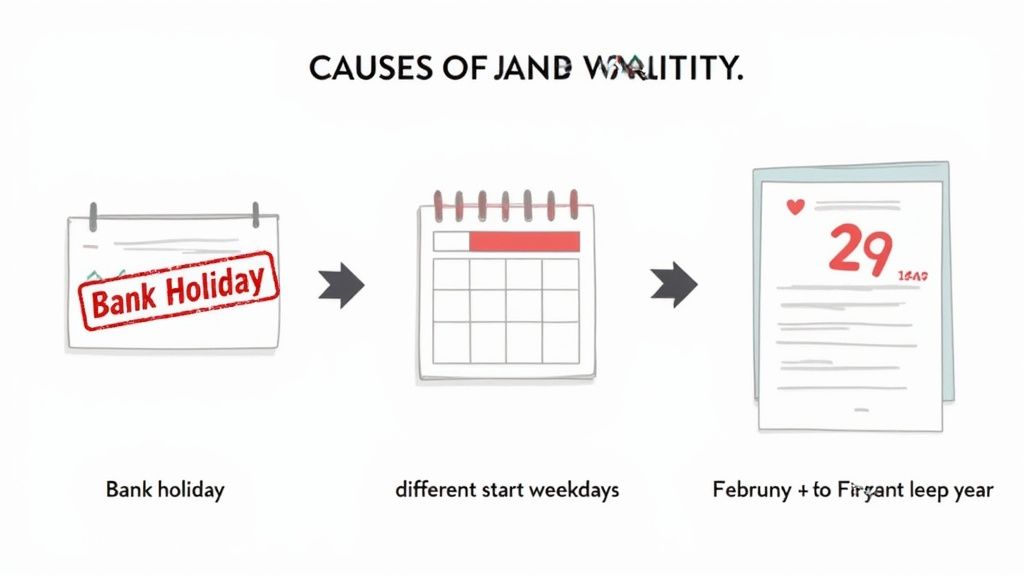
If we can rely on an average number of working days per month, why does the actual count seem to jump around so much? The truth is, the calendar isn't a neat, repeating pattern. A few key variables make sure each month and year has its own unique fingerprint.
It all starts with the obvious: the length of the month. A 31-day month like March will always have more potential workdays than a 30-day month like April, and both have more than February. That's a simple starting point, but the real nuance comes from how those days are arranged.
Think about it – a month that kicks off on a Monday is almost guaranteed to have more working days than one starting on a Saturday. It just contains more full workweeks. This simple structural difference is why the working day count for a month can swing anywhere between 20 and 23.
The Impact of Public Holidays
Public holidays – or bank holidays here in the UK – are the next big piece of the puzzle. The UK has eight annual bank holidays, but they don’t land on the same date each year. Easter, for example, can fall in either March or April, drastically changing the working day count for both months.
Because bank holidays often fall on a Monday, they directly shorten the workweek. This makes precise tracking essential for everything from payroll to project planning. A month with two bank holidays is a completely different beast from a month with none.
Getting your planning right means knowing exactly when these days fall. To get a clear picture of how to manage your team's time off around these dates, it's helpful to use a complete guide to annual leave and public holidays. You can get up to speed with this UK holiday calculator guide to make sure your records are always spot on.
Leap Years and Their Subtle Effect
The final, and often overlooked, factor is the leap year. Every four years, February gets an extra day – 29th February. While it only happens periodically, it can add an extra working day to the year if it happens to fall on a weekday.
This might seem like a tiny detail, but for annual forecasting or for businesses that run payroll on daily rates, it’s an important one. Ignoring it can lead to small but cumulative errors in your financial planning.
To see how this all comes together, let's look at how these factors can shift the final count.
Impact of Key Factors on Working Day Counts
This table breaks down how each variable can alter the number of working days you're planning for.
| Factor | Description of Impact | Example |
|---|---|---|
| Month Length | Shorter months inherently have fewer potential workdays. | February has 28 or 29 days, while March has 31, creating a significant baseline difference. |
| Day of the Week Start | A month starting on a weekday will generally have more working days than one starting on a weekend. | A 31-day month starting on a Monday has 23 working days, but one starting on a Saturday has only 21. |
| Public Holidays | Directly subtracts from the total working day count for that month. | May in the UK often has two bank holidays, reducing its working days from a potential 22 or 23 down to 20 or 21. |
| Leap Years | Adds an extra potential working day every four years. | If 29th February falls on a Wednesday, it adds one working day to that year's total count. |
Together, the length of the month, the day it starts, where the bank holidays land, and the occasional leap year are what create the dynamic and ever-changing nature of the working calendar.
Why This Simple Number Is Crucial for Your Business

The average number of working days in a month might sound like a minor detail, something you could just estimate. In reality, it’s a bedrock figure that quietly influences huge chunks of your business operations. Getting this number right isn't just about ticking boxes; it's the foundation for solid financial and project planning.
At its most basic level, this calculation is all about nailing your payroll. For salaried staff, it ensures their monthly pay is a fair slice of their annual agreement. For hourly workers, it’s even more direct, guaranteeing they’re paid precisely for the hours they’ve put in. Get this wrong, and you risk creating payroll discrepancies that chip away at team trust and morale.
This single figure connects your operational planning directly to your financial health. A miscalculation can ripple outwards, leading to budget shortfalls, delayed projects, and compliance issues.
Beyond paying your people, this number is a project manager's best friend. It’s what allows you to build realistic timelines, allocate your team's time effectively, and set deadlines that are ambitious but achievable. Without it, you're essentially just guessing, which often leads to overstretched teams and blown deadlines.
From Payroll to Annual Leave
An accurate count of working days is also essential for managing employee benefits. Everything from calculating annual leave entitlement to sick pay accrual hinges on this number. Any mistakes here can quickly spiral into compliance headaches and unfairness for your staff.
This is exactly where a robust system proves its worth. Trying to track all these moving parts in spreadsheets is not only tedious but also an open invitation for human error. To get ahead of this, many organisations use a dedicated tool. You can find out more by reading this guide to employee leave management systems.
Ultimately, precise payroll calculations are also vital for your company’s financial planning. A clear understanding of your outgoings is fundamental for predicting future liquidity and stability. This knowledge feeds directly into more complex financial strategies, including the use of essential cash flow forecasting methods to secure your business's future.
In short, getting this simple calculation right prevents financial errors, sharpens your operational planning, and helps you stay compliant. It's a small detail with a massive impact.
How the Working Week Has Changed Over a Century
The idea of a ‘working day’ feels set in stone, but it’s a surprisingly recent invention that has changed dramatically over the years. A century ago, the typical workweek was a gruelling affair, a world away from the Monday-to-Friday schedule we now use to figure out the average number of working days in a month.
Looking back at this evolution gives us some much-needed perspective on our current standards. It reminds us that the 40-hour week wasn't just plucked out of thin air; it was the result of massive social and legislative shifts. This history helps us appreciate the long road travelled to get to a healthier work-life balance.
From Factory Whistles to Flexible Schedules
In the early 20th century, the rhythm of work was dictated by industrial demands, not employee wellbeing. The landscape was completely different—a six-day workweek was the norm, and the hours were punishingly long. The main goal was production, often at the expense of the people doing the work.
The concept of a weekend as we know it was a luxury, not a given. The fight for more reasonable hours was a long and difficult one, spearheaded by labour movements and a growing realisation that working people to the bone wasn't actually the best way to boost productivity.
The move from a six-day to a five-day workweek was a landmark moment in labour history. It fundamentally reshaped not just how we work, but how we live, carving out dedicated time for rest, family, and leisure that was previously unimaginable for most.
This slow but steady transition eventually cemented the 40-hour week as the standard. It’s a change that directly impacts how we calculate working days and plan our business operations today.
A Century of Change in Numbers
The difference in working hours isn't just a vague historical idea; the data paints a very clear picture. Today, the average full-time employee in the UK works around 35.9 hours per week. A century ago, things looked very different.
Back in 1919, a manufacturing worker in the UK was expected to put in about 50 hours per week, which works out to roughly 200 hours per month. That's a staggering 45-hour difference every single month compared to what's normal today. If you're interested in the data, you can explore more on historical working hour trends.
This sharp drop shows just how much labour rights, technology, and shifting cultural attitudes have redefined what we consider a standard working day.
Common Questions About Working Day Calculations
Even with a clear formula, you're bound to run into some curly questions. To help you handle any situation with confidence, we've gathered the most common queries we hear about working day calculations and laid out some straightforward, practical answers.
Do Averages Account for Public Holidays?
In short, no. The standard, raw calculation for working days only removes weekends. To get the actual number for a specific month, you have to manually subtract any bank holidays that fall on a weekday.
So where does that widely used average of 21 working days come from? It's a handy generalised figure. It’s calculated from the annual total of working days after all the year's bank holidays have already been taken out, making it a reliable baseline for long-term planning.
How Do You Calculate for Part-Time Staff?
This is where a pro-rata approach is essential. Forget the standard monthly total; for part-time employees, you only count the specific days they are actually contracted to work.
For example, if someone works every Monday, Tuesday, and Wednesday, you’d simply count the number of Mondays, Tuesdays, and Wednesdays in that particular month. Just remember to also subtract any bank holidays that happen to fall on one of their scheduled workdays.
Quick Tip: For a rough estimate, you can adjust the standard average. For someone on a three-day week, their average would be around 12.6 working days a month (that's simply 3/5ths of the full-time average of 21).
Is There a Standard Number for UK Payroll?
This is a common point of confusion. While the number of working days changes each month, there isn't a single, legally mandated figure for UK payroll purposes.
For salaried staff, most payroll systems just annualise the salary and divide it by 12. This ensures they get a consistent gross paycheque each month, regardless of whether it has 20 or 23 working days.
However, for hourly workers or when you're calculating things like holiday pay accrual, you absolutely need the exact number of working days or hours in that specific pay period. Getting this right is crucial for accuracy and staying compliant. Consistency in your method is key.
How Do Leap Years Affect the Annual Count?
A leap year throws an extra day, 29th February, into the mix. If this day lands on a weekday (Monday to Friday), it adds one full working day to that month and, by extension, to the annual total.
It might seem like a tiny detail, but it can nudge annual salary calculations based on a daily rate, not to mention productivity metrics for that year. It's a small but important detail to remember for precise annual forecasting.
Trying to manage all these calculations manually is a recipe for headaches and errors. Leavetrack automates the entire process, from tracking bank holidays to calculating pro-rata leave for part-time staff, ensuring your records are always spot on. Simplify your absence management and get started with Leavetrack today.