

How Many Working Days In A Month UK Guide
Posted by Robin on 23 Oct, 2025 in
If you're trying to figure out how many working days are in a month, a good rule of thumb is somewhere between 20 and 22. This is the typical range for anyone working a standard Monday to Friday week here in the UK.
The Simple Answer to UK Working Days Per Month
Think of the 20-22 day average as your starting point. It’s a handy estimate for quick planning, but the actual number of days you'll work changes with every single month of the year. It's a bit like knowing the distance of a journey on a map, but not accounting for traffic lights or pit stops along the way.
To give you a much clearer picture, let's just look at the raw number of weekdays. This count ignores things like bank holidays or any personal leave you might take—we'll get to that later. It's purely about how the calendar itself shapes your potential working days.
Typical Weekday Count Per Month
The table below breaks down the total number of weekdays (Monday to Friday) you'll find in each month of a standard calendar year. This is the baseline number before we start subtracting any UK bank holidays.
| Month | Total Weekdays |
|---|---|
| January | 23 |
| February | 20 |
| March | 22 |
| April | 21 |
| May | 23 |
| June | 21 |
| July | 22 |
| August | 22 |
| September | 21 |
| October | 23 |
| November | 22 |
| December | 21 |
As you can see, the count really does jump around. That's why the average in the UK usually settles between 20 and 22 days—most months have a little more than four full weeks but don't quite make it to five.
Of course, this monthly view is just one piece of the puzzle. To get the full story, it helps to zoom out and see how these days stack up over a whole year. You can dive deeper into this in our guide on how many working days in a year for the UK edition.
Why Counting Weekdays Is Only Half the Story
Thinking you can figure out your team's availability just by counting the weekdays in a month is a bit like planning a road trip by only looking at the total miles on a map. It gives you a rough idea, sure, but it completely ignores all the petrol stops, traffic jams, and scenic detours that actually determine how long your journey will take.
To get a realistic picture of how many working days you truly have, you need to account for those stops.
The two big players that immediately shrink that initial 20-22 day estimate are UK bank holidays and everyone's annual leave. These factors are what turn a simple calendar count into a useful number for things like payroll, project planning, and figuring out who’s actually around to do the work.
The Impact of Public Holidays
First up, let's talk about bank holidays. In England and Wales, we typically get eight public holidays dotted throughout the year. Scotland and Northern Ireland have their own variations, which adjusts their totals slightly.
These days instantly chop down the number of available workdays in months like April, May, August, and December. A month like May might look like it has 23 weekdays on paper, but subtract the two bank holidays, and you're immediately down to just 21 working days—and that’s before anyone has even booked a day off.
This chart gives you a good starting point, showing the typical range of weekdays in any given month before you start making deductions.
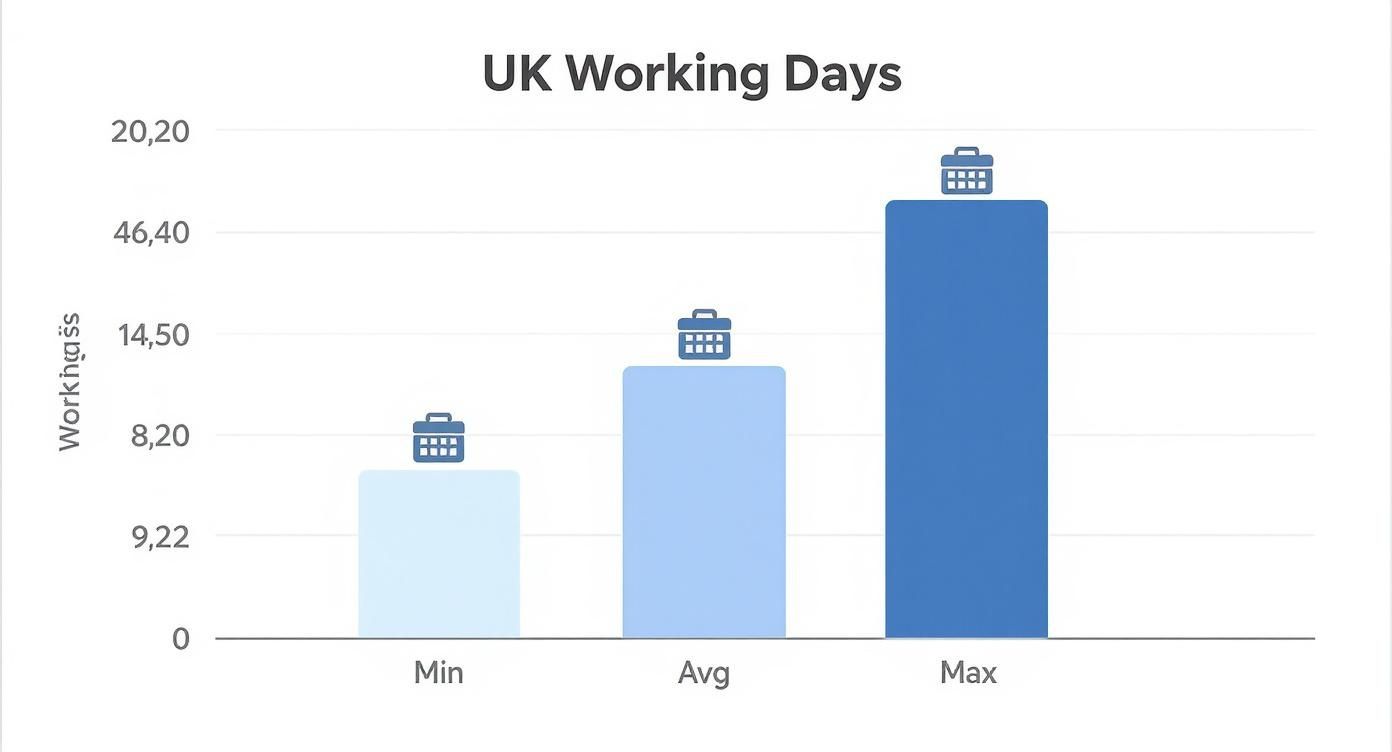
As you can see, the number generally falls between 20 and 22, with 21 being a pretty common average.
Factoring in Annual Leave
The second crucial piece of the puzzle is statutory annual leave. Here in the UK, nearly all full-time workers are entitled to 5.6 weeks of paid holiday each year. This entitlement is a direct reduction in the number of days an employee is actually at their desk and working.
When you spread this leave across the year, it works out to an average of just over two days being taken off by each person, every month. This is a vital deduction for accurate capacity planning and really understanding your team's availability.
For a deep dive into how this all breaks down, especially for different types of contracts, you should check out our ultimate guide to UK statutory holiday allowance. Once you combine bank holidays and annual leave, you start to see the true—and much smaller—number of operational days you have to play with.
How to Calculate Your True Working Days
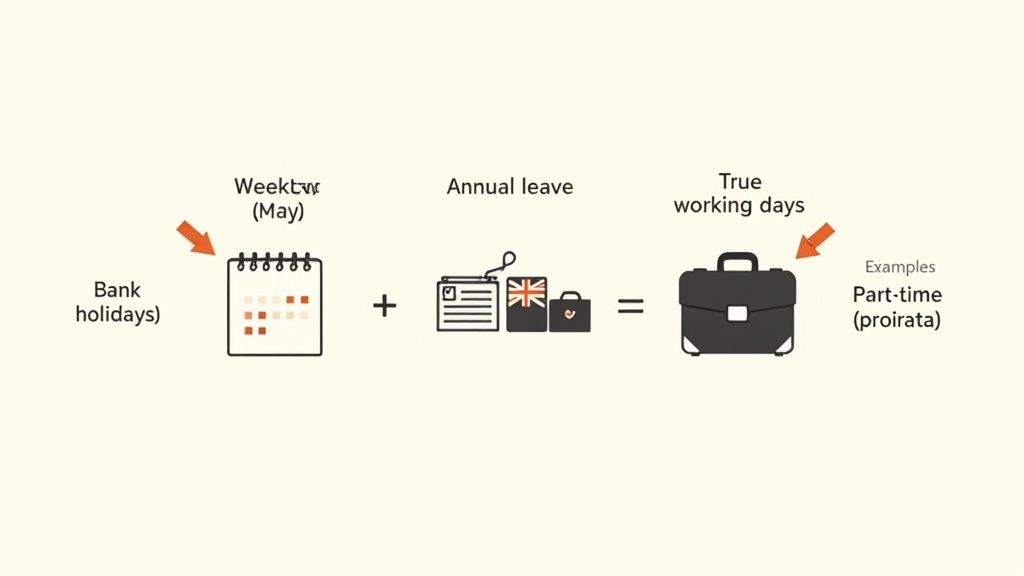
Working out the exact number of working days in a month isn't just a box-ticking exercise. It's the bedrock of solid project timelines, realistic staff rotas, and accurate financial forecasting. The good news is, the formula is refreshingly simple and you can apply it to pretty much any scenario.
It lets you move beyond rough estimates and find a number that truly reflects the time you have available.
The core idea is to start with the total number of weekdays and simply subtract any days that aren't worked. This simple bit of subtraction gives you the real number of days you've got for getting things done.
The True Working Days Formula:
(Total Weekdays in a Month) - (Bank Holidays) - (Annual Leave Days) = Your True Working Days
This little calculation provides a precise figure you can rely on for planning. Getting this number right is also a cornerstone of essential business operations like managing payroll; it's no surprise that many businesses turn to dedicated payroll services for small businesses to handle this kind of detail.
Let's put this into practice and see how it works with a couple of real-world examples.
Example 1: Full-Time Employee in May
Picture an employee in England who works a standard Monday to Friday week. We need to figure out their actual working days for May.
- Start with Total Weekdays: A quick look at the calendar tells us May has 23 weekdays.
- Subtract Bank Holidays: In England, May usually has two bank holidays (the Early May and the Spring bank holidays). So, we take off 2 days.
- Subtract Annual Leave: Our employee has booked a three-day holiday this month. That's another 3 days to subtract.
The maths looks like this: 23 - 2 - 3 = 18 working days. Simple as that.
Example 2: Part-Time Worker in April
Now, let's take a part-timer who works three days a week – Monday, Tuesday, and Wednesday. How many working days do they have in April?
- Count Their Specific Weekdays: In a typical April, there might be four Mondays, five Tuesdays, and five Wednesdays. That gives them a starting point of 14 working days.
- Adjust for Bank Holidays: If the Easter Monday bank holiday falls in April, that’s one of their normal working days. So we need to subtract 1 day.
- Factor in Annual Leave: This employee hasn't booked any time off.
So, the calculation is: 14 - 1 - 0 = 13 working days.
This approach gives you a crystal-clear picture of how many working days in a month someone is genuinely available, whether you're sorting out payroll or planning the next big project.
Calculating Work Days Beyond the 9-to-5
The classic Monday-to-Friday model just doesn't cut it for a massive slice of the UK's workforce. For millions of people in retail, hospitality, healthcare, and logistics, a "working day" isn't about the calendar. It's about the rota, and that often means weekends and evenings are very much on the table.
This is exactly where the simple method of counting weekdays and subtracting bank holidays starts to fall apart. The UK’s job market is incredibly diverse, with over 34.2 million people in employment, the majority in the private sector. Here, shift patterns, flexible hours, and zero-hour contracts are the norm. Suddenly, the traditional count of 20-22 working days a month doesn't mean much when schedules are so fluid. You can get a better picture of the structure of the UK labour market on Statista.com.
So, how on earth do you figure out how many working days in a month for these employees? It all comes down to two key things: their employment contract and the government's official guidelines.
Defining the 'Working Day'
For anyone working outside the typical 9-to-5, their employment contract is the ultimate source of truth. This is the document that defines what a working day actually is, what hours are expected, and clarifies the rules around weekend work. Always start there.
The Working Time Regulations 1998 are crucial here. They don't ban weekend or night work, but they do put legal limits on weekly working hours and ensure people get proper rest periods. It’s the safety net that makes sure even the most unconventional rota provides enough downtime for staff.
This legal framework essentially means that a "working day" for a shift worker is any day they are rostered to be on duty. It makes no difference whether it’s a Tuesday or a Sunday.
Calculating their monthly total, therefore, requires a different approach:
- Check the Rota: Your main tool isn't a calendar; it's the work rota. Your first step is to simply count the total number of shifts scheduled for that person within the month.
- Consult the Contract: Cross-reference what's on the rota with the terms laid out in their employment contract. This ensures everything lines up with what was agreed.
- Manage Extra Hours: If they've worked additional hours, you need to be clear on your company policy for handling overtime or accrued time off. We cover this in more detail in our complete guide to time in lieu in the UK.
The Real Impact of Unplanned Absence
So far, we’ve crunched the numbers on bank holidays and annual leave, which are fairly predictable. But there’s a wild card in the pack that can throw any calculation off course: unplanned absence. Life happens. Sickness, family emergencies, and other unexpected events create a gap between the days you plan for your team to work and the days they actually do.
This isn't about being pessimistic; it's just being realistic. Getting a handle on this gap is absolutely vital for accurate forecasting and managing your resources effectively. When you ask "how many working days in a month?", factoring in this variable adds a crucial layer of realism that stops projects from falling behind due to unexpected staff shortages.
The True Cost of Lost Time
The scale of this issue across the UK is enormous. In 2023/24, a staggering 33.7 million working days were lost in Great Britain just from work-related ill health and non-fatal injuries. Stress, depression, or anxiety alone were responsible for 16.4 million of those days. You can dig into the full details of these findings on lost working days from the HSE.
The data reveals that the average person affected took about 15.5 days off during the year. This highlights a significant truth: simply counting calendar days doesn’t capture the real working capacity of the UK workforce.
Managing this properly calls for a proactive approach, not just a reactive one. A great way to get ahead of the challenges posed by unplanned absence and boost overall workplace health is to explore transformative employee wellness program ideas.
This unpredictable human element is precisely why solid attendance tracking systems are so important. They give you the real-time data needed to see the difference between planned work and actual productivity. That insight allows you to make smarter, more agile adjustments. Without it, you're essentially planning with one hand tied behind your back, and disruptions are almost inevitable.
Your Questions About Working Days Answered
Even after getting to grips with the formulas, a few specific questions tend to pop up time and again. It’s those tricky little edge cases that can throw a spanner in the works. This final section is designed to tackle those common queries head-on.
Think of it as your go-to reference for clearing up the small details that can make a surprisingly big difference to your planning.
How Do Leap Years Affect Calculations?
Ah, the classic leap year question. It sounds complicated, but its actual impact on your working day count is minimal. A leap year simply slots an extra day—29th February—into the calendar every four years.
If that extra day happens to fall on a weekday, it adds just one single working day to February, and by extension, the entire year. It bumps the annual total from 260 to 261 working days (before you subtract bank holidays). For monthly planning, it only ever changes February, lifting its usual weekday count from 20 to 21. Every other month is completely unaffected.
Are Bank Holidays Always Paid Days Off?
This is a really important one, especially for anyone working part-time or on a contract. While most full-time, permanent employees get bank holidays as paid time off, it's crucial to know that this is not an automatic legal right.
The deciding factor is always the employment contract. An employee's entitlement to paid bank holidays depends entirely on what’s written in their contract. If it states that their annual leave is inclusive of bank holidays, then yes, they're paid. If the contract doesn't specify this, the employer isn't legally required to pay for them.
It's a common myth that everyone automatically gets a paid day off, but the reality always comes down to the specific terms of employment. Always check the contract!
What Tools Can Help Me Track Working Days?
Let’s be honest, manually tracking working days for a whole team can turn into a real headache. Thankfully, you don’t have to. There are plenty of tools out there that can automate the whole process, saving you time and ensuring you get it right.
- HR Software and Absence Management Systems: These are the gold standard. They act as a central hub for all leave requests, track balances automatically, and give you a clear calendar view of who's off and when.
- Online Calculators: For a quick, one-off calculation, a dedicated online working day calculator is perfect. Just plug in a date range, and it will instantly work out the total for you, factoring in weekends and UK bank holidays.
- Spreadsheet Templates: A well-made spreadsheet can do the job, particularly for smaller teams. You can set up templates to log leave and use formulas to add up the totals each month.
Using the right tool takes all the guesswork out of the equation. It cuts down on the admin and gives you a reliable, at-a-glance overview of your team's availability.
Leavetrack offers a simple, powerful solution to replace messy spreadsheets and manual tracking. Our online system gives you a clear, central view of all staff leave, making planning, approvals, and reporting effortless. See how much time you could save at https://leavetrackapp.com.