
How Many Working Weeks in a Year A UK Payroll Guide
Posted by Robin on 03 Jan, 2026 in
It’s a common mistake to think there are 52 working weeks in a year. While a typical year does contain 52.14 weeks, once you account for statutory time off, the actual number of working weeks for a full-time UK employee is closer to 46.5.
This might seem like a small detail, but it’s a crucial one for accurate planning.
The Simple Answer to Working Weeks in a Year
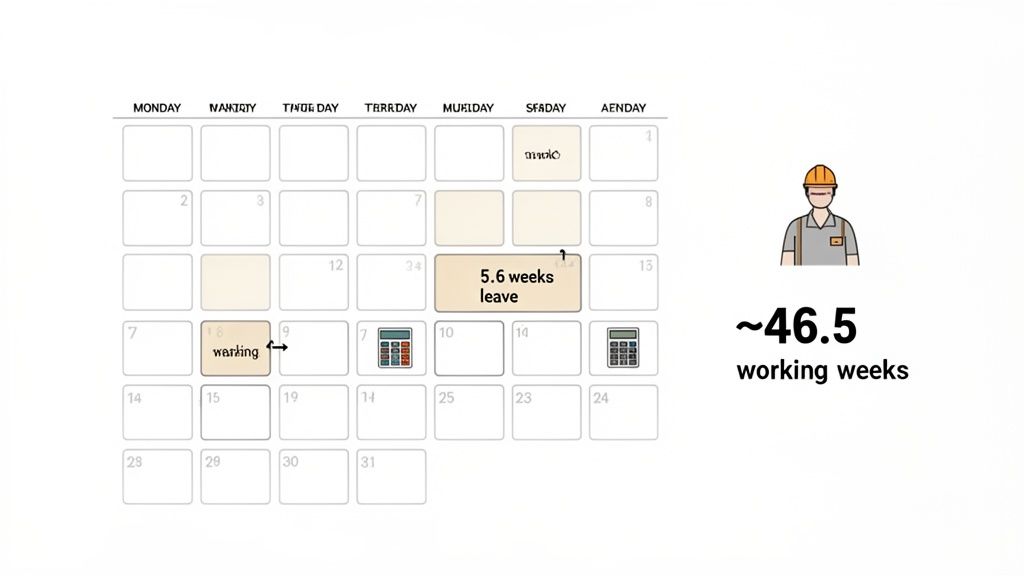
When you're figuring out project timelines, calculating payroll, or managing company resources, knowing the real number of working weeks is fundamental. Just using "52" can throw your entire forecast off.
The real answer comes from a simple but vital subtraction: taking the total weeks in a year and then removing the time off every employee is legally entitled to. This gives you a far more realistic baseline for any full-time employee in the UK working a standard five-day week.
The Basic Formula Explained
So, how do we get to that 46.5 figure? The maths is pretty straightforward. You just need to subtract the statutory holiday entitlement from the total number of weeks in a year.
Here’s how it breaks down:
- Total weeks in a year: 365 days ÷ 7 days/week = 52.14 weeks
- Statutory annual leave: In the UK, the law mandates a minimum of 5.6 weeks of paid holiday for full-time employees.
- The Calculation: 52.14 weeks - 5.6 weeks = 46.54 working weeks
UK Working Weeks at a Glance for a Full-Time Employee
To put it all together, here's a quick table showing how we get from the total weeks in a year to the actual working weeks after accounting for standard UK leave.
| Component | Number of Weeks | Number of Days |
|---|---|---|
| Total Weeks in a Year | 52.14 weeks | 365 days |
| Less: Statutory Annual Leave | - 5.6 weeks | - 28 days |
| Equals: Actual Working Weeks | 46.54 weeks | 337 days |
This quick overview makes it clear how statutory leave directly impacts the total available working time for a standard employee.
This baseline of roughly 46.5 weeks is the most reliable starting point for any business. It represents the maximum potential working time for a typical employee before you even start thinking about other factors like bank holidays that fall within that leave, sickness, or other types of absence.
Getting this core calculation right is a game-changer. It shifts you from a vague, back-of-the-envelope estimate to a precise figure that reflects your legal obligations. This forms the very bedrock of accurate payroll and fair leave management.
Of course, this number is just the beginning. The total can also be nudged up or down by the number of working days in a year, which changes depending on bank holidays and leap years. For a deeper dive into that, you can learn more about how many working days are in a year for the UK. This detailed breakdown helps you refine your calculations even further, ensuring your resource planning is as sharp as it can be.
Why the Simple Calculation Is Just a Starting Point
While getting a single number like 46.5 working weeks gives you a solid baseline, the reality of managing a UK workforce is far more nuanced. Relying only on that figure is like planning a long road trip using just the total mileage. It's a good start, but it ignores traffic, pit stops, and changing speed limits. It just doesn't paint the whole picture.
This is where a ‘one-size-fits-all’ approach can cause serious headaches in payroll, resource planning, and project timelines. Several key variables can shift that final number, and ignoring them can have real-world consequences for your business.
The Impact of Leap Years
One of the most straightforward variables is the leap year. Every four years, we add an extra day—29th February—to the calendar, pushing the total from 365 to 366.
For a business, this single extra day can subtly alter calculations for annual salaries, pro-rata entitlements, and project deadlines. While it might not seem like a huge deal, it adds a layer of complexity that manual systems can easily miss. This can lead to small but meaningful payroll mistakes.
Think of your annual plan as a finely tuned machine. An extra day might seem insignificant, but it’s an extra gear that needs to be accounted for. Failing to adjust for it can cause friction in your financial and operational processes down the line.
Regional Differences in Public Holidays
Another massive factor is the variation in public holidays across the UK. While many bank holidays are shared, each nation has its own unique dates. For instance, Scotland celebrates St Andrew's Day, and Northern Ireland observes the Battle of the Boyne.
These differences aren't just trivial; they directly impact staff availability and your operational capacity. Imagine managing a remote team with members in England, Scotland, and Northern Ireland. If your resource plan is based only on English bank holidays, you're going to run into scheduling conflicts and unexpected staff shortages.
Here’s a quick look at the standard number of public holidays:
- England and Wales: 8 public holidays
- Scotland: 9 public holidays
- Northern Ireland: 10 public holidays
This variance means there isn't one universal answer to how many working weeks in a year for every UK employee—the calculation has to be localised. For any business with a distributed workforce, accurately tracking these regional holidays is vital for keeping things running smoothly, treating all employees fairly, and staying compliant.
How Annual Leave and Public Holidays Shape Your Year
While things like leap years or regional holidays might tweak the numbers slightly, the two biggest factors that shrink your team's available time are annual leave and public holidays. These aren't just minor adjustments; they fundamentally redefine what a "working year" actually looks like for every single employee.
For any UK business, the starting point is the statutory minimum holiday entitlement. For a full-time employee, this is 5.6 weeks, which works out to be 28 days per year. Right away, that carves a significant chunk out of the calendar and is easily the biggest influence on the real number of working weeks for your staff.
Of course, that 28-day figure is just the legal floor. Many companies offer more generous leave as a competitive perk, which eats into the total number of working days even further. An extra week of holiday, for example, is a straight subtraction of five potential working days from an employee's calendar.
Factoring in Public Holidays
On top of individual annual leave, you also have to account for public holidays—or bank holidays, as we usually call them. These are fixed dates when most businesses shut their doors, and they need to be handled correctly within an employee's total leave allowance.
In England and Wales, there are typically 8 public holidays a year. It's a very common—and legally sound—practice for these 8 days to be included as part of that total 28-day statutory entitlement.
The key thing to remember is that an employee’s 5.6 weeks of leave isn't in addition to bank holidays—it usually includes them. This means a full-time employee gets 20 days of flexible holiday to book, plus the 8 fixed bank holiday dates.
Getting this distinction right is vital for both planning and payroll. Operations managers need to know about these company-wide shutdown days to manage workflows, while finance teams need it to calculate pro-rata entitlements for part-timers and manage leave liability. For a full breakdown of these dates, check out our complete guide to 2025 UK bank holidays.
The Real Number of Working Weeks
So, when you put statutory leave and public holidays together, what are you left with? The realistic amount of time people are actually at work is a lot lower than the 52 weeks you see on a calendar.
Data from the Office for National Statistics shows that after you take away the standard 5.6 weeks of statutory leave (which includes the 8 public holidays), the average full-time UK employee works for about 1,867 hours per year. This effectively boils down to around 40-42 actual working weeks of five days each, once you've also stripped out the weekends. You can find more insights on UK working hours and national averages on Clockify.me.
Understanding this more refined number is a game-changer. It gives you a solid, data-backed foundation for everything from project planning and setting realistic deadlines to calculating payroll accurately. It's about moving from a theoretical calendar to a practical, operational one that reflects how your business actually runs.
Calculating Working Weeks for Different Contracts
It's a rare business that runs on a single type of employment contract. You’ve likely got a mix of people on your team – part-time experts, staff on compressed hours, maybe even zero-hour contracts. This diversity is a strength, but it means your calculations need to be just as flexible to keep things fair and legal. You simply can't apply a one-size-fits-all formula and hope for the best.
The secret is to shift your thinking away from a rigid "week" and focus instead on the total number of working days or hours. This is where the idea of pro-rata, or proportional entitlement, becomes your best friend for getting things right.
Before diving into the maths, the first question is always how you treat public holidays. This one decision changes the entire calculation.
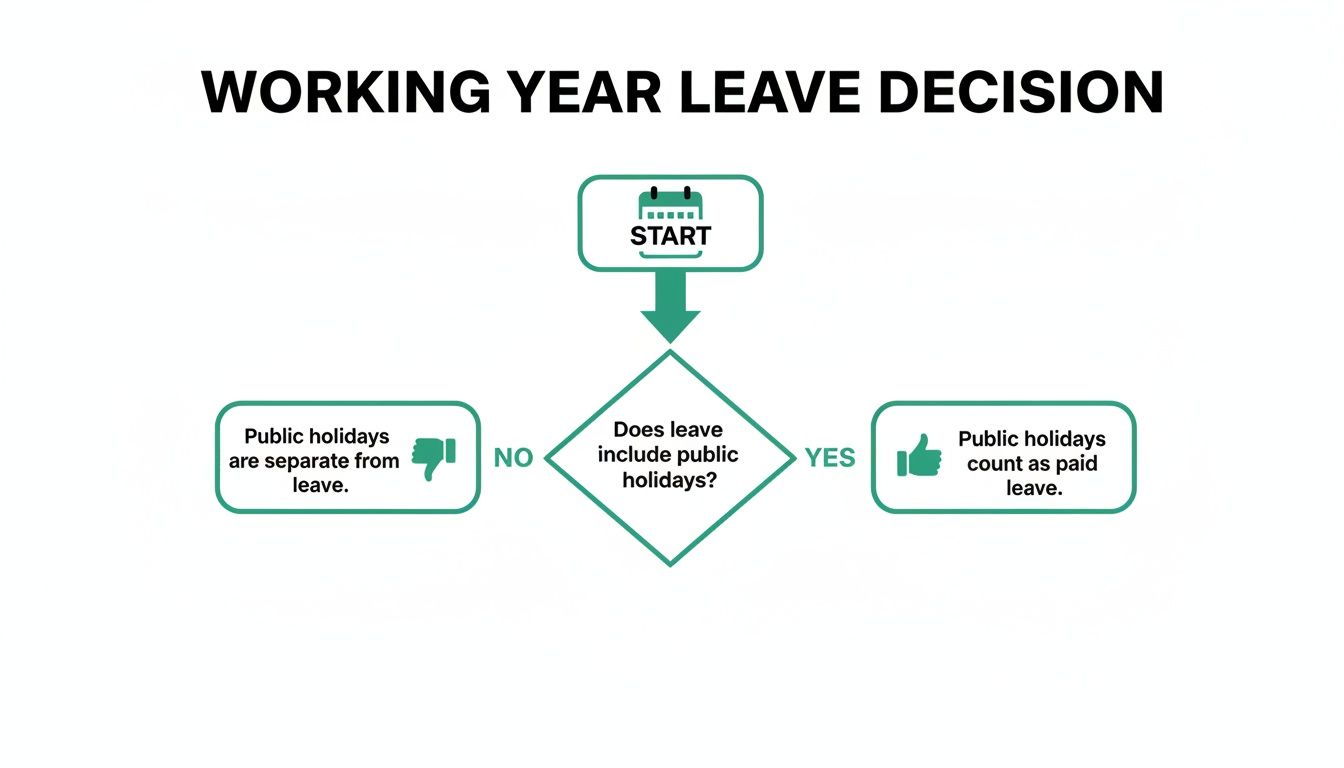
As the flowchart shows, whether you include bank holidays within the statutory leave or add them on top directly affects an employee's total days off.
Calculating for Part-Time Employees
The most common variation you'll encounter is the part-time contract. To figure out the working year for someone who works fewer than five days a week, you need a pro-rata approach. This ensures their holiday allowance is fair and proportional to what their full-time colleagues get.
Let's walk through an example for an employee who works three days per week:
- Calculate Their Annual Working Days: A standard full-time employee works 260 days a year (5 days × 52 weeks). Our part-timer, on the other hand, works 156 days a year (3 days × 52 weeks).
- Work Out Their Pro-Rata Holiday: If a full-timer gets 28 days of leave, the part-timer’s allowance is calculated proportionally: (3 ÷ 5) × 28 days = 16.8 days.
- Find the Net Working Days: Now, just subtract their holiday from their total working days: 156 – 16.8 = 139.2 working days.
- Convert Back to Working Weeks: Finally, divide their actual working days by their standard working week: 139.2 ÷ 3 = 46.4 working weeks.
You’ll notice the final number of working weeks is the same as for a full-timer, but we had to calculate it based on days to ensure complete accuracy.
The principle of pro-rata is the cornerstone of fair leave management for non-standard contracts. It guarantees that an employee's entitlement to time off is directly proportional to the time they work, preventing unfair discrepancies between full-time and part-time staff.
Adjusting for Other Contract Types
Part-time roles are just the beginning. Other working arrangements also require a bit of careful thought, as each one redefines what a 'working week' or 'working day' actually means.
- Compressed Hours: An employee might work their full 37.5-hour week over four days instead of five. While their weekly hours are the same as a full-timer, their 'day' is longer. In this case, it’s best to calculate holiday entitlement in hours, not days, to avoid them getting more time off than a five-day colleague.
- Zero-Hour Contracts: People on zero-hour contracts are absolutely entitled to paid holiday. Their leave accrues based on the hours they actually work, at a rate of 12.07% of hours worked. This slightly odd percentage comes from the standard 5.6 weeks of holiday divided by the 46.4 working weeks in a year.
- Annualised Hours: For staff contracted for a set number of hours across the entire year, their working time is already defined. The main job here is to make sure they receive their statutory 5.6 weeks of paid leave within that total, which needs to be factored into their schedule from the start.
Getting your head around these small but important differences ensures every employee is treated equitably, no matter what their contract says.
Here's a table to help visualise how these calculations differ across common employment types.
Working Week Calculations for Various Employment Types
| Employment Type | Weekly Days Worked | Annual Leave (Days) | Public Holidays (Days) | Total Working Days | Equivalent Working Weeks |
|---|---|---|---|---|---|
| Full-Time | 5 | 28 (inc. PH) | 0 | (5 × 52) - 28 = 232 | 232 / 5 = 46.4 |
| Part-Time (3 Days) | 3 | 16.8 (pro-rata) | 0 | (3 × 52) - 16.8 = 139.2 | 139.2 / 3 = 46.4 |
| Compressed Hours | 4 (full-time hours) | 22.4 (pro-rata) | 0 | (4 × 52) - 22.4 = 185.6 | 185.6 / 4 = 46.4 |
As you can see, while the total days worked varies significantly, the 46.4 working weeks remains the consistent baseline when calculated correctly.
Moving Beyond Manual Spreadsheets

After wrestling with the complexities of pro-rata leave and different contract types, it becomes painfully obvious that manual spreadsheets just don't cut it anymore. They're a liability.
It's far too easy for a simple typo in a formula or an outdated holiday calendar to throw everything off. These little mistakes can snowball into big problems, leading to incorrect pay, compliance headaches, and unfair leave allowances.
This is where a modern, automated system completely changes the game. Instead of you having to manually tweak calculations for every single employee, a dedicated system handles it all in an instant, and gets it right every time. It’s about ditching a fragile, old-school process for one that’s intelligent, reliable, and built for how we work today.
The True Cost of Manual Errors
The trouble with spreadsheets goes way beyond a few dodgy calculations. One wrong entry can have a ripple effect, creating major issues for HR managers and the business as a whole.
If you’re still using them, these pain points probably sound familiar:
- Inaccurate Accruals: Manually tracking how much leave someone has earned is tedious work, and it's a minefield for errors, especially with part-time staff or new starters.
- Compliance Risks: Getting statutory entitlements wrong can land you in legal hot water and seriously damage your company’s reputation.
- Lack of Visibility: Spreadsheets give you a static, and often out-of-date, snapshot. It’s practically impossible for a manager to get a real-time view of who's available for resource planning.
- Time Drain: Think of all the hours spent updating records, double-checking formulas, and answering staff queries about their holiday balance. It's a massive administrative burden.
An automated system isn't just a time-saver; it’s a safeguard. It ensures every calculation is precise, every employee is treated fairly, and the business remains compliant, freeing up your team to focus on people, not paperwork.
How Automation Creates Clarity and Control
A proper leave management system makes these problems disappear by automating the fiddly bits. For example, recent Onrec research highlights that with a minimum of 5.6 weeks holiday entitlement and 8 bank holidays, full-time UK staff work around 40-42 five-day weeks. Knowing this is vital for planning, and a system like Leavetrack puts this data at your fingertips.
Tools like a digital wall planner give you instant visibility, showing who is off and when – something that’s invaluable for managers trying to schedule projects. A spreadsheet simply can't compete with that kind of dynamic overview. If you’re looking to get a better handle on things, a great starting point is understanding how a comprehensive employee leave management system works.
Better yet, look for tools that connect with your other systems. For a truly seamless workflow, think about the benefits of setting up QuickBooks Payroll to handle the numbers automatically and sync perfectly with your leave data. This joins up the dots from leave request to payslip, guaranteeing accuracy every step of the way.
Common Questions About Calculating Working Weeks
Once you’ve got the basic formulas down, you’ll find that real-life scenarios start throwing a few curveballs. Getting the details right is what keeps your team happy and your business operations ticking over smoothly.
Let's walk through some of the most common questions HR managers and team leaders run into when they're figuring out the number of working weeks in a year for their people.
What Happens When a Bank Holiday Falls on a Weekend?
This one trips people up all the time. Here in the UK, if a bank holiday lands on a Saturday or Sunday, we get a ‘substitute’ day off instead, which is nearly always the following Monday.
So, what does this mean for your calculations? Simply put, nobody loses out on their day off. The substitute weekday just takes the place of the original date, ensuring everyone still gets their full holiday entitlement. Any decent payroll and leave management system will handle this automatically, but it’s a good detail to keep in mind if you're doing any manual planning.
How Do We Handle Leave for Employees Who Start Mid-Year?
When someone joins the team part-way through the year, their holiday is calculated on a pro-rata basis. It wouldn’t be fair to give them the full 5.6 weeks, so instead, their entitlement is based on how much of the leave year they’ll actually be working.
Here’s the simplest way to work it out:
- Start with the annual entitlement: For a standard full-time employee, that’s 28 days.
- Find the monthly accrual rate: Just divide the total entitlement by 12. So, 28 ÷ 12 = 2.33 days per month.
- Multiply by the months they'll work: Take that monthly rate and multiply it by the number of months remaining in your leave year.
For instance, if your leave year runs from January to December and a new starter begins on 1st July, they’ll be with you for six months. Their holiday entitlement would be 2.33 × 6 = 13.98 days. This is usually rounded up to a clean 14 days. It's a fair system that treats new starters properly from day one.
The guiding principle here is always fairness and proportionality. Whether you're dealing with a new starter, a part-time worker, or someone on a fixed-term contract, their leave should always be a direct reflection of the time they are contracted to work.
Should Overtime Affect Holiday Pay Calculations?
Yes, in many cases, it absolutely should. Recent UK employment law rulings have made it clear that regular, compulsory overtime has to be factored into an employee’s holiday pay. This applies to the first four weeks of their statutory leave and is designed to make sure their pay while on holiday reflects what they’d normally earn.
This does add a layer of complexity to payroll. You need to calculate an average of their pay over a reference period—typically the last 52 weeks they were paid—to work out the correct holiday pay rate. It’s one of the main reasons why automated systems that can manage variable pay rates are so invaluable. Getting this calculation wrong can easily lead to legal headaches down the road.
Trying to manage all these little details with spreadsheets is a recipe for mistakes and wasted hours. With Leavetrack, all these calculations—from pro-rata leave for new starters to tracking different holiday types—are completely automated. Our system gives you a clear, accurate, and real-time picture of your team's availability, ensuring total fairness and compliance without the spreadsheet-induced stress. See how simple it can be at https://leavetrackapp.com.