

How to Improve Employee Retention a UK Business Playbook
Posted by Robin on 14 Dec, 2025 in
If you want to improve employee retention, you have to start by figuring out why people are leaving in the first place. This means moving past your assumptions and digging into what your team truly values. A solid retention strategy is built on several core pillars: effective leadership, a structured onboarding process, genuine flexibility, and a culture that supports wellbeing and shows people a clear path forward.
Getting these areas right transforms retention from a constant fire-fight into a proactive part of how you run your business.
Diagnosing Why Your Best Employees Leave

Before you can build a strategy that actually works, you need a clear-eyed view of why your current one is failing. I see a fundamental disconnect in so many UK businesses: leadership often thinks competitive pay is the ultimate driver of loyalty, but employees consistently point to other factors when they hand in their notice.
It's rarely just about the money.
More often than not, high turnover is a symptom of deeper, systemic issues. Think of it as a recurring illness in your organisation. You can keep treating the symptoms—like throwing a counteroffer at a resigning employee—or you can diagnose the underlying cause to stop it from happening again and again. This diagnostic phase is all about asking the tough questions and being brutally honest with the answers.
Pinpointing Your Vulnerabilities
The real reasons people head for the door are often hidden in plain sight, embedded in the day-to-day experiences of your team. A huge part of retaining top talent is understanding their frustrations, which can include learning how to deal with workplace anxiety that stems from a poor or unsupportive environment.
Start by examining these common, yet critical, vulnerabilities:
- Leadership Gaps: Do your managers coach and develop, or do they just command and control? A lack of trust, support, and guidance from a direct manager is one of the fastest ways to lose a great employee.
- Onboarding Failures: Does your onboarding process feel like a warm, structured welcome or a frantic paper-chase? A poor experience in the first 90 days sets a negative tone for their entire time with you.
- Lack of Growth: If an employee can't see a future with you, they'll start looking for one elsewhere. A missing or poorly defined career path is a clear signal that their ambitions aren't valued.
- Inflexible Culture: Are you offering genuine flexibility, or just paying lip service to it? Rigid schedules and a culture built on mistrust will quickly erode morale and push talented people away.
To help you get started, here's a quick way to frame your initial thinking around these core pillars.
Quick Guide to Your Retention Strategy
| Pillar | Common Problem | Strategic Goal | First Action Step |
|---|---|---|---|
| Onboarding | New hires feel lost and disconnected in their first 90 days. | Create a welcoming experience that integrates new hires into the culture and their role. | Develop a structured 30-60-90 day plan with clear milestones and check-ins. |
| Management | Managers lack the skills to support and develop their teams effectively. | Equip managers with the tools to coach, give feedback, and build trust. | Roll out a simple manager training programme focused on 1-to-1s and performance conversations. |
| Career Paths | Employees see no opportunity for advancement and leave for better roles. | Make career progression visible and achievable for everyone. | Map out potential career ladders for key roles and discuss them in performance reviews. |
| Flexibility | Rigid policies are causing friction and burnout. | Offer genuine flexibility that empowers employees to manage their work and life. | Survey your team to understand what kind of flexibility they actually need (e.g., hours, location). |
| Wellbeing | High stress and burnout are leading to increased absences and turnover. | Build a culture where employee wellbeing is a priority, not an afterthought. | Review your absence and leave policies to ensure they are supportive and transparent. |
This table isn't exhaustive, but it provides a clear starting point for turning your diagnosis into a concrete plan of action.
By taking the time to diagnose these core issues, you shift from simply reacting to employee turnover to proactively building an organisation where people genuinely want to stay. This self-assessment is the first, most crucial step in creating an effective retention playbook.
Why Effective Leadership Is Your Best Retention Tool
If there's one truth I've learned from watching talented people walk out the door, it’s this: employees don't leave companies, they leave managers. Sure, compensation and perks matter, but the daily interactions with a direct leader have a huge impact on whether someone decides to stay or go.
This isn’t about being popular or well-liked. It's about the real difference between managing tasks and actually leading people. A manager organises work, hands out duties, and checks on progress. A leader, on the other hand, inspires commitment, builds genuine trust, and makes every single person on their team feel seen and valued.
That distinction is everything. When your managers are also effective leaders, your company becomes a place people want to be, not just a stepping stone to their next job.
The Real Cost of Poor Leadership
The damage from a leadership gap—both financially and culturally—is staggering. Teams with ineffective managers are plagued by low morale, disengagement, and, you guessed it, higher turnover. It’s a slow bleed that drains your business of its most valuable asset: its people.
Picture this. An employee, Sarah, is highly skilled but gets vague instructions and zero feedback from her manager. Her wins go unnoticed, her development is ignored, and her requests for support are met with a shrug. She's not just managing her workload; she's managing her manager's complete lack of interest.
How long do you think she'll stick around? It’s only a matter of time before Sarah starts looking for somewhere her contributions are appreciated and her growth is actually supported. She leaves, and the cycle just begins again with her replacement.
The data backs this up. When employees have both a great manager and a great leader, their commitment to stay jumps to a massive 94%. But with a poor leader? That figure plummets to just 35%. The ripple effects are stark, with turnover spiking dramatically after leadership changes. You can learn more about the critical link between leadership and attrition rates to see the full picture.
From Manager to Coach and Mentor
So, how do you build the kind of leadership that makes people want to stay? It starts by shifting your managers' mindset from being taskmasters to being coaches. This is a fundamental change, and it won't happen overnight without deliberate training and support.
A coaching approach involves:
- Active Listening: Genuinely hearing an employee's concerns and ideas without immediately jumping in with a solution.
- Asking Powerful Questions: Instead of just giving orders, a leader asks things like, "What support do you need to get this done?" or "What's one thing we could improve here?"
- Providing Constructive Feedback: Focusing on specific behaviours and their impact, not making broad, unhelpful criticisms. The goal is always development, not judgement.
Making this transition isn't always easy, but it’s absolutely essential for creating a culture of trust and psychological safety. When team members feel safe enough to take risks, share ideas, and admit mistakes, they become far more invested in their work and the company's success.
Practical Steps to Develop Your Leaders
Building effective leadership isn't a one-off training day; it's an ongoing commitment. You need to create systems that find and nurture leadership potential at every level. Here are three actionable strategies to get you started.
Implement 360-Degree Feedback
This means gathering anonymous feedback for a manager from their direct reports, peers, and their own boss. It gives them a complete, rounded view of their strengths and blind spots—insights they’d never get from a standard performance review. That feedback then becomes the blueprint for a personalised development plan.Build Clear Succession Plans
When employees can see a clear path for advancement, they’re much more motivated to stay and grow with you. Succession planning spots high-potential individuals and maps out the skills and experiences they need for future leadership roles. This kind of transparency shows you’re invested in their long-term career, not just their output this quarter.Invest in Practical Manager Training
Generic leadership theories aren't enough. Your managers need practical, hands-on training for core skills like running effective one-to-ones, giving developmental feedback, and handling difficult conversations. Give them a toolkit they can start using immediately. For some solid advice, check out these five top tips that will make you a better people manager.
Ultimately, investing in your leaders is the single most powerful investment you can make in employee retention. A great leader creates an environment where people feel motivated, supported, and optimistic about their future—and that’s a company culture no one wants to leave.
Mastering the First 90 Days for Long-Term Loyalty
The first three months of anyone's time at a new company are make or break. This isn't just about setting up a laptop and getting passwords; it’s the period where the foundation for their entire relationship with your business is poured. If that foundation is shaky, you’re just setting yourself up for another costly early departure.
A truly great onboarding experience goes miles beyond the standard admin checklist. It’s about making someone feel welcomed, valued, and confident from the moment they walk through the door. This is your one chance to prove they made the right call by joining your team and to set the scene for real, long-term commitment.
Moving Beyond the Welcome Pack
Look, a branded mug and a welcome email are nice gestures, but they don't tackle the real anxieties new starters have. People leave jobs early when they feel disconnected, confused about what’s expected of them, or when they simply can't see a future for themselves. A proper onboarding process hits these worries head-on.
The goal here is to intentionally forge connections and create total clarity. The data backs this up, time and time again. Research shows that 69% of employees are more likely to stick around for three years if they've had a great onboarding experience.
This whole process is about a deliberate evolution—from simply managing a new person to leading them in a way that inspires loyalty.
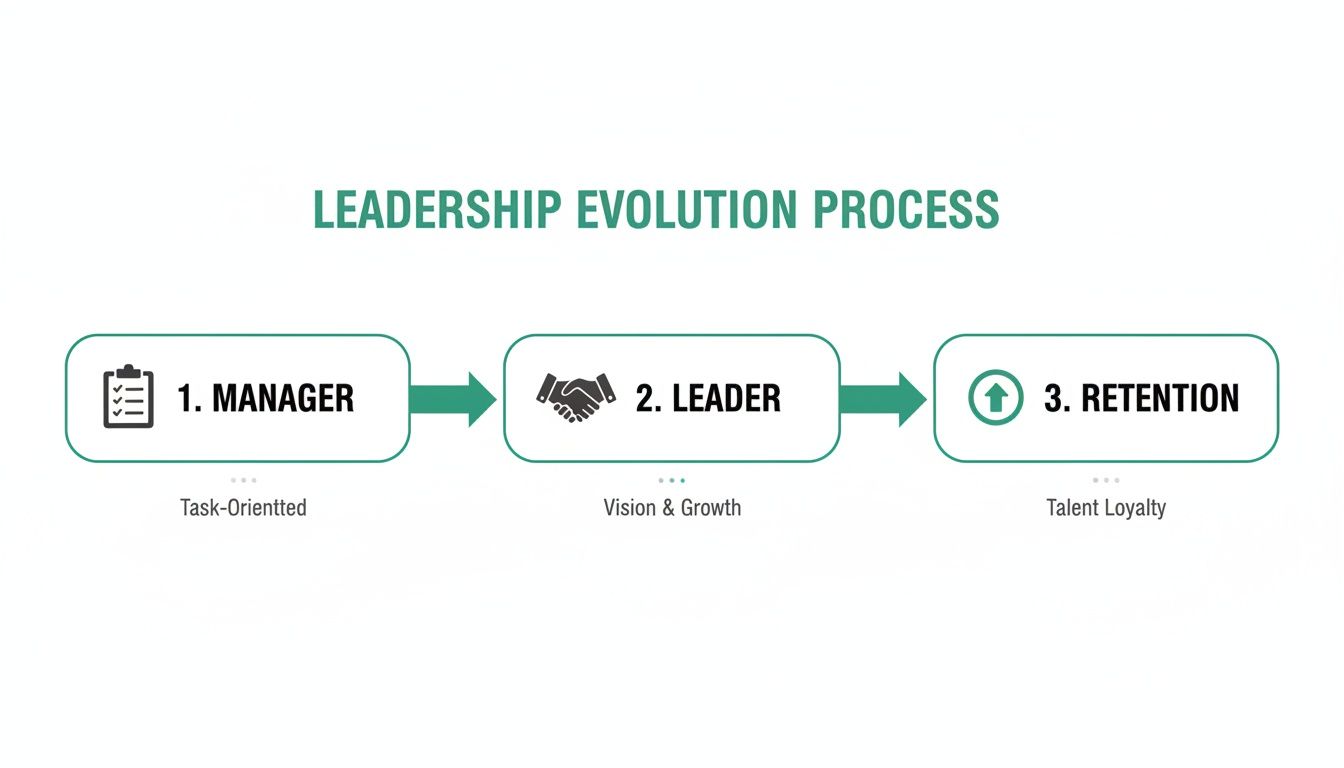
The shift from managing tasks to leading with genuine connection is what cements that long-term commitment.
The Power of a 30-60-90 Day Plan
One of the most effective tools in your arsenal is a simple 30-60-90 day plan. This single document cuts through the fog of a new role and gives your new hire a clear roadmap. It breaks down specific, achievable goals for their first three months, helping them see exactly what they need to do to start making a real impact.
Here's how you might structure it:
- First 30 Days (Learning and Acclimatising): This is all about integration. They should be meeting the team, getting a feel for the company culture, learning the essential systems, and getting a solid handle on their main responsibilities.
- Next 30 Days (Contributing and Collaborating): Now, they can start to take on more ownership. This means contributing to team projects, speaking up more in meetings, and maybe even spotting small ways to improve a process.
- Final 30 Days (Taking Initiative and Owning): By this point, the new hire should be flying more solo. They could be leading a small project, handling key tasks with little oversight, and starting to map out longer-term goals with their manager.
This structured approach doesn't just get them up to speed faster; it shows them you're invested in their success from day one. You can get more ideas for building out your own process by reading up on these top strategies for effective employee onboarding.
Building a Support System from Day One
Nobody wants to feel like they’re stranded on an island. Creating a support network is just as vital as laying out their tasks. A new starter who feels isolated is far more likely to check out mentally and start polishing their CV.
The biggest mistake you can make is just assuming a new hire will figure things out on their own. You have to be deliberate about building a support structure that makes them feel connected and psychologically safe.
To get this network in place, focus on two simple but powerful actions:
Assign a Dedicated Mentor or 'Buddy'
Pairing them up with a seasoned team member (who isn't their direct boss) gives them a safe person to ask all the "silly" questions. A buddy can help them learn the unwritten rules, introduce them around, and just be a friendly face.Schedule Structured Weekly Check-Ins
The direct manager needs to block out 30 minutes every single week for the first 90 days. This meeting isn't for a project status update. It's protected time to talk about challenges, celebrate small wins, answer questions, and reinforce that they have the manager's full support.
Nail this initial period, and you’re doing so much more than just filling a role. You're showing your new employee that they're a valued part of the team with a real future. That early investment pays off massively in loyalty, engagement, and your overall ability to keep great people for the long haul.
Implementing Flexibility That Actually Works

In today's workplace, flexibility has shifted from a nice-to-have perk to a core expectation. For many people, especially in fast-paced industries like retail and hospitality, having some control over their schedule is the deciding factor in whether they stay or start looking for a new job.
This is about more than letting office staff work from home a couple of days a week. We’re talking about a fundamental shift in how you approach scheduling, giving your team a sense of autonomy that builds incredible loyalty. When an employee isn't constantly fighting for a rota that fits their life, they're happier, more engaged, and far less likely to leave.
The demand for this is undeniable. A recent report found that for UK hourly workers, a massive 72% prioritise flexible scheduling when choosing a job. That same report revealed that a shocking 63% of these workers are planning to quit in the next year, pointing to a huge retention crisis that smart flexibility can help solve. You can dig into the data in the 2025 UK hourly workforce report.
Moving Beyond Remote Work
For roles that can't be done from home, flexibility needs to look different. It’s all about giving people more control over when and how they work. This is where you can get creative and show your team you're genuinely listening.
Here are a few practical strategies that work wonders for retention:
- Compressed Hours: Let people work their full weekly hours over fewer days. A retail team member might prefer four 10-hour shifts instead of five 8-hour ones to get an extra day for appointments or family.
- Flexible Shift Swapping: Empower your team to easily swap shifts with qualified colleagues through a simple, transparent system. This removes the stress of finding cover for an emergency and cuts down on last-minute no-shows.
- Predictable Scheduling: It sounds simple, but giving your team their rotas well in advance is a huge form of flexibility. It allows them to actually plan their lives, reducing stress and building trust.
These approaches show you trust your employees to manage their time and responsibilities—a message that goes a long way in building a positive culture.
Tackling the Managerial Burden
Let’s be honest, one of the biggest hurdles to offering real flexibility is the admin nightmare it can create for managers. Most are already stretched thin. The thought of juggling dozens of individual requests and manually building complex rotas feels completely overwhelming.
This is where outdated processes become the enemy of progress. When a manager spends three to ten hours every single week wrestling with a spreadsheet just to create the schedule, they have no time left for the things that really matter—like coaching their team and having meaningful conversations.
This administrative drain is a hidden retention killer. It not only burns out your managers but also leads to slow, inconsistent, and often unfair scheduling decisions that directly frustrate your employees and push them towards the door.
Modern tools can completely change the game here. By automating the scheduling process, you free up your managers to actually lead their people. A good system can instantly balance business needs (like full shift coverage) with employee preferences and availability. It’s a win-win that makes flexibility practical instead of painful.
If you're looking for guidance on handling these requests, our guide provides some excellent flexible working request example templates to help structure these conversations.
By putting in place a flexibility model that genuinely works for both your business and your team, you address one of the biggest drivers of turnover head-on. You give your people the control they value, remove a major source of frustration, and prove that you’re an employer worth sticking with.
Building a Culture That Encourages People to Stay
Beyond the initial welcome and leadership vision, it's the daily fabric of your company culture that truly convinces people to build a career with you. This isn't about grand gestures or flashy perks. It's about the systems, policies, and everyday interactions that shape an employee's experience long after their first 90 days.
A strong culture is forged in the consistent, fair, and supportive details. When you get these fundamentals right—from transparent pay to genuine wellbeing support—you create an environment of psychological safety. People stop worrying about being treated unfairly and can actually focus on doing their best work. This is the bedrock of long-term retention.
Getting the Basics Right: Compensation and Recognition
Let's start with the essentials. While money isn't everything, feeling underpaid is a powerful reason to look elsewhere. Your compensation simply has to be competitive for your industry and location. My advice? Benchmark salaries regularly and be as transparent as you can about your pay structures. It builds a massive amount of trust.
But salary alone won't keep your best people. Meaningful recognition is a huge driver of engagement, and it doesn't need to be expensive—it just needs to be specific and sincere. A true culture of recognition means celebrating wins, big and small, and making it easy for everyone to acknowledge great work.
- Peer-to-Peer Recognition: Set up a simple system, maybe a dedicated channel in your team chat, where colleagues can give "kudos" or shout-outs. It’s simple but incredibly effective.
- Managerial Acknowledgement: Train your managers to give immediate, specific praise for a job well done. Crucially, they should link it back to team or company goals.
- Milestone Celebrations: Formally recognise work anniversaries and major project completions. It shows you value commitment and see the effort people are putting in.
Prioritising Genuine Wellbeing
Employee wellbeing has finally shifted from a buzzword to a business necessity. A culture that genuinely supports health—mental, physical, and financial—is one where people can truly thrive. This means going beyond the occasional yoga session and embedding support directly into your operations.
A big part of creating this supportive environment is embracing different ways of thinking and working. Exploring the benefits of neurodiversity in the workplace is a powerful way to build a genuinely inclusive culture where every individual feels they belong.
I’ve seen that a key part of wellbeing is simply reducing friction in core admin processes. When an employee has to chase their manager for a simple approval or feels the system for booking time off is unfair, it adds needless stress and slowly chips away at morale.
The Hidden Power of Fair Absence and Leave Management
One of the most overlooked—yet impactful—areas of company culture is how you handle absence and leave. A clunky, opaque, or inconsistent process for managing holidays and sick days is a major source of frustration for employees. It sends a subtle message that you don't trust your team or respect their time.
On the flip side, a clear, fair, and responsive system demonstrates respect and builds immense goodwill. When your team knows the rules are applied equally to everyone and that their requests will be handled promptly, it removes a huge point of stress. This is where modern tools can make a world of difference.
For instance, a centralised system like Leavetrack provides a clear, real-time view of who is off and when.
This visual planner gets rid of all the guesswork. It ensures that every leave request is managed from one central place, preventing double-bookings and guaranteeing fairness. The whole process becomes transparent for employees and incredibly simple for managers. It turns a potential source of conflict into a smooth, trust-building interaction, and that kind of fairness is exactly what makes people want to stay.
Measuring Your Retention Success
You can't improve what you don't measure. After all the effort you've put into improving leadership, onboarding, and your company culture, you need to see what's actually working. This is the crucial step that shifts your retention plan from hopeful guesswork to a proper, data-driven strategy. It shows you exactly where you're winning and, just as importantly, where you still have gaps.
Think of it this way: tracking a few core metrics is like checking your organisation's vital signs. These numbers tell a story about how your people are really feeling in their roles and whether your retention initiatives are hitting the mark.
Key Retention Metrics to Keep an Eye On
To get a clear picture, you don't need a mountain of data. Focusing on a handful of key indicators is enough to get started. If you track these quarterly, you'll build a powerful baseline and spot worrying trends before they escalate into serious problems.
Here are the essentials I'd recommend for any retention dashboard:
- Employee Turnover Rate: This is the classic, for good reason. It shows the percentage of employees who leave over a set period. If you notice a consistently high rate bubbling up in one department, it often points to a very localised issue – like a manager who needs more support.
- Voluntary vs. Involuntary Turnover: It’s vital to separate the people who choose to leave from those you let go. High voluntary turnover is a massive red flag. It’s a direct signal of employee dissatisfaction, and you need to know why it’s happening.
- Employee Net Promoter Score (eNPS): This is a brilliantly simple survey. It just asks, "On a scale of 0-10, how likely are you to recommend our company as a place to work?" It’s a quick and surprisingly effective way to get a pulse check on overall morale.
- Absence Rate: Don't overlook this one. A rising absence rate can be an early warning sign of burnout, disengagement, or just plain low morale. Tracking this helps you get ahead of wellbeing issues before they lead to someone handing in their notice.
The final step? Turn these data points into a simple, visual dashboard. Review it with your leadership team every quarter to celebrate the wins, dig into the challenges, and adjust your strategy. This regular rhythm transforms retention from a reactive firefight into a proactive, sustainable part of how you do business.
Your Questions Answered
When you first start digging into employee retention, a few common questions always pop up. Getting a handle on these early on helps set the stage for a realistic and effective strategy.
What’s a Good Employee Retention Rate for a UK Business?
While hitting a 90% retention rate is a great ambition, there isn't one magic number that works for every business. The reality is, benchmarks swing wildly from one industry to another. Hospitality and retail, for example, will always have a much higher natural churn rate than sectors like finance or tech.
The most valuable metric isn't how you stack up against some generic average, but how you're trending internally. The goal is to track your own retention rate consistently over time. Seeing a steady improvement, even if you're starting from a lower number, is a clear sign that what you're doing is working.
Your real aim should be continuous improvement. Focus on moving your own needle forward, quarter by quarter, rather than getting hung up on an industry benchmark that might not even be relevant to you.
How Can a Small Business Improve Retention on a Tight Budget?
Boosting retention doesn't have to mean throwing money at the problem. In fact, many of the most effective strategies are low-cost initiatives that have a huge impact on morale and loyalty. You don't need massive pay rises to make people feel seen and valued.
Try focusing your efforts on things like:
- Meaningful Recognition: A simple peer-to-peer recognition programme can work wonders.
- Manager Training: It costs nothing but time to coach your managers on giving better, more constructive feedback.
- Flexible Scheduling: Giving your team more control over their shifts and working hours is a powerful, free perk.
How Long Does It Take for Retention Strategies to Actually Work?
This is a long game, so patience is crucial. The time it takes to see results really depends on the kinds of changes you're making. Some fixes can show an impact fairly quickly, but deeper, more cultural shifts need time to bed in before they start moving the needle on your numbers.
For instance, you might see early turnover drop within six months of overhauling your onboarding process. But for bigger initiatives, like building a stronger company culture or developing better leaders, it could take a good 12-18 months before you see a significant, lasting effect on your annual retention figures.
Ready to build a culture of fairness and transparency that makes people want to stick around? Leavetrack makes absence management simple, cuts down on manager admin, and ensures everyone on your team is treated consistently. See how it works at https://leavetrackapp.com.