
How to Write a Request for Annual Leave Letter That Gets Approved
Posted by Robin on 25 Jan, 2026 in
At its heart, a request for annual leave is a formal (or sometimes semi-formal) note you send your manager to ask for time off. To get a quick 'yes', it needs to be crystal clear on your proposed dates of absence, touch on how your responsibilities will be handled, and keep a professional, considerate tone.
The Anatomy of a Perfect Annual Leave Request
Before you even think about writing, there's some groundwork to do. This isn't just about listing dates; it’s about showing you’ve thought things through and respect your team’s workflow. A little bit of prep work transforms a simple ask into a professional courtesy that managers and HR really appreciate.
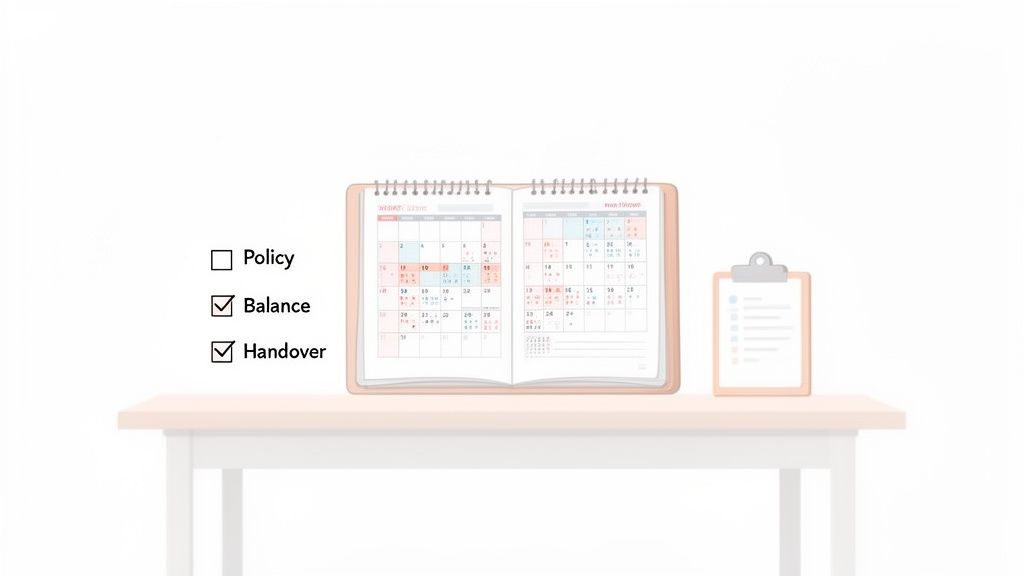
Check Your Company Policy First
Your first stop should always be your company’s leave policy. You'll usually find this tucked away in the employee handbook or on the company intranet. This document is your rulebook.
You'll want to look for a few key things:
- Notice period: How much of a heads-up do you need to give?
- Blackout periods: Are there any times of the year, like the end of a financial quarter or during a big project launch, where leave is a no-go?
- Approval process: Does the request go straight to your manager, or does HR need to be cc'd?
Ignoring these rules is the quickest way to have your request denied, no matter how well you've written it.
Know Your Entitlement and Balance
Next, get a handle on your leave entitlement. In the UK, the legal minimum annual leave is 5.6 weeks (that’s 28 days for most full-time roles). Your company might offer more, so it’s crucial to check your specific allowance.
It's also worth remembering that some dates are more popular than others. For example, data from Timetastic's annual leave insights shows the 27th of December is a huge favourite, and these seasonal peaks can put a real strain on managers trying to approve things manually.
Before you hit send, just log into your company's HR portal or glance at your latest payslip to double-check your remaining leave balance. Asking for more days than you have just creates a headache for everyone.
Draft a Preliminary Handover Plan
This is where you can really shine. Thinking about who will cover your crucial tasks before you even submit the request shows your manager you’re not just thinking about your holiday, but about the team's continued success.
It doesn’t need to be a massive document. Just jot down your key responsibilities and suggest a colleague who could step in. This little bit of prep demonstrates professionalism and shows you’re committed to making sure everything runs smoothly while you’re away.
Annual Leave Request Checklist
Feeling ready? Run through this quick checklist to make sure you've got all your bases covered before you send that email.
| Component | Why It Matters | Example Action |
|---|---|---|
| Check Company Policy | Ensures your request follows the official rules, avoiding an instant rejection. | Review the employee handbook for notice periods and blackout dates. |
| Confirm Leave Balance | Verifies you have enough accrued days to cover your requested time off. | Log into the HR system to see your remaining holiday allowance. |
| Choose Your Dates | Select dates that minimise disruption to major projects or team deadlines. | Cross-reference your calendar with the team's project timeline. |
| Draft a Handover Plan | Shows professionalism and makes approval easier for your manager. | List 2-3 key tasks and suggest a colleague who can cover them. |
| Determine the Tone | Matches the formality of your workplace culture (e.g., formal letter vs. casual email). | If your team uses Slack for everything, a brief email is likely fine. |
| Write a Clear Subject Line | Helps your manager immediately understand the email's purpose. | Use "Annual Leave Request - [Your Name] - [Dates]". |
Taking a few minutes to tick these boxes makes the whole process smoother for you and your manager, paving the way for that well-deserved break.
How to Structure Your Request for an Easy Yes
Alright, let's move from theory to action. How do you actually build a request that gets a fast, positive response? Whether you're sending a formal letter or just a quick email, having a clear structure shows you're professional and makes it incredibly simple for your manager to say yes.
Craft a Subject Line They Cannot Miss
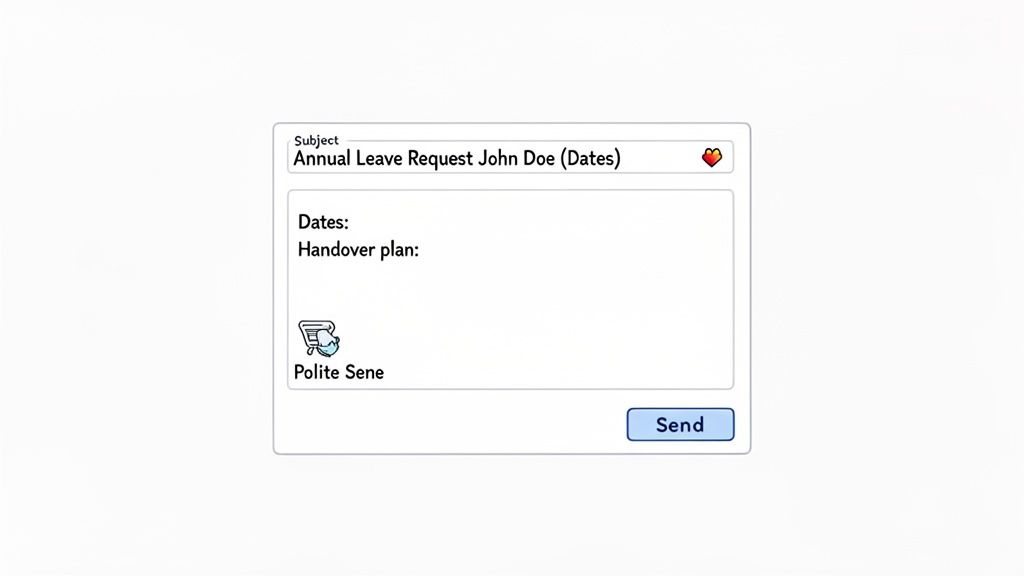
Think about your manager's inbox – it's likely overflowing. A vague subject line like "Time Off" or "Holiday" can easily get lost, pushed down the list, or just plain ignored. The goal is to give them all the essential info before they even open the email.
Keep it direct and informative. I've always found a simple formula works best: Request Type + Your Name + Dates.
- Good Example: Annual Leave Request – Sarah Jones (15-26 July 2024)
- Less Effective: Holiday time
This approach immediately tells your manager who you are, what you need, and for when. It allows them to prioritise it properly and signals that you're organised and considerate of their time. It’s a small detail, but it makes a big difference.
A clear subject line is your first impression. It sets a professional tone and shows you've organised your thoughts, making the entire approval process smoother from the very start.
The Core Components of Your Message
Once they've opened your email, the body of your request for annual leave letter needs to be just as efficient. I always think of it as having three simple but crucial parts.
- The Opening: Get straight to the point. State your intention to take annual leave and clearly specify the exact dates. It helps to include your proposed last day in the office and the date you plan to return. This leaves no room for confusion.
- The Handover Plan: This doesn't need to be a detailed project plan. Just a sentence or two confirming that you’ll prepare a handover document or brief a colleague on urgent tasks shows you're thinking ahead. It reassures your manager that things will run smoothly while you're away.
- The Closing: End with a polite and professional closing. Something as simple as "Thank you for your consideration" works perfectly. It keeps the tone respectful and professional.
This structure works because it anticipates the two main questions your manager will have: "When will they be gone?" and "What happens to their work?" By answering these upfront, you remove any potential roadblocks to getting your request approved. Building a strong case is a key skill in any professional communication. To sharpen your persuasive writing for any formal request, similar strategic preparation is vital, as seen in Mastering the art of asking for a raise.
Tailoring Your Tone for Different Workplaces
The final piece of the puzzle is matching your tone to your company's culture. A one-size-fits-all approach just doesn't work here. You have to read the room.
- Formal Environments: If you work in a more traditional organisation, a slightly more formal tone is the way to go. Use full sentences and standard professional language, like, "I am writing to formally request annual leave..."
- Casual Workplaces: In a relaxed startup or a team that communicates mostly via Slack, a more direct and casual email is perfectly fine. Something like, "Hi [Manager's Name], I'd like to book annual leave from..." will work well.
Adapting your language shows you understand the unwritten rules of your workplace. It makes your request feel natural and appropriate, which can only help your cause.
Proven Annual Leave Request Templates for Any Scenario
Knowing the theory is one thing, but having a solid starting point makes all the difference. To get you on your way, here are several field-tested templates you can copy, paste, and adapt to whatever your workplace looks like. These go beyond a single generic example, giving you options for almost any situation you might run into.
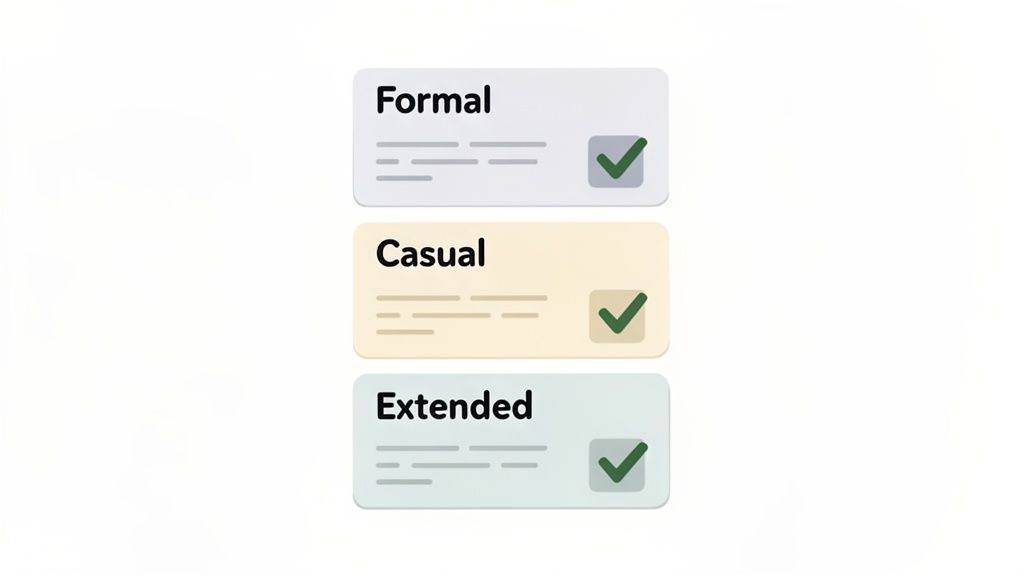
We'll cover everything from a traditional letter for a more buttoned-up organisation to a quick and professional email that works in most modern offices. Each template also includes a few notes explaining why it works, so you can tweak them with confidence.
The Formal Annual Leave Request Letter
This is your best bet for organisations with a more traditional structure, where formal written communication is still the standard. It’s professional, respectful, and leaves absolutely no room for misunderstanding.
Subject: Formal Request for Annual Leave – [Your Name]
Dear [Manager's Name],
Please accept this letter as a formal request for [Number] days of annual leave. My intended dates of absence are from [Start Date] to [End Date]. I plan for my last working day to be [Last Day of Work] and I will return to the office on [Return Date].
I will ensure all my current projects are up to date and my responsibilities are fully covered before my departure. I will prepare a detailed handover document and brief [Colleague’s Name] on any urgent tasks that may arise during my absence.
Thank you for considering my request. I look forward to your approval.
Best regards,
[Your Name]
Why this works: The formal tone, crystal-clear dates, and proactive mention of a handover plan show real professionalism and respect for company procedure. It gives your manager everything they need in a clean, structured way that's easy to process and approve.
The Standard Professional Email Request
For most modern workplaces, this is the template you'll use 99% of the time. It's polite and professional but a bit less stuffy than a full letter, making it perfect for an email.
Subject: Annual Leave Request: [Your Name] ([Start Date] - [End Date])
Hi [Manager's Name],
I would like to request annual leave from [Start Date] to [End Date], returning to work on [Return Date].
Before I leave, I'll make sure all my key tasks are completed. I will also coordinate with [Colleague’s Name] to ensure a smooth handover of any ongoing duties.
Please let me know if these dates work for the team.
Thanks,
[Your Name]
The Brief and Casual Email Request
Working at a startup or a small, close-knit team where communication is quick and direct? A shorter version like this is perfectly fine. Don't overthink it.
Subject: Time Off Request - [Your Name]
Hi [Manager's Name],
Just writing to request annual leave from [Start Date] to [End Date].
I'll get everything squared away before I go.
Let me know if that’s okay.
Cheers,
[Your Name]
The Request for Extended Leave
Asking for a longer chunk of time off—like for a sabbatical or a big trip—requires a bit more detail. This approach shows you’ve thought through the impact on the team and have a solid plan in place.
Subject: Extended Leave Request – [Your Name]
Dear [Manager's Name],
I am writing to formally request an extended period of annual leave for [Number] weeks, from [Start Date] to [End Date]. This time off would be for [briefly state reason, e.g., personal travel, a sabbatical opportunity].
I have been planning this for some time and have developed a comprehensive handover plan to ensure minimal disruption. I have already spoken with [Colleague 1] and [Colleague 2], who have agreed to cover my key responsibilities. I am committed to working diligently over the coming weeks to get ahead on my projects before I go.
I understand this is a significant request and am happy to discuss the logistics and my handover plan in more detail whenever you have a moment.
Thank you for your consideration.
Sincerely,
[Your Name]
These examples should give you a strong foundation for whatever message you need to send. If you're looking for even more variety, you can find other perfect email templates for your annual leave request to cover any other specific scenario you might face.
Ultimately, customising your request for annual leave letter to match your situation and company culture is the final step to securing that well-deserved time off.
Successfully Navigating Company Policy and Getting Approved
So you’ve drafted the perfect request for annual leave letter. That’s a great start, but getting it signed off is where the real skill comes in. It's less about the letter itself and more about navigating your company's policy, team dynamics, and the unwritten rules of professional courtesy.
Getting this right means stepping outside your own holiday plans for a moment and seeing things from your manager's point of view. They're likely juggling multiple requests, project deadlines, and the constant need to keep the team running smoothly. A thoughtful, well-timed request shows you get it, and that immediately puts you in a good position.
The Importance of Timing and Notice
Giving plenty of notice isn’t just about ticking a box in the company handbook; it’s a fundamental sign of respect for your colleagues and your manager. While there's usually a minimum notice period, the golden rule is to give as much warning as you possibly can, especially if you're planning a longer break.
A last-minute request can throw a real spanner in the works, leaving your manager scrambling to find cover. By getting your request in early, you give them the breathing room they need to shuffle workloads and approve your leave without any unnecessary stress.
A well-timed request isn't just about following policy—it's about demonstrating foresight. Your manager is more likely to approve a request that shows you've considered its impact on team schedules and project timelines.
Handling Scheduling Conflicts and Negotiations
What happens when you find out a colleague has already booked the same dates? It’s a classic problem, especially around popular times like summer or Christmas. The key here is to be flexible and collaborative, not confrontational.
If your first choice of dates isn't available, don't take it as a flat-out rejection. Think of it as the start of a conversation.
- Ask for alternatives: Start a constructive chat with your manager. Ask them which alternative dates would cause the least disruption for the team.
- Be flexible: It’s always smart to have a backup set of dates in mind. Showing you're willing to meet them halfway can make all the difference.
- Frame it positively: Ditch the "I can't believe I can't get that week off" mindset. Instead, try something like, "I understand there's a clash. Could we look at the calendar together to find a week that works for everyone?"
This kind of proactive, team-first approach is always a winner. It also helps to really understand how your company handles these situations; you can often find the specifics by looking at your company’s template annual leave policy.
This balancing act is getting trickier for managers. Recent data shows UK annual leave usage has dropped sharply, with the average employee taking just 33.9 days in 2023—that's a 7.67% fall from the previous year. In some sectors, like construction, the dip was even more pronounced at 10.98%. For managers, these trends flag a serious risk of employee burnout and coverage gaps, making a thoughtful, well-planned leave request more critical than ever. You can dig into these industry trends in a detailed report from People HR.
Common Mistakes That Get Leave Requests Denied
Even the most reasonable leave request can hit a wall because of a few small, avoidable mistakes. Getting to grips with these common slip-ups is the best way to make sure your request for annual leave letter gets a quick 'yes' without causing headaches for you or your manager.
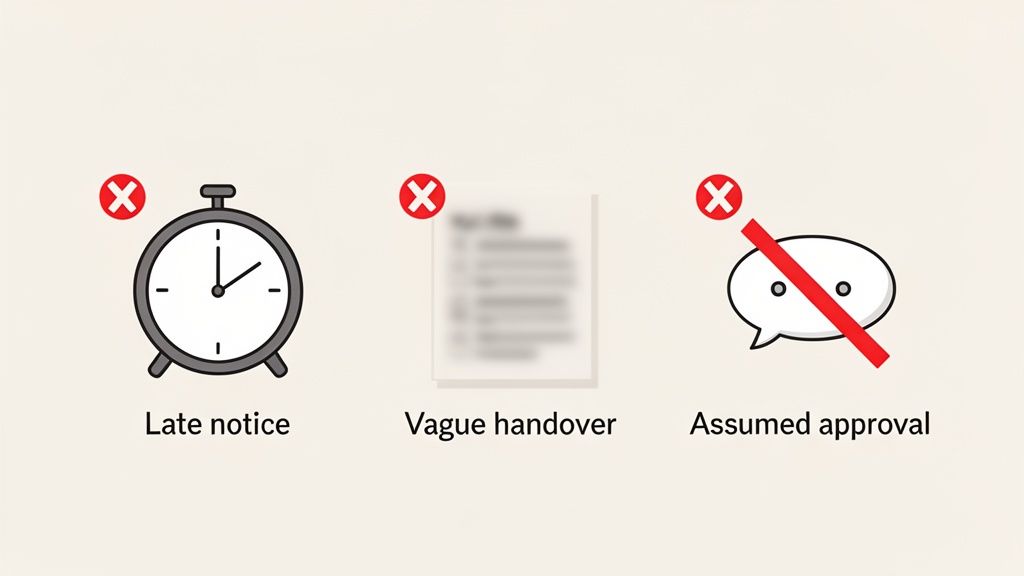
One of the biggest culprits is simply giving insufficient notice. Dropping a request for a two-week holiday just a few days before you plan to leave puts your manager in a really tight spot. They're left scrambling to arrange cover, which never goes down well. Always check your company policy, but a solid rule of thumb is to give at least twice as much notice as the time you're asking for.
Another classic error is a vague handover plan. Just saying "I'll get everything done" doesn't cut it. It creates more questions than answers and forces your manager to chase you for details. Be specific, even if it’s short and sweet: "I’ll brief Sarah on the Q3 report and clear all client emails before I go."
Getting the Tone and Timing Wrong
How you ask is just as important as what you’re asking for. An email with a demanding or entitled tone can put a manager on the back foot instantly. Phrases like "I need these dates off" sound more like an order than a request. Keep it professional and polite.
Likewise, bad timing can sink your request before it’s even properly read. Try to avoid sending it during a known crunch time, like a major project launch or the end of the financial year, unless it's a real emergency. Sending it then can make it seem like you're out of touch with business priorities.
Key Takeaway: A successful leave request anticipates your manager's two biggest concerns: team coverage and project continuity. When you address these points proactively with plenty of notice and a clear handover plan, you remove the biggest roadblocks to getting it approved.
And finally, never, ever assume your leave is approved until you have it in writing. A quick chat in the corridor or a sent email with no reply is not a confirmation. It's a surprisingly common mistake that can lead to total chaos.
Here are a few other quick things to sidestep:
- Forgetting to update shared calendars: As soon as you get the thumbs-up, block the time out in any team or project calendars.
- Being inflexible: If your first-choice dates clash with a colleague’s plans, be ready to chat about alternatives.
- Ignoring the official process: Even in a relaxed office, skipping the formal HR system or process can mean your request isn't valid.
By avoiding these common pitfalls, your request for annual leave letter becomes a simple, professional courtesy instead of a logistical nightmare.
Frequently Asked Questions About Requesting Annual Leave
Even with the best templates in hand, you'll probably still have a few questions when it's time to actually hit 'send' on your holiday request. Getting your head around the finer points of company policy and your own rights can feel a bit daunting, so let's clear up some of the most common queries that come up.
Knowing the answers to these will help you have a much more confident and professional chat with your manager.
How Much Notice Should I Give for an Annual Leave Request?
The golden rule here is to always check your company's official policy first – that's your ultimate source of truth. But if you're looking for a solid rule of thumb, a great guideline is to provide at least twice as much notice as the length of the holiday you want to take.
Think of it like this:
- For a one-week holiday: You should be aiming for a minimum of two weeks' notice.
- For a two-week holiday: Give them at least four weeks' notice.
And if you’re eyeing up those really popular times, like the school summer holidays or the Christmas break, you’ll want to get your request in months in advance. It's the best way to avoid disappointment and lock in the dates you actually want.
What Should I Do If My Leave Request Is Denied?
First things first, take a breath and stay professional. It's easy to get frustrated, but a calm approach works wonders. Politely ask your manager for the specific reason behind the decision. More often than not, it's down to a genuine business need, like a big project deadline or making sure the team has enough cover.
Once you understand their concern, you can start a proper conversation. Could you suggest alternative dates that might work better for everyone? Is there anything you could do to help prepare for your absence that might solve the problem? If, after all that, the denial still feels a bit unreasonable, your next port of call should be a quiet chat with HR.
Remember, a denial is often the start of a negotiation, not the end of the road. A flexible and problem-solving attitude can often turn a "no" into a "yes" for a different set of dates.
Can My Employer Cancel My Approved Annual Leave?
This is a big one. Here in the UK, an employer can legally cancel your pre-approved annual leave, but they can't just do it on a whim. They have to give you adequate notice.
The required notice period is typically at least the same length as the holiday you've booked. So, if they need to cancel your two-week trip, they must give you at least two weeks' warning.
If you’ve already paid for flights or accommodation that you can't get a refund for, you may be entitled to get that money back from your employer. Always double-check your employment contract for the specifics, and it's worth getting familiar with your statutory holiday entitlement in the UK.
Managing leave doesn't have to be a constant back-and-forth of emails and spreadsheets. Leavetrack provides a central, easy-to-use system for requesting, approving, and tracking all staff leave, giving you and your team total clarity. Find out how Leavetrack can simplify your absence management today.