

what are annualised hours: the essential guide
Posted by Robin on 04 Nov, 2025 in
Ever heard of annualised hours? It's a smart way of working where an employee agrees to a total number of hours for the whole year, rather than a rigid set number each week. The big win for staff is a stable monthly salary no matter how many hours they actually clock in, while the business gets the flexibility to ramp staffing up or down with demand.
So, How Does The Annualised Hours Model Actually Work?
Think of it like giving an employee a "time budget" for the year. Instead of being locked into a standard 9-to-5, 40-hour week, their schedule can ebb and flow with the natural rhythm of the business. This kind of flexibility is a cornerstone of modern, effective workforce management, particularly in industries with clear busy and quiet seasons.
A great example is retail. An employee might be pulling 50-hour weeks in the chaotic run-up to Christmas, but then drop down to 30-hour weeks during a slow January. The brilliant part? Their monthly paycheque stays exactly the same. That consistency is a huge relief for them, and a major operational plus for the business.
This approach essentially smooths out the operational bumps. It lets you align your biggest cost—your people—directly with your periods of highest income. You end up relying less on expensive overtime during the peaks and stop paying for unproductive downtime during the lulls.
It’s no surprise this model is a perfect fit for industries where demand is anything but constant:
- Manufacturing: Perfect for aligning production schedules with seasonal product launches.
- Hospitality and Tourism: Staffing can be matched precisely to holiday seasons and major events.
- Agriculture: Adapts naturally to the cycles of planting and harvesting.
- Retail: A lifesaver for scaling up during the Christmas rush and sales periods.
The popularity of this model in the United Kingdom is a clear sign of this shift towards more adaptable working arrangements. Right now, around 2.1 million employees are on these types of contracts. This figure really shows how businesses are getting creative to manage fluctuating workloads. It's a practical solution that balances the needs of the company with the financial security of its employees, making it an invaluable tool for any forward-thinking organisation.
How to Calculate Annualised Hours for Your Team
Figuring out annualised hours might sound complicated, but it's really just a straightforward, step-by-step process. The aim is to land on a total number of contracted work hours for the whole year, making things crystal clear for both you and your employee. Think of it as a simple bit of addition and subtraction.
The whole thing kicks off with the total possible working hours in a year, and from there, you just start taking away all the paid time off.
The Core Calculation Formula
First up, you need to work out the gross annual hours for a full-time employee. Here in the UK, a common starting point is to multiply a standard 40-hour week by 52 weeks. That gives you your initial figure: 2,080 hours.
From that total, you then need to deduct all paid leave entitlements. This includes the statutory minimum of 28 days of paid holiday. For an employee working 8-hour days, that comes to 224 hours (28 days x 8 hours). A quick subtraction brings the total contracted hours down to around 1,856 for the year.
Key Takeaway: The final annualised hours figure isn’t just weekly hours multiplied by 52. It’s the gross annual hours minus all paid holiday and bank holiday time. Getting this distinction right is absolutely vital for creating a fair and legally sound contract.
A Simple Calculation Breakdown
Let's walk through the calculation for a full-time employee to see how it works in practice.
Below is a table showing the step-by-step calculation for a typical full-time employee in the UK.
| Calculation Step | Hours | Notes |
|---|---|---|
| 1. Gross Annual Hours | 2,080 | Based on a 40-hour week (40 hours x 52 weeks). |
| 2. Annual Leave Entitlement | -160 | 20 days x 8 hours per day. |
| 3. Bank Holiday Entitlement | -64 | 8 days x 8 hours per day. |
| 4. Total Net Annual Hours | 1,856 | The final contracted hours for the year. |
This process ensures you have a clear, final number to work with. For a deeper dive into the numbers, check out our guide on how many working days are in a year in the UK.
With the total hours agreed upon, employees can be confident that their pay will stay consistent, smoothing out the financial bumps between busy periods and quieter times.
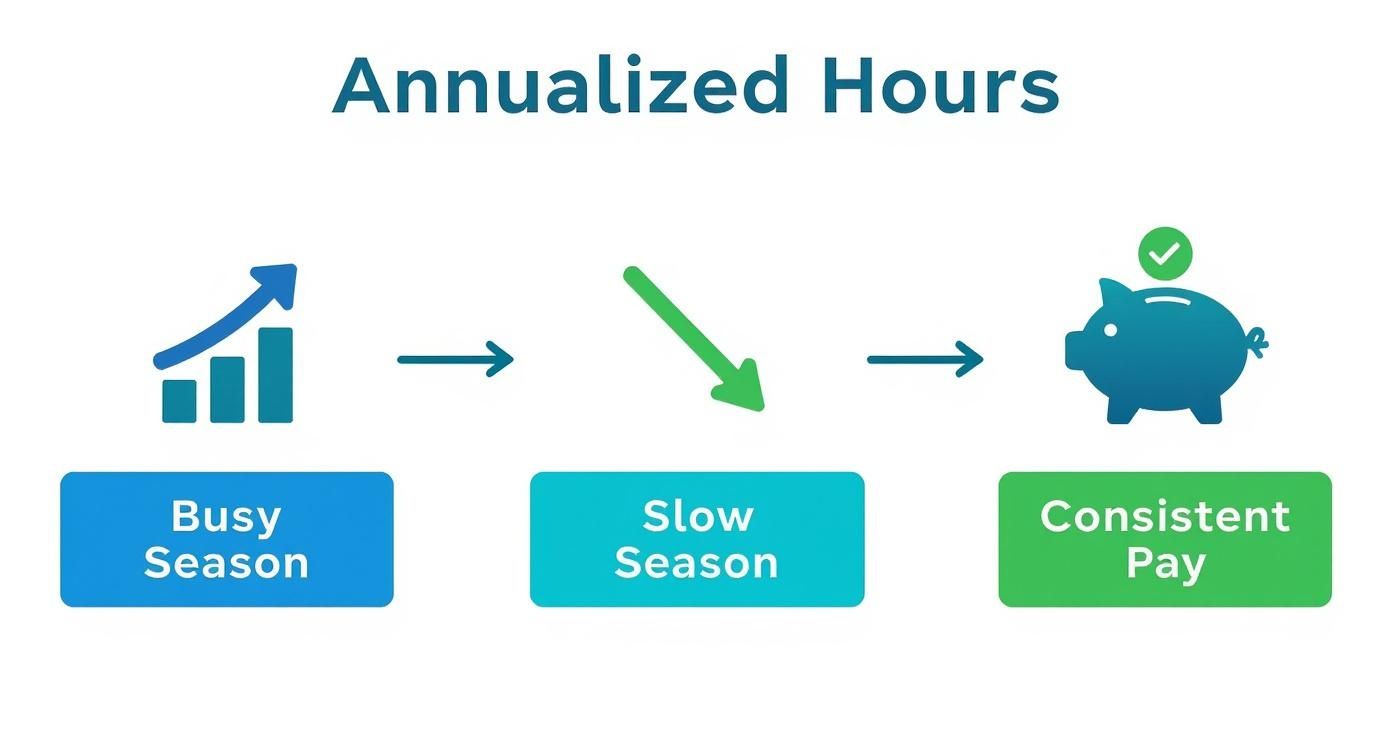
As the picture shows, work hours can go up and down, but pay stays the same. To keep everything on track without getting bogged down in spreadsheets, using a dedicated work hours calculator can make managing schedules and tracking time much simpler.
The Benefits for Your Business and Employees

So, what's in it for you and your team? Moving to an annualised hours model isn't just a scheduling tweak; it’s a strategic shift that creates a genuine win-win. You’re essentially swapping rigid, old-school timetables for a smarter, more responsive way of working that benefits everyone involved.
For employers, the big prize is operational agility. Imagine perfectly aligning your staffing levels with the natural peaks and troughs of your business. That's what this system delivers.
This smart alignment translates directly into better cost control. You can say goodbye to shelling out for expensive overtime during your busiest months and stop paying for idle hands during the quiet spells. It’s all about optimising your wage budget.
By tying your labour costs directly to your revenue-generating periods, you’re running a much tighter ship. It’s about putting your resources where they’re needed most, cutting out the waste.
Advantages for Your Organisation
From a business point of view, the perks go well beyond just saving a bit of cash. You're building a more robust and resilient operation. Key advantages include:
- Improved Productivity: Your team is on deck when it matters most, meaning you get maximum output during those critical business periods.
- Enhanced Flexibility: You can react to sudden market changes or take on unexpected projects without the usual drama of scrambling for staff or negotiating overtime.
- Simplified Budgeting: With a predictable annual wage bill, financial planning and forecasting become a whole lot less stressful.
Benefits for Your Employees
For your team, the headline benefit is financial stability. Getting a consistent monthly payslip, even when their hours fluctuate wildly, removes a huge amount of financial worry. It makes personal budgeting a breeze.
This predictability also paves the way for a much healthier work-life balance. Having chunks of downtime during the off-peak season gives people a real chance to rest, travel, or focus on personal projects. This is a massive boost for job satisfaction and a powerful antidote to burnout. At the end of the day, it just makes for a more secure and attractive job offer.
Navigating Compliance and Common Challenges
While annualised hours bring a ton of flexibility, making the model work fairly and successfully takes some careful management. One of the biggest hurdles is the admin load; you absolutely have to track every hour worked to make sure you're sticking to the contract and staying on the right side of the law.
If you don't have solid systems in place, you’re just asking for confusion and a breakdown in trust. Another major challenge is protecting your team from burnout. When you hit a long, busy stretch, people can feel overworked and exhausted, and that’s a fast track to poor morale and high staff turnover if you don't get ahead of it.
Staying Within Legal Boundaries
First things first, you have to follow the UK's Working Time Regulations. These rules are there to protect your team’s health and safety, and they apply to annualised hours contracts just like any other work setup.
The big one to watch is the average weekly working time. UK regulations say the average working week can't go over 48 hours when measured over a 17-week reference period. This means even during your peak season, you must ensure your employees’ average hours stay below that limit. Diligent tracking and forward-planning aren't just nice-to-haves; they're essential to avoid legal trouble.
It's a common myth that the flexibility of annualised hours lets you ignore weekly limits. That 48-hour average is a hard legal line, and if you're not monitoring it, you could face serious compliance issues and employee disputes.
Preventing Employee Burnout
Keeping your team's wellbeing in check is every bit as important as ticking the legal boxes. Long periods of high-intensity work can be incredibly draining, so it's vital to have a game plan to support your staff.
- Fair Scheduling: Get rotas out as far in advance as possible. This helps people plan their personal lives and shows respect for their time outside of work. Try to avoid last-minute changes whenever you can.
- Clear Communication: Keep an open dialogue about what’s coming up. Let people know when the busy periods will be, but also make sure they know when the quieter times are scheduled so they have something to look forward to.
- Managing Extra Hours: Be crystal clear on how you handle hours worked above the rota. Is it paid overtime or something else? For a deeper dive on this topic, check out our complete guide to time in lieu in the UK.
A Practical Roadmap to Implementation

Successfully rolling out an annualised hours system is all about solid planning and open communication. If you get the approach right, you can sidestep the common tripwires and get your team on board from day one. This roadmap will walk you through the essential steps.
First things first, you need to do a thorough needs analysis. Does your business really have those genuine seasonal peaks and troughs? Before you change anything, you have to be sure this model is the right solution for your operational rhythm.
Once you've confirmed it's a good fit, it’s time to talk.
Engaging Your Team
Bringing your employees and any union reps into the conversation early isn't just a nice-to-have; it's essential. You’ll need to clearly explain how the system works, talk up the benefits of a steady, predictable salary, and be ready to answer any and all questions about scheduling. This is how you build trust.
A classic mistake is to hand this down as a top-down directive. You'll get much further if you frame it as a joint effort to build a more flexible and stable work environment for everyone. That collaborative tone can make all the difference.
After the consultations, you've got to make it official. This means drafting new, crystal-clear contract clauses that spell everything out, including:
- The total number of contracted hours for the year.
- How rotas will be scheduled and communicated.
- The rules for handling any extra hours that are worked.
- What happens with reconciliation if someone leaves part-way through the year.
Finally, you need the right tools for the job. Trying to track all this manually is a recipe for errors and a massive admin headache. Your best bet is to check out our guide on the best staff scheduling software for the UK in 2025. It breaks down the top solutions that can automate your hour tracking and take the pain out of managing rotas.
Your Annualised Hours Questions, Answered
Even with the best implementation plan, you're bound to have questions pop up once your annualised hours system is up and running. Getting your head around the day-to-day practicalities is the key to making it work smoothly and keeping everyone on the same page.
Let's tackle some of the most common queries.
How Is Overtime Handled?
This is probably one of the biggest mental shifts from a standard contract. With annualised hours, you don't really think about overtime on a weekly basis. Instead, overtime only kicks in if someone works more than their total contracted hours for the entire year.
That means a few long weeks during your peak season won't automatically trigger overtime pay. Any extra hours simply balance out against the quieter periods. At the end of the 12-month cycle, you'll reconcile everyone's hours. If someone has worked over their total, you'll pay it out then – either as a lump sum or, depending on your contract, perhaps by adding it to their holiday allowance for the next year.
What Happens If an Employee Leaves Partway Through the Year?
This is a really important one to get right in your employment contracts from day one. When someone leaves, you'll need a clear reconciliation process to make sure things are fair for both sides.
- If they've worked more hours than they've been paid for: You’ll owe them a final payment to make up the difference. This can easily happen if a team member leaves right after a busy spell.
- If they've been paid for more hours than they've worked: You can usually deduct the overpayment from their final payslip. This is more likely if someone hands in their notice during a slow season.
It's absolutely vital that your contract spells out exactly how this reconciliation works. Any grey areas here are a recipe for disputes, so define the calculation method clearly before anyone even starts.
Can Employees Refuse to Work Certain Hours?
While the system is built on flexibility, it isn't a complete free-for-all. Your employment contract is the ultimate guide here. It needs to lay down the ground rules, like core operating hours, how much notice you'll give for schedule changes, and the general framework you're working within.
Remember, all scheduling must be reasonable and stick to the Working Time Regulations, which are there to protect people from working excessive hours. An employee can't just refuse any shift they don't fancy, but equally, an employer can't demand unreasonable, last-minute changes that fall outside what was agreed in the contract.
Ultimately, clear communication and scheduling well in advance are your best friends. They prevent disagreements and make sure the system feels fair to everyone.
Managing leave shouldn't be complicated. Leavetrack replaces messy spreadsheets with a simple, centralised system for planning and approving staff holidays. To see how you can save time and gain clear visibility over your team's absences, visit https://leavetrackapp.com.