

What's Gardening Leave A Practical Guide for UK HR Managers
Posted by Robin on 16 Jan, 2026 in
Gardening leave is a term you’ve likely heard, especially in senior-level departures. It’s the period where an employee who is leaving a job is asked to stay away from the office during their notice period, but they continue to receive their full pay.
This isn't a punishment. Think of it as a strategic "cool-down" period—a protective measure for the business designed to keep sensitive information and client relationships secure before the employee can start a new role, especially with a competitor.
What Is Gardening Leave And Why Is It Used?
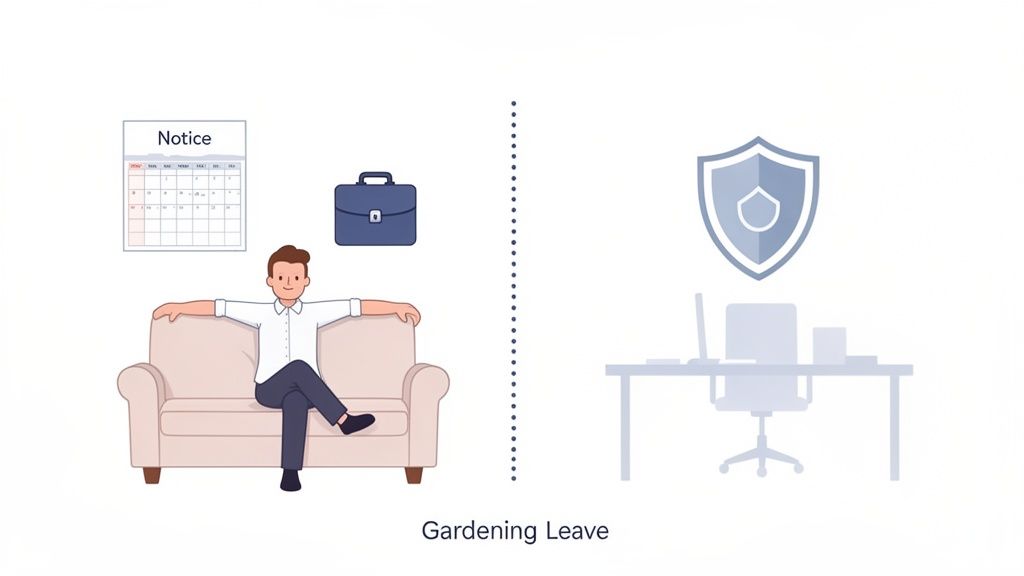
Let's paint a picture. A senior sales director hands in their notice to join your biggest rival. Instead of having them work their three-month notice period with full access to your client lists, upcoming strategies, and internal data, you place them on gardening leave. They stay on your payroll as an employee, but their access to the office, systems, and colleagues is cut off immediately.
The name itself is quite descriptive. The employee is technically free to spend their time at home—maybe even tending to their garden—while their contract continues to run. It's not a paid holiday; it's a strategic pause button. The whole point is to create a safe distance between the departing employee and the business's most valuable assets.
The Strategic Value of a Cool-Down Period
Gardening leave serves several crucial protective functions for an employer. By removing the individual from the day-to-day running of the business, you effectively quarantine sensitive information. Any knowledge they have about current projects, deals, or client negotiations becomes less relevant with each passing day.
The goal is to ensure that when the employee eventually starts their new role, any confidential information they possess is outdated and less damaging to your business interests.
This period also helps ensure a smooth transition. It stops a departing employee, who might be disengaged or even disruptive, from affecting team morale. Better yet, it gives you uninterrupted time to hand over their client relationships to other team members, strengthening those connections under your company's banner.
How It Works in Practice
A common practice in the UK, a garden leave clause is typically enforced for the duration of the employee's contractual notice period. For senior roles, this can often be anywhere from 3 to 12 months.
Crucially, the employment contract remains fully active. This means the employee not only continues to receive their salary and benefits but is also still bound by all their contractual duties, like confidentiality and fidelity. For a deeper dive into the legal basis for these arrangements, People Management offers some great insights.
Gardening Leave at a Glance
For a quick summary, here are the fundamentals of gardening leave in a nutshell.
| Aspect | Description |
|---|---|
| Definition | An employee serves their notice period at home, away from the workplace. |
| Pay & Benefits | The employee receives their full normal pay and all contractual benefits. |
| Employee Status | They remain an employee and are bound by all contractual terms (e.g., confidentiality). |
| Employer's Goal | To protect business interests, client relationships, and sensitive information. |
| Typical Duration | Matches the employee's contractual notice period (3-12 months for senior roles). |
| Key Requirement | Must be explicitly included as a clause in the employment contract. |
This table helps illustrate that while the employee is "off," they are very much "on" the books and still have obligations to their employer.
Understanding the Legal Framework in the UK
Here’s something many employers get wrong: gardening leave isn't an automatic right you can just spring on an employee. Its power, its very enforceability, is rooted entirely in the employment contract.
Without a specific, properly drafted clause, telling an employee to stay home could be a breach of contract. Ironically, this could shatter the very protections you were trying to put in place. Think of the contract as your legal bedrock; a vague clause is like building on sand and it simply won't hold up if challenged.
Your contract has to be crystal clear. It must explicitly state the company's right to place an employee on gardening leave and outline the conditions for doing so. This clarity is absolutely non-negotiable, and it also means you have to hold up your end of the bargain.
The Importance of Full Pay and Benefits
For a gardening leave clause to have any legal weight, the employment contract must remain fully in force. This means you are legally required to provide the employee’s full salary and all contractual benefits for the entire period. This isn’t just about their base pay; it covers everything they'd normally be entitled to.
- Bonuses and Commission: If the employee would have been in line for performance-based pay during their notice period, you'll need to calculate and pay it.
- Company Car and Health Insurance: Perks like a company car, private health cover, or pension contributions must continue without any interruption.
- Holiday Accrual: Employees don't stop accruing their statutory and contractual holiday entitlement just because they're at home. It’s vital to track this correctly, as any untaken leave will need to be paid out in their final settlement. You can get more details on this in our guide on holiday entitlement when leaving a job.
If you fail to meet these obligations, you risk voiding the entire arrangement. That could free the employee from all their restrictions, letting them walk straight to a competitor.
At its heart, the legal principle is about fairness. The employer takes away the employee's ability to work, and in return, the employee shouldn't suffer any financial loss. It's this balance that makes the clause enforceable.
The Reasonableness Test in UK Courts
Even with a perfectly written clause, UK courts can step in if they feel the length of the leave is unreasonable. The law always tries to strike a balance between protecting an employer's legitimate business interests and upholding an employee's right to work and keep their skills sharp.
Think about it. A long spell on the sidelines can make a professional's knowledge obsolete, especially in fast-moving sectors like tech or finance.
Courts will weigh the length of the leave against the actual risk the employee poses. Slapping a 12-month gardening leave period on a junior employee would almost certainly be seen as excessive and unenforceable. But for a CEO with intimate knowledge of long-term strategy? That might be justifiable.
This is where case law gives us clues. Courts often reduce the duration of garden leave if a shorter period is enough to protect the business. This pragmatic approach prevents the clause from being used as a punitive tool. The fact that these clauses now appear in 65% of FTSE 250 contracts shows how seriously businesses are taking the risk of IP theft. This judicial oversight ensures gardening leave is used as intended—a precise shield, not a blunt weapon.
What Are the Rules for Employers and Employees?
When you place an employee on gardening leave, the normal day-to-day relationship changes, but the legal one absolutely doesn't. It’s not a grey area; think of it as a specific set of rules that both sides must follow during the notice period. Getting these mutual obligations right from the start is the key to a smooth handover and avoiding any messy disputes down the line.
For the employer, your main goal here is to protect your business interests. You have the right to tell the employee to stop all work, stay away from the office, and—most importantly—not contact clients, suppliers, or their soon-to-be-ex-colleagues. This effectively creates a quarantine zone around your business while you get your house in order for their departure.
The Employer's Side of the Bargain
While you’ve put the employee on the sidelines, you have a strict set of responsibilities to live up to. If you drop the ball on your side of the contract, you risk making the whole gardening leave clause invalid.
Here’s what you absolutely must do:
- Keep Paying Their Full Salary: The paycheques must keep coming, on time and in full. No exceptions.
- Maintain All Benefits: Contractual perks like private health insurance, pension contributions, or a company car must continue uninterrupted.
- Let Holiday Entitlement Accrue: The employee still builds up their statutory and contractual holiday allowance just as they would if they were in the office.
This is the fundamental trade-off. You're paying for their inactivity to safeguard your business, and in exchange, they remain bound by the terms of their employment.
The Employee's Continued Duties
For the employee, being sent to the garden doesn't mean it's time to down tools completely. They are still on your payroll and legally employed until their very last day, which means they're still bound by all the terms of their contract.
The duty of good faith and fidelity remains fully intact. This is a legal principle meaning the employee can't do anything to harm the company's interests, like poaching staff or trying to set up a competing venture while still technically employed by you.
Key obligations for the employee include:
- Confidentiality is Non-Negotiable: They must not share any confidential information, trade secrets, or sensitive company data.
- Staying Available (Within Reason): You can require them to be available to answer handover questions or provide information. In reality, this is usually minimal, but the obligation is there.
- Not Starting a New Job: This is the big one. They cannot start working for another company during the gardening leave period. Doing so is a major breach of contract and could see them facing legal action from you, such as an injunction to stop them.
It's common for questions to pop up about what they can do. Generally, taking a course, pursuing a hobby, or even doing volunteer work is fine, as long as it doesn't clash with their contract or harm your business interests. A bit of clear communication on these points can prevent any misunderstandings and make for a much cleaner exit.
Gardening Leave vs Non-Compete Clauses
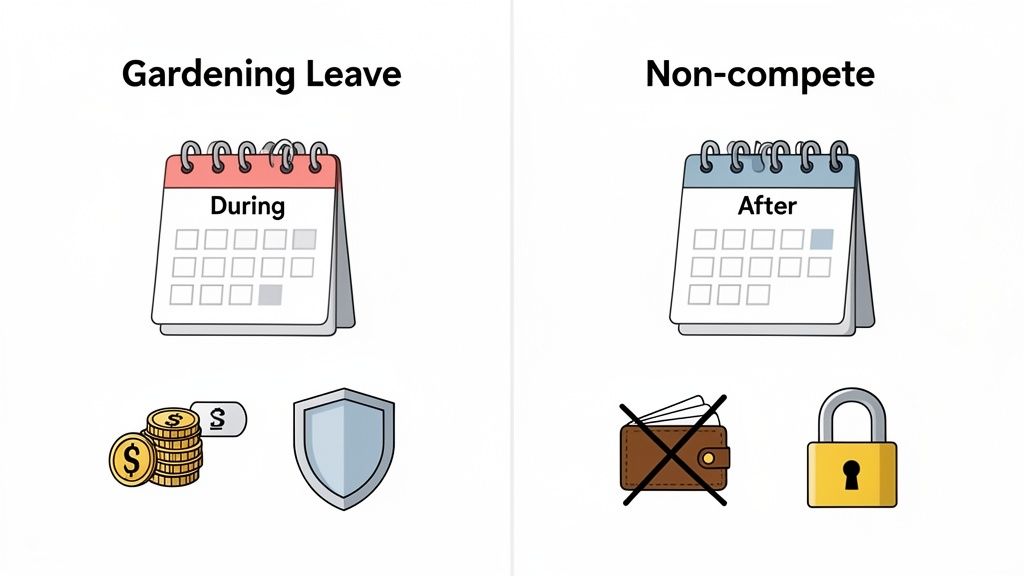
It's easy to get gardening leave and non-compete clauses mixed up. After all, both are designed to protect a business when a key employee heads for the exit. But they are fundamentally different tools that work in very different ways, and at different times.
For any HR manager looking to safeguard company secrets and client relationships, understanding this distinction is absolutely vital.
A Tale of Two Timelines
The simplest way to tell them apart is to think about timing. Gardening leave is a tactic you use during the employment contract—specifically, during the employee's notice period. A non-compete clause, on the other hand, only kicks in after the employment contract has officially ended.
This single difference has a huge knock-on effect, especially when it comes to pay and how likely a court is to enforce it.
During gardening leave, the individual stays on your payroll. They are still a full employee with all the rights that come with it, including their salary and benefits. You're essentially paying for their inactivity and continued loyalty during their notice period.
A non-compete clause offers nothing of the sort. It's a restrictive covenant that tries to stop a former employee from working for a competitor for a set time after they’ve left, but they are long gone from your payroll. This lack of pay is a major reason why courts scrutinise non-competes so much more heavily.
A non-compete clause essentially asks an ex-employee to limit their career options without compensation. That’s a tough sell, and courts will only uphold it if it’s very carefully and narrowly drafted to protect a legitimate business interest.
Enforceability and the Changing Legal Landscape
The legal ground is shifting under our feet, making this distinction more important than ever. The UK government is proposing to cap the length of non-compete clauses at just three months, which seriously blunts their effectiveness as a long-term protective shield.
This trend puts much more emphasis on the reliability of a well-structured gardening leave arrangement.
Courts are generally far more comfortable enforcing gardening leave because the employee suffers no financial loss. In fact, employment law analyses show that judges uphold around 80-90% of properly drafted garden leave clauses. That’s a world away from the shaky 50% enforceability rate for non-competes.
Judges also recognise that a period on garden leave can reduce the need for a lengthy post-termination restriction, often weighing one against the other. For a deeper dive, you can explore the nuances of gardening leave in HR practice.
Gardening Leave vs Non-Compete Clauses Key Differences
When you're deciding which tool is right for the situation, it helps to see them side-by-side. Here’s a quick breakdown of how they stack up against each other.
| Feature | Gardening Leave | Non-Compete Clause |
|---|---|---|
| When It Applies | During the notice period (while still employed). | After the employment contract has ended. |
| Payment Status | The employee receives full pay and benefits. | No payment is made to the ex-employee. |
| Employee Status | Remains a current employee, bound by all duties. | Becomes a former employee. |
| Legal Strength | High enforceability, generally seen as reasonable. | Lower enforceability, frequently challenged in court. |
| Primary Goal | To delay their start date with a competitor. | To prevent them from working for a competitor entirely. |
Ultimately, while both aim to protect your business, gardening leave is often the more robust, reliable, and enforceable option in your toolkit.
How to Implement Gardening Leave Effectively
Putting an employee on gardening leave isn't something you can just wing. It demands a clear, professional, and consistent process. Get it right, and you protect the business while treating the departing employee with respect. Get it wrong, and you risk disruption and legal headaches. The whole thing really boils down to solid communication and having your admin in order.
The process kicks off the moment you accept their resignation. This isn't a decision to take lightly, as it immediately changes the dynamic. Your very first step, always, is to dig out their employment contract and double-check that the gardening leave clause is actually in there and what it says.
The Initial Steps and Communication
Once you’ve confirmed you have the contractual right, it’s all about formal communication. A clear, unambiguous letter is non-negotiable. This document officially places the employee on gardening leave and reminds them of their ongoing duties, like confidentiality and the fact they can't just start a new job tomorrow.
You need to tackle this communication on three fronts:
- The Employee Conversation: Sit down with them for a private, professional chat. Explain that the decision is a standard protective measure, not a punishment. Be clear about what you expect in terms of handovers, their availability, and when they need to return company property.
- The Formal Letter: Draft a letter that spells out the start and end dates of the leave, confirms their pay and benefits will continue as normal, and details all their ongoing responsibilities. Getting this right relies on having a solid foundation in the first place, which is where knowing a thing or two about effective contract drafting really pays off.
- The Team Announcement: Let their immediate team know about the departure and the plan for handing over their work. Keep it brief and professional to stamp out any gossip before it starts and keep morale up.
Streamlining the Process with HR Tools
Trying to manually track an employee through a long notice period can get messy. Spreadsheets are a recipe for mistakes, which can lead to payroll blunders or scheduling mix-ups. This is where modern HR tools step in to take the administrative pain away, giving you clarity and control.
In the UK, gardening leave is a common feature in about 15-20% of resignations, particularly for senior staff in competitive industries who have access to sensitive information. It's a strategic move to prevent them from walking straight into a competitor's office while they're still on your payroll, receiving full pay and benefits.
Using a digital wall planner, for instance, gives managers and HR a bird's-eye view of who is on leave and for how long. It's a simple way to stop them from being accidentally pulled into new projects.
This kind of visual clarity makes sure everyone knows the employee’s status, which helps massively with planning handovers and reallocating resources.
By setting up a custom 'Gardening Leave' type in a system like Leavetrack, you can ensure payroll and benefits are tracked accurately without any manual effort. Automating these fiddly admin tasks frees up your HR team to focus on the more human side of the transition. A structured approach is also key for keeping company policies consistent across the board. You can get a head start by checking out our template annual leave policy. Ultimately, this transforms a potentially tricky process into a smooth and transparent workflow.
Common Questions About Gardening Leave
So, you've got the basic concept down, but what about the nitty-gritty? When you're dealing with a real-life departure, practical questions always pop up. Getting these wrong can be costly, so it pays to know exactly where you stand.
This flow chart gives a simple overview of how the process usually kicks off.
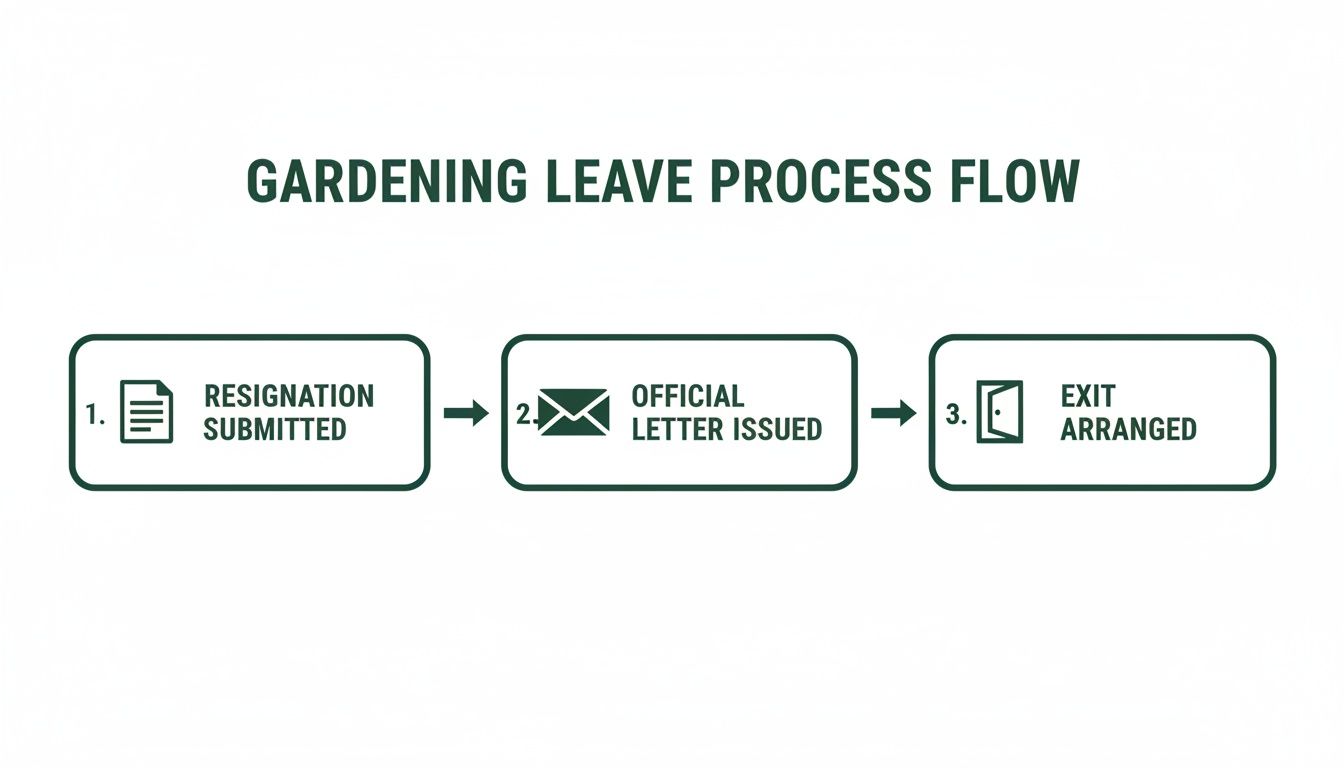
From the moment an employee hands in their notice, it’s a straightforward three-step dance: issue the formal letter, arrange the exit, and begin the leave period. A documented trail is your best friend here.
Can You Force an Employee to Take Gardening Leave?
This is a big one. You can only put an employee on gardening leave if their employment contract explicitly says so. Simple as that.
Without a clear clause giving you this right, telling an employee to stay home could land you in hot water. They could claim you’ve breached their contract by denying them the right to work. This is why a well-drafted contract is non-negotiable; it’s the legal bedrock you need to enforce gardening leave without facing a challenge.
What Happens to Holiday Pay During Gardening Leave?
Because the employment contract is still live, holiday pay continues to build up just as it would if the employee were in the office. It all accrues as normal.
As the employer, you can also instruct them to use up this accrued holiday during their gardening leave, as long as you provide the legally required notice. When their employment finally ends, any leftover holiday they haven't taken must be paid out in their final pay packet. Getting the calculations right is crucial to avoid any messy disputes.
Remember, an employee’s rights to pay and benefits, including holiday accrual, don't change at all. The only thing that stops is their obligation to show up and do the work.
Juggling different types of leave can quickly become a headache. It's worth looking into a guide to employee leave management systems that can automate the tracking and keep everything accurate.
Can an Employee Start a New Job While on Leave?
Absolutely not. An employee on gardening leave is still your employee. They are fully bound by their contract, which includes their duty of loyalty to your business.
Starting a new job, especially with a competitor, is a serious breach of contract. If you find out, you can take significant legal action. The consequences for the employee could include:
- An injunction from a court to force them to stop the new job immediately.
- A claim for damages if your business has suffered a financial loss.
- Losing their pay for the period they were in breach of their contract.
Are There Any Alternatives to Gardening Leave?
Yes, there are a few other routes you can take. Gardening leave isn't a one-size-fits-all solution, and it’s not always the most practical or budget-friendly option.
For instance, you could have the employee work their notice period but with restricted duties. This might involve revoking their access to sensitive client lists or reassigning them to a project with less strategic importance.
Another popular choice is payment in lieu of notice (PILON), which allows for a quick and clean break if it’s permitted in the contract. And for protecting your interests after they've left, you’d rely on restrictive covenants like non-compete or non-solicitation clauses, though enforcing these has its own set of legal hurdles.