

A Guide to Managing Absences at Work
Posted by Robin on 22 Nov, 2025 in
Are you struggling with employee absences? If so, you're not alone. Figuring out how to manage absences at work is much more than just keeping track of who is off and when. It's a vital sign of your company's health, often pointing to deeper issues that can hit your efficiency, team morale, and, ultimately, your bottom line.
The Growing Challenge of Absences at Work

Think of your team's workflow as a finely-tuned machine. Every person is a crucial cog, each with a specific job to do. When someone is suddenly absent, the whole machine starts to grind and strain.
Even a single person's absence can set off a powerful domino effect. Projects get delayed, deadlines are put at risk, and the rest of the team gets overloaded trying to pick up the slack. This isn't just an internal headache; the disruption can easily spill over, affecting your clients and damaging your company's hard-earned reputation.
The Scale of the Problem
Absence from work has snowballed into a major national issue. In recent years, the UK has seen a sharp increase in working days lost to sickness, with a staggering 149 million days lost in 2024 alone. That works out to a national absence rate of 2% of all working days. Dig into the numbers, and you'll find mental health is a massive factor, accounting for one in every five sick days. This really underscores the growing need for supportive, positive workplace environments. You can review more details about UK sickness absence data from 2024.
This guide is your roadmap for navigating this tricky landscape. We're going to move past simply counting sick days and help you build a much more strategic approach. Our goal is to shift your perspective—to see absenteeism not as a nuisance, but as a signal of underlying challenges that need your attention.
Absenteeism is rarely just an attendance problem. More often, it's a signal of deeper issues related to employee wellbeing, engagement, or workplace culture. Addressing the root cause is the only sustainable solution.
What You Will Learn
Throughout this guide, we’ll walk through practical methods and proven strategies to help you build a more resilient and present workforce. By the end, you'll have a clear understanding of:
- The different types and categories of workplace absence.
- How to accurately measure the true financial and operational costs.
- Essential KPIs for tracking and reporting on absence trends.
- Proactive strategies for prevention and effective management.
Understanding Different Types of Workplace Absence
To get a real handle on absence, you first need to realise that not all time off is created equal. Think about it like a doctor: you wouldn't prescribe the same treatment for a broken leg as you would for a common cold. In the same way, a pre-booked holiday needs a completely different response from a manager than a sudden, unexplained no-show.
Sorting absences into clear, logical buckets is the first step. It takes the guesswork out of the equation and makes sure you're applying company policies fairly for everyone. This simple act of categorisation is the bedrock of any solid absence management strategy.
Planned Versus Unplanned Absence
The first and most obvious way to slice it is by asking: did we know this was coming? This simple question immediately shapes how you'll need to react on the ground.
- Planned Absences: This is all the time off that's been requested and signed off in advance. The classic examples are annual leave, scheduled hospital appointments, or parental leave. Because they’re on the calendar, you can plan for them, arrange cover, and shift workloads to keep things running smoothly.
- Unplanned Absences: These are the curveballs that land with little or no warning. Sickness is the most common culprit, but it could also be a family emergency or the car breaking down. These absences demand an immediate reaction, forcing the team to scramble and adapt on the spot.
A high rate of unplanned absences at work is often a red flag, hinting at deeper problems that need a closer look. Planned absences, on the other hand, are just a normal, healthy part of running a business.
Authorised Versus Unauthorised Absence
The next layer to consider is whether the absence follows the rules. This is all about compliance with your company's procedures and policies.
An authorised absence is any time off – planned or not – that ticks all the right boxes. An employee who feels unwell and calls in sick according to your reporting procedure is on an authorised absence, even though it was completely unplanned.
On the flip side, an unauthorised absence is when someone breaks the rules. This could mean not phoning in, giving a dodgy reason, or simply taking a day off after you've already denied the request. These situations almost always require a more formal, disciplinary conversation.
While any unauthorised absence is a concern, it's the pattern of frequent, short, unplanned absences that really grinds down productivity and team morale over time.
To make this clearer, here’s a quick breakdown of how these common absence types compare.
Comparison of Common Absence Types
| Absence Type | Description | Common Causes | Initial Management Action |
|---|---|---|---|
| Short-Term Sickness | Typically 1-7 days, often unplanned. | Minor illnesses (cold, flu), stress, minor injuries. | Follow call-in procedure, record absence, conduct return-to-work interview. |
| Long-Term Sickness | Absence lasting more than 4 weeks. | Serious illness, surgery recovery, chronic conditions, mental health issues. | Maintain regular contact, request medical evidence, consider occupational health referral. |
| Annual Leave | Pre-booked, planned time off for holidays. | Holidays, personal relaxation, family events. | Review request against team calendar, approve/deny based on operational needs. |
| Unauthorised Absence | Employee is absent without permission or good reason. | Failure to follow procedure, AWOL (Absent Without Leave), denied leave taken anyway. | Attempt contact immediately, investigate reason, initiate disciplinary process if necessary. |
This table shows how a clear category instantly points you toward the right process, ensuring consistency and fairness.
The Hidden Absences Harming Your Business
Some of the most corrosive types of absence never even show up on a timesheet. They’re the invisible, cultural problems that quietly sabotage productivity and employee wellbeing if you let them.
Two of the biggest culprits are:
- Presenteeism: This is when people drag themselves into work even when they’re ill, either physically or mentally. They're at their desk, but they aren't really there. Studies have shown that the hit to productivity from presenteeism can cost a business far more than actual sick days.
- Leaveism: This is a bit more subtle. It’s when employees use their annual leave or flexi-time to recover from being sick because they feel they can't take a proper sick day. It also includes people working on holiday or late into the night just to keep their head above water.
Spotting these hidden absences at work is crucial. They are massive indicators of potential burnout, unsustainable workloads, or a culture where people just don't feel safe taking the time off they're entitled to. Tackling them means getting serious about managing workloads and building a truly supportive workplace.
Calculating the True Cost of Employee Absenteeism
When an employee calls in sick, it's easy to focus on the immediate cost: their salary or sick pay for the day. But that's just the tip of the iceberg. The real financial damage from absences at work lies beneath the surface, hidden from the daily balance sheet.
To really get to grips with the numbers, you need to think about two types of costs: direct and indirect. While both hit the bottom line, it’s the indirect costs that often do the most long-term damage and are much harder to pin down.
The Clear and Present Direct Costs
Direct costs are the tangible expenses you can easily track. They're the immediate, out-of-pocket payments your business makes when someone is off work.
Think of them as the first, most obvious ripple in a pond. They are straightforward to calculate and include things like:
- Statutory Sick Pay (SSP) and any enhanced contractual sick pay you offer.
- Overtime wages paid to colleagues who have to pick up the slack.
- Temporary staff fees if you bring in an agency worker to fill the gap.
- Administrative costs from processing the absence, adjusting payroll, and arranging cover.
While these costs certainly add up, they are only a small part of the total financial strain caused by absenteeism.
Uncovering the Hidden Indirect Costs
This is where the real damage is done. Indirect costs are the secondary, knock-on effects that disrupt workflows, strain your team, and slowly erode your company’s performance. Unlike direct costs, they won’t appear as neat line items on an expense report, making them much tougher to spot.
Imagine a finely tuned machine. If one small part is unexpectedly removed, the entire process doesn't just stop; it slows down, the quality of the output might drop, and the remaining parts come under extra strain. That’s what happens when a team member is absent.
The indirect cost of absenteeism is like a slow leak in a tyre. It might not seem urgent at first, but if left unaddressed, it will eventually bring everything to a standstill.
Here are some of the most significant indirect costs you should be thinking about:
- Lost Productivity: The absent employee isn’t producing anything, and the colleagues covering for them are often less efficient as they juggle unfamiliar tasks alongside their own workload.
- Reduced Team Morale: When your most reliable employees are constantly covering for others, it leads to burnout, stress, and resentment.
- Lower Quality of Work: Overstretched staff are more likely to make mistakes, which can lead to product defects or subpar service for your customers.
- Disrupted Customer Service: Project delays and slower response times can frustrate clients, damaging your reputation and potentially costing you business.
- Increased Management Strain: Managers spend valuable time reorganising workflows and finding cover instead of focusing on strategic goals. For a deeper dive, check out our guide on how much absenteeism really costs employers.
The cumulative effect of these indirect costs can be staggering. The financial impact of sickness absence on UK employers hit an estimated £103 billion in 2023, a sharp rise of £30 billion since 2018. Crucially, £25 billion of that increase was attributed not to more sick days, but to lower productivity from presenteeism—employees working while unwell. This highlights how hidden costs are now the primary driver of financial loss from employee absence. You can learn more about the real cost of absenteeism in the UK from this analysis.
How to Measure and Report on Absences
There’s an old saying in business: you can’t manage what you don’t measure. When it comes to staff absence, this couldn't be more true. Simply keeping a tally of who’s off sick isn’t enough. You need to transform that raw attendance data into something meaningful—business intelligence that reveals the real story behind the numbers.
This shift from just counting heads to understanding patterns is what allows you to move from a reactive to a proactive management style. With the right metrics, a simple list of names and dates becomes a powerful diagnostic tool for the health of your entire organisation.
Key Metrics for Absence Tracking
To get a proper grip on absenteeism, you have to look beyond the basic sick day count. Certain metrics are specifically designed to spotlight different kinds of problems. For instance, frequent, short-term absences are often far more disruptive to team workflows than a single, longer period of sick leave.
Here are three essential KPIs to get you started:
- Absence Rate: This is your foundational metric. It tells you the percentage of total contracted working time that’s been lost to absence over a period. Think of it as the high-level, bird's-eye view of your organisation's overall attendance health.
- Lost Time Rate: This is a more direct cousin of the absence rate. It focuses purely on the total number of workdays or hours lost. It's a blunt, straightforward way to quantify lost productivity and is particularly useful when you need to talk about absence in financial terms.
- The Bradford Factor: This is where things get really clever. The Bradford Factor is a formula that gives extra weight to frequent, short-term absences. The calculation (S² x D = B) squares the number of separate absence instances (S) and then multiplies that by the total number of days absent (D).
Why is this so powerful? The Bradford Factor helps you objectively pinpoint potentially worrying attendance patterns that might otherwise fly under the radar.
A single ten-day absence might be unavoidable, but ten separate one-day absences could signal underlying issues with engagement, morale, or wellbeing that require a manager’s attention. The Bradford Factor makes this distinction mathematically clear.
A Closer Look at the KPIs
Let's see how these metrics work in the real world. Imagine you manage a team of 10 employees. Each person works 220 days a year, giving you a total of 2,200 available workdays for the team.
Calculating the Absence Rate: If the team loses a total of 55 days to sickness over the year, your calculation is simple: (55 ÷ 2,200) x 100 = 2.5% Absence Rate. Now you have a solid benchmark to compare against industry averages or your own performance last year.
Putting the Bradford Factor to Work: Now, let's consider two employees, both of whom were absent for a total of 10 days.
- Employee A had one continuous 10-day period of absence. Their Bradford Factor score is (1² x 10) = 10.
- Employee B had 10 separate one-day absences. Their score is (10² x 10) = 1,000.
That massive difference immediately flags Employee B’s attendance pattern. It doesn't mean they're in trouble, but it does signal that a supportive check-in from their manager is a much higher priority, even though both employees lost the same amount of time.
To really get to grips with these metrics, we've put together a quick-reference table.
Key Absence Management KPIs and Their Purpose
This table breaks down the most vital metrics for tracking and analysing workplace absence. It shows you not just what to measure, but how to calculate it and, most importantly, what the numbers are actually telling you about your business.
| KPI (Key Performance Indicator) | How to Calculate It | What It Tells You |
|---|---|---|
| Absence Rate | (Total days lost ÷ Total possible workdays) x 100 | Provides a high-level percentage of working time lost to absence. Great for benchmarking against industry standards or past performance. |
| Lost Time Rate | Total hours or days lost during a period | A direct measure of lost productivity. Simple to calculate and effective for showing the tangible impact of absence on output. |
| Bradford Factor | (Number of instances)² x Total days absent | Highlights disruptive, frequent, short-term absences. A high score suggests a pattern that may need managerial intervention. |
| Frequency Rate | Number of absence instances ÷ Number of employees | Measures how often absences occur on average per employee. Helps identify if absenteeism is a widespread or isolated issue. |
| Severity Rate | Average length of each absence spell | Shows the average duration of an absence. A high severity rate might point towards more serious, long-term health issues within the workforce. |
By using a combination of these KPIs, you can build a multi-dimensional picture of absence within your organisation, moving beyond simple counts to a much deeper understanding of the underlying causes and impacts.
Building an Effective Reporting Dashboard
Once you’re gathering this data, the next job is to make it visible and genuinely useful for your managers. A good reporting dashboard, whether it's built in a spreadsheet or a dedicated system like Leavetrack, should present these KPIs in a way that’s easy to digest. For a deeper dive, our guide on the importance of accurate absence tracking covers this in more detail.
A well-designed dashboard lets managers:
- Spot trends over time (are absences always higher in winter or after a bank holiday?)
- Pinpoint departmental hotspots that might need some extra support or investigation.
- Compare their team’s performance against company-wide benchmarks.
By regularly reviewing these simple metrics, you give your leaders the tools to make data-informed decisions. They can intervene early, offer support exactly where it's needed, and ultimately help foster a more present, engaged, and productive workforce.
Building a Proactive Absence Management Strategy
Seeing the patterns in your absence data is a great start, but it's just that—a start. The real magic happens when you shift from just reacting to absences at work to actively preventing them in the first place. A modern, effective strategy isn't just about rules; it's a blend of clear expectations and genuine employee support, creating a culture where people feel valued and understood.
This is about building a complete support system, not just an enforcement mechanism. When you get this right, you don't just reduce absenteeism. You boost engagement, show a real commitment to wellbeing, and ultimately, you build a stronger, more resilient organisation.
Establishing a Clear and Fair Absence Policy
Every solid absence strategy starts with a crystal-clear policy. Think of it as the rulebook for a game; without one, nobody knows how to play, and disagreements are almost guaranteed. This document needs to be easy to find, simple to understand, and applied consistently to everyone, from the newest hire to the CEO.
A robust policy should spell out the non-negotiables:
- Reporting Procedures: Who does an employee need to contact if they can't work? By what time, and how? (e.g., a phone call, not a last-minute text).
- Certification Requirements: When is a doctor's fit note needed? This is typically after seven calendar days of sickness in the UK.
- Return-to-Work Interviews: A commitment to have a brief, supportive chat after every single absence, no matter how short.
- Trigger Points: Clear, objective thresholds (like a certain Bradford Factor score) that prompt a more formal review.
Getting these details down in black and white removes any grey areas. It ensures every situation is handled fairly and transparently, which is the bedrock of building trust with your team.
This data chart visualises key performance indicators like the Bradford Factor, absence rates, and lost time, which a strong policy helps to manage.
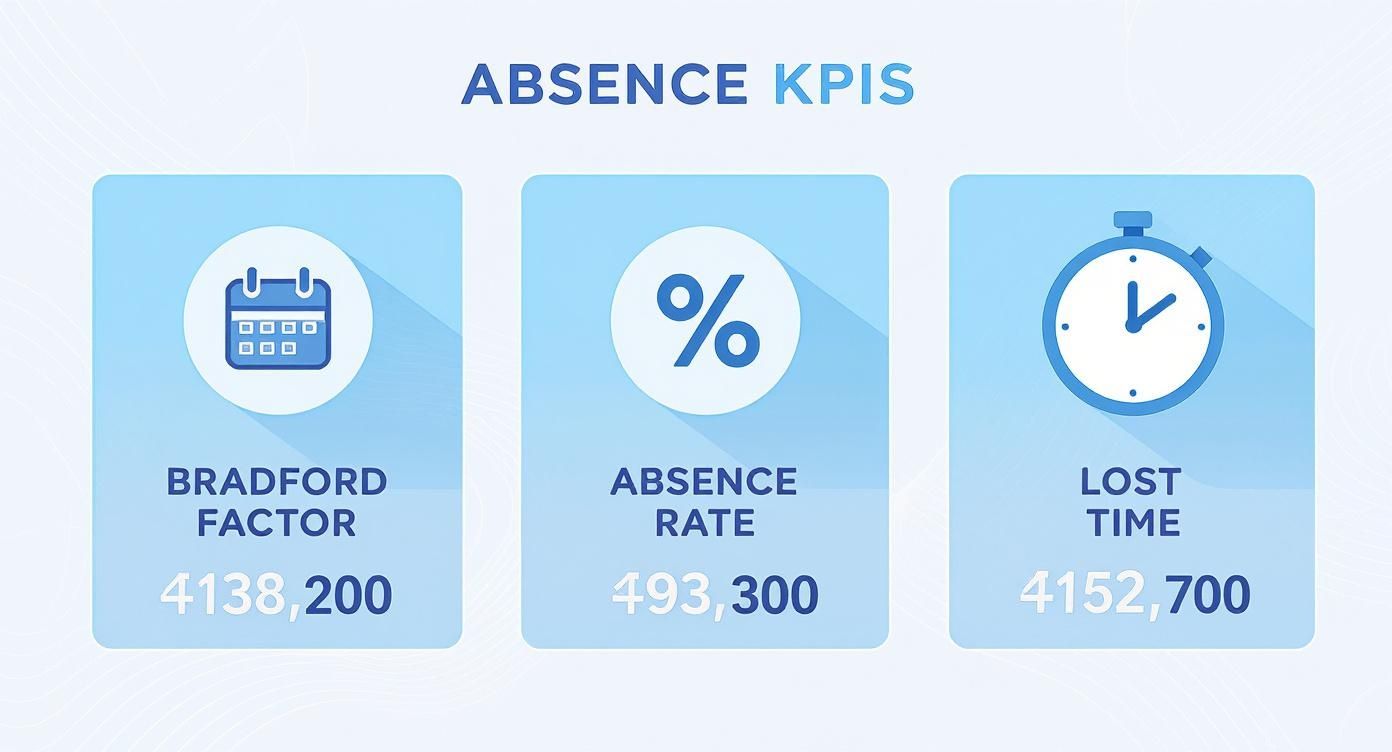
Keeping an eye on these KPIs gives managers a direct line of sight into how their policies are working and helps them spot where more proactive support might be needed.
Shifting Focus to Proactive Prevention
While a firm policy is essential, the best strategies focus on stopping absences before they even happen. This means digging into the root causes—things like stress, burnout, and a poor work-life balance—and tackling them head-on. The aim is to create a workplace where people are healthy, engaged, and want to be there.
This isn't just a "nice-to-have." Recent data shows a sharp rise in sickness absence. In the UK, the average number of sick days per worker hit 7.8 days in 2023, a big jump from the pre-pandemic average of 5.8 days. What's fascinating is how this changes with company size. Smaller organisations saw rates of just 5.0 days, while the largest employers faced a staggering 13.3 days per employee.
These numbers tell a clear story: a one-size-fits-all approach just won't cut it. Your prevention strategy has to be shaped by the unique challenges your organisation faces.
Implementing Supportive Initiatives
To really get ahead of absence, you need to build a supportive and flexible culture. These aren't just perks; they are strategic investments in the long-term health of your workforce.
Try introducing a mix of the following:
- Wellness Programmes: Offer resources that support both mind and body. This could be access to counselling services (like an Employee Assistance Programme), workshops on stress management, or even subsidised gym memberships.
- Flexible Working Options: Where the role allows, things like hybrid working, flexible start times, or compressed hours can make a massive difference to work-life balance and dramatically reduce stress-related absences.
- Manager Training: Your line managers are your first line of defence. Equip them with the skills to spot the early signs of stress or burnout. Training them to have supportive, empathetic conversations is one of the most powerful prevention tools you have.
- Mental Health Support: Work to create a culture where it's okay to talk about mental health. You can explore and implement effective workplace stress management strategies, especially for neurodivergent employees who might need more specific kinds of support.
A proactive absence management strategy is less about policing attendance and more about fostering an environment where employees want to be. It's an investment in people that pays dividends in productivity, morale, and retention.
By combining a fair and consistent policy with a genuine commitment to wellbeing, you create a powerful framework. This balanced approach doesn't just deal with the disruption of absences at work—it tackles the underlying causes, building a healthier and more productive organisation for the future.
Using Modern Tools for Absence Management
Trying to manage absences at work with a messy patchwork of spreadsheets, emails, and paper forms is like trying to direct rush-hour traffic blindfolded. It's chaotic, riddled with errors, and eats up valuable time for managers and HR pros who have far better things to do. These old-school manual processes create data silos, make it a nightmare to enforce policies consistently, and turn reporting into a monumental headache.
This is exactly where dedicated absence management software steps in. It takes that fragmented, broken system and turns it into a single, reliable source of truth for everything leave-related. Imagine swapping that clunky spreadsheet for a clean, automated platform that handles everything from holiday requests to accrual calculations with pinpoint accuracy.
From Manual Chaos to Automated Clarity
The difference is night and day. A manual system hinges on an employee remembering to fill out a form, a manager finding a spare moment to approve it, and someone in HR keying the data in correctly. Every single step is a potential point of failure where a request gets forgotten, lost, or just plain wrong.
Modern tools completely flip this on its head, creating a smooth, automated workflow for the entire journey:
- Centralised Requests: Employees can pop in a holiday or sick leave request through a simple online portal or mobile app, and it’s instantly logged. No more lost emails.
- Automated Approvals: Managers get a notification and can approve or deny the request with a single click, often straight from their email inbox or a Slack message.
- Real-Time Visibility: A shared team calendar, often called a wall planner, gives everyone an immediate, up-to-the-minute view of who is off and when. This visibility alone stops countless scheduling clashes before they happen.
- Accurate Entitlement Tracking: The system automatically calculates and keeps track of holiday allowances, sick leave balances, and other leave types, preventing anyone from accidentally taking more time than they have.
Here’s a quick look at how a team’s leave schedule is displayed, offering crystal-clear visibility for everyone.
This kind of visual planner immediately cuts through the confusion, showing overlapping leave and staff availability at a single glance.
The Strategic Advantage of Data
Beyond just making things run smoother, these tools arm you with powerful data. Instead of spending hours digging through spreadsheets to pull a report, you can generate genuinely useful insights on absence rates, trends, and even calculate metrics like the Bradford Factor in seconds.
By automating the administrative slog of tracking absences, modern tools free up managers to focus on the human side of the equation—supporting their teams and getting to the root causes of absenteeism.
This data-driven approach lets you spot patterns, identify departments that might be struggling, and make truly informed decisions about your workforce. It also ensures policies are applied fairly across the board, which is vital for team morale and for staying on the right side of employment law.
Making the switch from spreadsheets to a dedicated system is a huge step toward building a more resilient and efficient organisation. If you're thinking about making the move, it's well worth checking out our guide on choosing the right absence management solution to make sure you find the perfect fit for your team.
Common Questions About Managing Workplace Absence
When you're managing people, dealing with absences at work throws up some tricky situations. It’s one of those areas where managers and HR professionals are constantly fielding questions, and getting it wrong can be costly. Having clear, straightforward answers is the key to handling things fairly, consistently, and without falling foul of the law.
Think of this section as your go-to guide for those frequent queries. Nailing these fundamentals isn't just about ticking legal boxes; it's about building trust with your employees. A confident, fair approach to these common scenarios is the bedrock of any solid absence management strategy.
Authorised Versus Unauthorised Absence
One of the first hurdles is often understanding the difference between an authorised and an unauthorised absence. It sounds simple, but the lines can get blurred.
At its core, an authorised absence is any time off you’ve approved according to your company policy. This could be a pre-booked holiday, a scheduled hospital appointment, or an employee calling in sick and following your reporting procedure to the letter.
On the flip side, an unauthorised absence is when someone just doesn't show up without permission, or they fail to let you know in the right way. This isn't something you can ignore; it needs a formal response, usually starting with an investigation and potentially leading down a disciplinary route to understand what happened and reinforce your company's expectations.
Handling Long-Term Sickness
When an employee is off work for an extended period, your duty of care really kicks in. This is about much more than just marking them as absent on a spreadsheet; it’s a proactive and supportive role.
You absolutely must:
- Keep in regular, sensitive contact. This isn't about chasing them for a return date; it's about showing support and staying connected.
- Explore reasonable adjustments. This is a legal requirement under the Equality Act 2010 if their condition counts as a disability. It’s about finding practical ways to help them come back to work.
- Follow a fair capability procedure before even thinking about dismissal. This almost always involves getting medical reports (with the employee's consent, of course) to properly understand their long-term prognosis.
Rushing this process or skipping any of these supportive steps is a fast track to an unfair dismissal or disability discrimination claim.
The goal with long-term absence should always be supportive reintegration, not dismissal. A fair, well-documented process protects both the employee and the business, proving that all reasonable steps were taken to help them return.
Managing Frequent Short-Term Absences
A pattern of frequent, short, unplanned absences can often be far more disruptive to a business than one single period of long-term sick leave. Tackling this requires a consistent and supportive approach.
First, you need a crystal-clear policy that sets out reporting rules and defines the 'trigger points' for a review. Then, the single most effective tool you have is the return-to-work interview. You should be holding one after every single absence, no matter how short.
This quick, informal chat does three things brilliantly: it shows you’re paying attention, it opens the door to discussing any underlying issues, and it often deters non-genuine absences. If the pattern continues despite this, you can then move towards more formal steps, while still offering support like a referral to occupational health.
Tired of trying to manage absences at work with chaotic spreadsheets and endless email chains? Leavetrack gives you a simple, clear system that centralises all your leave requests, approvals, and reporting in one place. Discover how Leavetrack can save you time and bring clarity to your absence management.