

A Practical Guide to Bradford Factor Calculations for UK HR
Posted by Robin on 19 Dec, 2025 in
The Bradford Factor calculation uses a simple formula, S² x D, to measure the impact of employee absence. It’s designed to highlight the disruption caused by frequent, short-term absences, which are often more problematic than a single long spell of leave.
The score is calculated over a rolling 12-month period. It works by multiplying the total number of separate absences (or 'spells') by itself, and then by the total number of days absent.
Understanding the Bradford Factor Formula
At its heart, the Bradford Factor is a tool built on a simple premise: frequent, unplanned absences wreak more havoc than a single, longer period of leave. It’s something every manager knows instinctively.
You can plan cover for a colleague who’s off for a fortnight. But scrambling to cover five separate, unexpected single-day absences is far more chaotic and damaging to team morale and productivity. The formula is designed to quantify that disruption.
The magic is in the maths: B = S² x D.
Let’s quickly break that down:
- S (Spells): This is the total number of separate instances of absence. A single five-day absence is one spell. Five separate Mondays off are five spells.
- D (Total Days): This is simply the cumulative number of days an employee was absent during the period.
- B (Bradford Factor Score): The final score, which rises exponentially with the number of spells.
The formula intentionally penalises frequency. By squaring the number of spells, the score becomes highly sensitive to repeated absences, mirroring their real-world operational impact.
How Absence Patterns Impact Bradford Factor Scores
To see just how much the pattern of absence matters, let's look at a few scenarios. In each case, the employee has been off for a total of 10 days, but their Bradford Factor scores tell very different stories.
| Employee Scenario | Spells (S) | Total Days (D) | Bradford Factor Score (S² x D) |
|---|---|---|---|
| One long-term absence (e.g., post-surgery recovery) | 1 | 10 | 10 |
| Two separate absences (e.g., two 5-day illnesses) | 2 | 10 | 40 |
| Five separate absences (e.g., five 2-day illnesses) | 5 | 10 | 250 |
| Ten single-day absences | 10 | 10 | 1,000 |
As you can see, the score for ten single-day absences is 100 times higher than the score for one ten-day absence. This immediately flags the more disruptive pattern, even though the total time off is identical.
Why It Matters Beyond the Score
The Bradford Factor isn't just about crunching numbers; it's a trigger for conversation.
The metric first emerged from UK research in the 1980s and was quickly adopted by public sector organisations struggling to get a handle on absenteeism. But it’s crucial to remember that the score itself doesn't tell the whole story.
Leading HR guidance is clear: these scores should never be used in isolation. The formula can't distinguish between a legitimate health issue and discretionary time off. Applying it blindly risks being unfair and, frankly, heavy-handed.
The Bradford Factor is at its most effective when it’s used to start supportive, constructive conversations, not as a standalone disciplinary stick. For a deeper dive, you can explore the Bradford Factor's origins and application to understand its intended purpose. This approach ensures you can manage attendance effectively while still treating your people fairly.
Calculating Bradford Factor Scores for Different Scenarios
The best way to really get your head around the Bradford Factor is to see it in action. Let's walk through three common scenarios you’re likely to come across. By breaking each one down, you'll see exactly how the formula (S² x D) shines a light on different attendance patterns. For these examples, we'll assume a standard rolling 12-month period.
Scenario 1: The Single Long-Term Sickness
First up, let's look at an employee named Sarah. She had a planned operation and needed a decent chunk of time to recover. Her absence record shows just one continuous period of leave.
- Absence Details: Sarah was off work for 10 consecutive working days.
- Spells (S): Because this was one continuous absence, S = 1.
- Days (D): The total number of days she was off was 10.
The calculation is pretty straightforward: 1² x 10 = 10. Sarah’s Bradford Factor score is incredibly low. This makes perfect sense—while she was away for a while, it was a single, predictable event for the business, not a disruptive pattern of frequent, unplanned days off. A score of 10 would almost certainly fall below any trigger point.
Scenario 2: Frequent Single-Day Absences
Now, consider another employee, Mark. Over the same 12 months, Mark has also been absent for a total of 10 days. But his pattern is completely different, made up of lots of separate, single-day absences.
- Absence Details: Mark took 10 separate days off for various minor, unrelated illnesses.
- Spells (S): Each separate absence is its own spell, so S = 10.
- Days (D): His total days absent is also 10.
Mark’s calculation tells a very different story: 10² x 10 = 1,000. His score is a massive 100 times higher than Sarah's, even though they were off for the same number of days. This high score immediately flags a potentially disruptive pattern, and it’s a clear signal to have a supportive conversation to understand what’s going on.
This is where you can really see the formula's power. It highlights the stark difference in impact between one long absence and lots of short ones.
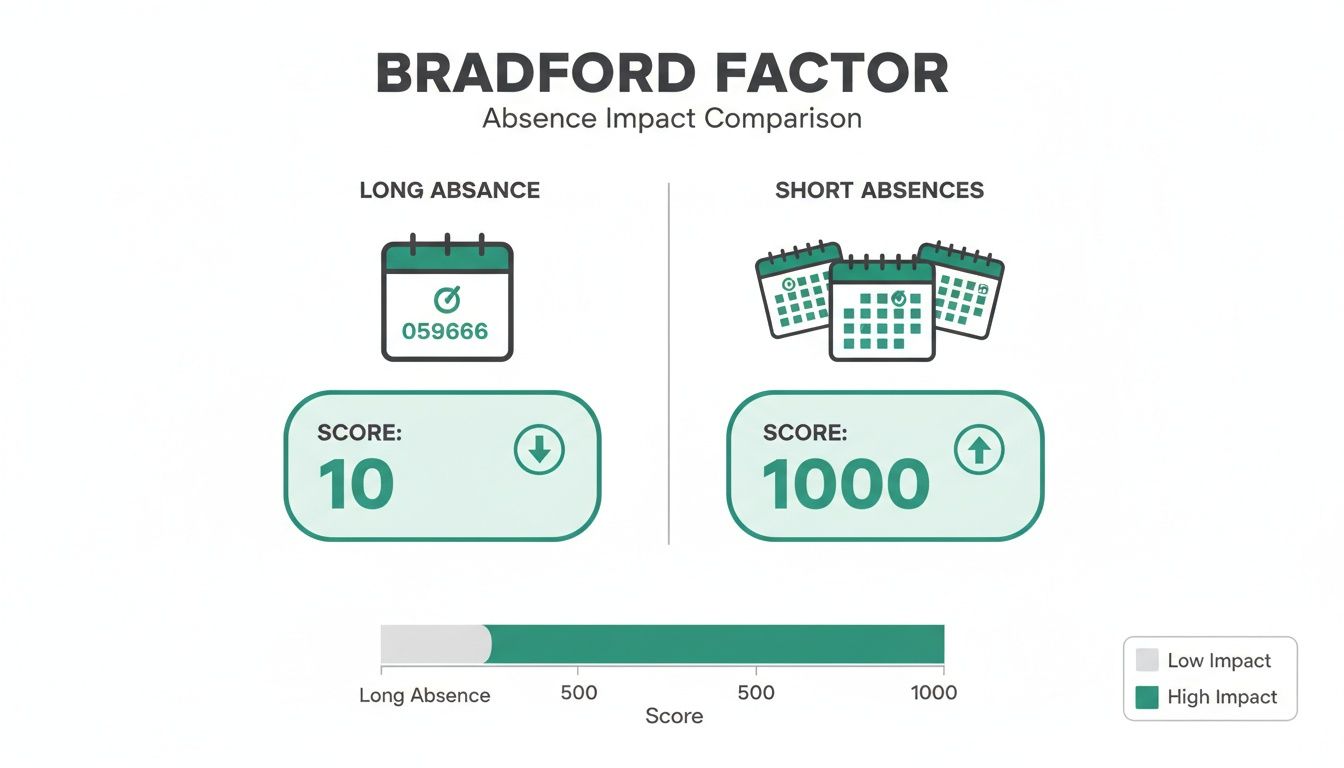
As the image shows, the formula is designed to heavily penalise the frequency of absence, giving a much higher, more critical score to short, repeated instances of leave.
Scenario 3: A Mixed Pattern of Absence
Finally, let’s look at Chloe, whose attendance record is a mix of short and slightly longer absences. Her pattern isn’t as clear-cut as the first two.
- Absence Details: Chloe had a three-day absence for the flu, followed by two separate single-day absences later in the year.
- Spells (S): She has three distinct periods of absence, so S = 3.
- Days (D): Her total days off come to 3 + 1 + 1 = 5.
Her Bradford Factor calculation is: 3² x 5 = 45. This score sits comfortably in a low-risk category. It shows a few separate instances but doesn't point to the kind of persistent, frequent absenteeism that sent Mark's score soaring.
Key Takeaway: The Bradford Factor isn't just about counting days. It’s a tool designed specifically to quantify the disruption caused by how often someone is absent, giving HR managers an objective starting point for managing attendance.
Of course, absenteeism is just one piece of the puzzle. HR teams track all sorts of crucial metrics. For instance, knowing how to manage your Recruitment Cost Per Hire is another key data point for smart workforce planning. These calculations, much like the Bradford Factor, are all about turning raw data into information you can actually act on.
Ditch the Manual Hassle: Automating Your Bradford Factor Calculations
Let's be honest, manually calculating Bradford Factor scores for every single employee is a fast track to headaches and mistakes. It’s the kind of admin task that eats up valuable time you could be spending on more strategic HR work. A much smarter way forward is to set up a simple, automated calculator in Microsoft Excel or Google Sheets.
This one move can transform a tedious job into a perfectly manageable process.
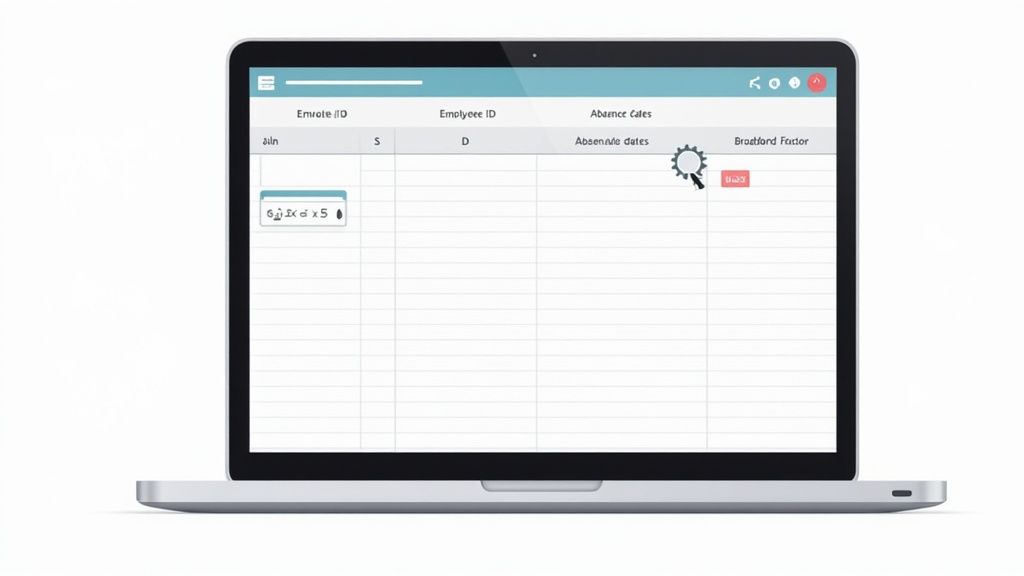
As you can see, a well-structured spreadsheet (or a dedicated tool) lays everything out clearly. You get a clean view of employee details right next to their calculated scores. By automating the maths, you can instantly spot who has crossed your absence thresholds, allowing you to step in consistently and on time.
First, Get Your Absence Data in Order
Before you can even think about formulas, your absence data needs to be organised properly. Don't worry, a simple table is all it takes to get the ball rolling. Just create columns for the essential information your formulas will need to pull from.
Your basic setup should include at least these columns:
- Employee ID: A unique code for each person.
- Absence Start Date: The first day of any given absence.
- Absence End Date: The last day of that same absence spell.
- Reason for Absence (Optional): This isn't essential for the calculation, but it adds crucial context for any follow-up conversations.
This clean, structured data is the foundation for everything that follows. With this in place, you’re ready to let the formulas do the heavy lifting of counting spells and summing up days for each employee.
The Formulas for Excel and Google Sheets
Now for the clever part. Once your data is structured, you can use a couple of key formulas to run the Bradford Factor calculations automatically. In both Excel and Google Sheets, the goal is to calculate the two key variables for each employee: the total number of absence spells (S) and the total days absent (D).
Let's say you have an employee ID in cell A2 on your main summary sheet, and all your raw absence data is on another sheet named 'AbsenceData'. You can use formulas like these:
- To Count Spells (S):
=COUNTIF(AbsenceData!A:A, A2)- This formula simply counts every row in your 'AbsenceData' sheet where the Employee ID matches the one in cell
A2. Since each row represents one spell, this gives you your 'S' value.
- This formula simply counts every row in your 'AbsenceData' sheet where the Employee ID matches the one in cell
- To Sum Days (D):
=SUMIF(AbsenceData!A:A, A2, AbsenceData!C:C)- This one adds up the total days for that employee. (Note: This example assumes you have a 'Duration' column (C) in your data where you've already calculated the length of each absence.)
- Final Bradford Score: With 'S' and 'D' calculated, the final score is easy:
=(S*S)*D.
Moving beyond spreadsheets, understanding general workflow automation principles can unlock even bigger improvements across all your HR processes.
Pro Tip: Want to get a bit more advanced? You can use
SUMPRODUCTorCOUNTIFSfunctions to filter absences that fall within a specific rolling 12-month period. This is the best way to ensure your calculations are always up-to-date and relevant.
While spreadsheets are a fantastic starting point, many growing businesses eventually find that a dedicated system is far more scalable and robust. If you're curious about how specialised tools can take this off your plate entirely, it's worth learning more about the benefits of absence management software to see if it's the right next step for you.
Setting Fair Thresholds and Interpreting Scores
A Bradford Factor score is just a number until you give it meaning inside your company’s absence policy. Without a clear framework, these calculations are just data points floating in the ether. Setting fair, transparent thresholds is how you turn this metric into a genuinely useful management tool that supports both your employees and the needs of the business.
The real key here is to remember that these scores are designed to be conversation starters, not automatic disciplinary triggers. A high score doesn't instantly mean someone is a poor performer; it simply flags a pattern of absence that probably warrants a supportive discussion. Your goal should be to build a system that prompts early intervention, not just punishment down the line.
Establishing Your Trigger Points
Most UK organisations that use this method rely on a tiered system of thresholds. As scores rise, they trigger different, escalating management actions. This creates consistency and makes sure everyone is treated fairly under the same set of rules. While there’s no single “correct” set of numbers that fits every business, a common structure gives you a solid starting point for your own policy.
Example Bradford Factor Thresholds and Actions
Think of these thresholds as a guide for your line managers. They provide a clear, step-by-step process for addressing absence patterns consistently across the organisation, removing guesswork from the equation.
Here is a typical example of how you might structure these trigger points:
| Score Range | Risk Level | Recommended Action |
|---|---|---|
| 0 – 50 | No Concern | No action needed. This is a typical, healthy score for most employees. |
| 51 – 200 | Informal Monitoring | A line manager might have a brief, informal chat during a routine one-to-one to check in on the employee's wellbeing. |
| 201 – 400 | Formal Concern | This would trigger a documented return-to-work interview to discuss the absence pattern and offer support. |
| 401+ | Formal Review | A high score like this typically initiates a formal attendance review meeting, which could lead to a verbal or written warning if no mitigating circumstances are found. |
It's vital that any actions taken are clearly mapped out in your employee handbook. Building your guide to a fair absence and sickness policy is the foundation that makes using a tool like the Bradford Factor both effective and legally sound.
Interpreting Scores with Context
Applying these thresholds requires nuance and a human touch. A rigid, "computer says no" approach will almost certainly lead to unfair outcomes and do real damage to morale. Before acting on any score, you always have to consider the bigger picture.
A UK public-sector body reported a 25% reduction in absenteeism after introducing Bradford scoring alongside targeted, supportive interventions. This highlights how the metric is most effective as a trigger for managerial action, not as a standalone penalty. Discover more insights about how UK organisations use Bradford Factor thresholds on kelio.co.uk.
Context is everything. Are the absences related to a known disability or a long-term health condition? Is the employee a new parent dealing with a child's frequent illnesses? Trade unions and staff associations in the UK have repeatedly cautioned against misapplying the formula, recommending a full review of medical evidence and any reasonable adjustments before formal steps are taken.
A high score should prompt you to ask questions, not jump to conclusions. It’s an opportunity to open a dialogue, understand the root cause of the absences, and explore what support the employee might need to improve their attendance.
Navigating the Limitations and Fairness Considerations
Getting the Bradford Factor calculation right is one thing, but using it responsibly is another challenge entirely. Its greatest weakness is also its defining feature: it applies a purely mathematical lens to what is often a deeply human issue. A rigid, by-the-book application of the score risks inadvertently penalising your most vulnerable employees.
This is where the formula can quickly become problematic. Imagine an employee with a chronic health condition, a disability, or even just the unpredictable reality of caring for a young child. They might have frequent, short, and entirely unavoidable absences that send their Bradford Factor score soaring. The formula has no way of distinguishing this from a pattern of someone just taking a few extra days off.

Upholding Legal and Ethical Duties
Here in the UK, this isn't just about being a good employer; it's a legal necessity. Your duties under the Equality Act 2010 require you to make reasonable adjustments for employees with disabilities. Allowing a high Bradford score, driven by disability-related absences, to trigger disciplinary action could easily be seen as discriminatory.
The best practice is to build flexibility right into your policy to account for these situations:
- Discounting Absences: Many organisations choose to exclude absences related to known disabilities or pregnancy from the calculation entirely.
- Adjusting Thresholds: You could set higher trigger points for employees who have disclosed a long-term health condition.
- Excluding Certain Leave Types: It’s also common to exclude statutory time off for dependents to avoid penalising parents for unforeseen family emergencies.
Transparency is absolutely paramount. Your absence management policy must clearly define which types of leave are included in Bradford Factor calculations and which are not. This ensures everyone is treated consistently and helps manage employee expectations fairly from the outset.
Using the Score as a Supportive Tool
The most effective way to use the Bradford Factor is not as a disciplinary hammer, but as a conversation starter. A high score should be an objective signal to a line manager to check in with their team member, not to immediately issue a formal warning.
A high score is a prompt to ask, "Is everything okay?" It’s an opportunity to open a supportive dialogue, understand the root causes of the absence, and explore what assistance the employee might need—from flexible working arrangements to occupational health referrals.
This approach shifts the focus from punishment to genuine support. It helps foster a culture where employees feel they can be open about their health and personal challenges. It also ensures you meet your duty of care as an employer. Indeed, knowing why accurate absence tracking is crucial for compliance helps reinforce the importance of having a fair and legally sound process.
Ultimately, a successful policy uses data to drive human-centric decisions, promoting employee wellbeing while managing the operational impact of absence effectively.
Common Bradford Factor Questions
Once you start using the Bradford Factor in your absence policy, you'll find that some specific, tricky questions pop up again and again. Getting the maths right is one thing, but applying it fairly and consistently across your team is where the real challenge lies.
Let's walk through some of the most common queries HR managers have, so you can handle these situations with confidence. These are often the grey areas where legal obligations meet the need for a supportive company culture.
Does the Bradford Factor Discriminate Against Employees with Disabilities?
If you just apply the formula blindly, then yes, it absolutely can. The calculation itself doesn't care why someone was off; it only sees the frequency. An employee with a chronic health condition, which would be protected under the Equality Act 2010, might have lots of short, unavoidable absences. This would quickly send their Bradford Factor score soaring.
To stay on the right side of the law and, just as importantly, to be a good employer, you must make reasonable adjustments. In practice, this usually means one of two things:
- Discounting any absence directly related to the disability from the calculation entirely.
- Adjusting the trigger point thresholds for that specific employee, creating a fairer benchmark for them.
The golden rule here is to treat a high score as a trigger for a supportive conversation, not an automatic disciplinary. It's about opening a dialogue to understand what's going on, ensuring you meet your legal duties and look after your employee's wellbeing.
What Is a Rolling Year and Why Do We Use It?
A 'rolling year' is simply the 365-day period leading up to today's date. It's not the same as a fixed calendar year (e.g., January to December). This is the standard for Bradford Factor calculations because it gives you a much more current and accurate picture of someone's attendance patterns.
Think about it: a fixed calendar year can easily hide a recurring problem. An employee's score would reset to zero on the 1st of January, making it look like the issue has vanished, even if their pattern of frequent absence continues straight into the new year. A rolling period provides a continuous, realistic view of attendance.
Can We Dismiss an Employee Just Because of Their Bradford Factor Score?
Dismissing someone based only on a high Bradford Factor score is incredibly risky and something I would never advise. You should see a high score as an objective flag that tells you it's time to start a formal investigation and support process, not as the final verdict itself.
For a dismissal to be legally sound, you need to follow a proper, documented procedure. This involves:
- Meeting with the employee to discuss the reasons for their absences.
- Properly considering any mitigating circumstances, like underlying health conditions or personal difficulties.
- Issuing formal warnings and setting clear, achievable targets for improvement.
- Exploring every possible support option before dismissal is even on the table.
If you end up at an employment tribunal, they will almost certainly view a dismissal based purely on a number as unfair.
How Should We Handle Absences for Dependents or Emergencies?
This is where your company culture really comes into play. To build a fair and supportive workplace, most UK employers choose to exclude certain types of leave from the Bradford Factor calculation. Statutory time off for dependents is a classic example. Penalising a parent for dealing with a child's sudden illness is a sure-fire way to damage morale.
The key is to be crystal clear in your absence management policy. It needs to state exactly which types of leave are included in the Bradford Factor calculations and which are exempt. This transparency is vital for managing everyone's expectations and ensuring the policy is applied the same way for all.
Managing absence doesn't have to be a headache of spreadsheets and manual calculations. Leavetrack automates your entire leave management process, from requests and approvals to reporting, giving you clear visibility and saving valuable admin time. Discover a simpler way to manage your team's time off at https://leavetrackapp.com.