

Your Guide to a Fair Absence and Sickness Policy
Posted by Robin on 28 Nov, 2025 in
An absence and sickness policy is just a formal document that lays out your company's rules for when an employee is ill or has an unplanned absence. Think of it as a clear, consistent handbook for reporting sickness, explaining sick pay, and handling the return-to-work process for everyone in the business.
Why a Clear Sickness Policy Matters More Than Ever

Let's be honest, managing employee absence has become a real headache for UK businesses. It's no longer a simple HR box-ticking exercise; it’s a critical function that hits your productivity, team morale, and bottom line. Without a clear framework, you're opening the door to inconsistency, confusion, and even potential legal trouble.
The reality is, sickness absence is climbing. It's actually reached its highest level in over a decade. One recent report found that UK employees were off sick for an average of 9.4 days last year, a huge jump from the 5.8 days we saw before the pandemic. This trend creates massive operational strain, forcing teams to stretch themselves thin to cover for missing colleagues.
The Real-World Impact of Absenteeism
When an employee is off unexpectedly, the ripple effects are felt right across the business. Projects can stall, customer service might dip, and the rest of the team often gets lumped with a heavier workload. This is a fast track to burnout and sinking morale. These disruptions have very real costs, which is why it's so important to understand how much does absenteeism cost employers.
A well-crafted absence and sickness policy acts as a vital buffer against all this chaos. It makes sure that:
- Everyone knows the rules: Staff understand exactly how and when they need to report an absence.
- Managers act consistently: Line managers have a clear, fair process to follow every single time.
- The business is protected: You minimise legal risks tied to discrimination or unfair treatment.
Adapting to Modern Workplace Challenges
The nature of sickness itself is also changing. There’s a growing, and welcome, recognition of mental health issues as a completely valid reason for time off. This demands a more empathetic and supportive approach from employers. A modern policy has to reflect this shift, creating a culture where people feel safe reporting any health concern, whether it's mental or physical.
A robust absence policy does more than just manage sick days—it builds trust. When employees see a system that is fair, consistent, and supportive, it reinforces their confidence in the organisation and fosters a healthier work environment for everyone.
Ultimately, understanding why health and safety is important in the workplace gives you the foundation for your policy. It’s all about creating a safe, transparent, and supportive environment where both the business and its people can thrive. This guide will walk you through building a policy that does exactly that.
Building the Core of Your Sickness Policy
Right, let’s get down to brass tacks. It's time to move from theory to action and start drafting the essential components of your absence and sickness policy. This is where you build the framework that ensures everyone is treated fairly and consistently. A solid policy leaves no room for confusion, making sure both employees and managers know exactly where they stand when someone is off sick.
Let's break down the core elements you absolutely have to include. I’ll give you some clear advice and adaptable phrasing to help you put together a policy that’s not just compliant, but genuinely effective in the real world.
Defining Different Types of Absence
First things first, your policy needs to be clear about different kinds of leave. This isn't just about sickness; it’s about creating clear categories for all sorts of planned and unplanned time off. It’s a common point of confusion, so getting this right from the start saves a lot of headaches later.
Of course, you’ll need to define what counts as "sickness absence" – any time an employee is unfit for work due to illness or injury. But you can't stop there.
It's a good idea to have specific sections for things like:
- Medical and Dental Appointments: Be clear about whether these should be scheduled outside of work hours if possible, and what kind of notice is needed.
- Emergency Dependant Leave: Outline the statutory right for employees to take unpaid time off to handle an emergency involving a dependant.
- Compassionate Leave: Define the circumstances for paid or unpaid leave following the death of a close family member.
Clarity on these points stops misuse and guides employees to follow the right procedure for their specific situation.
Establishing Clear Reporting Procedures
How an employee reports their absence is one of the most critical parts of your policy. Vague instructions like "let us know if you're sick" just won’t cut it. You need a simple, non-negotiable process.
Your procedure should answer three key questions with absolute clarity:
- Who do they notify? It should always be their direct line manager, not a text to a colleague. Make sure there’s a secondary contact in case the manager is unavailable.
- How do they notify? A phone call is always best practice. It allows for a proper conversation and stops messages from getting lost in a sea of emails or instant messages.
- When do they notify? Be specific. For example, "at least one hour before your normal start time."
Your reporting procedure is the first line of defence against operational disruption. A clear, consistently enforced process ensures managers are informed promptly, allowing them to rearrange workloads and minimise the impact on the team.
This structured approach removes any guesswork. It also establishes a professional standard from day one of an absence, setting the tone for how sickness is managed across the business.
Your sickness policy is the bedrock of how you manage employee health and attendance. To make sure it's robust and legally sound, you need to include several key elements. Below is a checklist of the essential components every UK absence and sickness policy should contain to ensure it's fair, clear, and compliant.
Essential Elements of a Compliant Sickness Policy
| Policy Component | Key Information to Include | Why It's Important |
|---|---|---|
| Policy Aims | A brief statement on promoting wellbeing and managing absence fairly. | Sets a supportive tone and clarifies the policy's purpose beyond just rules. |
| Absence Types | Clear definitions for sickness, appointments, dependant leave, etc. | Prevents confusion and ensures employees use the correct leave category. |
| Reporting Procedure | Who to contact, by when, and how (e.g., phone call to line manager). | Ensures timely communication, allowing for cover to be arranged and minimising disruption. |
| Certification | Rules for self-certification (up to 7 days) and when a fit note is required. | Provides a clear process for medical evidence, ensuring legal and payroll requirements are met. |
| Sick Pay Details | Clear explanation of Statutory Sick Pay (SSP) and any Company Sick Pay (CSP) scheme. | Manages employee expectations about pay during illness, reducing stress and queries to HR. |
| Return to Work | Details of return-to-work interviews and their supportive purpose. | Facilitates a smooth return, identifies ongoing support needs, and helps prevent future absences. |
| Long-Term Sickness | The process for managing absences of four weeks or more, including communication. | Shows a commitment to supporting employees during prolonged illness and manages the situation proactively. |
| Confidentiality | A statement on how medical information will be handled confidentially. | Builds trust and assures employees their sensitive health data is protected under GDPR. |
By including these components, your policy becomes a reliable guide for both managers and employees, fostering a culture of trust and consistency when dealing with health-related absences.
Medical Evidence and Fit Notes Explained
For short-term sickness, self-certification is standard practice. An employee can self-certify their illness for the first seven calendar days. Your policy should state this plainly and explain how they can complete a self-certification form when they get back.
After seven days, a "fit note" (what we used to call a sick note) from a doctor is required. Your policy needs to detail this, explaining that the fit note must be provided promptly if they are to receive any applicable sick pay.
It’s also really helpful to explain the two types of fit notes:
- "Not fit for work": This is straightforward – the employee is unable to work at all.
- "May be fit for work": This is a great opportunity. It means the employee might be able to return with adjustments, opening the door for a supportive chat about a phased return or temporary changes to their duties.
Demystifying Sick Pay Schemes
Let's be honest, pay is a major worry for any employee who is unwell. Your policy has to be crystal clear about what they will be paid and when.
You'll need to cover two key areas:
- Statutory Sick Pay (SSP): Explain that this is the legal minimum paid to eligible employees. You don't need to state the exact weekly rate (it changes), but you should confirm that the company complies with all SSP regulations.
- Company Sick Pay (CSP): If you offer a more generous contractual scheme, detail it here. Be specific about eligibility (e.g., after passing probation), how much is paid (e.g., full pay for 4 weeks, half pay for 4 weeks), and any conditions attached.
Being totally transparent about pay builds trust and helps employees plan financially during a tough time, which can reduce a lot of extra stress.
Managing Long-Term Sickness and Return to Work
A dedicated section on long-term absence (typically defined as four weeks or more) is essential. This part of the policy should be all about support and communication, outlining a process for keeping in regular, sensitive contact with the employee.
The return-to-work interview is a crucial final step. It's a supportive conversation, not an interrogation. Frame it in your policy as a chance to:
- Welcome the employee back.
- Confirm they feel fit enough to resume their duties.
- Give them an update on anything important they've missed.
- Discuss if any reasonable adjustments are needed to support their return.
This process ensures a smooth transition back into the workplace and shows you’re a supportive employer. It's also your best opportunity to spot any underlying issues that might need addressing to prevent future absences.
Navigating UK Employment Law and Fair Process
Once you’ve got the bones of your absence and sickness policy drafted, it’s time to layer in the legal framework. This isn't just a box-ticking exercise in the UK; it's about embedding fairness and legal compliance into every part of your process. Get this bit wrong, and you could find yourself facing serious legal challenges, including some very costly discrimination claims.
This isn’t just an HR formality, either. Sickness absence rates have stayed stubbornly above pre-pandemic levels. The Office for National Statistics (ONS) found that while the rate recently dropped to 2%, it's still higher than the 1.9% we saw before the pandemic. It’s clear that managing absence effectively is a pressing business need.
The Equality Act and Reasonable Adjustments
The Equality Act 2010 is your North Star here. It protects employees from discrimination based on nine "protected characteristics," with disability, age, and pregnancy being particularly relevant to sickness policies.
Disability is the one that most often comes into play. If an employee has a physical or mental impairment with a ‘substantial’ and ‘long-term’ negative effect on their ability to do normal daily activities, they are almost certainly protected. This triggers a critical legal duty for you as an employer: the duty to make reasonable adjustments.
This isn't a suggestion; it's a legal requirement to take positive steps to remove or reduce disadvantages the employee faces.
So, what does a reasonable adjustment look like in the real world? It could be things like:
- Adjusting working hours: A phased return after a long illness, or flexible start times to fit around medical appointments.
- Modifying equipment: Providing an ergonomic chair for someone with a back problem or specialised software for an employee with a visual impairment.
- Reallocating minor duties: If a small part of a role is causing significant difficulty, it might be reasonable to assign it to another team member.
The operative word is "reasonable." What’s considered reasonable will depend on the size and resources of your business and how effective the adjustment will be.
Handling Sensitive Medical Data Lawfully
When you're managing sickness, you’re going to be handling some very personal information. Under UK GDPR, medical details are classed as ‘special category data’, which means they need a much higher level of protection.
Your policy must be crystal clear about how you will handle this data. You need a lawful basis for processing it, which in this context is usually to fulfil your employment law obligations (like managing sick pay or making those reasonable adjustments).
Your promise of confidentiality is a cornerstone of trust. Employees must feel confident that their private health information is stored securely, accessed only by those with a legitimate need (like HR and their direct manager), and used solely for managing their employment.
A slip-up here can lead to significant fines and do real damage to your reputation as an employer. Make sure your data handling processes are solid and clearly spelled out in your policy.
Fairness in Complex Situations
Consistency is everything. Your policy must be applied evenly to avoid any hint of discrimination. A common pitfall is treating an absence related to a protected characteristic more harshly than other types of sickness.
For instance, if you use a trigger system for reviewing frequent absences, you must be careful not to penalise someone whose absences are directly linked to a disability or a pregnancy-related illness. That could easily be classed as discrimination. Your policy should build in room for managerial discretion to consider the reasons behind the absence. Getting the pay aspect right is also key, and understanding how Statutory Sick Pay for part-time workers explained can help ensure you’re being fair to everyone.
Thinking about dismissal for long-term sickness is another tricky area. This is not a decision to be taken lightly and you absolutely must follow a fair and thorough process. A fair dismissal would involve:
- Full consultation: Keeping in regular, open contact with the employee to discuss their health and the prospects of them returning.
- Obtaining medical evidence: Getting an up-to-date medical report (always with the employee's consent) to properly understand the situation.
- Exploring all alternatives: Looking at every possible reasonable adjustment or alternative role before you even think about concluding that a return to work isn't feasible.
By documenting every single step and showing you’ve acted reasonably and with compassion, you protect the business and treat your employee with the dignity they deserve. This legal and ethical foundation is what turns a good policy into a great one.
Bringing Your New Policy to Life
A brilliantly drafted absence and sickness policy is just a document until you put it into practice. For it to really work, your team needs to know about it, and your managers need to apply it properly. This rollout phase is crucial; it's where your policy becomes a real, living part of your company culture. Success boils down to two things: clear communication and confident, well-trained line managers.
Your first step is a company-wide announcement. Don't just email a PDF and hope people read it. You need to actively launch the policy. Explain the "why" behind it – that it’s about ensuring fairness, consistency, and support for everyone. This is your chance to frame it in a positive light right from the start.
To get the launch right, think about a few different channels:
- All-Hands Meeting: A quick company meeting, virtual or in-person, is a great way to introduce the new policy, point out the key features, and tackle any immediate questions.
- Email Announcement: Follow that up with a clear, concise email that includes a link to the full policy document for everyone to access.
- Intranet/Shared Drive: Make sure the policy is easy to find. Store it in a central, well-signposted location on your company intranet or shared drive.
The aim is to stamp out any confusion from day one, making sure every employee understands what’s expected of them and what support they can expect in return.
Empowering Your Line Managers
While telling everyone is vital, your line managers are the people who will make this policy a reality day-to-day. They’re on the front line, dealing with sensitive conversations and making important decisions. Just handing them the document and expecting them to get on with it is a recipe for disaster. You have to invest in training to empower them.
Good manager training shouldn't feel like a lecture; it should be more of a practical workshop. It needs to give them the skills and confidence to handle real-world situations with empathy and, crucially, consistency.
A policy is only as good as the managers who implement it. Consistent application across all teams is the key to maintaining trust and fairness. When managers are well-trained, they become advocates for a supportive and transparent workplace culture.
Focus their training on the most critical areas to make sure they're ready for the common (and sometimes challenging) scenarios they'll face.
Key Training Modules for Managers
Your training sessions should be interactive. Ditch the boring slide deck and focus on discussion, scenarios, and even a bit of role-playing to build practical skills.
Here are the essential topics you need to cover:
- Conducting Return-to-Work Interviews: This is probably the most important tool a manager has. Train them to lead these conversations in a supportive way. The focus should be on welcoming the employee back and checking if they need any ongoing support, not making it feel like an interrogation.
- Spotting Absence Patterns: Show managers how to recognise potential issues, like frequent Friday/Monday absences. The goal here isn't to make accusations, but to offer support and try to understand the root cause.
- Navigating Sensitive Conversations: Give them the right language and approach to discuss things like mental health or chronic conditions sensitively and legally. This includes knowing what they can and can’t ask, and always respecting confidentiality.
- Applying the Policy Consistently: This is non-negotiable. Stress the importance of treating every team member fairly and following the policy's procedures to the letter. Inconsistency is a fast track to grievances and a surefire way to damage team morale.
By putting time into this training, you’re turning your managers into an extension of your HR team. They become capable of handling absence management effectively and compassionately. This ensures your new policy doesn't just gather dust on a shelf but actively helps build a healthier, more productive, and fairer workplace for everyone.
Streamlining Absence Management with Technology
A comprehensive absence and sickness policy is a great starting point, but let’s be honest, a static document tucked away on the intranet can only do so much. To truly bring your policy to life and make it work day-to-day, you need to operationalise it. This is where technology steps in, transforming your carefully worded guidelines into an automated, efficient, and transparent system that works for everyone.
Relying on manual tracking with spreadsheets or, even worse, paper forms, is not just a drain on your time; it's a breeding ground for errors, inconsistencies, and endless admin headaches.
The financial hit from managing absence poorly is massive. The hidden cost of employee sickness to UK employers, including lost productivity from things like presenteeism, is estimated to have ballooned to a staggering £103 billion last year. That's a huge jump of £30 billion since 2018, which really drives home the need for better systems. Bringing in a dedicated tool isn’t just about convenience; it's a strategic move to reclaim lost time and finally get some proper oversight.
From Policy Document to Automated System
Think of a tool like Leavetrack as the engine that actually powers your policy. It takes the rules you’ve already defined—your reporting procedures, sick pay entitlements, approval chains—and builds them into a seamless, automated workflow. This lifts the manual burden from HR and line managers, freeing them up to focus on the stuff that really matters.
Here’s how you can translate the key bits of your policy into a dynamic, living system:
- Custom Leave Types: Your policy probably outlines various types of absence, from standard sickness to specific medical appointments. In a system like Leavetrack, you can create these as distinct, customisable leave types, each with its own set of rules.
- Approval Workflows: You can set up automatic routing for leave requests. When an employee reports they're sick, their manager can be instantly notified via email or a Slack message. This allows for immediate acknowledgement and helps them plan cover straight away.
- Accurate Accrual Tracking: The system can automatically calculate and track both Statutory Sick Pay (SSP) and any contractual sick pay you offer. This ensures every employee receives exactly what they're entitled to and prevents any accidental overpayments.
When you bring your policy into a digital system, you close the gap between your stated rules and what actually happens on a daily basis.
Achieving Real-Time Visibility and Control
One of the biggest frustrations I hear about manual systems is the complete lack of visibility. Who is actually off today? Does that team have enough cover for the big project deadline next week? Just answering these simple questions can involve digging through old emails or trying to make sense of a clunky, out-of-date spreadsheet.
Technology solves this instantly. A centralised digital planner gives everyone, from team members right up to senior leaders, a clear, up-to-the-minute view of who's in and who's out. This transparency is incredibly powerful. It helps managers make smarter, quicker decisions about distributing workloads and planning projects, preventing bottlenecks before they even happen. For employees, it simply means they can see when colleagues are away and plan their own time off more effectively.
Of course, integrating technology is a critical step, which is why it's so important to follow time tracking best practices to ensure the data you're collecting is both accurate and compliant.
An automated system transforms absence management from a reactive, administrative chore into a proactive, strategic function. It provides the data you need to spot trends, support your employees, and make informed decisions that benefit the entire organisation.
This shift pays off immediately. Our guide on the three key benefits of absence management software for SMEs dives deeper into how this centralisation saves time, cuts down on errors, and improves fairness across the board.
Monitoring Trends with Powerful Reporting
Your policy isn't just about managing individual absences; it's also about understanding the bigger picture of what's happening in your business. An automated system gives you powerful reporting dashboards that turn all that raw absence data into genuinely useful insights.
With just a few clicks, you can:
- Track Absence Rates: See how sickness levels are trending across different departments, teams, or the whole company over time.
- Identify Patterns: Easily spot recurring trends, like a spike in short-term absences on Mondays or Fridays, which might point to underlying wellbeing issues that need addressing.
- Calculate Key Metrics: Automatically calculate things like the Bradford Factor to flag potentially problematic absence patterns, allowing you to step in with supportive intervention early on.
This is a key part of rolling out any successful absence policy. It's a three-stage process: communicate the new system, train your managers on how to use it, and then apply it consistently.
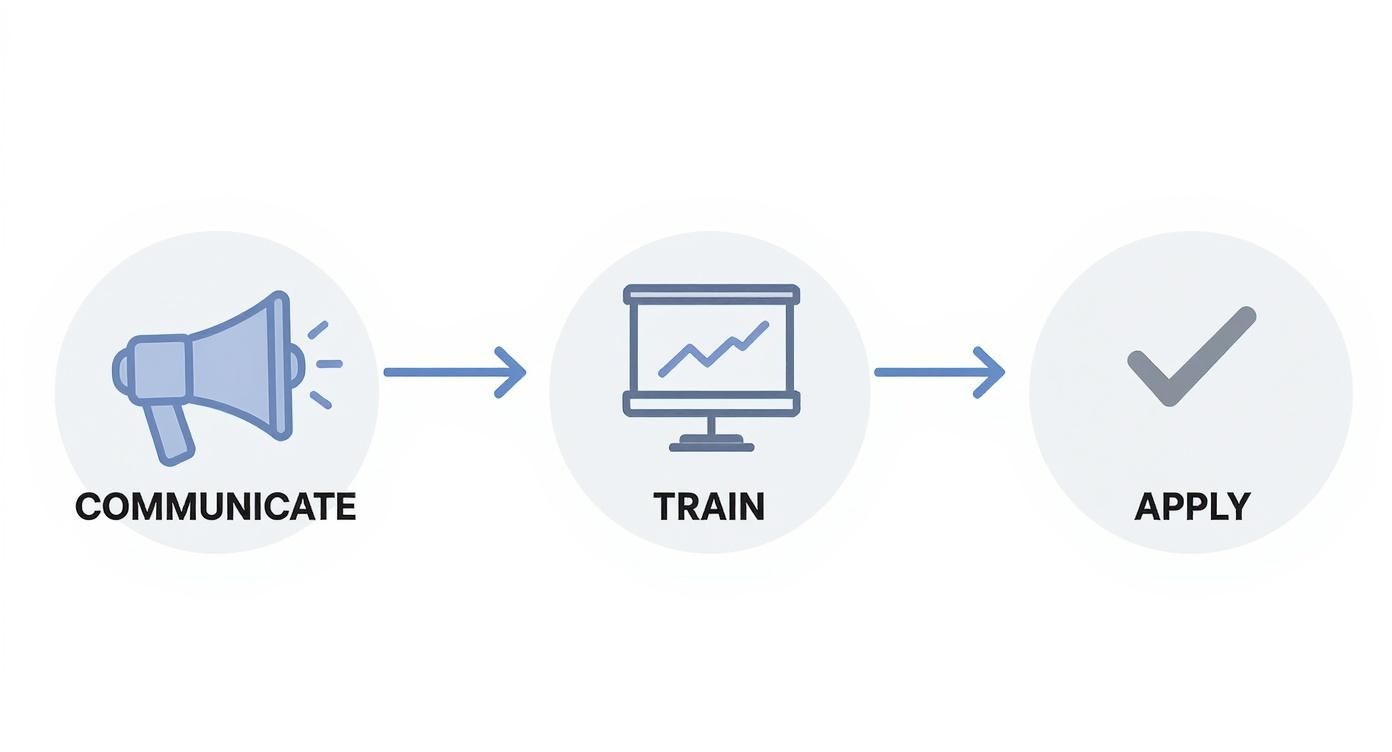
As you can see, technology is the tool that enables you to 'Apply' your policy effectively once the communication and training are done. By moving away from manual methods and embracing an automated solution, you not only enforce your absence and sickness policy more effectively but also create a much more supportive and organised workplace for everyone.
Common Sickness Policy Questions Answered
Even with the most carefully drafted absence and sickness policy, you can guarantee certain questions will keep landing in your inbox. It’s the tricky stuff: navigating the nuances of sick pay, figuring out what to do with different types of absence, and handling those sensitive long-term cases.
This section gets straight to the point, offering actionable answers to the questions we see HR managers and business owners grapple with most often. Getting these details right isn’t just about ticking boxes; it’s how you build trust and show your policy is fair for everyone.
What Is the Difference Between SSP and Contractual Sick Pay?
This is a classic point of confusion for employees and managers alike. They both involve getting paid while ill, but they come from two very different places.
Statutory Sick Pay (SSP) is the legal minimum. Think of it as the government-mandated safety net that UK employers must provide to eligible staff who are off sick. The rules on who gets it and how much they get are set by the government and tend to change each year.
Contractual Sick Pay (CSP), sometimes called company sick pay, is an extra benefit an employer chooses to offer in the employment contract. It’s not a legal requirement, but it’s a huge perk that can make a real difference to morale and retention.
Here’s a simple way to think about it:
- SSP: The legal baseline, offering a basic, government-set rate of pay.
- CSP: An optional company benefit, often paying full or half pay for a set period.
Your policy needs to spell out both clearly. Make sure you detail your company’s specific CSP scheme, including who qualifies and for how long.
How Should We Handle Frequent Short-Term Absences?
When an employee has a pattern of regular, short-term absences, it’s tempting to jump straight to formal warnings. But that’s rarely the best approach. The key is to first understand what’s really going on.
Your most important tool here is the return-to-work interview. This isn’t an interrogation; it’s a conversation. Use it to ask open, supportive questions to see if there’s a problem you can help with. Is there an underlying health condition they haven’t mentioned? Are they struggling with stress? This informal chat often gives you all the insight you need.
Frequent short-term absences can be a red flag for a deeper issue, from an unmanaged health condition to low morale. A supportive, investigative approach will always get you further than a purely disciplinary one.
Lots of businesses use a trigger system, like the Bradford Factor, to flag when an absence pattern might be becoming a problem. If a trigger is hit, it shouldn’t mean automatic disciplinary action. Instead, it should prompt a more formal, documented conversation to discuss the situation and agree on a plan for support or improvement. Always, always document these conversations.
Can We Dismiss an Employee on Long-Term Sick Leave?
This is probably the most legally sensitive part of absence management. So, let’s be direct: yes, it is possible to dismiss someone on long-term sick leave, but it has to be the absolute last resort. You must follow a fair, thorough, and compassionate process to avoid a costly unfair dismissal claim.
Dismissal should only ever be on the table after you've tried all other reasonable options. A fair process involves several non-negotiable steps:
- Maintain Regular Contact: Stay in touch with the employee. Your communication should be sensitive and supportive throughout their absence.
- Get Medical Evidence: With the employee’s permission, get an up-to-date medical report from their GP or an occupational health specialist. You need to understand their prognosis and the likelihood of them returning to work.
- Consult Fully with the Employee: Talk through the medical report with them. Listen to their perspective and what they think about returning.
- Explore All Reasonable Adjustments: Brainstorm every possible adjustment that could help them come back. This could mean a phased return, different duties, or flexible hours.
- Look for Alternative Roles: Before you even think about dismissal, you must consider if any other vacant roles in the company might be suitable for them.
Only after you have meticulously followed and documented these steps, and if there’s still no realistic chance of the employee returning to work in any capacity, can you fairly consider dismissal on the grounds of capability.
Putting a clear, fair, and automated absence and sickness policy into action is easier than you think. Leavetrack transforms your policy from a static document into a dynamic system, handling everything from requests and approvals to sick pay tracking and reporting, all in one place. Discover how Leavetrack can save you time and bring consistency to your absence management.