

A UK Guide to Unlimited Time Off Policies
Posted by Robin on 24 Dec, 2025 in
Let's be clear: unlimited time off isn't some mythical, never-ending holiday. It's a fundamental shift in how we think about work, trust, and performance. Instead of counting down a fixed number of annual leave days, it’s a flexible, trust-based system. Employees take time off when they need it, as long as their work is getting done and their absence doesn’t throw a spanner in the works for the team.
The whole focus moves from hours clocked to results and accountability.
How Unlimited Time Off Actually Works

The idea of "unlimited" leave can conjure up images of empty offices and year-long holidays. The reality is far more structured. It’s built on a foundation of mutual trust and responsibility between a company and its people. It's less about the quantity of days off and more about the quality of the work and the well-being of the team.
A good analogy is the office kitchen pantry. It’s stocked with snacks and drinks for everyone. The company trusts employees not to raid the shelves, and in return, everyone uses it responsibly to stay energised and productive. An unlimited leave policy runs on that same principle of mature autonomy.
A Framework of Trust and Performance
Instead of employees anxiously watching a dwindling bank of holiday days, the entire focus shifts to performance and output. An unlimited time off policy gives people the freedom to manage their own schedules—whether that’s for a family holiday, a doctor’s appointment, or a much-needed mental health day—without worrying about accruals.
Of course, this freedom is balanced by some very clear expectations:
- Performance is Paramount: The core agreement is that all job responsibilities are being met. As long as projects are on track and deadlines are hit, taking leave is straightforward.
- Team Coordination is Key: It's not a solo mission. Employees need to communicate with their managers and colleagues to ensure there's proper cover and no disruption to the workflow.
- Managerial Approval Still Applies: While the number of days isn't capped, requests still need to be approved. This isn't about control; it's about managing team schedules and business needs effectively.
An unlimited policy doesn't mean unplanned or unapproved absences. It's a system built on open communication, where time off is a dialogue, not a transaction. The goal is to create a culture where rested, recharged employees perform at their best.
To give you a clearer picture, let's quickly compare the two approaches.
Traditional PTO vs Unlimited Time Off at a Glance
This table breaks down the core differences in philosophy and practice between a standard leave policy and an unlimited one.
| Aspect | Traditional Paid Time Off (PTO) | Unlimited Time Off (UTO) |
|---|---|---|
| Core Principle | Time off is an earned benefit, accrued over time. A finite resource. | Time off is a flexible resource, based on trust and mutual responsibility. |
| Employee Focus | Managing and conserving a fixed number of days. | Managing workload and performance to enable taking time off when needed. |
| Administrative Focus | Tracking accruals, balances, and carry-over rules. | Fostering a culture of accountability and clear communication. |
| Manager's Role | Approving requests against a balance; managing leave liabilities. | Guiding team on performance, ensuring adequate cover, and promoting well-being. |
As you can see, the shift is from accounting for time to enabling performance.
Moving Beyond Accrual Accounting
From an admin perspective, this model gets rid of the headache of tracking holiday accruals for every single employee. However, for UK businesses, it’s crucial to remember that this doesn't remove the legal requirement to ensure employees take their statutory minimum leave. The policy simply provides flexibility above that legal baseline.
Ultimately, a successful unlimited time off policy is less about the rules in a handbook and more about the culture you build. It thrives in an environment where trust is high, communication is crystal clear, and success is measured by results, not just by being present.
The Real Pros and Cons of an Unlimited Policy
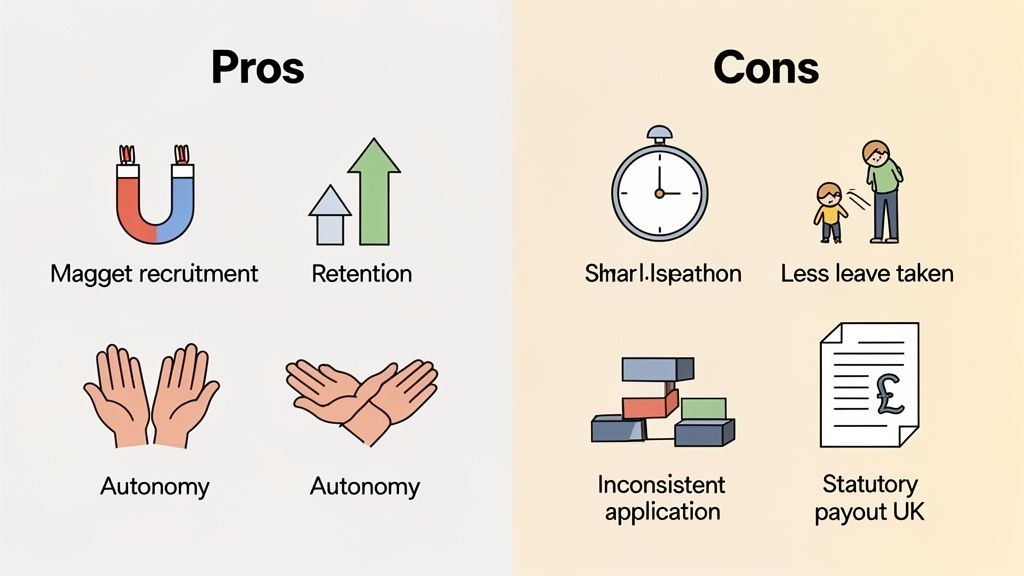
Switching to an unlimited time off policy can feel like a huge leap forward for a modern company. But it's crucial to weigh the genuine benefits against the potential drawbacks. It's not a silver bullet for company culture, and making it work depends on understanding both sides of the coin before diving in.
On the positive side, the upsides are significant and can directly impact your bottom line. An unlimited leave policy is a powerful magnet in a competitive job market, signalling a culture of trust and autonomy that is highly attractive to top talent.
Beyond boosting morale, it can be a powerful part of your wider HR strategy. If you're exploring other strategies to increase employee retention, you'll see how unlimited leave fits into the bigger picture. This approach empowers your team, improves work-life balance, and can lead to higher productivity from well-rested employees.
The Clear Advantages for Your Business
For many organisations, the benefits go well beyond simply making staff happier. They create real, tangible business value.
- Enhanced Recruitment and Retention: In a world where nearly 80% of employees might choose better benefits over a pay rise, an unlimited policy really stands out. It shows you trust your team and are invested in their well-being, which is a huge factor in keeping your best people.
- Increased Employee Autonomy and Trust: This kind of policy hands the reins to your staff, letting them manage their own time and energy. This sense of ownership often leads to greater job satisfaction and a more committed, motivated workforce.
- Reduced Administrative Burden: Say goodbye to the headache of complex accrual calculations and tracking carry-over days. While you still need to monitor statutory leave in the UK, the overall admin load for managing holiday balances is significantly lighter.
An unlimited time off policy is a statement. It declares that you hire responsible adults and trust them to manage their work and their well-being without micromanagement.
The Hidden Pitfalls to Watch Out For
Of course, the reality of an unlimited policy isn't always as rosy as it sounds. If it isn't managed with real care and intention, a few counterintuitive challenges can pop up. Good intentions can easily pave the way for negative outcomes.
One of the most surprising risks is that employees may actually take less time off. This isn't a myth; it happens for a few key reasons:
- Fear of Perception: Staff might worry about being seen as less committed than their colleagues. This can create a culture of "leave shame" where nobody wants to be the first to book a long holiday.
- Ambiguity and Guilt: Without a defined number of days, employees can feel genuinely uncertain about what's an "acceptable" amount of leave to take. This often leads them to err on the side of caution and take fewer breaks.
- Managerial Inconsistency: If one manager approves leave freely while another is more restrictive, it can breed resentment and confusion across teams. This completely undermines the policy's sense of fairness.
This is a well-documented trend. Case studies right here in the UK show that employees with open-ended holiday policies often take the same or even fewer days than those with a set allowance. Some data suggests employees on unlimited plans can take up to 30% less leave than their peers.
This phenomenon, when combined with UK legal requirements for paying out statutory leave on exit, has led some companies to add mandated minimums to their policies. It's a way to prevent burnout and ensure they stay compliant.
Finally, the legal complexity for UK businesses is a massive consideration. An "unlimited" policy doesn't get you out of your duty to track and pay out accrued statutory leave when an employee leaves. This creates a critical administrative task that, if you get it wrong, can lead to serious legal and financial trouble.
Navigating UK Employment Law and Payroll
The idea of "unlimited time off" sounds wonderfully simple, but in the UK, it operates within a surprisingly firm legal framework. This is a crucial point that trips up many businesses; "unlimited" doesn't mean unregulated. Getting this wrong isn't an option, so understanding your legal duties is non-negotiable to protect both your company and your people.
At the heart of UK employment law is the statutory minimum entitlement to paid leave. Think of this as the non-negotiable foundation upon which any flexible leave policy must be built. You can't just swap it out for a vague promise of unlimited days off.
The Unbreakable Rule of Statutory Leave
In the UK, the law is crystal clear: workers are entitled to a minimum of 5.6 weeks of paid annual leave. For someone working a standard five-day week, that works out to 28 days. This figure can include bank holidays, depending on how their employment contract is worded.
This legal minimum is an absolute. An unlimited time off policy can grant flexibility above and beyond this amount, but it can never erase this statutory floor. This means you must still track this base entitlement for every single employee, even within an "unlimited" system.
It's best to think of unlimited leave in the UK as a two-tier system. The first tier is the legally required 5.6 weeks, which you absolutely have to track and manage. The second tier is all the extra, flexible leave your company offers on top of that.
This isn't just a matter of good practice; it has serious payroll and legal implications, especially when an employee decides to move on.
The Payout Problem at Termination
One of the trickiest parts of running an unlimited policy in the UK pops up when an employee leaves. The law states that any accrued but unused statutory holiday must be paid out in their final salary. This creates a real administrative headache if you haven't been keeping proper records.
If you aren't tracking that statutory portion of leave separately, how can you possibly calculate what you owe? This is where many well-intentioned policies fall apart. Without clear records, you risk underpaying former employees, leaving your business wide open to employment tribunals and expensive legal battles.
This is exactly why implementing these policies is more complex for UK employers. As employment law specialists often point out, you can't just replace statutory leave with a blanket "unlimited" offer. For a proper deep-dive into these obligations, check out our comprehensive guide on UK statutory holiday allowance. British law guarantees that 5.6 weeks' minimum, and it's your job to make sure it's met, accounted for, and paid out correctly on termination.
Best Practices for UK Compliance
To run a compliant unlimited time off policy in the UK, you need a solid system for tracking leave that clearly separates statutory time from the extra, flexible time off.
Here are the essential steps to stay on the right side of the law:
- Track Statutory Leave Separately: Use a system like Leavetrack to earmark the first 5.6 weeks of an employee’s leave as their statutory entitlement. This gives you a clear, auditable record.
- Ensure Minimums Are Met: Your policy and your managers should actively encourage staff to take at least their statutory minimum leave. This isn't just about compliance; it's about preventing burnout and fulfilling your duty of care.
- Establish a Clear Payout Formula: Your policy document must state exactly how accrued, unused statutory leave will be calculated and paid when someone leaves. This removes any grey areas and ensures the process is fair.
- Communicate the Policy Clearly: Make sure every employee understands that while their leave is flexible, the company is still tracking and protecting their fundamental statutory rights.
By treating the statutory 5.6 weeks as a distinct and protected block of time, you can offer all the flexibility of unlimited leave without falling foul of UK employment law. It’s an approach that ensures fairness, keeps you compliant, and makes the offboarding process smooth and legally sound for everyone involved.
How to Draft a Clear and Compliant UTO Policy
An unlimited time off (UTO) policy sounds liberating, but winging it is a recipe for disaster. The idea might be built on trust, but a solid, written policy is what makes it work in the real world. This document is your safety net—it provides clarity for your team and legal protection for the business.
Moving from a great idea to a practical policy means getting the details right. You need to set clear expectations to prevent misuse and, crucially, make sure you're still playing by the rules of UK employment law. Without this framework, you're opening the door to confusion, inconsistency, and some serious legal headaches.
Starting with a Purpose Statement
Every good policy needs a "why." Before you dive into the nitty-gritty, start with a purpose statement that explains the philosophy behind your approach to unlimited leave. This is your chance to frame it not just as a perk, but as a commitment to trust, accountability, and focusing on results, not just hours clocked.
This section should spell out that you want employees to have the flexibility to manage their work-life balance, to properly rest and recharge. It’s about showing you trust them to take the time they need while still smashing their professional goals. A clear purpose statement gets everyone, from the CEO to the newest hire, on the same page.
Defining Key Processes and Expectations
Once you've set the tone, it's time for the practical stuff. Vague guidelines are the number one cause of UTO policies going wrong. Your policy needs to be crystal clear on how things will actually work day-to-day.
Here are the key things you need to spell out:
- Eligibility: Who gets this benefit? Be specific. State whether it’s for full-time, permanent staff and if it kicks in after a probationary period.
- Request and Approval Process: How do people ask for time off? Detail the notice period you expect. For example, maybe two weeks' notice for a short break of 3-5 days, and four weeks for anything longer. And always stress that all leave is subject to a manager's approval based on business needs.
- Team Coordination: This is a big one. Add a clause that requires employees to coordinate with their teammates to ensure their work is covered. It reinforces that with great freedom comes great responsibility.
If you’re looking for a solid starting point, seeing how traditional policies are structured can be a massive help. You can learn more about these core elements by exploring a template annual leave policy, as many of the fundamental clauses will still apply.
Ensuring UK Legal Compliance
For any UK business, this is non-negotiable. Your UTO policy cannot simply ignore statutory holiday entitlements; it has to work alongside them. Get this wrong, and you're in very hot water.
In the UK, an unlimited leave policy must supplement, not replace, an employee's statutory rights. Your policy has to make it crystal clear that the company guarantees every employee will take their legal minimum of 5.6 weeks of paid leave.
To cover all your bases, you'll need to create some essential clauses for your policy. Here’s a breakdown of what to include to ensure everything is clear, fair, and legally sound.
Essential Clauses for Your UK UTO Policy
| Clause/Section | Purpose and Key Details to Include |
|---|---|
| Purpose and Philosophy | Explain why you're offering UTO. Frame it around trust, flexibility, and focusing on results over hours worked. |
| Eligibility | Clearly define who the policy applies to (e.g., full-time, permanent employees) and when it becomes effective (e.g., after probation). |
| Request & Approval | Detail the process for requesting leave, including notice periods and the requirement for managerial approval based on business needs. |
| Minimum Leave Requirement | State that the company requires employees to take a minimum number of days off per year (e.g., 25 days) to promote wellbeing. |
| Statutory Leave Tracking | Explicitly state that the company will track leave to ensure the statutory minimum of 5.6 weeks is taken. The first 28 days (pro-rata) taken will be logged as statutory holiday. |
| Payment on Termination | Clarify that any accrued but unused statutory holiday for the current leave year will be paid out when an employee leaves the company. |
| Long-Term Absences | Specify that UTO is separate from statutory leave like sickness, maternity, or paternity leave, which are governed by their own policies. |
| Fair Use & Performance | Include a clause that links the policy to performance expectations. The privilege of UTO is contingent on meeting job responsibilities. |
By building these clear, compliant clauses directly into your policy, you create a robust framework that gives your team genuine flexibility while protecting the business and fulfilling all your legal duties. It's the only way to make unlimited time off a sustainable success.
Successfully Implementing Your New Leave Policy
Having a well-written policy is one thing, but the rollout is where the rubber meets the road. This is the moment your new unlimited time off policy moves from a document into a living, breathing part of your company culture. It demands a proper strategy, focusing on clear communication, solid manager training, and keeping a watchful eye to make sure it actually works as you intended.
Let’s be clear: this isn't a 'set it and forget it' perk. In fact, an unlimited policy needs more active management than a traditional one if you want to avoid common traps like staff burnout or people taking even less time off than before. The real goal here is to build a system that genuinely looks after your team's wellbeing while still hitting business targets.
Communicating the Change Effectively
First things first: communication. Your team is going to have questions, maybe even a few doubts, so you need to get out in front of it and explain the ‘why’ behind the shift. It's crucial to frame this as a move based on trust, giving people more autonomy, and focusing on results, not just hours clocked.
When you introduce the policy, make sure you nail these points:
- The Philosophy: Hammer home that this is about trusting your team to be responsible adults who can manage their own time while delivering on their commitments.
- The Process: Spell out exactly how to request leave, what the notice periods are, and stress the importance of coordinating with teammates to ensure there’s always cover.
- The Safeguards: Reassure everyone that the company will be making sure people take enough time off to rest, which includes tracking the statutory minimums.
Training Your Managers to Lead the Way
Your managers are the gatekeepers. How they understand and apply this policy will make or break its success. If they aren't fully on board and properly trained, you're heading for a world of inconsistent approvals, confusion, and maybe even a culture where people are afraid to ask for time off.
Manager training needs to be laser-focused on three key areas:
- Approving Requests Fairly: Teach managers to look at requests through the lens of team capacity and project deadlines, not personal feelings or how much leave someone has already had that year.
- Managing Team Capacity: Give them the tools and skills to plan for absences. They need to ensure workloads stay manageable and projects don't grind to a halt just because someone’s on holiday.
- Leading by Example: This one is massive. Managers have to take holidays themselves and properly switch off. If they don't, they send a silent message to their teams that taking time off isn’t really okay.
This infographic breaks down the essential process for getting your new policy off the ground.
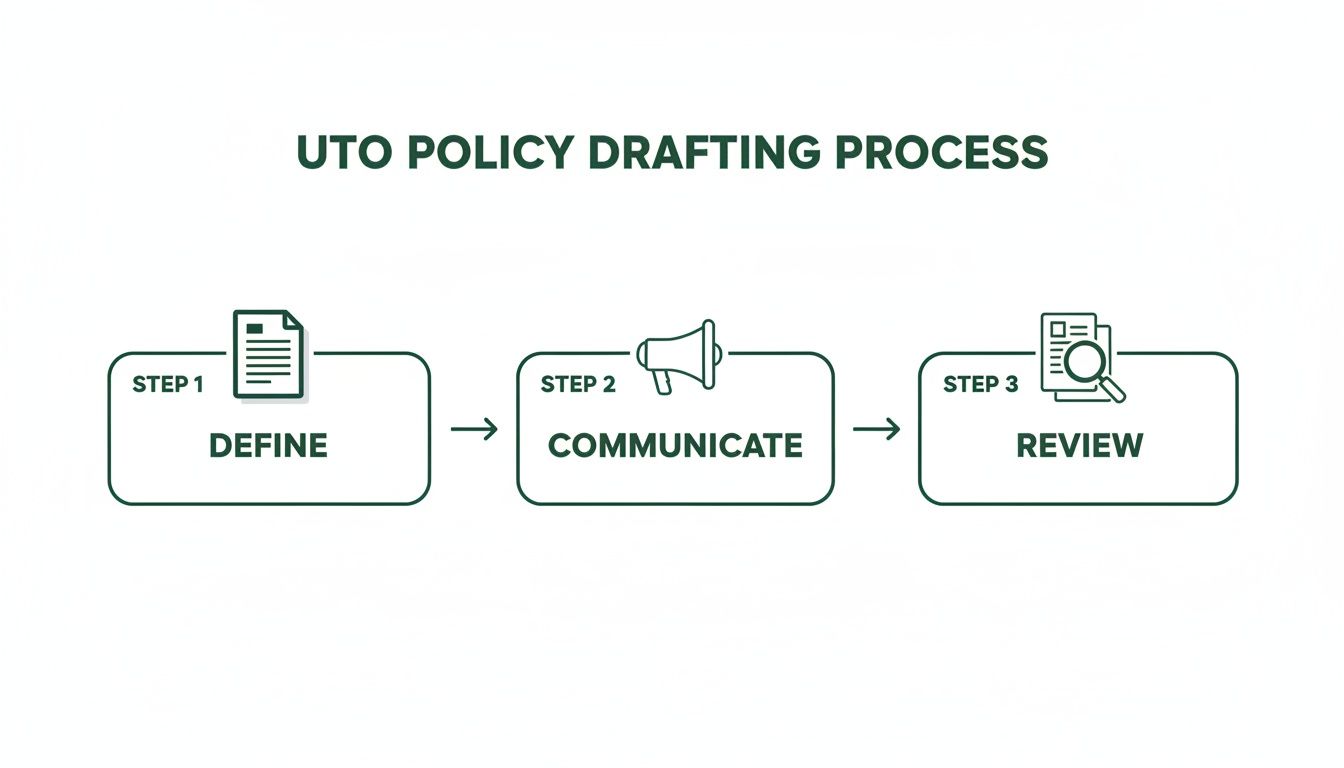
This simple flow—Define, Communicate, Review—shows that launching a policy isn't a one-off task. It's a continuous cycle.
The success of an unlimited leave policy hinges on active management. It is a continuous effort to foster a culture where rest is encouraged and performance is measured by outcomes, not by hours spent at a desk.
That cultural piece is everything. A generous policy on paper doesn't guarantee people will take more time off. Real-world data shows that it’s often managers and the wider company culture that dictate how much leave people actually take, far more than the policy itself.
Using Tools to Ensure Fairness and Visibility
To avoid the classic pitfall of people taking too little holiday, you need a solid system for keeping an eye on time off. This isn't about micromanagement; it’s about your duty of care as an employer and making sure the policy benefits everyone. When you're rolling out your new policy, using modern HR software can make management and compliance a whole lot simpler—for example, by partnering with a Hubdrive HR solution expert.
A dedicated leave management tool is pretty much non-negotiable. It gives everyone a clear, central view of who is off and when, which helps managers make fair decisions and spot anyone who might be overworked or not taking enough breaks. We've put together a full step-by-step guide to implementing an absence management system if you need more detail.
A clear dashboard gives managers the at-a-glance visibility they need to stay on top of things. By actively watching trends, you can step in and have a supportive chat with team members who might be on a path to burnout, long before it becomes a serious problem.
Measuring Success and Avoiding Common Pitfalls
So, you’ve rolled out an unlimited time off policy. How can you tell if it’s actually working? The real measure of success isn’t just counting how many days people take off. It's about the real, positive impact the policy has on your people and, in turn, your business.
A successful unlimited leave policy should be a catalyst for improvement across the board. You need to look beyond the holiday calendar and dig into key business metrics to see the full picture. Success is a healthier, more productive, and more engaged workforce—not just an empty office.
Key Metrics to Monitor
To get a clear view of your policy's impact, you need a mix of hard data and genuine feedback from your team. This balanced approach will tell you whether the policy is a genuine benefit or just a nice idea on paper.
Here are the essential metrics to keep an eye on:
- Employee Engagement Scores: Are your team members more motivated and satisfied? Regular pulse surveys are a great way to get direct insight into morale.
- Staff Retention Rates: A great unlimited leave policy can be a powerful reason for people to stay. Monitor your turnover rates before and after you brought the policy in to see if more of your top talent is sticking around.
- Productivity Levels: Is work still getting done to a high standard? Keep track of project completion rates, team output, and other key performance indicators (KPIs) to make sure performance hasn't dipped.
- Sickness Absence: A well-rested team is a healthier team. A noticeable drop in short-term sick days can be a strong signal that employees are using their leave to properly recharge and avoid burnout before it happens.
Avoiding the Most Common Traps
Even with the best intentions, an unlimited time off policy can go wrong if you're not careful. Knowing the common pitfalls is the first step to dodging them and making sure your policy remains a valuable, sustainable benefit for everyone.
The greatest risk of an unlimited policy is not that people will take too much time off, but that they will take too little. A culture of 'leave shame' can quickly turn a well-intentioned perk into a source of anxiety and burnout.
Here are the most frequent issues and how to tackle them head-on:
- The Culture of 'Leave Shame': This is what happens when employees feel guilty or worry they’ll be judged for taking time off.
- Solution: Managers and senior leaders have to lead by example. They need to take proper, meaningful breaks and actively encourage their teams to do the same. This reinforces the message that rest is essential, not a luxury.
- Inconsistent Approvals: If one manager is easy-going while another is strict, it creates a sense of unfairness that can poison the whole policy.
- Solution: Provide clear, consistent training for all managers. The focus should be on approving leave based on team capacity and business needs, not on personal feelings or discretion.
- Poor Tracking and Visibility: Without a central system, you have no real way of knowing who is taking leave, who isn't, and whether you're even meeting your legal minimums for time off.
- Solution: Use a dedicated tool like Leavetrack to get a clear, real-time view of absences across the entire company. This is crucial for ensuring both fairness and compliance.
Frequently Asked Questions About Unlimited Leave
Even the most carefully planned unlimited leave policy will spark questions from managers and team members alike. Getting ahead of these queries is the best way to ensure a smooth transition and build confidence in the new system. Let's tackle some of the most common questions that crop up when UK businesses introduce a flexible leave policy.
By addressing these concerns head-on, you foster a culture of clarity and trust from day one.
Is Unlimited Time Off Really Unlimited?
In a word, no. The term "unlimited" is more about the philosophy behind the policy than a literal promise of endless holidays. It simply means we've removed the fixed cap on the number of days an employee can take each year; there's no set accrual limit.
But all time off is still grounded in reality:
- Managerial Approval: Every request needs a green light from a manager. This ensures business needs are met and teams always have enough cover.
- Performance Expectations: The whole system is built on trust. It assumes that employees are on top of their responsibilities and hitting their performance goals.
- Team Coordination: You can't just disappear. Staff need to coordinate with their colleagues to make sure projects and workflows aren't disrupted.
Think of it as flexible, not infinite. It’s a grown-up approach based on mutual trust, empowering people to take the time they genuinely need to rest and recharge, as long as it works for the business.
How Do We Handle Holiday Pay When Someone Leaves?
This is a massive one for UK employers, and you have to get it right. While your policy might be "unlimited," you are still legally required to pay out any accrued but unused statutory holiday entitlement when an employee leaves.
In the UK, that statutory entitlement is 5.6 weeks per year. Your leave management system must be able to track this statutory portion completely separately from any additional time off taken. When someone's contract ends, you need to calculate how much of their statutory allowance they've earned in the current leave year, subtract any statutory leave they’ve already taken, and pay them the difference in their final salary. Getting this wrong can land you in a costly employment tribunal.
What Happens If Someone Takes Too Much or Too Little Leave?
Managing the extremes is where good management really shines. If an employee is taking so much time off that it's hurting their performance or impacting the team, that's a performance issue, not a leave issue, and it should be handled as such.
The bigger risk, funnily enough, is often that people take too little time off. They worry about being seen as less committed, so they don't switch off. This is where active management is crucial.
Managers should be keeping an eye on leave patterns and giving a gentle nudge to team members who haven't had a proper break. Some companies even bring in a minimum leave requirement (say, 20 days per year) to make sure everyone gets enough downtime to avoid burnout. This proactive approach ensures the policy actually does what it's supposed to: support employee wellbeing.
Ready to manage your leave policy with clarity and confidence? Leavetrack provides the tools you need to track statutory leave, ensure fairness, and give your team the visibility to plan effectively. See how it works at https://leavetrackapp.com.