
Annual Leave Entitlement United Kingdom Explained
Posted by Robin on 14 Nov, 2025 in
In the UK, nearly every full-time worker is legally entitled to 5.6 weeks of paid holiday each year. This is the statutory minimum, which works out to 28 days off for someone on a standard five-day week. This baseline is a legal right that applies whether you're a full-time employee, an agency worker, or on a zero-hour contract.
Understanding Your Core Holiday Entitlement
Think of your annual leave as a protected time-off account that your employer is required by law to provide. It's a fundamental right that helps you rest, prevents burnout, and ensures you get a proper break from work. Getting your head around this core principle is the first step to managing your time off properly.
This legal minimum is the absolute floor; employers can, and often do, offer more generous holiday packages. They just can't ever provide less. The details of any extra leave are usually spelled out in your employment contract, which is known as 'contractual leave'.
Statutory vs Contractual Leave Explained
It's really important to know the difference between your statutory rights and what your contract offers. The annual leave entitlement in the United Kingdom guarantees the 5.6 weeks, but your company might add extra days as a perk.
- Statutory Leave: This is the legal minimum of 5.6 weeks. It’s a universal right for almost all workers.
- Contractual Leave: This is any extra holiday your employer offers on top of the statutory amount. For example, a company might give you 33 days of leave per year, which is the 28 statutory days plus 5 extra contractual days.
Knowing this distinction is key because different rules can apply to the statutory part versus the extra contractual days, especially when it comes to carrying over leave or getting paid for it when you leave a job. You can find out more in our guide on statutory holiday entitlement in the UK.
How Your Work Schedule Affects Your Entitlement
The 5.6-week figure is always the same, but the actual number of days you get depends on how many days a week you work. The calculation is pretty simple: just multiply the number of days you work each week by 5.6.
Here’s a quick summary to show how the minimum legal holiday entitlement works for different schedules.
Minimum Annual Leave Based on Your Work Week
| Days Worked Per Week | Minimum Weeks of Leave | Total Days of Leave |
|---|---|---|
| 5 days | 5.6 weeks | 28 days |
| 4 days | 5.6 weeks | 22.4 days |
| 3 days | 5.6 weeks | 16.8 days |
| 2 days | 5.6 weeks | 11.2 days |
| 1 day | 5.6 weeks | 5.6 days |
As you can see, part-time workers still get the same number of weeks off, but it translates to fewer days on a pro-rata basis. This system keeps things fair, no matter what your working pattern looks like.
The core principle is that every worker receives a minimum of 5.6 weeks of paid time off. This is a foundational element of UK employment law, ensuring everyone has the opportunity for rest and recuperation.
The official GOV.UK website has some handy tools and guidance to help workers double-check their rights.
This screenshot shows the government's holiday entitlement calculator, a really useful resource for getting a quick and official confirmation of your specific leave allowance. It just goes to show that the legal minimum is the starting point for everything.
For companies that operate globally or are thinking about hiring internationally, figuring out how to manage employee entitlements can lead them to explore Employer of Record services. These services take care of all the legal compliance across different countries, making sure local labour laws, including annual leave, are handled correctly.
Calculating Annual Leave For Different Work Patterns
Let's face it, the classic nine-to-five, Monday-to-Friday job isn't the only way people work anymore. From part-time roles to flexible shift patterns and zero-hour contracts, the modern workplace is incredibly diverse. This means our approach to calculating annual leave entitlement in the united kingdom has to be just as flexible.
The key principle that keeps everything fair is pro-rata. Think of the statutory holiday entitlement as a whole pizza. A full-time employee gets the whole pizza, while a part-time worker gets a slice that's in proportion to the hours they work. This ensures everyone gets their 5.6 weeks of leave, even if the final number of days or hours looks different on paper.
This handy infographic breaks down how the basic entitlement works for a full-time employee.
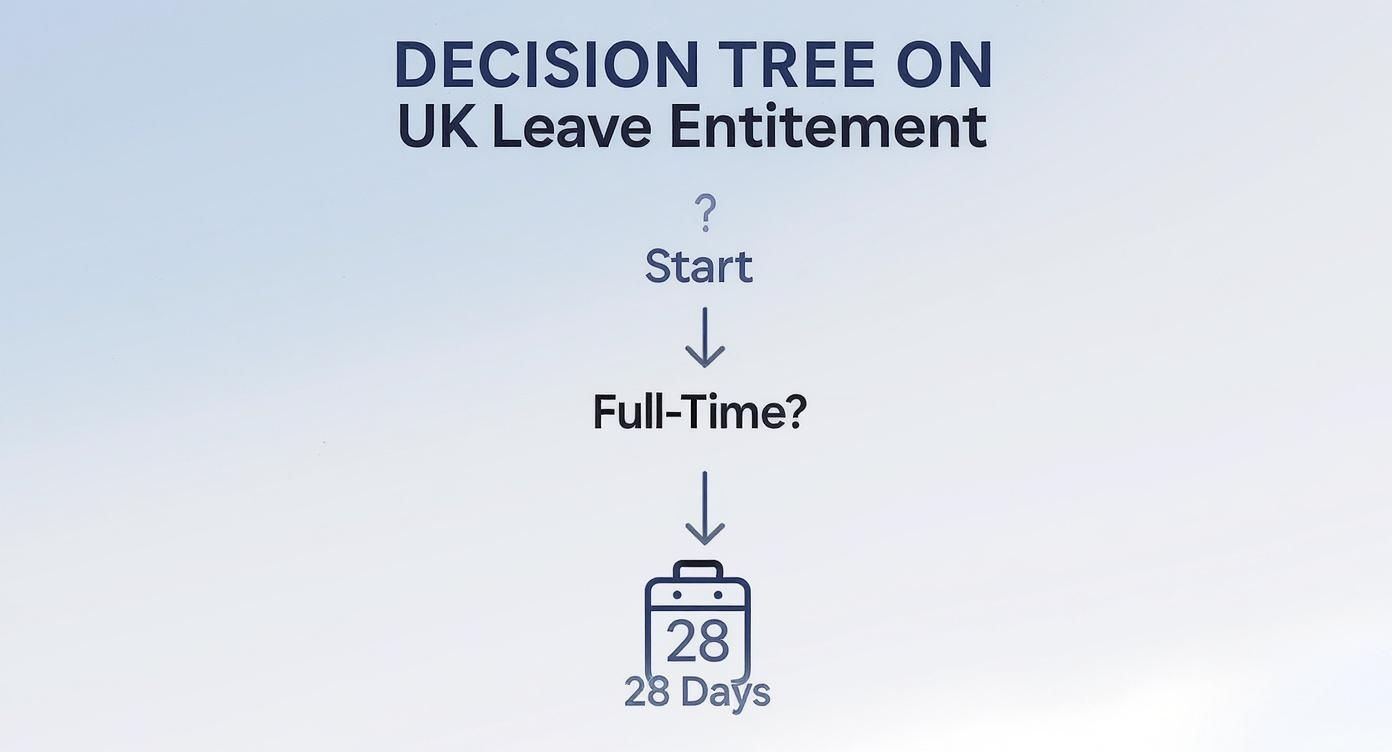
As you can see, it's pretty straightforward for full-timers, confirming the statutory minimum of 28 days. But what happens when your work schedule isn't so simple?
Different work patterns require different calculation methods to ensure fairness. Below is a quick comparison of the most common scenarios.
How Leave Calculations Differ by Job Type
| Employment Type | Calculation Method | Example Calculation |
|---|---|---|
| Part-Time | Days worked per week multiplied by 5.6 | 3 days/week × 5.6 weeks = 16.8 days |
| Irregular Hours | Average weekly hours (over 52 weeks) multiplied by 5.6 | 20 average hours/week × 5.6 weeks = 112 hours |
| Zero-Hour Contract | Hours worked multiplied by 12.07% | 80 hours in a month × 12.07% = 9.656 hours |
These methods ensure that, no matter the working arrangement, every employee receives their fair, proportional holiday entitlement as mandated by UK law. Let's dig into each one.
Leave Calculations For Part-Time Workers
For part-time staff, the calculation is refreshingly simple. You just multiply the number of days they work each week by 5.6.
Let's take Sarah, who works three days a week.
- Calculation: 3 days × 5.6 weeks = 16.8 days of paid annual leave.
This method keeps things fair. Sarah works 60% of a standard five-day week, so she gets 60% of the full-time holiday allowance (16.8 days is 60% of 28). If you need to tackle more complex situations, our guide on how to calculate pro-rata holiday in the UK breaks things down even further.
Calculating Holiday For Irregular Hours and Shift Work
But what about people whose hours change week to week, like casual staff or shift workers? Trying to calculate their leave in 'days' just doesn't work. The solution is to calculate it in hours instead.
First, you need a baseline. A typical full-time employee on a 37.5-hour week gets 210 hours of holiday (37.5 hours × 5.6 weeks). For someone with a variable schedule, we need to find their average weekly hours using a 52-week reference period.
Here’s how it works:
- Look back over the last 52 paid weeks. If they haven't been with you that long, just use the number of weeks they have worked.
- Add up the total hours they worked during that time.
- Divide the total hours by 52 (or the number of weeks worked) to get their average weekly hours.
- Finally, multiply those average weekly hours by 5.6 to get their total holiday entitlement in hours.
This 52-week reference period is vital. It ensures holiday pay accurately reflects what someone typically earns, especially if they do a lot of overtime or their hours fluctuate.
The 12.07% Method For Zero-Hour Contracts
For workers on zero-hour contracts or other highly unpredictable schedules, there’s another approach which has recently been formalised in law: the 12.07% accrual method.
Where does that number come from? Well, a standard year has 52 weeks. Take away the 5.6 weeks of statutory leave, and you're left with 46.4 working weeks. That 5.6 weeks of leave is 12.07% of the 46.4 working weeks. Simple, right?
This means for every single hour an employee works, they build up holiday entitlement at a rate of 12.07%.
Let's imagine Tom is on a zero-hour contract and works 80 hours in a month.
- Calculation: 80 hours × 12.07% = 9.656 hours of paid holiday accrued.
This gives a clear, direct way to figure out holiday for the most unpredictable work patterns. The law now also permits "rolled-up holiday pay" for these workers, where the 12.07% is added to their regular pay packet. As long as it's clearly itemised on their payslip, it provides immediate payment for the leave they're earning as they go.
How Bank Holidays Affect Your Total Leave
Bank holidays often feel like a welcome bonus, a few extra days off scattered throughout the year. But how they actually fit into your annual leave entitlement in the United Kingdom can be a bit of a grey area for many employees. A common misconception is that you have an automatic legal right to paid time off for bank holidays. The reality? It all comes down to what's written in your employment contract.
The good news is that most employers do count bank holidays as part of your paid leave. The statutory minimum is 5.6 weeks of paid holiday per year (which works out to 28 days for a full-time employee), and it's up to the employer how they manage bank holidays within that total. This usually plays out in one of two ways.

Common Approaches To Bank Holidays
Take a look at your contract, and you’ll likely find your company uses one of these two models to handle bank holiday leave.
- Inclusive Model: Your contract might give you a single pot of leave, something like, "28 days of annual leave, inclusive of bank holidays." This approach offers flexibility, but it means you have to actively book bank holidays as leave if you want them off and your workplace stays open.
- Exclusive Model: Alternatively, your contract could state you get "20 days of annual leave plus bank holidays." In this case, the 8 bank holidays (for England and Wales) are essentially fixed days off, leaving you with 20 flexible days to book as you please.
For many office-based roles, the exclusive model is the norm. However, for sectors that operate seven days a week, like retail or hospitality, the inclusive model is far more practical. It's vital you know which system your company follows.
Working On A Bank Holiday
So, what happens if your rota has you down to work on a bank holiday? Your employer is perfectly within their rights to ask this of you, particularly in customer-facing industries. The crucial thing to remember is that your holiday entitlement is protected.
If you work on a bank holiday, you don't simply lose that day off. Instead, you should be given that time back "in lieu," allowing you to book another day off at a later date. Your total paid leave for the year must never dip below the 5.6-week statutory minimum.
An employer can require you to work on bank holidays. The key is that this does not reduce your overall annual leave entitlement; you are still owed that day off, to be taken at another time.
Bank Holidays For Part-Time Workers
For part-time staff, fairness is built into the system using a pro-rata calculation. This ensures they receive a proportional amount of the bank holidays, regardless of whether they would normally work on the days the bank holidays happen to fall.
For example, if a full-time employee gets 8 bank holidays, a part-timer working three days a week (which is 60% of a full-time week) is entitled to 4.8 of them (8 days x 0.6). This system prevents someone from being penalised just because their regular day off is always a Monday.
This calculation makes sure everyone gets their fair share of paid time off, keeping the annual leave entitlement in the United Kingdom consistent for all. While the dates are a welcome break—especially during that long stretch in autumn—it always helps to understand the rules. For more on that, you might enjoy our article on surviving the UK's bank holiday drought until Christmas.
Rules for Carrying Over Unused Annual Leave
So, what happens to the holiday days you don’t manage to take by the end of the year? Many of us assume it’s a simple “use it or lose it” situation, and for the most part, UK law agrees. The whole point of annual leave is to make sure we all get enough rest, and stockpiling days doesn’t really fit with that idea.
But it's not quite that black and white. The rules are actually more nuanced, and it all comes down to understanding how your annual leave entitlement in the United Kingdom is split into two distinct pots when it comes to carrying days over.

The Two Tiers of Statutory Leave
Think of your statutory 5.6 weeks of leave like a bank account with two separate pots of money, each with different rules for withdrawal.
- The Core Four Weeks: This chunk of your leave comes from the EU's Working Time Directive. The law is incredibly strict here—these four weeks cannot generally be carried over into the next leave year. The only real exceptions are if you were physically unable to take them because of long-term sickness or family-related leave.
- The Additional 1.6 Weeks: This is the extra bit of leave granted under UK law. With this portion, employers have a bit more wiggle room. They can let you carry these days over, but only if they have a specific agreement or policy in place that says so.
This means that, by default, you could stand to lose up to four weeks of holiday if you don’t use it. That’s why your company's policy is the most important document to check.
When Carrying Over Leave Is Legally Protected
While the default position is restrictive, there are a few specific situations where the law steps in to protect your right to carry forward holiday—especially those core four weeks. This protection kicks in when you were legally unable to take your leave.
The most common scenarios are:
- Long-Term Sickness: If you're on long-term sick leave and just can't take your holiday, you’re allowed to carry over up to four weeks of statutory leave. The catch is that it must be used within 18 months of the end of the leave year in which it was accrued.
- Family Leave: If you’re on maternity, paternity, adoption, or shared parental leave, you continue to build up holiday entitlement. Since you can’t take annual leave at the same time as family leave, the law says you can carry over any unused statutory holiday to the next year.
It is crucial to remember that your employment contract or company handbook is your definitive guide. Many employers offer more generous carry-over policies than the legal minimum as a staff benefit.
Company Policies and Contractual Agreements
Your employer can always choose to be more generous than the statutory minimum. They might let you carry over a set number of days—often up to five—from your contractual allowance into the new year. This is a common perk, but it’s completely at the employer's discretion and has to be written down in your contract or staff handbook.
Always check your company's specific rules. They will spell out:
- How many days (if any) you can carry over.
- The deadline for using any carried-over days.
- The process for actually requesting to carry leave forward.
Interestingly, there's been a positive shift in how we're using our holiday time. The amount of unused annual leave has dropped massively over the past five years. Back in 2019, the average UK employee left 18.5 days unused, but by 2024, this plummeted to just 5.3 days—that’s a 71% decrease.
While this is great news for employee wellbeing, 65% of UK workers still left some holiday on the table in 2024. You can discover more insights about annual leave statistics on timetastic.co.uk. This just goes to show how important it is to get your head around the carry-over rules so you don't lose out on a well-earned break.
What Happens to Holiday When You’re on Sick or Family Leave?
Life happens. Whether it's an unexpected illness or the wonderful chaos of a new baby, these major events shouldn't mean you lose out on your well-deserved holiday time. Thankfully, the law in the UK protects your annual leave entitlement, making sure it keeps building up even when you’re away from work for health or family reasons.
It’s a simple but vital rule: your statutory holiday entitlement continues to accrue (that’s the official term for 'build up') when you're on sick leave. This holds true no matter how long you're off. Think of your right to paid time off as a core part of your contract – it doesn’t just disappear because you’re unwell.
Sickness During a Pre-Booked Holiday
We’ve all dreaded it. You’ve booked a lovely week off, only to come down with a nasty bug the day before you’re meant to fly. It’s incredibly frustrating, but UK law is firmly on your side. Holiday is for rest, not recovery. You can't be on sick leave and annual leave at the same time.
If you fall ill, you need to treat it just like any other sickness absence:
- Tell your employer straight away, following their usual sickness reporting procedure.
- Get a doctor's note if that’s part of your company's policy for the length of your absence.
- Ask to cancel the annual leave for the days you were sick and have them recorded as sickness instead.
Do this, and you can reclaim those holiday days you couldn't enjoy. They simply go back into your leave pot, ready for you to book a proper break once you’re back on your feet.
Holiday is for rest and relaxation. Sick leave is for recovery. If you’re genuinely unfit for work, you have the right to take that time as sick leave and get your annual leave days back, even if they were booked months in advance.
Holiday Entitlement During Family Leave
This protection extends to family-related leave, too. When you’re on maternity, paternity, adoption, or shared parental leave, your statutory holiday entitlement keeps growing just as if you were clocking in every day.
Take a new parent on maternity leave for a full year. When they return to work, they'll have a full 5.6 weeks of statutory holiday waiting for them. Since you can’t take annual leave at the same time as family leave, you and your employer need to plan for how you'll use it.
There are a few common ways to handle this:
- Use it beforehand: Take some of your accrued holiday before the baby is due to start your leave a bit earlier.
- Tack it on the end: Extend your time off by taking your full holiday entitlement immediately after your family leave finishes.
- Get paid for it: This is known as 'payment in lieu' and is only an option for any holiday you get above the statutory minimum. It also has to be something agreed upon in your contract.
This is a key part of the annual leave entitlement in the United Kingdom, ensuring that taking precious time to care for your family doesn’t force you to sacrifice your paid time off.
Holiday Pay When Starting or Leaving a Job
Your holiday entitlement works a little differently when you’re just starting a job or getting ready to leave one. The standard 28 days (or more) is based on a full year of work, so there are specific rules to make sure you get a fair, pro-rata amount when you only work for part of the year.
Think of it this way: your annual leave is something you earn over time, not something you're given in a lump sum on day one. Let’s break down how this works when you're joining or leaving a company.
Holiday Entitlement for New Starters
When you walk into a new job, you don't immediately have your full year's holiday allowance ready to use. Instead, you build it up gradually each month in a process called accrual. For every full month you work, you effectively "bank" one-twelfth of your total annual leave.
For a full-time employee on the statutory minimum of 28 days a year, the maths looks like this:
- 28 days / 12 months = 2.33 days per month
So, after three months on the job, you’ll have earned about seven days of holiday. It’s worth noting that while some companies might ask you not to take holidays during your probation period, your entitlement legally starts building from your very first day.
Key Takeaway: You start earning your holiday leave from day one. This accrual system makes sure your entitlement is directly proportional to the time you’ve actually worked.
Calculating Your Final Holiday Pay When Leaving
When it’s time to move on, a similar calculation happens to figure out exactly what you’re owed up to your last day. Your employer will look at what fraction of the leave year you’ve worked and calculate the holiday you've earned in that time.
Let's say you're a full-timer with a 28-day allowance, and your company's holiday year runs from January to December. If you hand in your notice and your last day is 30th June, you've worked for exactly half the year.
- Calculation: 28 days × (6 months worked / 12 total months) = 14 days of accrued holiday.
This number is then checked against the amount of leave you've already taken.
Settling Up on Your Final Payslip
The final step is to square things away. Your employer will compare the holiday you've earned with the holiday you've actually used, which can go one of two ways.
- You've Taken Less Holiday Than You've Earned: If you earned 14 days but only took 10, your employer owes you for the remaining 4 days. This will be added to your final payslip as a 'payment in lieu'.
- You've Taken More Holiday Than You've Earned: On the flip side, if you've earned 14 days but have already taken 18, you've used 4 days more than you were entitled to. In this case, your employer can deduct the value of those four days from your final pay, but only if this is clearly stated in your employment contract.
Getting your head around these calculations means there are no nasty surprises in your final paycheck, helping you make a smooth and confident transition to whatever’s next.
Your Annual Leave Questions Answered
Trying to get your head around the UK's annual leave rules can throw up some tricky questions. Let's break down a few of the most common queries that pop up in the real world, giving you clear, straightforward answers.
Can My Employer Dictate When I Take My Annual Leave?
In a word, yes. Your employer can tell you when to take your holiday. This is pretty common for things like a company-wide Christmas shutdown, for instance. They can also say no to a leave request if it genuinely clashes with the needs of the business.
But they can't just spring it on you. They have to give you proper notice, which is usually double the length of the holiday they want you to take. So, if they need you to take a week off, they must tell you at least two weeks in advance. It’s always a good idea to check your employment contract, as it might have specific company policies on this.
The key takeaway here is that while employers do have a say in scheduling holidays, they have to be reasonable and follow the notice periods set out in UK law.
What Is Rolled-Up Holiday Pay and Is It Legal?
Rolled-up holiday pay is a system where an employer adds an extra amount for holiday pay to your regular wages, rather than paying you when you actually take the time off. For a long time, this was a definite no-go and considered unlawful.
However, the law has recently changed, and this practice is now allowed for irregular-hour and part-year workers. If an employer uses this method, the holiday pay must be calculated at 12.07% of what you earned in that pay period, and it needs to be shown clearly as a separate item on your payslip.
What Happens to My Leave if My Company Is Taken Over?
If your company gets sold and you're transferred to a new owner, your rights are protected under what's known as TUPE (Transfer of Undertakings Protection of Employment) regulations. It’s a bit of a mouthful, but it’s great news for you.
Essentially, all your existing terms and conditions—including your accrued annual leave and your total holiday allowance—are automatically carried over to the new employer. You can't lose the holiday you’ve already built up. The new owner is legally required to honour it.
For anyone in HR or just keen to get a better grip on employment law, tuning into some HR podcast platforms can be a fantastic way to keep up with the latest insights and policies.