

annual leave entitlements uk: Your UK rights explained
Posted by Robin on 17 Nov, 2025 in
In the UK, every employee is legally entitled to 5.6 weeks of paid holiday each year. This is the absolute minimum, set in stone by law.
For most people working a standard five-day week, that works out to a straightforward 28 days of paid time off. Think of this as the legal floor – the foundational right for every worker to rest and recharge.
Understanding Your Basic Annual Leave Entitlement
At its heart, the UK’s approach to holiday pay is all about fairness. It establishes a non-negotiable baseline to ensure everyone gets a proper break. This isn't a perk; it's a legal safety net. Whether you're a full-time director or a part-time weekend assistant, this right applies to you.
The law is designed to protect the entire workforce from burnout and help everyone find a healthier work-life balance. No employer can legally offer you less than this.
While the 5.6 weeks figure is the universal starting point, how it translates into actual days off depends entirely on your working pattern. Getting this right is crucial for both staff and their managers.
The Standard Five-Day Week Calculation
For the millions of us working a typical five-day week, the maths is simple. You just multiply the days you work each week by the statutory entitlement in weeks:
5 days/week × 5.6 weeks = 28 days of paid annual leave.
This 28-day figure is what you’ll hear most often, and it serves as a reliable benchmark for full-time employment. It’s a clear and simple framework that most businesses can easily follow.
To make this even clearer, here's a quick breakdown of the minimum entitlement based on how many days you work.
Statutory Annual Leave Entitlement at a Glance
| Days Worked Per Week | Statutory Leave in Weeks | Statutory Leave in Days |
|---|---|---|
| 5 Days | 5.6 weeks | 28 days |
| 4 Days | 5.6 weeks | 22.4 days |
| 3 Days | 5.6 weeks | 16.8 days |
| 2 Days | 5.6 weeks | 11.2 days |
| 1 Day | 5.6 weeks | 5.6 days |
As you can see, the entitlement scales down proportionally. It's all about ensuring fairness, no matter your work schedule.
What About Bank Holidays?
This is where things can get a bit confusing. Are bank holidays an extra on top of your 28 days? Not necessarily.
The law gives employers flexibility here. A company can choose to include the eight bank holidays (or nine in Scotland) as part of the 28-day minimum. For example, your contract might say you get 20 days of leave to book yourself, plus the 8 bank holidays, which adds up to the required 28 days. This is perfectly legal and very common.
On the other hand, a more generous employer might offer 28 days of leave in addition to bank holidays as a contractual perk. The crucial thing is that your total paid time off never drops below the 5.6-week threshold.
Always check your employment contract to be certain about how your company handles bank holidays. For a more detailed look at this, check out our full guide on statutory holiday entitlement in the UK.
How to Calculate Holiday for Different Work Patterns
The standard 28-day rule for full-time staff is pretty straightforward, but let's be honest, the modern workplace is rarely that simple. Teams are often a mix of part-time roles, people on irregular hours, and flexible shift patterns. This is where getting to grips with annual leave entitlements in the UK becomes absolutely critical, ensuring everyone on your team gets their fair share of paid time off.
The guiding principle here is pro-rata, which is just a fancy way of saying "in proportion." A person's holiday is calculated in proportion to the amount of time they actually work. It’s the fairest way to make sure someone working two days a week gets the same proportional holiday as their colleague working five.
This little decision tree is a great starting point for figuring out the basic entitlement.
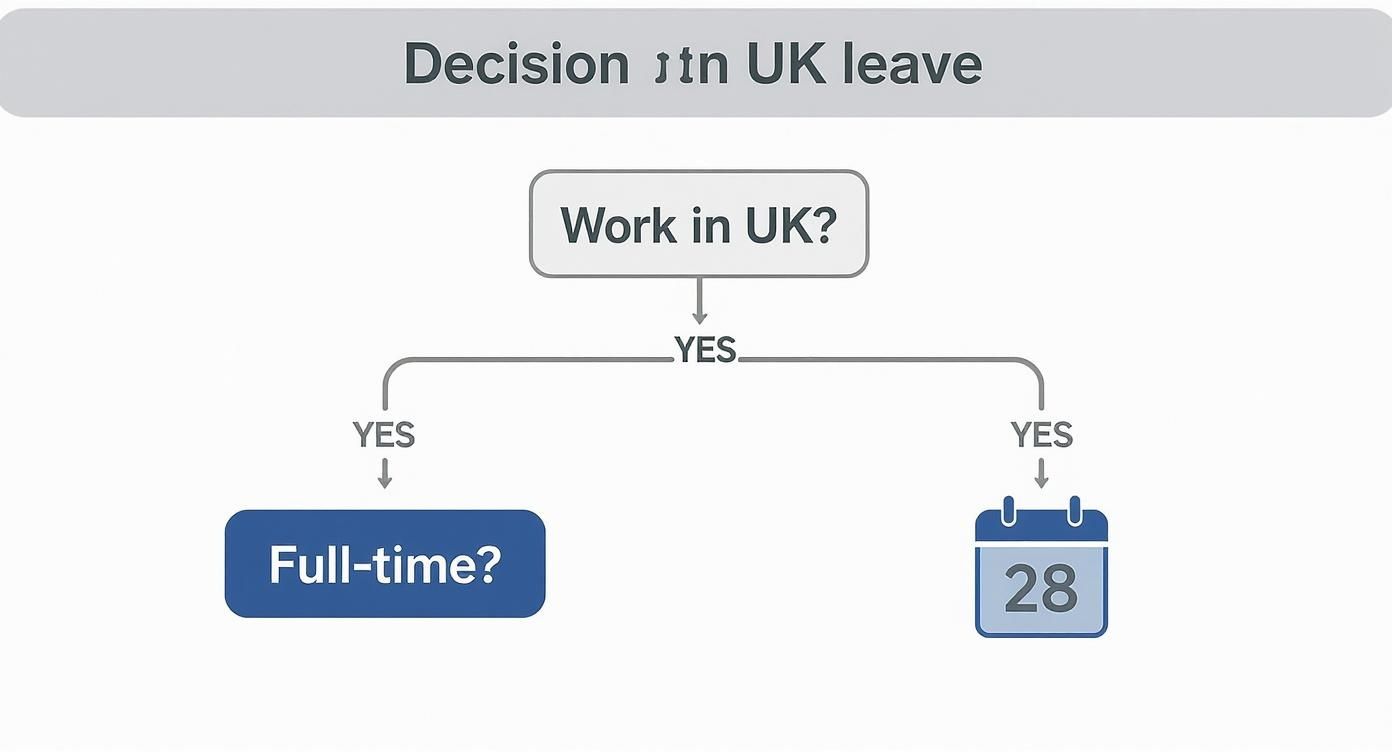
As you can see, the statutory 5.6 weeks is the baseline for everyone. From there, the calculations just adapt to fit the specific work pattern.
Calculating for Part-Time Workers
For part-timers who work a consistent number of days each week, the maths is nice and simple. You just multiply the number of days they work per week by the statutory entitlement of 5.6 weeks.
Let's take Sarah, who works a steady three days every week.
- Calculation: 3 days per week × 5.6 weeks = 16.8 days of annual leave per year.
It’s really important not to round that figure down. Sarah is legally entitled to every bit of her 16.8 days. Most modern leave management systems can handle decimals, allowing employees to take a part-day off to use up that remaining 0.8 of a day. If you want to dive deeper, we've put together a full walkthrough on how to calculate pro-rata holiday in our UK guide.
Calculating for Staff on Irregular Hours or Zero-Hours Contracts
So, what about team members whose hours change from one week to the next, like those on zero-hours contracts? Trying to calculate their leave in "days" just doesn't work. Instead, their holiday entitlement builds up based on the hours they actually work.
For this, the government recommends using an accrual rate of 12.07%. This number isn't just plucked out of thin air; it's the statutory 5.6 weeks of holiday expressed as a percentage of the remaining 46.4 working weeks of the year (52 weeks - 5.6 weeks = 46.4).
To figure out what someone's earned, you simply multiply the total hours they've worked in a pay period by 12.07%. The answer is the holiday time they've accrued, in hours.
Let's say David works 60 hours in a month on a zero-hours contract:
- Calculation: 60 hours × 12.07% = 7.24 hours of paid holiday earned that month.
This method ensures leave is earned in direct proportion to the work done, making it a fair system for the most flexible members of your team. The government even has a handy online calculator to help you with the sums.
Handling New Starters and Leavers
When employees join or leave partway through your company's holiday year, they're entitled to a pro-rata chunk of annual leave. You just need to calculate their entitlement based on the fraction of the year they’ve been with you.
Imagine your holiday year runs from January to December. A new full-time employee starts on 1st July. They'll be working for six months, or 6/12 of the year.
- Calculation for a New Starter: (6 ÷ 12) × 28 days = 14 days of leave for the rest of that holiday year.
The same logic applies when someone leaves. If a full-time staff member's last day is 31st March, they've worked for three months, or 3/12 of the year.
- Calculation for a Leaver: (3 ÷ 12) × 28 days = 7 days of leave entitlement.
If they’ve taken more holiday than they’ve earned, you may be able to deduct the difference from their final pay packet, provided their contract allows for it. On the flip side, if they have leave left over, you must pay them for it.
Juggling Leave Requests, Sickness, and Bank Holidays
Knowing your total leave entitlement is just the starting line. The real challenge comes when you have to juggle actual holiday requests, unexpected sickness, and the ever-present bank holidays. This is where a crystal-clear policy on annual leave entitlements in the UK proves its worth, making the process fair and smooth for everyone.
So, let's tackle one of the most common questions: how much notice does an employee need to give? The statutory rule is refreshingly simple. An employee has to give notice that is at least twice as long as the leave they want to take.
For instance, if a team member wants a week off (that's five working days), they need to put in their request at least ten calendar days beforehand. This basic rule creates a default framework that works for both sides, giving you enough time to sort out cover and preventing any last-minute scrambles.
The Rules for Requesting and Refusing Leave
Just as employees have a process for asking, employers have one for saying no. You can decline a holiday request, but you must give notice equal to the length of the leave requested. So, if you need to refuse that one-week holiday request, you have to do it at least one week before the holiday was supposed to begin.
While you don't legally need to give a reason for refusing leave (as long as it’s not discriminatory), it’s always better to do so. Citing a valid business reason—like a massive project deadline or half the team already being off—fosters a much healthier and more transparent work environment.
Of course, you can set your own notice periods in the employment contract. You might, for example, require a month's notice for any leave longer than a week. That’s perfectly fine, as long as it’s written down and you apply it consistently to everyone.
Sickness During Annual Leave
What happens when someone falls ill just before or during their long-awaited holiday? This is a frequent point of confusion, but the law is quite clear. If an employee is genuinely sick, they can effectively ‘reclaim’ their holiday.
This means they should report in sick as they normally would, and those days are then treated as sick leave instead of annual leave. They can then take the holiday they missed at a later date. This right exists for a good reason: holiday time is meant for rest and relaxation, not for recovering from the flu.
For this to work, the employee must follow your company's usual sickness reporting procedure, even if they're stuck in a hotel abroad. They can't just come back to work a week later and say they were ill.
Holiday Accrual During Sick Leave
Another key part of annual leave entitlements in the UK is that holiday time keeps building up even when an employee is on long-term sick leave. Their entitlement accrues just as if they were in the office every day.
This ensures that people who are unable to work because of their health don't lose out on their statutory right to paid time off. If they can't use their accrued leave within the current holiday year because of their illness, the law says they must be allowed to carry it over to the next one.
Bank Holidays and Forced Leave
Many people assume they have an automatic right to take bank holidays off. They don't. It all comes down to what's in their employment contract. While most offices shut down, sectors like retail, hospitality, and healthcare simply can't, and their staff are often required to work.
On the flip side, an employer can require staff to take their annual leave on specific dates. The classic example is a company-wide shutdown over the Christmas period. This is perfectly legal, as long as you give the correct notice – which is at least double the length of the leave. For a two-week shutdown, you'd need to give your team at least four weeks' notice. As always, this should be spelled out clearly in your leave policy.
UK Annual Leave Trends and What They Mean for You
Knowing the legal minimums for annual leave in the UK is one thing. But what’s far more revealing is how people are actually using their time off. When you dig into the data, a surprising—and frankly, a bit worrying—trend starts to emerge.
Despite having a clear legal right to paid holidays, UK employees are taking fewer of them. This isn't just a small dip, either. It’s a significant shift that points to some deeper issues in our workplaces, from crushing workloads to a cultural pressure to never truly switch off.
The Decline in Days Taken
The numbers don't lie. While the law guarantees 28 days of paid leave for a full-timer, the reality on the ground is quite different. Between 2020 and 2023, the average number of holiday days taken by UK employees dropped from around 38 (including bank holidays) to just 33.9 days. That’s a fall of nearly 12% in only three years. You can get more of the story from the annual leave statistics for 2024-2025.
This has a real-world consequence for businesses, creating a growing headache known as leave liability. This is the financial cost that sits on a company's balance sheet for all the untaken holiday days that are piling up.
Why Aren’t People Using Their Full Entitlement?
So, what's behind this? It's not one single thing, but more of a perfect storm of factors pushing employees towards burnout and creating financial risk for their employers.
- Heavy Workloads: It’s a common story. Many people feel they simply have too much on their plate. They're afraid that taking a week off just means returning to an even bigger mountain of work.
- Pressure from Management: This can be subtle. If managers rarely take holidays themselves or are seen firing off emails from the beach, it sends a powerful message that being 'always on' is what's really valued.
- Fear of Falling Behind: In a competitive workplace, there's often an unspoken fear that taking all your holiday will make you look less committed than your colleagues, possibly hurting your chances of promotion.
The truth is, it nearly always comes down to company culture. A generous holiday policy written down in a handbook is pointless if the day-to-day environment doesn't genuinely encourage people to take the breaks they've earned.
The Real Cost of Untaken Leave
When your team doesn't take enough time off, the fallout spreads through the whole organisation. It's not just about the final bill for unused leave when someone eventually leaves the company. The more immediate damage is often hidden, but it cuts much deeper.
These hidden costs show up in a few key ways:
- Increased Burnout: An overworked team is an underperforming team. People running on empty are less productive, their creativity dries up, and they're more likely to make costly mistakes.
- Higher Staff Turnover: When people feel they can't get a proper break, job satisfaction plummets. They start looking for the exit, which means you're stuck in a costly cycle of recruiting and training new staff.
- A Hit to Wellbeing: A lack of proper rest is a direct line to stress, anxiety, and other mental health issues. This, in turn, fuels higher rates of sickness and absence.
At the end of the day, building a culture where taking holiday is seen as a good thing isn't just a 'nice to have'—it's a core business strategy. It’s how you keep your team engaged, resilient, and performing at their best for the long haul.
Right, let's get one thing straight: while the law sets a baseline for annual leave entitlements in the UK, what you actually get can look wildly different depending on where you work. There’s no such thing as a one-size-fits-all holiday policy. Industries have their own unique rhythms—seasonal rushes, project deadlines, quiet spells—and these all shape the culture around taking time off.
Think about it. A marketing agency might see August as a ghost town, making it the perfect time for everyone to jet off on a proper break. But for retail and hospitality, that same period is an all-hands-on-deck frenzy. The same goes for Christmas. It’s crucial to understand these norms, whether you’re an employer trying to figure out if your policy is competitive or an employee weighing up a job offer.
Why The Big Differences?
The work itself is the biggest driver here. A creative team racing towards a massive campaign launch will have a completely different leave pattern to an accountant whose workload is steady all year round. It’s just the nature of the beast.
Lately, these differences have become even more stark. Some sectors have been battered by economic headwinds, and that’s had a direct knock-on effect on both the holiday offered and the amount people are actually taking.
We’ve seen data showing sectors like agriculture, forestry, and fishing with a drop in leave usage of 11.85%. Construction wasn't far behind, with a 10.98% decline. This tells a story about how external pressures can get in the way of people taking the breaks they need.
It's not just about people feeling too swamped to book a holiday, either. In some industries, the actual entitlements have been trimmed back. Take the construction sector, where the average holiday allowance dropped from 34.85 days down to 32.55 days per employee. That’s a 6.61% cut, the biggest reduction seen across all industries, as highlighted in a recent UK annual leave report by industry.
Comparison of Annual Leave Trends by UK Industry
To paint a clearer picture, it’s worth looking at how these dynamics play out across various fields. The table below shows just how much things can vary, and why. The reasons often link directly back to the industry's business model and the day-to-day demands on its people.
| Industry Sector | Percentage Change in Leave Taken (2022-2023) | Common Contributing Factors |
|---|---|---|
| Construction | -10.98% | Project-based deadlines, economic uncertainty leading to reduced entitlements. |
| Agriculture, Forestry & Fishing | -11.85% | Seasonal demands, labour shortages, and significant operational pressures. |
| Technology & Finance | +2.5% | Competitive hiring market, focus on employee wellbeing to retain talent. |
| Healthcare & Social Care | -3.1% | Staffing shortages, high burnout rates, difficulty in scheduling cover. |
| Retail & Hospitality | -5.8% | Peak season restrictions, high staff turnover, and pressure on margins. |
This data really underscores that you can’t look at leave in a vacuum. A drop in one sector might be driven by project cancellations, while a rise in another could be a deliberate strategy to attract and keep the best people.
A Closer Look at Key Sectors
Let’s break it down a bit further.
- Technology and Finance: These industries are locked in a constant battle for talent. Generous leave packages—often more than 30 days plus bank holidays—are a key weapon in their arsenal. The flip side? A high-pressure, 'always-on' culture can mean that people don't always feel they can take all the time they're owed.
- Healthcare and Social Care: Here, you're dealing with essential, round-the-clock services. Leave planning is a logistical nightmare. It has to be managed with military precision to keep staffing levels safe, which often means more rigid rules about when you can and can't take holiday.
- Education: Everything revolves around the academic calendar. Teachers get long, fixed holidays in the summer, at Christmas, and Easter, but there's practically zero flexibility to take a week off in the middle of term time.
What all this shows is that a rigid, top-down approach to leave policy just doesn't work. A policy that’s truly effective has to be tuned into the realities of its own sector. It has to create a culture where taking time off isn’t just allowed, but actively encouraged for the good of the entire team.
Creating a Fair and Compliant Annual Leave Policy
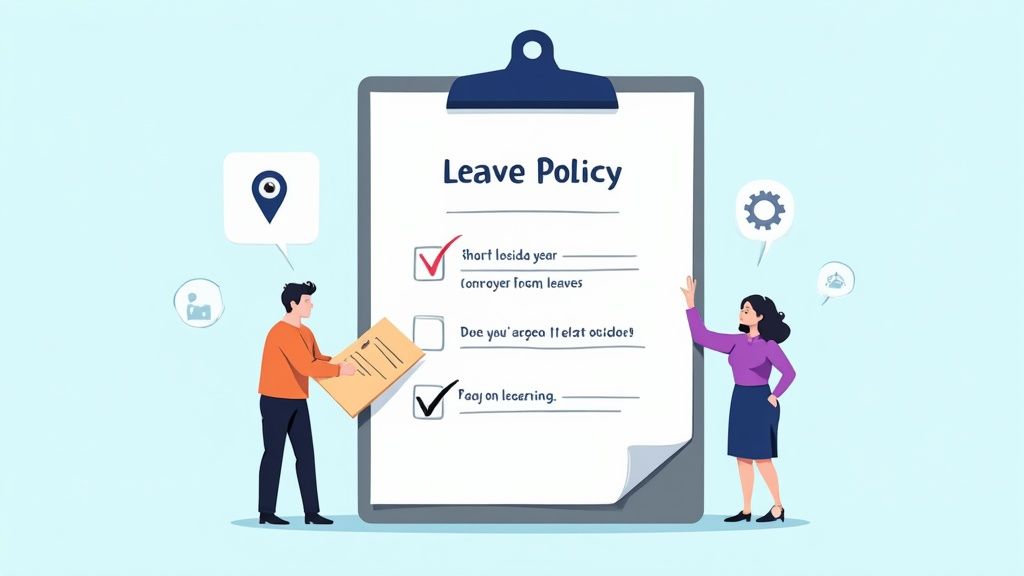
Getting to grips with the law is the starting point, but a solid, transparent annual leave policy is where theory meets reality. A well-thought-out policy is your best defence against misunderstandings, ensuring fairness and showing your team you’re serious about their wellbeing. Think of it as the official rulebook for time off that everyone can turn to.
Without one, you’re just inviting confusion, arguments, and inconsistent decisions. A formal policy isn't just bureaucratic box-ticking; it’s a crucial tool for building a positive culture where everyone knows exactly where they stand on their annual leave entitlements in the UK.
This document should be the single source of truth for everything holiday-related, from booking a day off to handling leave when someone moves on.
Core Components of a UK Leave Policy
To be truly effective, your policy needs to cover a few essential bases. These are the non-negotiable building blocks for a system that’s both legally sound and simple for your team to use.
A comprehensive policy must clearly outline:
- The Holiday Year: Pin down the exact start and end dates of your company's leave year. Is it 1st January to 31st December, or 1st April to 31st March? This period is the foundation for all leave calculations.
- Total Entitlement: State the total number of days (or hours) of leave each employee gets. Crucially, make it crystal clear whether this figure includes bank holidays.
- Request and Approval Process: Map out the step-by-step process for requesting leave. What’s the notice period? Who signs it off? Don't leave it to guesswork.
- Rules for Leavers: Explain exactly how final holiday pay is calculated when an employee leaves. This should cover both paying out for unused leave and, if necessary, clawing back pay for leave taken but not yet accrued.
By getting these key elements down on paper, you kill ambiguity before it starts. A clear policy guarantees that rules are applied the same way for everyone, which is the bedrock of treating all employees fairly.
Communicating Your Policy Effectively
Writing the policy is only half the job. The best policy in the world is useless if it’s gathering dust in a forgotten corner of the shared drive. Your team needs to know it exists and understand how it works.
Make it easy to find. Pop it in the employee handbook and on the company intranet. When a new starter joins, walk them through the key points as part of their onboarding so they get it from day one. And if you ever need to change the policy, communicate it clearly and explain why you’re making the changes. A great way to get started is by using a template annual leave policy to build upon.
Using Technology to Guarantee Compliance
Let’s be honest, tracking leave manually on spreadsheets is a headache. It’s slow, clunky, and riddled with opportunities for human error. Modern leave management software, like Leavetrack, automates the whole thing—from request to approval—and makes compliance almost effortless.
These systems do the heavy lifting for you. They automatically calculate pro-rata entitlements for new starters, part-time staff, and leavers, taking the risk out of those tricky manual sums. They give managers a clear, real-time picture of who’s off and when, helping them plan cover and avoid clashes.
By keeping all your records in one place, you create a solid audit trail, meaning you can always prove you’re complying with UK employment law. It frees up hours of admin time and gives everyone—managers and employees alike—confidence that the system is fair and accurate.
Common Questions About UK Annual Leave
When you get down to the nitty-gritty of annual leave entitlements in the UK, some specific, often tricky questions tend to pop up. Think of this section as your quick-reference guide for those moments where you need a straight answer, fast.
Can My Employer Dictate When I Take My Annual Leave?
In a word, yes. Your employer has the right to tell you when to take your holiday. A classic example is a company-wide shutdown over the Christmas period where everyone is required to take leave.
But they can't just spring it on you. The rule is that they must give you notice that is at least twice the length of the leave they're making you take. This should always be spelled out clearly in your employment contract or company handbook, so there are no surprises.
What Happens to My Holiday Entitlement During Maternity Leave?
Your statutory holiday entitlement keeps building up (or accruing) just as it normally would throughout your entire maternity leave. You're still an employee, and your right to paid holiday is fully protected by law.
The one catch is that you can’t take annual leave at the same time as maternity leave. Because of this, what most people do is arrange with their employer to take their built-up holiday either just before their maternity leave starts, or tack it onto the end before they officially come back to work.
Is Rolled-Up Holiday Pay Legal?
This is a big one, as the rules have changed recently. For leave years starting on or after 1 April 2024, the government has made rolled-up holiday pay legal, but—and this is a crucial ‘but’—only for irregular-hour and part-year workers.
This practice involves adding an extra 12.07% on top of their regular pay to cover their holiday entitlement. It’s vital that this amount is clearly shown as a separate item on their payslip. For everyone else, like your full-time or regular part-time staff, rolled-up holiday pay is still against the law.
Can I Carry Over Unused Annual Leave to the Next Year?
Whether you can carry over unused leave really depends on your contract and the situation. UK law does give workers a specific right to carry over up to four weeks of statutory leave if they were unable to take it because they were off sick.
Beyond that, for the remaining 1.6 weeks of statutory leave and any extra holiday your contract gives you, carrying it over is entirely up to your employer. Many companies have a policy that allows you to carry a few days over (say, up to five), but they are not legally required to do so.
Trying to keep all these rules straight doesn't have to be a headache. With Leavetrack, you can automate accruals, see leave balances in real-time, and make sure your policies are applied fairly for everyone on the team. Discover how Leavetrack simplifies absence management.