

Average UK Annual Leave: A Guide to average uk annual leave
Posted by Robin on 05 Feb, 2026 in
When you hear "annual leave," what's the first number that pops into your head? For most people in the UK, it’s 28 days. But that number is just the starting point, not the full story.
The law says that nearly all full-time workers are entitled to a minimum of 5.6 weeks of paid holiday each year. For someone working a typical five-day week, that works out to 28 days. This is the absolute legal baseline—the bare minimum every employer has to provide.
But here’s where it gets interesting.
Understanding The UK Annual Leave Landscape
Think of the statutory 28 days as the ground floor. It’s where every business has to start, but many of the best employers build much higher to give their teams a better view.
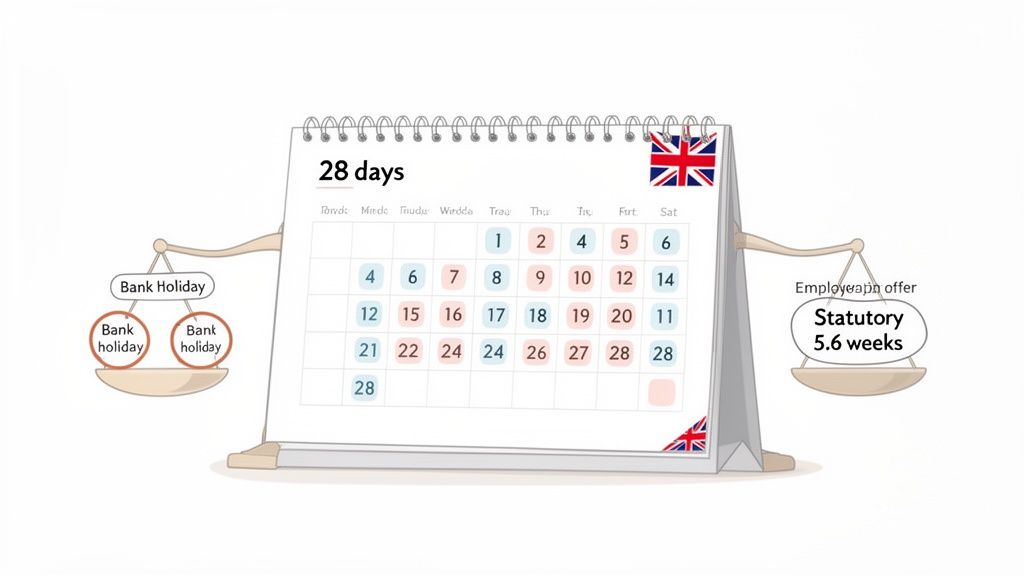
The legal foundation is clear-cut: 5.6 weeks per year, which can include bank holidays. This ensures nearly everyone gets paid time off, but it doesn't reflect what’s actually happening in today’s competitive job market. Digging deeper into UK leave entitlement can offer some great insights, like those shared by Vacation Tracker.
The real story isn't just about what's legally required; it's about what companies are actually offering.
Statutory Minimum vs Competitive Reality
The gap between the legal floor and what top companies offer is where the action is. While 28 days is the requirement, it’s increasingly common to see policies offering 30, 33, or even more days, especially in sectors desperate for skilled professionals.
This really boils down to two different mindsets for an employer:
- Compliance: Ticking the box to meet the legal obligation of 5.6 weeks and avoid any trouble.
- Competitiveness: Using a generous leave policy as a powerful tool to attract top talent, keep staff turnover low, and boost morale.
An employer’s annual leave policy is more than just a legal formality; it’s a direct statement about its culture and how much it values employee wellbeing and work-life balance.
Let's take a quick look at how these numbers stack up.
UK Annual Leave At a Glance
The table below provides a simple comparison between the legal minimum, what many companies actually offer, and the average number of days employees end up taking.
| Metric | Number of Days |
|---|---|
| Legal Minimum (Statutory) | 28 |
| Typical Employer Offering | 33-35 |
| Average Days Taken | 20 |
As you can see, there's a big difference between entitlement and what's actually used, which is a whole other challenge for employers to tackle.
Why The 'Average' Can Be Misleading
Simply looking at the statutory minimum gives a skewed picture of the real employee experience. The true "average" annual leave in the UK is a blend of this legal baseline and the more generous policies offered by forward-thinking companies. What an employee actually gets often depends on their industry, company size, and even how long they’ve been with the business.
For HR managers and business leaders, the takeaway is simple: sticking to the bare minimum will keep you compliant, but it won't make you an employer of choice. Understanding this difference is the first step towards building a holiday policy that isn't just about following rules but about creating a strategic advantage for your business.
Calculating Holiday Entitlement For Your Entire Team
Figuring out holiday for a full-time employee on a standard five-day week is pretty straightforward. But let's be honest, the modern workforce is a vibrant mix of working patterns, and this is exactly where many businesses get tripped up.
Getting the calculations right for your part-time, variable-hour, and zero-hour contract staff isn't just about being a good employer; it’s a legal must.
Think of it like trying to divide a cake among a team where everyone arrives at different times and wants a different-sized slice. A one-size-fits-all approach just won't cut it. It leads to confusion, unfairness, and eventually, disputes.
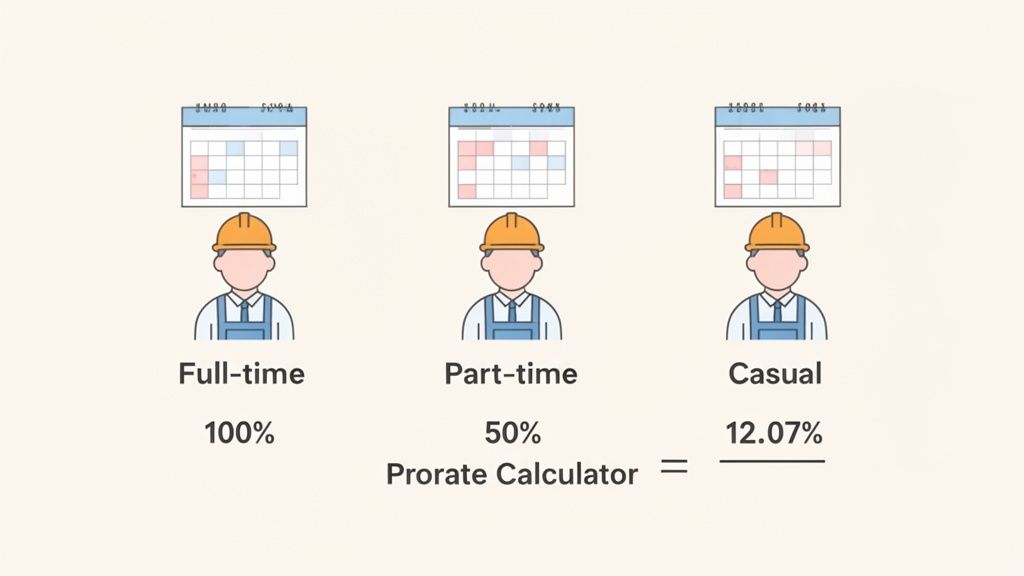
The guiding principle here is pro-rata, which simply means "in proportion." Every single worker is legally entitled to 5.6 weeks of paid holiday. The actual number of days or hours they get is directly proportional to how much they work.
Calculating for Part-Time Staff
For part-timers who work a set number of days each week, the maths is a simple multiplication.
Let's say your full-time staff get the statutory minimum of 28 days (which is 5.6 weeks x 5 days). To work out the entitlement for a part-time colleague, you just:
- Step 1: Figure out how many days they work per week.
- Step 2: Multiply that number by 5.6 weeks.
So, an employee who works 3 days a week is entitled to 16.8 days of paid leave (3 days x 5.6 weeks). It's common practice to round this up to the nearest half or full day, so you'd probably offer 17 days.
Dealing With Variable Hours and Casual Workers
What about employees whose hours chop and change week by week, or those on zero-hour contracts? Calculating their entitlement based on days is impossible. This is where you switch to an accrual method based on the hours they actually work.
The standard industry method for this is the 12.07% accrual rate.
Where does this number come from? It's pretty simple: 5.6 weeks of holiday divided by the remaining 46.4 working weeks of the year (52 - 5.6). This works out to 12.07%. In real terms, for every hour an employee works, they earn just over 7 minutes of paid holiday.
To put this into practice, you just multiply the total hours worked in a pay period by 12.07%. This tells you exactly how many hours of holiday they've earned.
- Example: If a casual worker clocks 80 hours in a month, their holiday accrual for that month is 9.66 hours (80 hours x 0.1207).
This approach keeps things fair, as their holiday pay directly reflects their contribution. For a more detailed walkthrough, you might find it helpful to learn more about how to calculate holiday entitlements in our UK guide.
Prorating Leave for Leavers and Starters
What happens when someone joins or leaves your company part-way through the holiday year? Their entitlement has to be prorated to reflect the portion of the year they've actually worked with you.
This stops a new starter from taking their full annual allowance in their first few months, and it ensures a leaver is correctly paid for any holiday they've accrued but not taken.
The calculation is usually based on months worked:
- Start with the full annual entitlement (e.g., 28 days).
- Divide this by 12 to get the monthly accrual rate (28 / 12 = 2.33 days per month).
- Multiply the monthly rate by the number of full months the employee will work in that leave year.
So, if someone joins in July and your leave year runs from January to December, they'll work for 6 months. Their prorated entitlement would be 14 days (2.33 days x 6 months), which you would likely round up.
Getting a handle on these different calculation methods is fundamental to running a fair, compliant, and happy workplace. It turns what feels like a complex admin headache into a straightforward process, making sure every team member gets exactly what they're entitled to.
How Your Leave Policy Stacks Up Against Industry Averages
Knowing the statutory minimum for UK holiday is one thing. Knowing where you stand in the battle for talent is another thing entirely. Is your annual leave policy a powerful magnet for attracting the best people, or is it a quiet weakness holding you back?
To find out, you need to look past the legal baseline and dive into what's happening in the real world. Benchmarking your holiday allowance against industry averages gives your benefits package a much-needed health check, showing you whether you’re leading the pack or just keeping up.
The simple truth is, the average UK annual leave offered—and actually taken—can be wildly different from one sector to another. A policy that feels generous in one industry might be seen as completely standard, or even stingy, in another.
A Sector-by-Sector Breakdown of Annual Leave
It's no surprise that the fight for skilled professionals often leads to more generous benefits. Industries with red-hot demand for specialists, like consulting and technology, frequently use beefed-up leave policies as a key weapon to attract and keep the best people.
On the flip side, sectors with different operational pressures or workforce dynamics might stick closer to the statutory minimums. This isn't necessarily a bad thing; it just reflects the different priorities and pressures shaping each industry's approach to employee benefits.
Data from 2023 shows a clear league table in how much leave employees actually take across different fields. Let’s take a look.
Average Annual Leave Days Taken by UK Industry
The numbers below paint a fascinating picture of work-life balance across the UK. They show the average number of holiday days employees took in 2023, giving a real-world glimpse into which sectors are encouraging their teams to properly switch off.
| Industry Sector | Average Days Taken | Year-on-Year Change |
|---|---|---|
| Consulting | 35.5 | +1.2 days |
| Education | 34.8 | +0.9 days |
| Technology | 34.2 | +1.5 days |
| Healthcare | 33.7 | +0.7 days |
| Finance | 32.9 | +1.1 days |
These figures, which you can explore in more detail in this guide to UK annual leave trends, tell a story. They reflect workloads, company cultures, and the unique competitive pressures within each sector. For HR and people managers, this is invaluable intel.
Why Do These Averages Differ So Much?
The big gaps in annual leave aren't random; they’re driven by the unique DNA of each industry. Getting to grips with the 'why' behind the numbers is the key to making smart choices about your own policy.
Here are a few of the driving forces:
- Talent Competition: In fields like tech and consulting, the competition for top talent is fierce. A generous holiday allowance becomes a critical part of the compensation package, helping companies stand out.
- Workload and Burnout Risk: Industries known for high-pressure environments, such as finance and healthcare, may see people taking less leave due to heavy workloads or a culture where taking time off is subtly discouraged.
- Project Cycles: The nature of the work itself plays a big part. In education, for example, leave is often built around the academic calendar, leading to longer, more structured breaks.
- Company Culture: Some sectors have simply built a stronger culture of prioritising work-life balance. This shows up in their policies and in how much employees are actively encouraged to use their full entitlement.
For an HR manager, these industry benchmarks are more than just numbers. They are a strategic tool for assessing whether your current leave policy aligns with market expectations and supports your recruitment and retention goals.
Benchmarking Your Policy: A Step-by-Step Guide
So, how can you put this data to work and see where your company stands? A quick benchmarking exercise can bring a lot of clarity and help shape your strategy.
- Identify Your Sector: First, pinpoint which industry category your business fits into. If you straddle a couple of sectors, focus on the one that represents your core talent pool.
- Compare Your Offering: Look at the total number of days you offer (including bank holidays) and stack it up against the average for your sector. Are you above, below, or right on the money?
- Analyse Leave Taken: This is the crucial bit. It’s not just about what you offer, but what your employees actually use. If your team is taking far less leave than the industry average, it could be a red flag for issues with workload or company culture.
- Gather Employee Feedback: Data gives you the 'what', but your team can tell you the 'why'. Use anonymous surveys or informal check-ins to understand how they feel about the current policy and if they face any roadblocks when trying to book time off.
By running through this analysis, you can shift from just having a policy to strategically managing it. You’ll get the insight you need to decide if your current approach is helping you compete or if it’s time for a change to better meet the needs of both your team and your business.
The Hidden Reasons UK Employees Are Taking Less Leave
Having a generous annual leave policy on paper is one thing, but it’s pretty meaningless if your team feels they can’t actually use it. A worrying trend is cropping up across the UK: a growing gap between holiday entitlement and the days people actually take off. This isn't just about someone forgetting to book a long weekend; it points to deeper, more systemic issues within a company's culture.
This gap, often called 'leave liability', is more than just an admin headache. It’s a significant business risk hiding in plain sight. When people consistently skip their holidays, it’s usually a symptom of bigger problems that can quietly chip away at productivity, morale, and staff retention. Understanding why this happens is the first step towards building a culture where rest isn't just allowed, but actively encouraged.
The Rise of Presenteeism and Workload Pressure
One of the biggest culprits behind all this unused leave is a culture of 'presenteeism'. This is that nagging feeling that you need to be constantly visible and working, even if it means sacrificing a well-deserved break. People worry that taking time off will make them look less committed, or even put them at a disadvantage when it comes to promotions or performance reviews.
This pressure is often cranked up by ever-increasing workloads. When teams are running lean, the thought of taking a week off only to return to an avalanche of emails and tasks is enough to put anyone off booking that holiday. The short-term relief of a break just doesn't seem worth the long-term stress of catching up.
The data backs this up, showing a clear downward trend in how much holiday people are actually taking. Recent figures show that in 2020, the average UK employee used 38 days of annual leave (including bank holidays). By 2023, this had fallen to just 33.9 days—a drop of around 12% in three years, with the sharpest decline happening between 2022 and 2023.
The chart below shows how leave patterns can vary even between high-performing sectors.
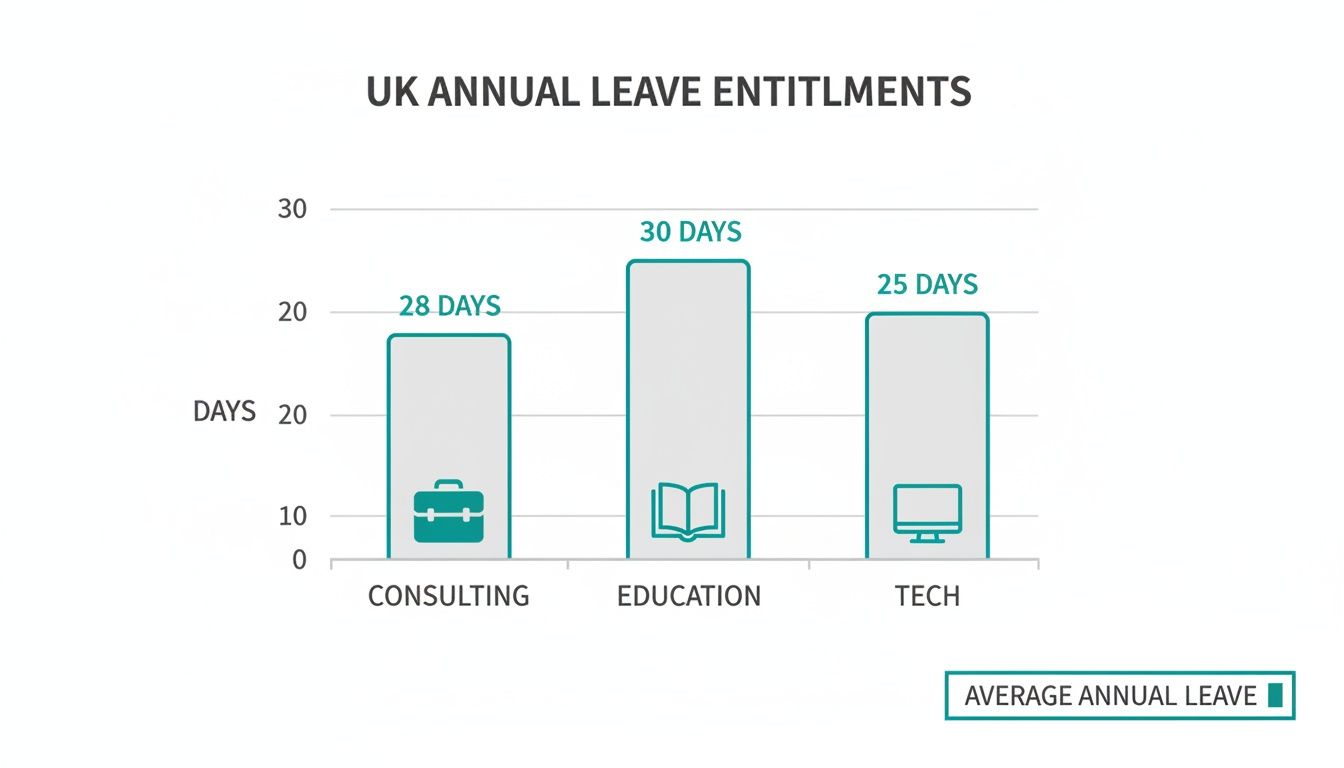
This really highlights that even in competitive industries, it’s the cultural norms and workload pressures that ultimately influence whether employees feel they can take their full leave entitlement.
Economic Anxiety and the Fear of Disconnecting
It’s not just about workload, though. Broader economic uncertainty plays a huge part. During shaky financial times, people tend to become more risk-averse, fearing that taking too much time off could make their position seem less essential. This anxiety fuels a mindset where they feel the need to constantly prove their value by being perpetually online and available.
For many, the fear of disconnecting is real. A holiday should be a complete mental and physical break, but if an employee spends it checking emails and worrying about work, the restorative benefits are lost. This cycle leads directly to burnout, a critical issue that harms both the individual and the business.
Fostering a healthier work environment is crucial. Implementing effective corporate wellness programs can get to the root causes of stress and presenteeism. By actively looking after your team’s wellbeing, you can shift from being a passive leave provider to a proactive partner in their health. For some practical ideas, check out our guide on three tips for overcoming burnout in the workplace.
Avoiding Common Annual Leave Management Pitfalls
Even with the best of intentions, managing annual leave can feel like navigating a minefield. What seems like a small oversight can quickly snowball into much bigger problems, from getting on the wrong side of employment law to watching team morale take a nosedive.
Getting a handle on these common traps is the first step toward building a holiday process that’s fair, transparent, and won’t crumble under pressure. Think of it like maintaining a complex piece of machinery; if one small gear is misaligned—like how you handle bank holidays for part-time staff—the whole system can start to grind and eventually break.
The goal isn't just to fix problems as they pop up, but to prevent them from happening in the first place. Most mistakes come from fuzzy rules or applying policies inconsistently, leaving employees confused and managers making it up as they go along.
Mishandling Part-Time Bank Holidays
One of the most frequent tripwires is getting bank holiday allocation wrong for part-time employees. It’s a classic mistake, but a costly one. Legally, part-timers are entitled to a pro-rata share of paid bank holidays, just like their full-time colleagues. Getting this calculation wrong is a surefire way to end up in a dispute.
For instance, if someone’s part-time schedule means they never work on a Monday, they'll naturally miss out on most bank holidays. A fair policy doesn't just let that slide; it gives them a proportional allowance of paid time off to make up for it, which they can take on their normal working days. It’s all about ensuring equitable treatment, no matter the working pattern.
The core principle here is simple: fairness through proportionality. A part-time worker's bank holiday entitlement should be a direct reflection of the hours they work. This stops any indirect discrimination and makes sure everyone gets the benefit of public holidays.
Without a proper system, these calculations become a manual, error-prone headache for HR. It’s a perfect example of why having a structured, automated approach is so vital.
Inconsistent Carry-Over Policies
Rules around carrying unused annual leave into the next year are another major headache. If you don’t have a firm, clearly communicated policy, you’re basically inviting inconsistency and claims of favouritism. One manager might approve a carry-over request while another denies a similar one, breeding resentment across the team.
A solid carry-over policy needs to be crystal clear on a few key points:
- How many days can be carried over (e.g., a maximum of 5 days).
- The deadline for using them (e.g., must be taken by the end of March).
- Any exceptions to the rule, such as when someone couldn't take their holiday due to long-term sickness or maternity leave.
Putting this in writing removes all the guesswork. It ensures every request is handled by the same set of rules, which is the only way to make the process fair for everyone.
Ignoring Accrued Holiday for Leavers
Forgetting to correctly calculate and pay for accrued holiday when an employee leaves is a critical error, and it’s surprisingly common. This isn’t just good practice; it's a legal obligation. An employee’s final paycheck must include payment for any statutory holiday they’ve earned but not taken during that leave year.
Getting this wrong can easily lead to legal challenges and leave a sour taste, damaging your company’s reputation. You absolutely need a reliable process for prorating their entitlement right up to their last day and making sure the final payment is spot on. It protects the business and ensures you part on fair terms. Properly managing the average UK annual leave means getting these departures right, every single time.
Streamlining Your Holiday Management Process
Trying to connect the dots between all the common holiday management pitfalls and a modern solution reveals a clear path forward. Manually tracking different leave types, calculating pro-rata entitlements, and making sure everything is fair across all contract types is an administrative tightrope walk. One little slip can lead to compliance headaches, payroll errors, and a serious dip in team morale. A dedicated system is built to solve these exact problems.
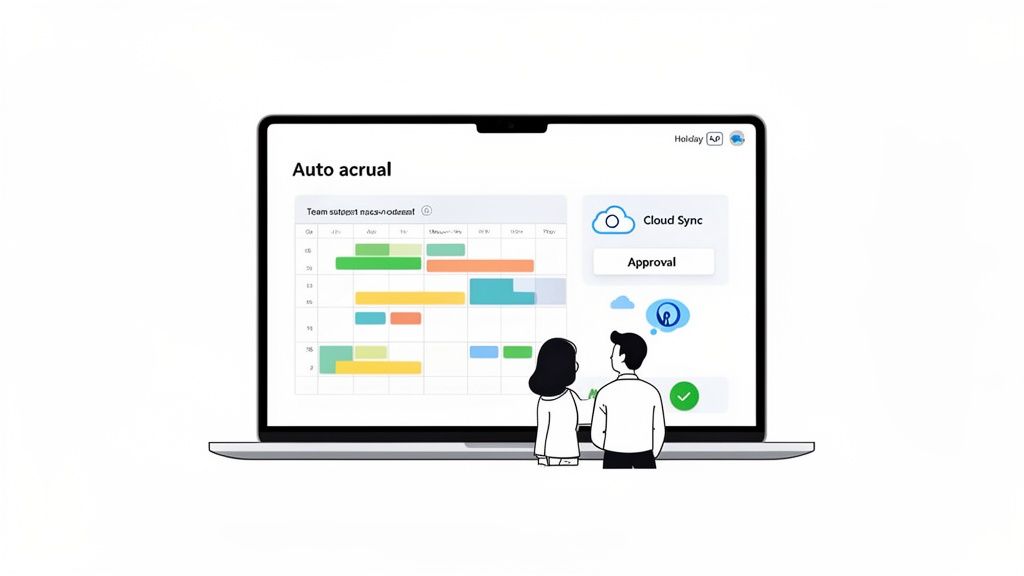
This kind of approach replaces clunky spreadsheets and scattered email chains with a single, clear source of truth. It automates all those complex accrual calculations for part-time and variable-hour staff, which gets rid of the risk of human error and ensures everyone gets their correct entitlement.
The benefits ripple outwards, moving beyond simple admin relief to much smarter workforce planning.
Gaining Clarity and Control
A centralised digital calendar gives you instant, at-a-glance visibility of who is off and when. This simple feature is a game-changer for team leaders trying to balance holiday requests with operational needs, preventing accidental staff shortages during critical periods.
The request-and-approval workflow is also completely transformed. Instead of chasing managers for signatures or losing track of verbal agreements, requests are logged, reviewed, and approved (or denied) right there in the system. This creates a transparent, auditable trail that protects both the employee and the business.
By automating the mechanics of leave management, you free up valuable time and mental energy. HR managers can shift from reactive problem-solving to proactive strategy, focusing on employee wellbeing and building a culture where rest is truly valued.
For anyone looking to dive deeper, there are some great resources out there on what to look for. You can learn more by reading a guide to employee leave management systems, which outlines the key features and benefits.
Empowering Your Team
The right system doesn’t just benefit managers; it empowers the whole team. Giving employees direct access to see their remaining leave balance and view the team calendar helps them plan their time off far more effectively. This transparency builds trust and cuts down on the constant back-and-forth queries that clog up HR inboxes.
This clear, colour-coded view instantly shows which team members are off, preventing scheduling conflicts before they even happen. Ultimately, moving to a dedicated tool is about creating a fair, efficient, and compliant process that works for everyone. It ensures that managing the average UK annual leave becomes a smooth, strategic function rather than a source of constant administrative friction.
Still Have Questions About UK Annual Leave?
Navigating the rules around annual leave often throws up a few tricky questions for both HR managers and employees. Getting these details right isn't just about compliance; it's about building a fair, transparent, and respectful workplace culture. We've tackled some of the most common queries to clear up the finer points.
Think of this as a quick-reference guide for those real-world scenarios you're bound to run into.
Can An Employer Refuse An Annual Leave Request In The UK?
In short, yes, but there has to be a solid business reason behind it. It's not about being difficult. Common justifications include needing all hands on deck for a busy period or preventing a situation where too many key people are away at the same time.
The key here is fairness and transparency. If you have to turn down a request, the law says you must give notice that's at least as long as the leave requested. So, if an employee asks for a week off, you need to give them at least one week's notice of the refusal. This is where having a clear, consistently applied leave policy becomes your best friend—it ensures every decision is justified and understood.
What Happens To Unused Annual Leave When An Employee Leaves?
When someone's contract ends, they are legally entitled to be paid for any statutory holiday they've built up but not taken. It's often called 'payment in lieu of holiday', and it has to be included in their final payslip.
The calculation is done on a pro-rata basis, reflecting the portion of the leave year they actually worked.
It's crucial to remember this applies to the statutory minimum of 5.6 weeks. How you handle any extra contractual leave you offer is up to the terms laid out in the employee's contract or your company policy.
This is a non-negotiable part of the offboarding process and a classic tripwire for legal disputes if you get it wrong.
Does Holiday Entitlement Accrue During Maternity Or Sick Leave?
Absolutely. An employee's statutory holiday entitlement continues to build up (or accrue) at the normal rate, no matter if they're on maternity, paternity, or sick leave. It’s a fundamental right designed to protect people during important periods of absence.
If an employee can't take their annual leave because they were away—say, on long-term sick leave for the second half of the year—you must let them carry it over into the next leave year. This ensures they don't lose their legal right to paid time off just because they were unwell or welcoming a new child. It's a key part of managing the average UK annual leave fairly and legally.
Ready to stop juggling spreadsheets and start managing leave the smart way? Leavetrack centralises everything from holiday requests to approvals and reporting, giving you instant visibility and control. Discover how Leavetrack can save you time and ensure fairness across your entire team.