

Calculate Annual Leave a UK How-To Guide
Posted by Robin on 26 Oct, 2025 in
Before you can even think about calculating annual leave, you need to have a firm grasp of the statutory minimum. It's the baseline that everything else is built on. In the UK, every full-time employee is legally entitled to 5.6 weeks of paid holiday each year. If they work a standard five-day week, this works out to 28 days.
Simple, right? Well, that's just the starting point.
Your Essential Guide to UK Annual Leave Rules

Getting to grips with the basics of UK annual leave is fundamental. That 5.6-week entitlement is the absolute legal minimum, but there’s a crucial detail that often gets overlooked: bank holidays. An employer can decide to include the standard bank holidays within this total, or they can offer them on top of the 28 days. This one detail, usually tucked away in the employment contract, can change an employee's total time off by more than a week.
Nailing these calculations isn't just about keeping your team happy; it's a legal requirement. Messing up holiday tracking can easily lead to non-compliance, financial penalties, and a team teetering on the edge of burnout. When people don't get the time off they're owed, you'll see productivity and morale take a nosedive.
The Legal Framework for All Workers
It’s a common mistake to think these rules only apply to your full-time staff. UK law is clear: this minimum entitlement is for all workers. That includes your part-time team members and even those on zero-hour contracts, with their holiday calculated on a pro-rata basis. The core principle is fairness—everyone deserves their proper rest, proportional to the hours they put in.
For anyone not working standard hours, the entitlement is worked out as 12.07% of the hours they've worked. For example, if you have a part-timer who works 30 hours a week, they would accrue just under four hours of leave each week. This percentage method is the key to managing variable work patterns fairly and accurately.
Statutory Annual Leave Entitlement At a Glance
To make this even clearer, here's a quick table showing the minimum legal holiday entitlement based on the number of days someone works each week.
| Days Worked Per Week | Statutory Leave in Weeks | Statutory Leave in Days |
|---|---|---|
| 5 | 5.6 | 28 |
| 4 | 5.6 | 22.4 |
| 3 | 5.6 | 16.8 |
| 2 | 5.6 | 11.2 |
| 1 | 5.6 | 5.6 |
Remember, this table reflects the absolute minimum. Many employers offer more as part of their benefits package.
Why Every Detail Matters
Meticulous records are your best friend when it comes to preventing disputes and ensuring your business runs smoothly. Knowing exactly how much leave an employee has built up is vital, especially when they join or leave part-way through the year, or when you’re planning out project timelines. This is where relying on spreadsheets can become a huge liability—they're just too prone to human error.
For a more detailed breakdown of the rules, you can check out our guide on the UK statutory holiday allowance.
An accurate, transparent leave system does more than just tick a legal box. It builds trust, supports employee wellbeing, and gives managers the clarity they need to plan resources effectively, preventing those last-minute staffing gaps and project delays.
Before we jump into the specific formulas for different contract types, it's essential that these core principles are locked in. A solid foundation ensures every calculation you make is built on a correct and compliant understanding of the law.
Calculating Holiday for Full-Time Employees
On the surface, figuring out holiday entitlement for a full-time employee seems simple enough. For most people on a standard Monday to Friday contract, the basic calculation is a doddle. But it’s the little details that can trip you up if you’re not paying attention.
Let’s take a classic example. Sarah works a typical five-day week. To work out her statutory minimum holiday entitlement, the formula is straightforward:
5 (days worked per week) × 5.6 (statutory weeks) = 28 days of annual leave.
That figure of 28 days is the legal baseline here in the UK, and it usually includes bank holidays. It’s the absolute minimum you can offer. Of course, many companies provide a more generous allowance as part of their benefits package, so your first port of call should always be the employment contract.
Understanding How Leave Accrues
An employee’s full entitlement isn't just handed over on day one. Instead, holiday leave accrues, or builds up, as the year goes on. For a full-timer with 28 days of leave, this works out to about 2.33 days for every month they work (28 days ÷ 12 months).
This accrual system is crucial when you're dealing with new starters or leavers. If someone joins your team halfway through the holiday year, you need a fair way to calculate their entitlement from their start date. It's the same when an employee leaves – you have to work out exactly how much holiday they’ve earned up to their last day to make sure their final pay is correct.
Manually tracking this monthly accrual on a spreadsheet is a common pitfall. It's so easy for errors to creep in, especially once you have more than a handful of staff. Automating the calculation is the best way to prevent mistakes and keep things fair for everyone.
Applying Pro-Rata for Mid-Year Starters
The term 'pro-rata' often makes people think of part-time staff, but it’s just as important for full-timers who haven’t worked the entire leave year. Let's say your company’s holiday year runs from January to December, and a new joiner, Ben, starts on 1st July.
Ben is only going to be with the company for six months of that twelve-month period. It stands to reason, then, that he’s entitled to a proportion of the full annual allowance.
Here’s how you would calculate annual leave for him on a pro-rata basis:
- (Months remaining in the leave year ÷ 12) × Full annual entitlement = Pro-rata entitlement
- (6 ÷ 12) × 28 days = 14 days of holiday
This same logic applies if an employee leaves; you'd just calculate the entitlement they've earned for the part of the year they have worked.
An even easier way to handle all these sums is to use an online tool. For instance, our free UK holiday calculator takes the guesswork out of these scenarios for you. It ensures every calculation is accurate and compliant, whether it’s for a new starter, a long-serving team member, or someone moving on to their next role.
Mastering Pro-Rata Leave for Part-Time Staff
Calculating annual leave for part-time staff is often where the spreadsheets get messy and the real headaches begin. A simple day count just won't cut it. Instead, you need to get comfortable with pro-rata calculations to make sure every member of your team is treated fairly and legally, no matter their working pattern.
Let's walk through two of the most common part-time scenarios I see. Once you understand the logic behind each, you'll be able to handle almost any non-standard contract that comes your way.
Fixed Part-Time Days
This is the most straightforward setup. You have an employee who works the same, set number of days each week.
Let’s take David as an example. He works a fixed schedule of three days per week—every Monday, Tuesday, and Wednesday. The company's full-time holiday entitlement is 28 days, including bank holidays.
To figure out David's pro-rata entitlement, we just need to work it out as a percentage of the full-time allowance.
- (David's weekly days ÷ Full-time weekly days) × Full-time entitlement
- (3 ÷ 5) × 28 days = 16.8 days
So, David gets 16.8 days of paid holiday for the year. This simple calculation ensures he receives the same proportional leave as his full-time colleagues. If you want to get deeper into these kinds of calculations, we've put together a comprehensive UK guide on how to calculate pro-rata holiday.
This infographic gives you a quick decision tree for figuring out the right approach, whether you're dealing with standard, mid-year, or pro-rata calculations.
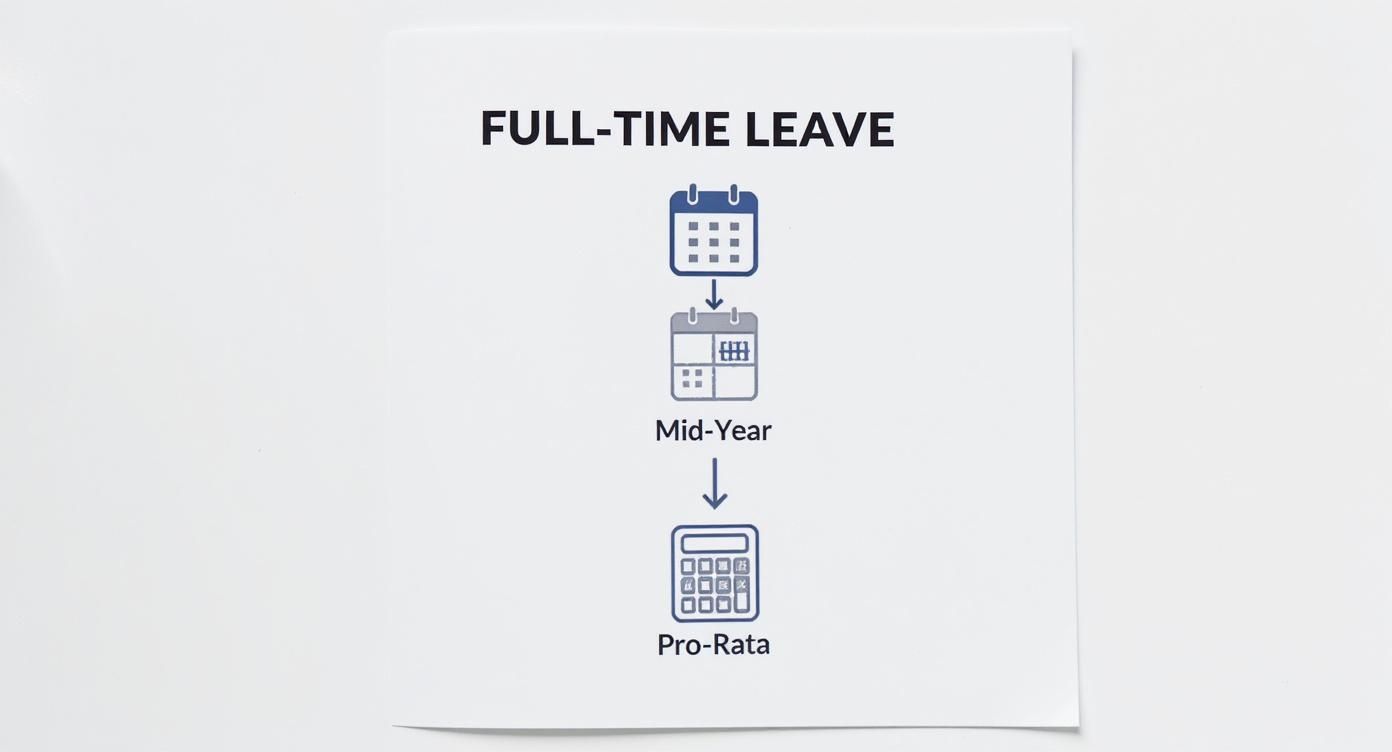
As the visual shows, as soon as you identify a non-standard working pattern, the pro-rata path is the one you need to take for accurate results.
Variable Hours and the 12.07% Method
Now for something a bit trickier. What about staff with no fixed hours?
Meet Maria. She works in retail on a flexible contract, so her hours change every week depending on the rota. Last month, she worked a total of 110 hours. In this situation, calculating leave based on days is impossible.
This is where we use a method based on the statutory leave of 5.6 weeks. The formula comes from dividing the statutory leave by the total working weeks in a year (5.6 ÷ 46.4 = 12.07%). You then apply this percentage to the hours an employee has worked.
For Maria, the calculation for the holiday she earned last month looks like this:
- 110 hours × 12.07% = 13.27 hours of holiday earned
This approach ensures Maria accrues holiday in direct proportion to the hours she actually puts in, making it the fairest and most accurate method for casual or zero-hour contracts.
The key takeaway is simple: tie the entitlement directly to the unit of work. If someone is paid by the day, calculate their leave in days. If they are paid by the hour, calculate it in hours. This alignment prevents confusion and ensures accuracy.
To give a clearer picture, here’s how the calculations might look for a few different part-time arrangements.
Pro-Rata Leave Calculation Examples
| Working Pattern | Calculation Method | Example Annual Entitlement |
|---|---|---|
| Fixed 4 days/week | (4 ÷ 5) × 28 days | 22.4 days |
| Fixed 2.5 days/week | (2.5 ÷ 5) × 28 days | 14 days |
| Variable hours | Hours Worked × 12.07% | Accrued in hours (e.g., 80 hours/month = 9.65 hours leave) |
| Term-time only | Standard pro-rata based on weeks worked per year | Varies based on contract (e.g., 39 weeks/year) |
These examples show just how different the outcomes can be. Trying to manage all these different calculations manually across a team is a huge administrative burden. It's also worth getting familiar with the general rules around PTO for part-time employees in different regions, as legal frameworks can vary.
This is exactly why tools like Leavetrack exist. A dedicated system automates these pro-rata calculations, applying the correct formula based on each person's contract. It completely eliminates human error and frees up valuable time, letting you focus on supporting your team instead of getting lost in spreadsheets.
Navigating Complex Annual Leave Scenarios

The standard leave calculations are one thing, but the reality of employment is rarely that simple. Things get particularly tricky when an employee's pay isn't just a basic salary, and it's these complex situations where getting it right is absolutely crucial to stay compliant with UK employment law.
Many businesses get caught out when variable pay comes into the picture. If a team member regularly earns commission or works paid overtime, their holiday pay has to reflect this. You can't just pay them their basic rate; the law demands their holiday pay is based on their average earnings over the previous 52 paid weeks. This ensures they aren't penalised financially for taking the time off they're legally entitled to.
Calculating Holiday Pay with Overtime and Commission
So, how do you correctly calculate annual leave pay for someone with variable earnings? You need to work out their average weekly pay. This means looking back over the last 52 weeks where they actually received pay, and importantly, ignoring any weeks they were unpaid (like if they were on statutory sick pay).
Let's walk through an example. Imagine an employee, Alex, has a basic weekly pay of £400 but has also pulled in £2,600 in commission over the last 52 weeks.
- Total annual earnings: (£400 × 52) + £2,600 = £23,400
- Average weekly pay: £23,400 ÷ 52 = £450
- A week of holiday pay: This comes to £450, not the basic £400.
This calculation makes sure Alex's holiday pay is a fair reflection of what he normally earns.
Carrying Over Unused Leave
Another frequent question is about carrying over unused holiday. Under UK law, employees have to take at least four weeks of their statutory leave within the leave year. The leftover 1.6 weeks can be carried over, but only if you have a specific agreement in place allowing it.
There are, however, some important exceptions. If someone couldn't take their leave because of long-term sickness or because they were on family-related leave (like maternity), they must be allowed to carry over the untaken portion of their four-week entitlement.
The core principle here is that an employee should not lose out on their statutory holiday entitlement due to circumstances beyond their control. This is a key protection under the Working Time Regulations.
Sickness Absence and Termination Pay
It’s a common misconception that holiday accrual pauses during long-term sickness. That's not the case. An employee continues to build up their full statutory and contractual holiday entitlement while they're off sick. They can even choose to take paid holiday during their period of sickness absence.
Finally, when an employee leaves your company, you have to pay them for any holiday they've accrued but not taken. This final payment is worked out on a pro-rata basis right up to their last day. It should be part of their final payslip and, again, must reflect their average earnings if they had variable pay. Getting these final sums right is essential for a clean and compliant offboarding process.
Why Taking Annual Leave Is a Business Imperative
Getting the annual leave calculations right is a crucial box to tick for compliance, but it’s only half the story. The real challenge? Creating a culture where your team feels they can actually take the time off they’ve earned. When holiday days start piling up, it's often a red flag for deeper issues like burnout and plummeting productivity.
Unspent leave is a massive problem in the UK. Many people admit that workload anxiety or the simple fear of falling behind are the main reasons they don't book time off. They dread the thought of the email mountain and task list that will be waiting for them when they get back, turning a much-needed break into just another source of stress.
This isn’t just a hit to employee wellbeing; it’s a direct blow to your business's performance. A team that is constantly overworked and under-rested is simply less creative, makes more mistakes, and is far more likely to head for the exit.
A Concerning Trend in the UK
Recent data shows a pretty worrying trend. The average UK employee took just 33.9 days of annual leave last year. That’s a noticeable drop from 36.7 days in 2022 and 38 days back in 2020. This decline of nearly 12% since 2020 is a clear signal that British workers are skipping their breaks more and more. You can dive deeper into the UK annual leave report on PeopleHR.com.
This pattern has real-world consequences. Beyond just ticking legal boxes, actively encouraging and managing annual leave is a core part of effective employee retention strategies. When your staff feel like they can never truly switch off, their engagement nosedives, and it's only a matter of time before your best people start looking for a workplace that values their wellbeing.
Reframing Leave as a Necessity
To turn this around, managers need to start talking about annual leave differently. It’s not a perk; it's an essential part of running a healthy, sustainable business. This isn't about being generous—it's about being smart.
Here are a few practical ways to build a healthier culture around time off:
- Lead by Example: Managers have to take their full holiday allowance and genuinely disconnect. If the boss is firing off emails from the beach, it sends a clear message that nobody is ever really expected to be offline.
- Plan Ahead: Make holiday planning a normal conversation at the start of the year. This helps normalise taking breaks and makes it much easier to juggle workloads and arrange for cover without last-minute panic.
- Implement Proper Handovers: Create a straightforward handover process for projects before someone goes on leave. This eases the anxiety for the person taking a break and prevents chaos for the colleagues left behind.
Ultimately, a well-rested team is a more productive and innovative one. Viewing annual leave as an investment in your people’s performance is one of the most effective long-term strategies for business success.
Your Annual Leave Questions Answered
Even when you’ve got the formulas down, real-life situations can throw a spanner in the works. Let’s tackle some of the most common questions that pop up, giving you straightforward answers to handle these scenarios confidently.
One of the biggest worries for any good employer is that their team isn't actually taking the time off they've earned. It’s a real problem; recent data shows British workers consistently leave a full working week (five days) of their annual leave on the table each year.
This isn't because they don't want a break. It's often down to workload pressures. The same research found many people work an average of 2.5 days during a seven-day holiday, completely blurring the line between rest and work. You can dive into the full findings on the state of UK annual leave over on timetastic.co.uk.
What Happens to Bank Holidays if I Work Part-Time?
If you work part-time, you're still entitled to bank holidays—just on a pro-rata basis.
It's a simple calculation. For instance, if you work three days a week instead of the standard five, you're entitled to 3/5ths (or 60%) of the bank holiday allowance. Many employers find it easiest to just add this pro-rata amount to your total annual leave pot, letting you book those days off whenever you like.
Can My Employer Tell Me When to Take My Leave?
Yes, they can. An employer has the right to require you to take leave on specific dates, which is common for things like a company-wide Christmas shutdown.
However, they can't just spring it on you. They have to give you proper notice. The standard rule is that they must provide notice that is at least twice as long as the period of leave they're asking you to take.
This rule is all about fairness. It prevents last-minute forced leave that could wreck an employee's plans and highlights the need for clear, forward-thinking communication from the business.
How Is Holiday Pay Calculated if My Pay Varies?
This is a great question, especially for teams with commission, overtime, or variable hours. If an employee's pay changes from week to week, their holiday pay must be based on their average weekly pay.
This average is worked out over the previous 52 weeks in which they were actually paid. Any weeks where they didn't work or receive pay are simply skipped over in the calculation.
Do I Accrue Holiday While on Maternity Leave?
Absolutely. An employee's statutory and contractual holiday entitlement continues to build up as normal throughout their entire maternity, paternity, adoption, or shared parental leave.
They can then choose to take this accrued holiday either before they start their family leave or tack it on to the end before they return to work.
Trying to track all these rules manually is a recipe for mistakes and headaches. Leavetrack automates everything from pro-rata calculations to accruals, making sure every single employee gets the right entitlement, every time. See how Leavetrack simplifies leave management.