
Calculation of Leave: A Practical UK HR Guide
Posted by Robin on 13 Feb, 2026 in
Getting holiday calculations right is fundamental. Mess it up, and you’re in for a world of payroll headaches, employee disputes, and compliance nightmares. It all starts with the legal framework set by the UK government, which provides the absolute baseline every employer must meet.
The cornerstone is the statutory minimum entitlement of 5.6 weeks of paid holiday per year for all full-time UK employees. For someone working a typical five-day week, this translates neatly into 28 days of paid annual leave. This can include bank holidays, but it doesn't have to. Many companies, of course, offer more than this as part of their benefits package to attract and keep good people.
Mastering the Essentials of UK Leave Calculation
Before you can tackle part-timers, new starters, or leavers, you have to get your head around the two core types of leave. A solid grasp of the fundamentals isn't just about compliance; it's about setting a fair, transparent standard for your entire team. When employees understand how their leave is calculated, it builds trust and cuts down on confusion.
Differentiating Statutory and Contractual Leave
It's absolutely crucial to distinguish between the legal minimum (statutory leave) and any extra days you offer as a perk (contractual leave). Statutory leave is your legal duty, whereas contractual leave is a benefit you define in the employment contract. This distinction affects everything from how leave accrues for new joiners to the final pay calculations for people who leave.
Imagine a small marketing agency that has always tracked holidays on a basic spreadsheet. They offer a generous 25 days plus bank holidays, making a total of 33 days. An employee leaves mid-year, and the manager mistakenly calculates their final holiday pay based on the full 33 days, instead of pro-rating the statutory and contractual parts separately. This simple oversight results in an overpayment and shows exactly why you need to be clear on the two types from the get-go.
Key Differences at a Glance
To make it even clearer, let's break down the main differences between the legal floor and any enhanced company policies you might have. Nailing these nuances is the first step towards accurate calculations for every single employee, no matter their role or how long they've been with you.
Statutory vs Contractual Leave Entitlement
| Feature | Statutory Leave (5.6 Weeks) | Enhanced Contractual Leave |
|---|---|---|
| Source | Mandated by UK law (Working Time Regulations 1998) | Defined in the employee's contract of employment |
| Minimum Amount | 5.6 weeks per year (capped at 28 days) | Any amount offered above the statutory minimum |
| Flexibility | Rules are rigid and legally defined | Can be tailored with specific company policies (e.g., carryover rules) |
| Payment on Leaving | Must be paid out for any unused, accrued entitlement | Governed by the terms outlined in the employment contract |
Understanding this table is key. While you can't touch the rules around statutory leave, you have much more control over the contractual element, which is where your company policies on things like carrying over unused days come into play.
The Importance of Getting It Right
Accurate leave calculation is far more than a box-ticking exercise. Recent data shows a worrying trend: the average UK employee took only 33.9 days of annual leave in 2023, a sharp drop from 36.7 days in 2022. This points to mounting pressure on staff, who might feel they can't take the time off they've rightfully earned.
Getting your calculations right is the first step in creating a culture where people feel encouraged to take a proper break. This is especially true when you start dealing with more complex scenarios like part-time staff or workers on variable hours, where the maths gets a bit trickier. Building your process on a solid understanding of these basics makes everything that follows far more manageable.
To dive deeper into the legal requirements, check out our guide on the UK statutory holiday allowance.
Calculating Pro-Rata Holiday for Your Flexible Workforce
Once you have a firm grip on the basics, the next real-world challenge is applying them to your flexible workforce. This is where I’ve seen many businesses trip up – calculating leave for part-time, irregular-hour, and zero-hours contract staff. But honestly, the logic is straightforward once you break it down. It’s all about fairness and proportionality.
A part-time employee is entitled to the same 5.6 weeks of holiday as a full-time colleague; the crucial difference is that their "week" is shorter. The key is to calculate their entitlement based on the days or hours they actually work, ensuring they receive a fair, pro-rata amount.
This diagram shows a simple visual guide to the core components of UK leave calculation.
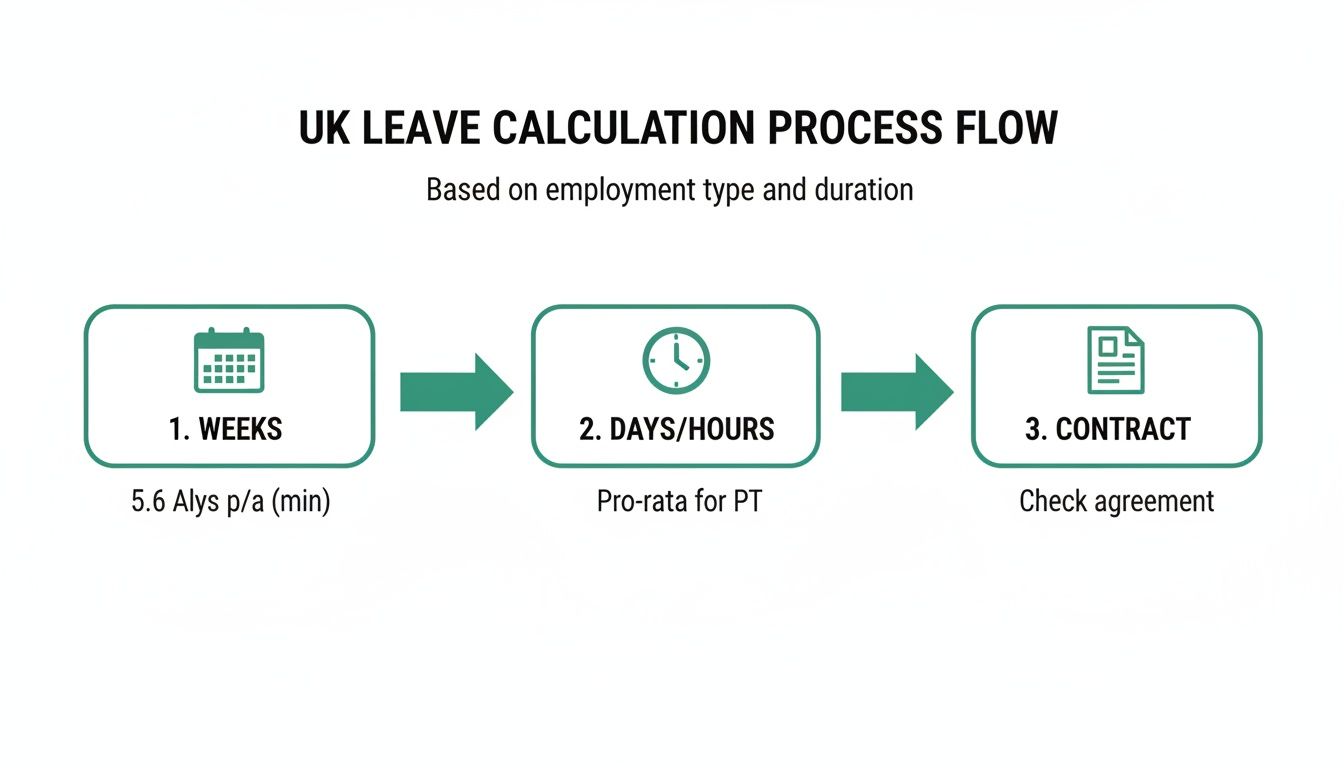
The flow from the statutory weeks to the specific days or hours, all governed by the contract, is the fundamental journey for every single leave calculation you'll make.
Part-Time Staff with Regular Hours
Let's start with the simplest scenario: calculating leave for part-time employees who work a consistent pattern. The goal here is to convert the standard 5.6-week entitlement into a figure that reflects their actual working pattern.
For an employee who works a set number of days each week, the calculation is refreshingly direct.
- Formula: (Number of days worked per week) x 5.6 weeks = Total annual holiday entitlement in days.
Let’s take a practical example. Say Sarah works three days a week—Monday, Tuesday, and Wednesday. To figure out her holiday entitlement, you just multiply her working week by the statutory 5.6 weeks.
- Calculation: 3 days/week x 5.6 weeks = 16.8 days of paid holiday per year.
A quick tip from experience: it’s good practice to round up partial days to the nearest half or full day. It’s a small gesture that avoids disputes and shows you're a fair employer. In this case, you might round Sarah’s entitlement up to 17 days.
Irregular Hours and the 12.07% Method
For workers with no fixed hours, like those on zero-hours contracts or your casual staff, the calculation needs a different approach. You can't use a fixed weekly pattern because their hours fluctuate. Instead, their holiday entitlement accrues as they work.
Following some recent legal back-and-forth, the government has thankfully re-introduced a clear method for these workers for leave years starting on or after 1st April 2024. Holiday entitlement for irregular-hour and part-year workers is now calculated at 12.07% of the hours they have worked in a pay period.
This 12.07% figure isn't just pulled out of thin air. It's derived from the statutory 5.6 weeks of holiday divided by the remaining 46.4 working weeks of the year (52 - 5.6 = 46.4). So, 5.6 / 46.4 is roughly 12.07%.
Let's see this in action. Imagine David is on a zero-hours contract and in May, he worked a total of 80 hours.
- Calculation: 80 hours x 12.07% = 9.66 hours of holiday accrued that month.
You simply repeat this calculation for each pay period. This method ensures the holiday David earns is directly proportional to the time he has actually put in, which is the fairest way to handle it for everyone involved.
Rolled-Up Holiday Pay Explained
Alongside the 12.07% accrual method, the concept of rolled-up holiday pay has been made legally permissible again for irregular-hour and part-year workers. This just means you pay an employee their holiday pay at the same time as their basic pay, rather than when they actually take the time off.
In practice, this means you can add an extra 12.07% on top of their hourly wage for the hours they've worked. It is absolutely crucial, however, that this additional amount is clearly itemised on their payslip as 'holiday pay'.
- Why does this matter? Transparency is everything. If it’s not clearly separated, you risk a tribunal finding that you haven’t paid their holiday pay at all, leaving you liable to pay it a second time.
While it can be convenient, I'd advise using this method with caution. It can sometimes discourage employees from taking proper breaks, as they've already received the money. The whole point of holiday is to provide rest, so encouraging people to actually take their leave is always the best practice for employee wellbeing. If you do go this route, make sure you have a clear policy and communicate it well.
Untangling Trickier Leave Scenarios and Adjustments
Beyond your standard full-time and part-time holiday calculations, you'll inevitably run into more complex situations. Things get interesting when you’re dealing with new starters, leavers, or staff on long-term absence. This is where a rock-solid policy and a methodical approach are absolutely essential to keep things fair and legally compliant.
The core principle never changes: holiday entitlement accrues from an employee's first day right up to their last. The real challenge is applying that rule consistently when people join, leave, or are off sick.
Calculating Leave for New Starters
When someone joins your team part-way through the holiday year, you’ll need to work out their leave entitlement on a pro-rata basis. It’s a simple way to give them a fair allowance for the portion of the year they'll actually be working.
The calculation itself is pretty straightforward. You just need to figure out how many months they'll be with you in the current leave year and apply that fraction to the full annual entitlement.
Let's walk through a quick example.
- Imagine your leave year runs from January to December.
- Your new starter, Alex, joins the team on 1st April.
- The full-time entitlement at your company is 28 days.
- From April to December, Alex will work for 9 of the 12 months in that leave year.
The formula is: (9 months ÷ 12 months) x 28 days = 21 days. Easy. Alex gets 21 days of holiday for their first year.
Handling Final Leave for Leavers
The process for an employee who is leaving is very similar, but with a crucial final step. You have to calculate the total leave they’ve accrued up to their last day and then square that against the leave they’ve already taken.
Let's say another employee, Ben, is leaving on 30th June. The company leave year is January-December, and the full entitlement is 28 days. Ben will have worked for 6 full months of the year.
First, you work out his accrued leave: (6 months ÷ 12 months) x 28 days = 14 days.
Now, you have to check this against his records.
- If Ben has taken less than 14 days: You owe him for the difference. If he’s only used 10 days, you’ll need to add payment for the remaining 4 days to his final payslip.
- If Ben has taken more than 14 days: This is where things can get tricky. If your employment contract has a specific clause allowing you to deduct pay for holiday taken in excess of entitlement, you can reclaim it. If that clause isn’t there, you generally can’t make the deduction.
Having a clear, well-drafted clause in your employment contracts to cover deductions for excess holiday is a vital bit of admin foresight. It protects the business and makes sure everything is transparent for the departing employee.
The Impact of Sickness and Other Absences
This is a big one that catches many managers out: an employee’s statutory holiday entitlement continues to build up even when they're off work for other reasons. This includes sickness, maternity, paternity, or adoption leave.
Someone on long-term sick leave for six months is still accruing their holiday entitlement in the background, just as if they were in the office every day.
This isn’t a minor detail, especially when you consider the scale of workplace absence. In the UK, work-related ill health and injuries led to a staggering 40.1 million lost working days in 2024/25, with stress, depression, or anxiety being a major cause. You can dig into the numbers yourself by checking the latest workplace health statistics from the HSE.
- Key Consideration: If an employee can't take their holiday because of long-term sickness, they must be allowed to carry it over into the next leave year. The law is very clear on this.
Rules on Carrying Over Unused Leave
Whether an employee can carry over unused holiday all comes down to your company policy and the type of leave in question. The rules are different for the statutory minimum versus any extra contractual leave you might offer.
Here’s how it breaks down legally in the UK:
- Statutory Leave (First 4 weeks / 20 days): Under normal circumstances, this chunk of leave cannot be carried over. It has to be taken in the leave year it's accrued. The main exception, as we've seen, is for employees on long-term sick leave.
- Additional Statutory Leave (1.6 weeks / 8 days): This part can be carried over into the next leave year, but only if you have a written agreement in place with the employee.
- Contractual Leave: For any holiday you offer on top of the 5.6-week statutory minimum, you’re free to set your own carry-over rules. You could let people carry over 5 days, or you could have a "use it or lose it" policy.
Whatever you decide, make sure your carry-over policy is spelled out clearly in the employee handbook or contract. A well-defined, well-communicated policy is your best defence against confusion and ensures every calculation is handled consistently.
Practical Tools and Formulas for Accurate Leave Tracking
Let's move from theory to practice. Understanding the rules is one thing, but having the right tools makes calculating leave entitlements much, much easier. For many smaller businesses, a well-structured spreadsheet is often the first step in moving away from paper forms and building a more organised system.
Here are some practical formulas and a simple layout you can use to start tracking leave more effectively today. This approach will help you maintain accurate records and provide a clear history of every employee's holiday balance.
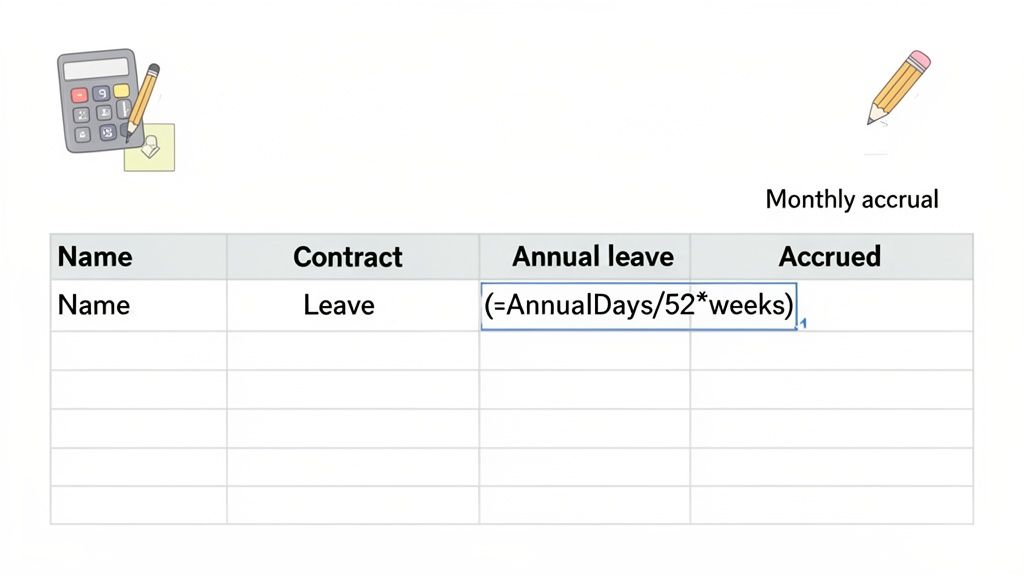
Essential Excel Formulas for Leave Calculation
With a couple of key formulas, you can get Excel to do most of the heavy lifting. These examples can be copied straight into your own tracker, saving you time and cutting down on the risk of manual errors. Just remember to tweak the cell references to match your own sheet.
Pro-Rata Entitlement for a New Starter
This formula is perfect for figuring out the correct holiday allowance for someone who joins part-way through your leave year.
=(C2/12)*(12-MONTH(B2)+1)
- B2: This should be the employee's start date.
- C2: This is your company's full-time annual leave entitlement in days.
It works by calculating how many full months of the leave year the new employee will work and gives them their pro-rata entitlement. It's a quick way to ensure you're being fair from day one. For even more detailed scenarios, you can find more options in our handy UK holiday calculator guide.
Monthly Accrual Tracking
Need to see how much leave an employee has earned at any point in the year? This formula tracks their monthly accrual.
=(C2/12)*MONTH(TODAY())
- C2: The employee's full annual leave entitlement.
This calculates the cumulative leave earned from the start of the year right up to the current month. It's incredibly useful for checking balances before you approve a request, especially for newer members of staff.
Structuring Your Leave Tracker
A simple but effective spreadsheet is built on a logical structure. A disorganised sheet just becomes a source of confusion. The trick is to capture only the essential data points for every employee in a clear, consistent format.
Here’s a sample layout that provides a solid foundation. It covers the core information you’ll need to manage leave requests and balances accurately.
Sample Excel Leave Tracker Layout
| Employee Name | Annual Entitlement (Days) | Leave Taken (Days) | Remaining Balance (Days) | Monthly Accrual Rate |
|---|---|---|---|---|
| John Smith | 28 | 10 | 18 | 2.33 |
| Emily Jones | 16.8 | 5 | 11.8 | 1.40 |
| Aisha Khan | 28 | 15 | 13 | 2.33 |
This basic structure can easily be expanded. You could add columns for start dates, contract types, or notes for specific adjustments, creating a single source of truth for your team's time off.
Common Spreadsheet Pitfalls to Avoid
While spreadsheets are a great starting point, they absolutely come with their own set of challenges. Knowing about these common traps can save you from major headaches down the line.
One of the biggest issues I see is inconsistent rounding. Do you round partial days up to the nearest half-day or full day? The law says you can't round a statutory entitlement down, but your company policy needs to be crystal clear on how you handle fractions. Without a consistent rule, you risk treating employees unfairly.
A lack of real-time visibility is another major drawback. A spreadsheet is only as up-to-date as the last time someone manually updated it. This can easily lead to conflicting holiday requests being approved or managers being totally unaware of who is actually off.
Finally, the risk of human error is always there. A simple typo in a formula or an accidental deletion can corrupt your entire tracker, leading to incorrect payroll calculations and unhappy employees. These limitations are often the signal that it’s time to look at a more reliable, automated way to manage leave.
Why Smart HR Teams Automate Leave Calculations
Let’s be honest: managing leave with spreadsheets is a recipe for disaster. It’s a messy tangle of errors, wasted hours, and frustrated staff. While the formulas we've covered are a decent starting point, they're really just a plaster over a much deeper problem. This is where modern, automated solutions completely change the game.
Systems like Leavetrack are built to take the guesswork out of the equation. They handle accruals on autopilot, figure out complex pro-rata calculations in a heartbeat, and give you a clear, real-time dashboard of all leave balances. Instead of wrestling with cells and formulas, you get pinpoint accuracy with the click of a button.
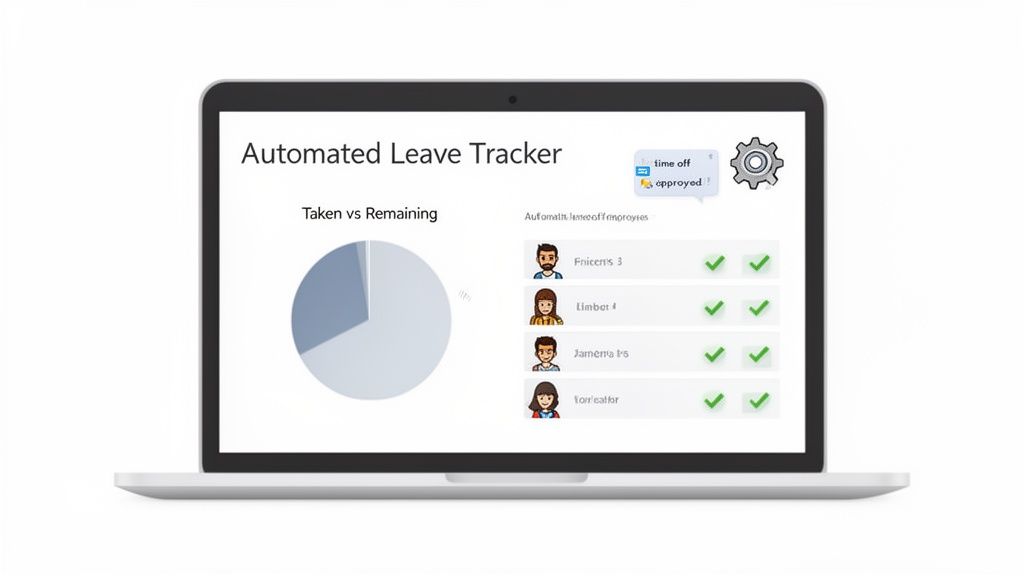
This kind of dashboard gives HR managers and team leaders an instant, visual overview of who’s available and what leave people have left. It shifts leave management from a reactive, admin-heavy chore to a proactive, strategic part of running the business.
Eliminating Errors and Saving Valuable Time
Think about the daily grind of an HR manager—we’ll call her Chloe—at a growing tech firm. Her life was ruled by a sprawling, colour-coded spreadsheet. Every holiday request meant manually checking balances, updating cells, and fielding a constant stream of emails asking, "How many days do I have left?" It was a full-time job within a job.
The breaking point came when a simple copy-paste error meant two key developers were approved for the same two weeks off, right before a major product launch. The chaos that followed was the final push she needed to find a better way.
By switching to an automated system, Chloe immediately got hours back every single week. The difference was stark:
- No more manual data entry: The system handled accruals automatically based on the policies she set.
- Instant pro-rata calculations: Onboarding a new part-time team member took minutes, not a stressful half-hour with a calculator.
- Self-service for employees: Staff could check their own balances 24/7, which dramatically cut down on the inbox clutter.
This story is incredibly common. Implementing effective business process automation streamlines these mundane tasks, giving HR professionals time back to focus on people, not paperwork.
Ensuring Compliance and Fairness
Beyond just saving time, automation brings a level of consistency that a manual system can never hope to match. An automated platform enforces your company policies—from carry-over limits to accrual rules for different contract types—without fail, every single time.
This consistency is vital for legal compliance and for keeping staff morale high. In the UK, where employee turnover averages a staggering 34% annually, small frictions can have a big impact. When leave calculations are imprecise, it can lead to disputes and demotivation—something that 15% of resigning employees cite as a factor in their decision to leave.
An automated system acts as your single source of truth. It ensures every calculation is based on the same rules, providing a clear, auditable trail that protects both the business and its employees.
Fostering Transparency and Integration
The best systems do more than just crunch numbers; they plug right into the tools your team already uses every day. For Chloe’s team, the ability to see who was off directly in their shared calendars and to approve requests via Slack was a massive win.
This new level of transparency got everyone on the same page. Project managers could plan workloads with confidence, and team members could see their colleagues' availability without having to chase anyone down. It transformed leave management from a siloed HR task into a seamless part of the company's daily operations.
To see more on how this works in practice, you might be interested in our guide to automated leave management systems.
Answering Your Trickiest Leave Calculation Questions
Even with the best systems in place, some scenarios always seem to cause a headache. Let's tackle some of the most common questions that pop up about leave calculations, giving you clear answers to handle these situations like a pro.
How Should We Handle Bank Holidays For Part-Time Staff?
Ah, the classic part-timer and bank holiday puzzle. The only fair and legally sound way to handle this is to treat bank holidays proportionally. Think of it this way: if a part-time employee works three days a week, they should get a pro-rata share of the bank holidays, just like their annual leave.
You can't just give them a paid day off if a bank holiday happens to fall on their working day and nothing if it doesn't. That's a recipe for inequality.
Instead, the best practice is to calculate their total pro-rata holiday entitlement for the year (which includes an allowance for bank holidays). Then, if a bank holiday falls on one of their usual working days, they simply book it off using that total allowance. This method ensures everyone gets the right proportional benefit, no matter their work pattern.
How Is Holiday Pay Calculated For Staff With Commissions?
This is a big one. For any staff whose pay fluctuates because of commissions or regular overtime, their holiday pay has to reflect what they normally earn, not just their basic salary. The law is very clear on this: people shouldn't be financially worse off for taking a holiday.
To get this right, you need to calculate their average pay over the previous 52 weeks where they actually earned money. It's crucial to ignore any weeks where they didn't work or weren't paid. This 52-week reference period gives you a true picture of their typical income.
Forgetting to include regular overtime or commission in holiday pay calculations is one of the most common and expensive payroll mistakes. It can easily lead to hefty back-pay claims if an employee decides to challenge it.
Can We Legally Refuse a Holiday Request?
Yes, you absolutely can refuse a holiday request, but you must have a solid business reason. Maybe you need all hands on deck for a busy period, or perhaps too many other team members have already booked the same time off. These are perfectly valid reasons.
The key is to give proper notice. The minimum notice you have to give when refusing a request is the same length as the holiday requested. So, if someone asks for one week off, you must let them know at least one week before their holiday was due to start.
What Happens to Holiday During Long-Term Sick Leave?
An employee's statutory holiday entitlement keeps building up even when they're on long-term sick leave. As long as they are employed, their right to accrue leave continues just as if they were in the office.
If an employee can't take their holiday because they're ill, they must be allowed to carry over a minimum of four weeks (20 days) of their statutory leave into the next holiday year.
Stop wrestling with spreadsheets and complex rules. Leavetrack automates every aspect of leave calculation, from pro-rata entitlements to real-time balance tracking, ensuring you're always accurate and compliant. Discover a simpler way to manage leave.