

Flexible Working Request Template: flexible working request template for hybrid
Posted by Robin on 18 Dec, 2025 in
A solid flexible working request template anchors your proposal in clear legal rights and tangible business benefits. By calling out your Day-One Right alongside company policy, you strike a professional tone. The right structure keeps your message concise and compelling.
Understanding Legal Rights And Core Concepts
The UK’s flexible working framework shifted on 6 April 2024, so now every employee can request changes from day one. That includes tweaks to hours, locations or both. Grasping these new rules helps you craft a template that blends legal accuracy with operational sense.
- Day-One Right: Ask for flexible hours or locations from your very first day.
- Reasonable Consideration: Employers must respond within two months and treat every request fairly.
- Hybrid Requirements: 65% of hybrid organisations expect at least three in-office days each week.
- Policy Interpretation: Look for clauses on minimum hours, core working days or trial periods.
Under these reforms, roughly 32 million employees in Great Britain can now put in a flexible working request immediately rather than after 26 weeks. For a deeper dive into UK flexible working stats, Learn more.
Interpreting Your Employer’s Policy
Company handbooks usually spell out core days, notice periods and the application process. Picking up on anything about office days or trial runs lets you tailor your request perfectly.
Here’s the government’s official guidance on flexible working requests.

This screenshot lays out the formal steps, including the application form and valid business reasons. It also highlights the eight-week decision window and the right to appeal.
Anticipating Common Objections
- Cover Arrangements: Outline who will handle your tasks during flex hours.
- Productivity Impact: Suggest KPIs to measure outputs and efficiency.
- Team Collaboration: Emphasise tools like Slack, Microsoft Teams or other channels.
For organisational perspectives, check our guide on the risks associated with a work-life integration approach.
Framing Your Business Case
Tie your request directly to department goals and operational priorities. For instance, link remote days to looming project deadlines or potential savings on office overheads.
- Use real metrics to illustrate productivity gains or cost avoidance.
- Propose a review meeting after a defined pilot period to fine-tune the arrangement.
- Maintain a collaborative tone—show that you’ve your team’s back and deadlines are still front of mind.
Always suggest a trial period with clear start and end dates.
By rooting your proposal in these legal rights and company realities, your flexible working request template becomes a compelling business document.
Exploring Real World Request Scenarios
In the UK, life demands seldom fit into neat nine-to-five slots.
Here, we dive into genuine examples—home working arrangements, term-time setups and even compressed hours—to spark ideas for your own flexible working request.
This ONS snapshot shows weekly home working percentages by sector.
Notice how roles with higher pay and a university background dominate hybrid and remote options.
Hybrid And Remote Adoption Trends
Data from the ONS and UK Parliament reveals that 39% of working adults worked from home in 2025, with 26% in hybrid roles and 13% fully remote.
For a deeper dive, see Euronews’s report on flexible work adoption in Great Britain.
Parents and carers often exceed these averages, crafting days around school runs or breaking tasks into micro-shifts.
- A mum in finance might log off at 2 pm and finish her report after the school run.
- A carer tackles work in two-hour blocks to fit in medical appointments.
- An office professional starts at 7 am to avoid rush hour and wraps up by mid-afternoon.
These real-life patterns create a compelling narrative for your manager. Mirror one of these models to make your case both concise and convincing.
Flexible requests grounded in real routines win approval more than abstract proposals.
Framing your proposal around familiar scenarios makes it feel bespoke. Plus, managers relax when they see tried-and-tested routines rather than vague ambitions.
Choosing The Right Flexible Pattern
Pick a model—compressed hours, term-time only or remote-first—that suits your role and team dynamics.
Think about deadlines, critical meetings and the collaboration tools you’ll need.
A compressed hours plan might give you four 10-hour days, freeing up an extra weekday. Term-time only schedules prove invaluable for parents aligned with school calendars.
- Check your team’s peak workload and dependencies.
- Match your pattern to project milestones and meeting cadences.
- Propose a trial period with clear review dates and measurable KPIs.
These steps ensure your request template is precise and grounded in real business needs.
With a solid pattern in hand, head over to Leavetrack.
Leavetrack’s calendar view lays out your proposed hours and cover arrangements in one glance.
Managers can instantly visualise how your trial fits team workflows and identify any coverage gaps.
Blending a real-world example with Leavetrack’s visual tools often seals the deal. It turns a hypothetical request into a transparent plan.
Tweak your draft language to match your team’s culture and timetable.
Those small touches—a five-week trial or a simple handover plan—often tip the balance.
It’s time to draft that personalised flexible working request template. Use these scenarios as your blueprint and submit with confidence today.
Crafting Your Flexible Working Request Template
When you nail your request template, you give your manager everything they need in one place. Start by framing your role and how long you’ve been with the team. That bit of context sets the scene before you dive into your proposed pattern.
Essential Template Components
Keep each part crystal clear so nothing slips through the cracks. A robust template usually includes:
- Introduction: Your position and length of service
- Working Pattern: Specific days, hours and location
- Trial Period: Start/end dates and clear KPIs
- Cover Arrangements: Who handles urgent tasks in your absence
- Business Rationale: How this change saves time or cuts costs
Template Components Comparison
Below is a quick rundown comparing each component’s purpose with sample wording. It helps you see how the pieces fit together.
| Component | Purpose | Example |
|---|---|---|
| Introduction | Establish role and tenure | “I have been a marketing coordinator for 3 years.” |
| Working Pattern | Specify days and hours | “I propose three days remote, two days in the office each week.” |
| Trial Period | Define timeframe and success metrics | “Let’s pilot for six weeks with weekly output targets.” |
| Cover Plan | Maintain workflow continuity | “Colleague X will manage urgent calls on remote days.” |
| Business Case | Highlight efficiency gains | “Remote days can reduce commuting delays by 20%.” |
A concise business case helps managers see value at a glance.
This table helps you tailor each section quickly. Adjust the examples to reflect your own situation.
Common Phrasing Dos And Don’ts
- Do spotlight benefits to the business early on.
- Don’t hide key details in jargon or legalese.
- Do use strong verbs like “will deliver” and “will maintain.”
These pointers keep your wording tight and engaging.
That ACAS guidance spells out valid reasons for a request and underlines the eight-week decision window plus the right to appeal.
Polishing Email And Letter Tone
Emails can feel warm but still professional. Start with a subject line such as:
- Flexible Working Request – [Your Name]
Keep paragraphs short, friendly and to the point. A touch of contraction here and there adds personality.
Letters need a formal header with your address and the date. Citing the Employment Rights Act 1996 shows you know your rights. Legal references work best in a structured paragraph.
Across both formats, make sure to include:
- A clear introduction of your role
- Your proposed working pattern
- The business rationale linked to team goals
- Trial period details with measurable KPIs
- A plan for covering responsibilities
You’ll find more examples in our guide on mastering the requesting annual leave email.
By blending clear structure, real-world examples and the right tone, your flexible working request template will speak volumes. Tailor each component, add the legal nod where needed and project confidence. That’s how you make it easy for managers to say “yes.”
Examples Of Flexible Working Request Templates
Moving from idea to action can be daunting. To help, here are four real-world templates covering hybrid working, fully remote setups, compressed hours and term-time only schedules.
- Hybrid-working request for split office and home days
- Fully remote arrangement for care commitments
- Compressed hours over fewer days
- Term-time only option for parent schedules
Hybrid Working Request
Jess in operations had grown tired of two-hour commutes three days a week. She pitched a hybrid model to reclaim quiet focus time. By working remotely twice a week, she boosted her report turnaround by 20%.
- Business Impact Statement: Save four hours commuting and increase throughput by 20%
- Trial Proposal: Six-week trial with weekly check-ins
- KPI Suggestions: Tickets closed and milestone completion rates
- Call To Action: Request a meeting to agree on start dates
Jess shared a sample week view from Leavetrack to illustrate coverage. That simple visual helped her manager see gaps and say yes.
Fully Remote Arrangement
Mark cares for his elderly father and needs a fully remote setup to balance daily care. He pointed out that cutting office overheads could save £600 per quarter. That financial angle framed remote work as a win-win.
- Business Impact Statement: Remote work saves £600 per quarter in desk costs
- Trial Proposal: Four-week pilot with daily progress updates
- KPI Suggestions: Completed tasks against targets and response times
- Call To Action: Approve via email for a 1 May start
Mark attached a KPI dashboard export to underline expected gains. Here’s what Leavetrack’s planner view looks like:
This calendar overlay makes gaps and coverage crystal clear, so managers can sign off with confidence.
Compressed Hours Option
Sophie in finance squeezed her 40-hour week into four 10-hour days to carve out an extra weekday. She said those longer sessions sharpened focus on month-end reporting. The result? Cleaner reconciliations and fewer deadline scrambles.
- Business Impact Statement: Dedicated long sessions improve reconciliation accuracy
- Trial Proposal: Month-long trial ending 30 June
- KPI Suggestions: Report accuracy rate and deadline adherence
- Call To Action: Seek confirmation by Friday to adjust schedules
Pairing core hours with clear deliverables, Sophie found, quickly builds trust. It’s a small tweak with big impact.
Term-Time Only Request
Laura, a working mother, aligned her hours to school terms so she could drop off and pick up her children. She stressed maintaining full annual hours over those weeks and tackling peak periods together. That plan cut unexpected absences and smoothed planning.
- Business Impact Statement: Aligns work schedules with school terms to reduce absenteeism
- Trial Proposal: Three-month pilot covering core projects
- KPI Suggestions: On-time delivery and client satisfaction ratings
- Call To Action: Invite HR to finalise contract addendum by next week
She also suggested overlap days for urgent tasks in school holidays, keeping projects on track.
| Template Type | Ideal For | Key Benefit |
|---|---|---|
| Hybrid Working | Mixed focus and collaboration | 20% boost in efficiency |
| Fully Remote | Care commitments | £600 savings per quarter |
| Compressed Hours | Deep work and continuity | Extra weekday gained |
| Term-Time Only | Parent schedules | Reduced absenteeism |
Integrate With Leavetrack
Leavetrack’s planner feature maps every proposed shift and sends pilot reminders. It centralises approval logs, making follow-ups effortless. You’ll always know who’s where and when.
Follow-Up Reminders
Set polite follow-up reminders at four weeks and again at seven weeks. A friendly nudge shows you’re organised and committed. It can be the difference between a yes and a delay.
Tip HR experts say clear metrics speed decisions.
Pick one template to start, tweak the wording for your team and manager style, then submit your request through Leavetrack. Small phrasing adjustments can tip the balance in your favour—give it a go today.
Manager Review Checklist And Integration
When a team member asks to switch to hybrid, remote or compressed hours, you need a clear path through the decisions. This approach ties every request back to legal timelines, workload considerations and consistent treatment.
A straightforward checklist trims the back-and-forth, speeds up approvals and helps everyone feel they’ve been treated fairly.
Verifying Legal Timelines
Start by logging the employee’s submission date. Under the Employment Rights Act, you’ve got eight weeks to respond.
Next, check that any trial period aligns with company policy and agreed review dates. Record any extensions and outcomes of discussions so you can prove compliance at a glance.
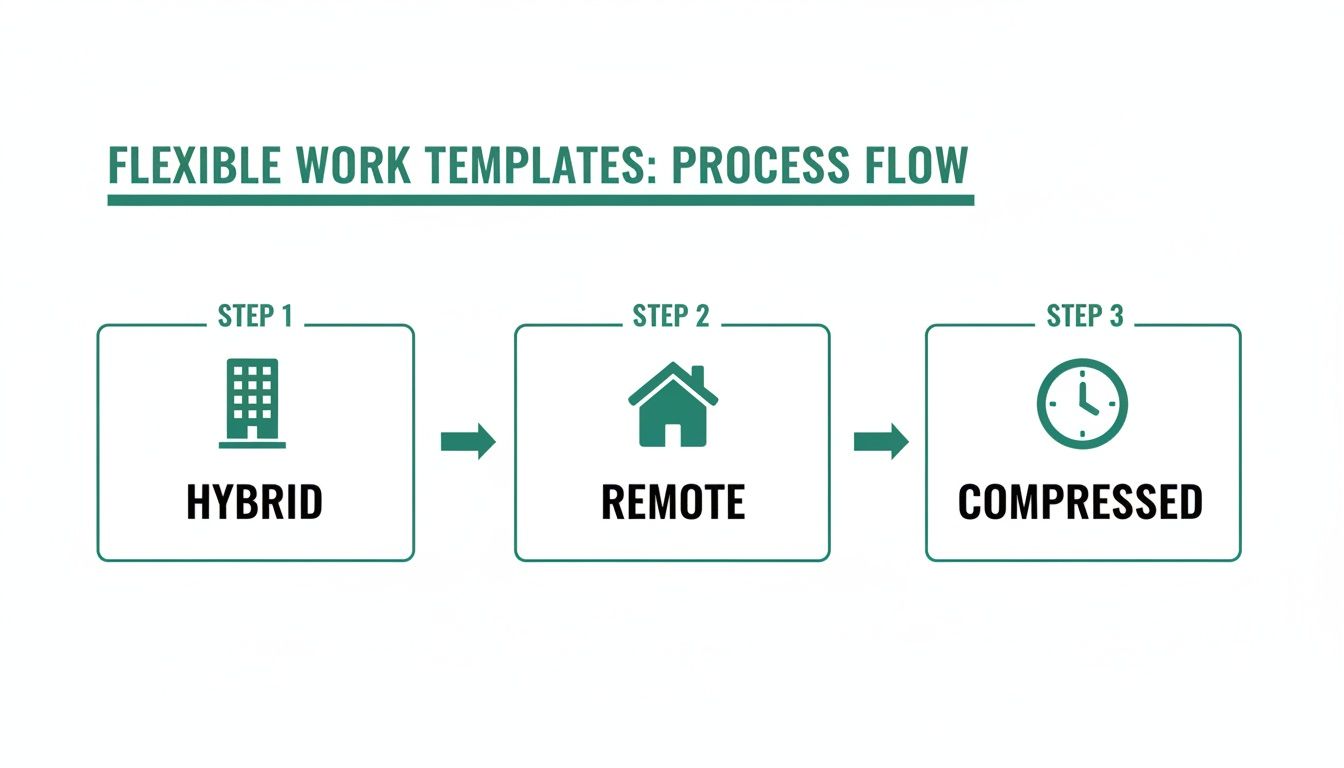
This infographic lays out a three-stage process for hybrid, remote and compressed arrangements. It’s a handy side-by-side view when you’re comparing multiple proposals.
Assessing Workload Impact
Invite feedback from colleagues who’ll be affected by the change. Map out who covers which tasks if hours shift.
Estimate how responsibilities move around, then compare the requested hours against your team’s current forecasts. This flags any capacity gaps before you green-light a trial.
Below is a quick manager’s checklist to ensure requests stay on track and compliant.
Review Checklist Items
| Checklist Item | Description |
|---|---|
| Legal Timelines | Confirm submission date and eight-week response deadline are logged. |
| Coverage Planning | Identify colleagues who can cover tasks during flex hours. |
| Team Consultation | Gather feedback on timelines, handovers and dependencies. |
| Capacity Analysis | Match requested hours against team workload forecasts. |
| System Integration | Record decisions and trial notes in Leavetrack. |
This grid helps you spot any missing steps before you agree to a new working pattern. It keeps the process transparent, consistent and within policy.
Tracking Pilot Outcomes
• Log weekly KPIs and handover notes directly in Leavetrack for full visibility.
• Schedule a mid-trial check-in to tweak coverage or timings based on real feedback.
• Note the trial’s start date and ping HR via the system so everyone stays aligned.
• Set calendar alerts for decision deadlines—no more slipping past the eight-week mark.
• Confirm to the employee that you’ve received their request and outline next steps.
Consistent record-keeping across managers speeds up approvals and cuts out bias.
When the trial wraps up, document feedback, mark patterns that work and plan any follow-up reviews. Clear communication before, during and after the trial ensures everyone knows where they stand.
To dive deeper into crafting staged return-to-work plans, see our article A Manager’s Guide To Phased Return To Work Plans.
Follow Up Strategies And Timelines
A little nudge can work wonders, making sure your flexible working request doesn’t vanish in a busy manager’s inbox. I like to pencil in a check-in at four weeks post-submission—just enough time for them to consider your proposal without letting it slip through the cracks.
- Set calendar alerts at two and six weeks to track the eight week decision window.
- Flag the critical dates in Leavetrack so your manager spots any pending items in the team calendar.
- Book a short catch-up just before the eight week mark to iron out any feedback.
Visualising Your Timelines
A quick visual aid turns abstract deadlines into something you can actually scan at a glance. The screenshot below pulls together ACAS guidance on the eight week decision window and valid reasons for refusals.
It clearly shows your manager when a formal response is due—and reminds you to appeal or ask for clarification if you haven’t heard back.
Drafting Polite Reminder Emails
A concise, friendly email keeps your request front of mind without crossing the line into pushiness. I always:
- Use a straightforward subject line like ‘Flexible Working Request Follow Up’
- Briefly thank the manager for considering the proposal
- Restate key points—proposed days, trial length and any other essential details
If silence continues after two reminders, suggest a quick call to address any concerns. Ending with an open invitation for questions signals that you value their input and are open to adjustments.
Escalation And Documentation
When the eight week deadline passes without a response, it’s time to escalate—politely. CC your HR contact and reference ACAS guidelines to show you’ve done your homework. This approach underlines your seriousness while keeping respect front and centre.
Always copy documentation into Leavetrack to build clear evidence.
You might find your manager has reservations. In that case, tweak your proposal—perhaps a shorter trial or different core days—and resubmit an updated template. Finally, set a reminder two weeks before any extended deadline to confirm the details.
Integrating calendar, email and system prompts in Leavetrack keeps everyone aligned. Start follow-ups soon after your initial submission to maintain momentum and close the loop promptly. Good luck!
FAQ
It’s normal to have a few nagging questions when you’re drafting a flexible working request. What’s the first thing your manager will look for? How detailed does your plan need to be?
Every formal request should open by stating your role, length of service and the pattern you’re proposing. Detailing a trial period – complete with start/end dates and success measures – shows you’ve thought this through.
- Your Position and Tenure (e.g. Marketing Coordinator for three years)
- Exact Days, Hours and Location (e.g. three days remote, two in the office)
- Trial Period Timeline with clear KPIs
- Cover Arrangements for urgent work
- Reference to the Employment Rights Act 1996
Once you hit send, mark your calendar for the eight-week decision window. Pop reminders in at four and six weeks so you can follow up if there’s radio silence.
If two months pass without a response, send a polite reminder referencing ACAS guidelines.
That gentle nudge demonstrates your professionalism and keeps things moving. In your follow-up, briefly recap your proposed dates and the metrics you’ll track.
Obviously, not every request sails through. Common reasons for refusal include:
- Significant Extra Costs to the business
- Negative Impact on Performance or Quality
- Disruption to Team Collaboration
- Inability to Redistribute Work
- Legal or Regulatory Constraints
If your request is declined, ask for written feedback. Tweak your plan to tackle any concerns, then try again.
How To Revise Your Proposal
Begin by shortening the trial period or adjusting core days. Add more detail on how urgent tasks will be covered or how you’ll measure success. Finally, resubmit through your HR system or via Leavetrack for complete transparency.
Including a screenshot from Leavetrack’s planner can really help managers spot coverage gaps at a glance. That visual cue often pushes a “yes” over the line.
Lock in your follow-up dates, keep every email logged, and you’ll turn your flexible working request into an opportunity no manager can ignore.
Start your free trial right now.
Ready to streamline your flexible working request? Try Leavetrack for clear tracking and approval at https://leavetrackapp.com