
holiday entitlement when leaving a job: UK pay & rights
Posted by Robin on 20 Nov, 2025 in
When you hand in your notice, your mind is probably racing with thoughts about your next steps, handover notes, and maybe even a leaving do. But one crucial thing often gets overlooked until the final payslip arrives: your unused holiday time.
So, what actually happens to all that annual leave you’ve saved up?
Holiday Pay When You Leave a Job: What You’re Owed
Sorting out your holiday entitlement when leaving a job is a vital part of wrapping things up correctly. It's not just a nice gesture from your employer; it's a legal right that protects you. This applies no matter how you're leaving—whether you've resigned for a new role, been made redundant, or even if you've been dismissed.
Think of it like this: you earn your holiday entitlement bit by bit with every day you work. If you leave part-way through the company’s holiday year, you're entitled to a slice of that annual leave pie. This is usually called a 'pro-rata' entitlement.
Your Basic Legal Protections
UK law is crystal clear on this. There’s a minimum amount of paid holiday that nearly every worker is entitled to, and this forms the foundation of your rights when you leave.
- The Statutory Minimum: Legally, you get 5.6 weeks of paid annual leave. For someone working a standard five-day week, that works out to 28 days.
- It Covers Everyone: This isn't just for full-timers. The right extends to part-time staff and those on zero-hours contracts, with their entitlement calculated on a pro-rata basis.
- Payment for Untaken Leave: This is the big one. Your employer must pay you for any statutory holiday you've earned but haven't used up by your last day.
This legal minimum is just the baseline. Your contract might offer more generous holiday perks, which is great, but it can't offer less. To get a deeper understanding of the nuts and bolts, check out our detailed guide to statutory holiday entitlement in the UK.
It's a simple exchange at its core. You've earned that time off. If you can't take the holiday before you go, your employer has to give you the cash equivalent. This is often called 'payment in lieu of holiday'.
Getting your head around this basic framework is the first step. It's also a good idea to stay aware of any recent changes to termination payments, as employment law does evolve. The key takeaway is that you've earned it, and the law says you must be compensated for it.
Before we dive into the calculations, let's quickly break down the key terms you'll come across. Understanding the language makes the whole process much less confusing.
Key Holiday Entitlement Terms Explained Simply
Here’s a quick summary of the essential terms you'll see, helping you understand the concepts behind your final holiday pay.
| Term | Simple Explanation |
|---|---|
| Statutory Holiday | The legal minimum paid holiday entitlement in the UK, which is 5.6 weeks per year. |
| Contractual Holiday | Any extra holiday your employer offers on top of the statutory minimum. |
| Pro-Rata | A proportional calculation. It’s how you work out the amount of holiday you've earned for the part of the year you’ve worked. |
| Accrual | The process of gradually building up your holiday entitlement over the year. |
| Payment in Lieu | The money you receive for any untaken holiday when you leave your job. |
With these terms under your belt, you’ll find it much easier to follow along as we get into the specifics of how your final holiday pay is actually worked out.
Calculating Your Pro-Rata Holiday Entitlement
Figuring out exactly how much holiday you’re owed when you leave a job can feel like a head-scratcher, but the logic behind it is actually quite simple. The key is understanding pro-rata entitlement, which is just a fancy way of saying you earn your holiday leave in proportion to how much of the year you’ve actually worked.
I like to think of it like a yearly gym membership. If you cancel six months in, you’ve only used half the year, so it makes sense you’d only be accountable for half the cost. Your holiday works the same way; if you leave halfway through the company’s holiday year, you’ve earned half of your annual holiday allowance.
This keeps things fair. It means your holiday entitlement when leaving a job is based on the real time you spent with the company, not the full year you might have worked if you'd stayed.
This whole process ensures your final payslip accurately reflects the paid leave you’ve rightfully earned but haven't yet taken. The infographic below maps out this simple journey from earning your leave to getting paid for it when you move on.

As you can see, holiday time accrues as you work. Any of that unused leave you have in the bank when you leave gets converted into a final payment. Simple as that.
The Basic Calculation Method
For most people in a standard full-time role, the maths is pretty straightforward. The first step is to figure out what fraction of the holiday year you’ve completed before your last day.
Let’s walk through a clear example.
- Employee: Alex, who works a full-time, five-day week.
- Annual Leave: 28 days (which is the statutory minimum in the UK).
- Holiday Year: Runs from 1st January to 31st December.
- Leaving Date: 30th June.
By leaving on the 30th of June, Alex has worked for exactly six months of the 12-month holiday year. He's halfway through.
The core calculation is simple: divide your total annual leave by 12 (for the months in a year), then multiply that by the number of full months you've worked. This tells you exactly how much holiday you've accrued.
So, for Alex, the sum looks like this: (28 days / 12 months) x 6 months worked = 14 days.
Alex has earned 14 days of holiday. Let's say he's only taken 10 days of leave by the time he leaves. This means his employer owes him payment for the remaining 4 days. If you want a more detailed look at different scenarios, our guide on how to calculate pro-rata holiday in the UK breaks it down even further.
Dealing with Different Work Patterns
Of course, not everyone works a standard 9-to-5 week. But even if you don't, the principle of pro-rata entitlement still holds true. The calculation just needs a little tweak to account for part-time schedules or variable hours.
For part-time workers, you typically calculate the full-time equivalent first and then adjust it based on the number of days they work. For example, if someone works three days a week instead of the standard five, their entitlement is 3/5ths of the full-time allowance.
When it comes to working out the final payment value, you need to be sure about your daily or hourly rate. Using a free salary calculator is a great way to double-check your numbers before you compare them with what your employer has calculated.
How Your Unused Holiday Is Converted into Pay

Once you’ve worked out how many holiday days you're owed, the next question is a simple one: what’s that worth in pounds and pence? Getting your head around how those days translate into a figure on your final payslip is crucial. Your holiday entitlement when leaving a job isn’t just about the time off you missed; it's about the value of that time.
The process boils down to your employer calculating what "a day's pay" or "a week's pay" looks like for you. It sounds simple on the surface, but the method can change quite a bit depending on your pay structure.
Calculating Pay for Salaried Employees
If you're on a fixed monthly salary, the calculation is usually the most straightforward. Your employer just needs to work out a daily rate to figure out what each of your leftover holiday days is worth.
Let's walk through an example. Imagine you earn a salary of £30,000 a year and work a standard five-day week. The sums typically look like this:
- Find your weekly pay: £30,000 / 52 weeks = £576.92 per week.
- Find your daily pay: £576.92 / 5 days = £115.38 per day.
So, if you have four days of holiday left in the bank, your employer would multiply your daily rate by those days (£115.38 x 4). That comes out to £461.52, which will be added to your final pay before any tax and National Insurance are taken off.
What About Variable Pay and Commission?
Now, things get a bit more complex for people whose pay packet changes from month to month because of overtime, bonuses, or commission. It just wouldn't be fair to calculate your holiday pay based on your basic salary alone, as it wouldn't reflect what you actually earn.
To make sure things are fair, UK law steps in. It requires employers to look back at your recent earnings to find a proper average. This stops you from being penalised for taking a holiday and makes sure your final payout reflects what you would have normally earned.
The standard way to do this is for employers to use a 52-week reference period. They'll look at your total earnings over the last 52 weeks you actually got paid, ignoring any weeks you didn't work. From this, they calculate an average weekly pay, which gives a much truer reflection of your earnings and becomes the foundation for your holiday pay.
For casual or zero-hours workers, a similar principle is applied, but the accrual method is often different. Holiday entitlement for these roles is usually calculated at 12.07% of the hours worked. The final payment is then your total untaken holiday hours multiplied by your average hourly rate, which is again, often worked out using that 52-week reference period.
What if You Have Taken Too Much Holiday?
It’s a situation that catches many people by surprise. You take a well-deserved break early in the holiday year, only to hand in your notice a short while later. Then comes the sinking feeling when you realise you’ve used more holiday than you’ve actually earned up to that point.
This common scenario brings up a crucial question about your holiday entitlement when leaving a job: can your employer actually take that money back from your final pay?
The short answer is yes, they can, but it’s not an automatic right. An employer is only legally allowed to deduct the value of the excess holiday from your final paycheque if there’s a specific clause in your employment contract allowing them to do so. Without that written agreement, they can’t reclaim the money.
Check Your Employment Contract
In this situation, your employment contract is everything. It's the legally binding agreement between you and your employer, and it should spell out the rules for this exact scenario.
Have a good read through your contract, looking for sections on leave, termination of employment, or deductions from pay. You’re searching for wording that looks something like this:
"If, on the termination of your employment, you have taken more annual leave than you have accrued, we reserve the right to deduct a sum equivalent to the excess holiday taken from your final salary payment."
A clause like this gives your employer the legal standing they need to make the deduction. If you can't find anything similar in your contract, employee handbook, or any other written agreement you've signed, your employer may have no grounds to reclaim the pay.
It pays to be proactive here. If you think you might have taken too much leave, check your contract straight away. Knowing where you stand legally empowers you to have a proper, informed conversation with HR and helps you avoid any nasty surprises in your final pay packet. A little bit of preparation now can save a lot of headaches later.
A Practical Plan for Disputed Holiday Pay
It’s one of the most frustrating things that can happen when you leave a job: you check your final payslip and realise the holiday pay is wrong. Your first instinct might be to fire off an angry email, but it pays to take a breath and handle it methodically. A calm, organised approach will always get you further than a heated phone call.
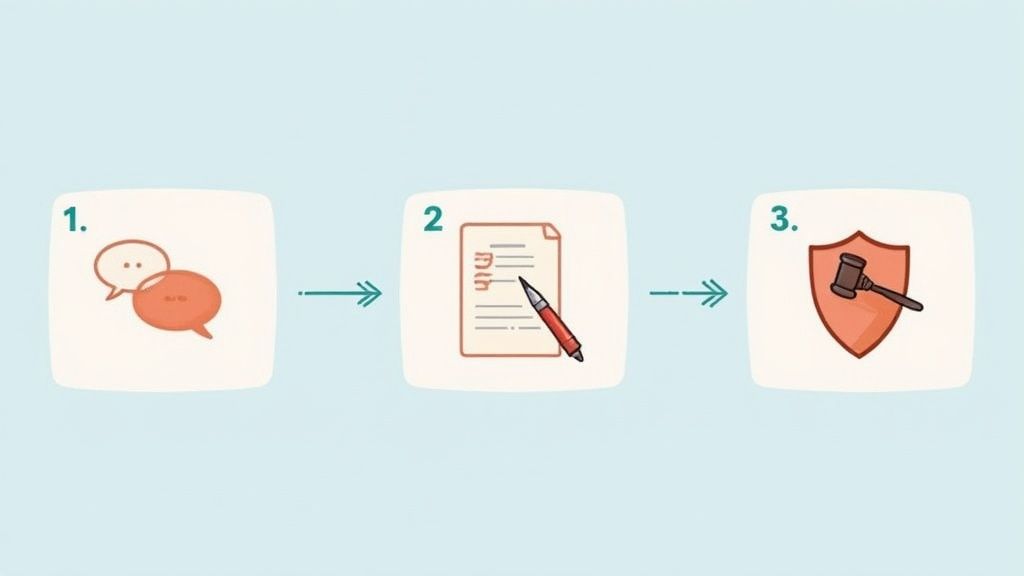
The best place to start is with a simple, informal chat. Get in touch with your line manager or someone in HR. Before you do, have your own calculations ready to go so you can walk them through exactly how you arrived at your figure. Nine times out of ten, these discrepancies are just honest admin mistakes that are easily fixed once you point them out. It’s situations like these that really show why accurate absence tracking is crucial for compliance — good records protect everyone and prevent these mix-ups from happening in the first place.
Raising a Formal Grievance
So, what happens if that friendly chat doesn't get you anywhere? It’s time to take things up a notch. The next logical step is to raise a written grievance.
Your company will have a formal grievance procedure, usually tucked away in the staff handbook or your employment contract. It's vital you follow this process to the letter.
Your written grievance doesn't need to be complicated, but it should be professional and clear. Make sure it includes:
- A clear statement that you are raising a formal grievance.
- The full details of the problem, including the exact amount of holiday pay you believe is missing.
- A breakdown of your calculations showing how you worked out the figure.
- What you want to happen – which is simply to be paid the outstanding amount.
Always, always keep a copy of everything you send. This creates a paper trail and proves you’ve followed the correct internal channels before considering any other action.
Escalating the Issue Further
If you’ve been through the internal grievance process and you're still not happy with the outcome, don't worry – you still have options. Your next port of call is usually Acas (the Advisory, Conciliation and Arbitration Service). They offer a fantastic free service known as 'early conciliation'.
An impartial Acas conciliator will talk to both you and your former employer to see if an agreement can be reached without the need for legal action. This is a mandatory step before you can proceed to a tribunal.
If conciliation doesn't work, your final resort is to make a claim to an Employment Tribunal. This is a much more serious legal step, and you have to act fast—you typically only have three months (less one day) from the date you should have received the correct pay. It’s your ultimate right if you’re certain your employer has unlawfully withheld your wages.
Navigating a pay dispute can feel overwhelming, so here’s a simple action plan to follow if you find yourself in this situation.
Action Plan for Disputed Holiday Pay
| Step | Action | Key Objective |
|---|---|---|
| 1. Informal Chat | Speak with your manager or HR. Present your calculations clearly. | Resolve the issue quickly and amicably through direct communication. |
| 2. Formal Grievance | Submit a written grievance following your company's official procedure. | Create a formal record of your complaint and trigger an internal investigation. |
| 3. Acas Early Conciliation | Contact Acas to initiate their free conciliation service. | Find a resolution with the help of a neutral third party, avoiding legal action. |
| 4. Employment Tribunal | As a last resort, file a claim with an Employment Tribunal. | Seek a legally binding judgment to recover the unpaid wages. |
Following these steps in order gives you the best chance of resolving the dispute fairly while ensuring you have a solid case if you need to take it further.
Common Questions About Holiday Pay When You Leave
When you're getting ready to leave a job, the last thing you want is confusion over your final pay. Understanding how your holiday entitlement works during your notice period is a common sticking point. Let's clear up some of the most frequent questions people have.
Does My Holiday Entitlement Keep Growing During My Notice Period?
Yes, absolutely. You continue to build up (or accrue) holiday time right through your notice period, just like you did every other month you worked there. This is the case whether you’re working your notice as usual or you've been placed on garden leave.
Your employer is legally required to include the holiday you've earned during this final stretch in your final pay calculation. Your employment is active until your very last day, and so are your rights.
Can My Boss Force Me to Use My Holiday During My Notice?
This is a big one. Your employer can tell you to take your remaining holiday during your notice period, but they can't just spring it on you at the last minute. They have to play by the rules.
The general rule is that an employer has to give you notice that is at least twice the length of the leave they want you to take. So, if they want you to use five days of holiday, they must tell you at least 10 calendar days in advance.
What Happens With Bank Holidays That Fall in My Notice Period?
How bank holidays are treated really comes down to what's written in your employment contract. If your contract includes bank holidays as part of your statutory 5.6 weeks of annual leave, then they're treated just like any other day of holiday you've accrued.
If a bank holiday comes up during your notice period and it’s a day you would have normally been paid for, it should be counted as a day of paid leave in your final figures.
Will I Be Taxed on My Holiday Pay in My Final Salary?
Yes, any payment for unused holiday is treated as earnings. That means it’s subject to the same Tax and National Insurance contributions as your regular wages. This amount will be added to your final payslip, and the usual deductions will be taken from the total amount.
Getting holiday pay right, especially when an employee is leaving, is crucial for avoiding headaches and staying compliant. Leavetrack gives you a clear, simple system to track everything, making those final pay calculations straightforward and accurate. Find out more at https://leavetrackapp.com