
How to Improve Workplace Productivity A Manager's Guide
Posted by Robin on 05 Jan, 2026 in
If you want to improve productivity, you first need to figure out what's slowing you down. It’s tempting to jump straight into solutions, but without understanding the real problems, you’re just guessing. We need to look past the obvious symptoms, like a missed deadline, and dig into the reasons why things are falling behind schedule.
Pinpointing Your Productivity Bottlenecks
Before you can solve the productivity puzzle, you have to find all the pieces. Prescribing a solution without a proper diagnosis is a recipe for wasted time and effort—and it can sometimes make things worse.
This isn’t about pointing fingers. It’s about spotting the friction in your systems. Are projects stalling because communication is a mess? Is a clunky piece of software adding hours of admin to everyone's week? Or is a quiet wave of disengagement slowly dragging down output? To get to the bottom of it, you need a clear plan of attack.
Starting Your Diagnostic Audit
A process audit is a great place to start. Get your team in a room and map out a typical workflow, from the initial brief to the final delivery. Note every single step, every tool used, and every point where work is handed off to someone else. You’ll be amazed at what you uncover—redundant tasks and bottlenecks that have become so normal nobody questions them anymore. Maybe you’ll find three people are updating the same spreadsheet, creating chaos and duplicated effort.
Anonymous surveys are another brilliant tool. Your team knows what the problems are, but they might not feel comfortable raising them in a group meeting. An anonymous questionnaire gives them a safe way to share honest feedback on things like:
- Tool Inefficiency: Which software is a genuine help, and which is just a hindrance?
- Meeting Overload: Are our meetings driving work forward, or are they just getting in the way?
- Communication Gaps: Where does information get lost in translation?
- Workload Balance: Does everyone feel their workload is fair and achievable?
This kind of direct feedback is pure gold. It helps you focus on fixing the problems that are actually having the biggest impact on your team's day-to-day work.
Analysing Communication and Collaboration Patterns
The way your team communicates (or doesn't) is a huge clue to its productivity health. Watch how information flows. Do decisions get held up for weeks waiting for a sign-off? Do people in different departments struggle to get a straight answer from each other? These are classic signs of a communication breakdown.
A simple "five whys" analysis works wonders here. When a problem pops up, just keep asking "why?" until you hit the root cause. A missed deadline might seem like one person's fault at first glance, but if you dig deeper, you might discover they never got a key piece of information because the project management tool wasn't updated.
Key Insight: Productivity drains are rarely about a lack of effort. More often, they come from broken processes, clunky tools, or unclear expectations that create unnecessary roadblocks for good people trying to do good work.
One area that often gets missed is the ripple effect of unplanned absences. When someone is off unexpectedly, it can throw entire projects into chaos, overload the rest of the team, and grind progress to a halt. Taking a close look at your attendance data can highlight patterns that point to bigger issues, like burnout or low morale. Understanding https://blog.leavetrackapp.com/articles/how-much-does-absenteeism-cost-employers is the first step in seeing just how much this invisible problem is costing you.
For a wider view, you could also explore these seven key levers to improve business productivity. By getting specific about where the real bottlenecks are, you can make sure your efforts are targeted, effective, and create change that actually sticks.
Setting KPIs That Actually Drive Performance
Right, you’ve figured out where productivity is stalling. The next logical step is to define what good actually looks like. So many managers fall into the trap of tracking vanity metrics—things like hours spent at a desk—which measure presence, not progress. If you genuinely want to improve workplace productivity, you need Key Performance Indicators (KPIs) that connect daily tasks to real business outcomes.
The goal isn't to micromanage people into the ground; it's to give them clarity and a sense of purpose. When an employee understands exactly how their work contributes to a bigger company objective, their motivation and focus sharpen. Think of great KPIs as a compass, guiding your team toward what truly matters and helping them prioritise their efforts.
Moving Beyond Generic Metrics
Every role is different, so your KPIs have to be too. A generic metric like "tasks completed" is pretty meaningless without any context. For a customer support agent, much better KPIs would be Customer Satisfaction Score (CSAT) or First Contact Resolution (FCR). These metrics actually measure the quality and efficiency of their interactions, not just the sheer volume.
It's the same story for a software developer. Simply tracking lines of code written is an old-school, and frankly, terrible indicator of performance. Instead, you should focus on metrics that reflect the quality and impact of their work.
- Lead Time for Changes: How long does it take from a code commit until it’s successfully running in production? This measures the health and efficiency of your entire workflow.
- Change Failure Rate: What percentage of changes to production need an immediate fix? This is a strong indicator of code quality and stability.
- Deployment Frequency: How often does your team successfully release to production? This shows agility and momentum.
This approach shifts the focus from "busy work" to tangible results, empowering your team to take proper ownership of their contribution to the company's success.
Creating a Balanced Scorecard
Productivity is a multi-faceted beast. Focusing only on raw output can easily lead to burnout and a nosedive in quality. A balanced scorecard helps you measure performance more holistically by bringing together different types of metrics, giving you a complete picture of an individual's or team's contribution.
A truly effective KPI framework doesn't just track what gets done; it measures how well it gets done, how efficiently the work is completed, and whether the process is sustainable for the team.
Try building a scorecard that includes a mix of quantitative and qualitative measures. For instance, a marketing manager's scorecard might include Lead Generation Volume (quantity), Lead-to-Customer Conversion Rate (quality), and Campaign ROI (efficiency). This ensures they aren't just generating a high volume of poor-quality leads but are focused on activities that genuinely drive business growth.
Communicating Goals for Empowerment
Setting brilliant KPIs is only half the battle. How you communicate them makes all the difference. Your team needs to understand not just what they are being measured on, but why those metrics are important. It's much better to frame the conversation around shared goals rather than top-down monitoring.
Show them the direct line between their individual KPIs and the company's big-picture strategic objectives. When a salesperson sees that their target for Average Deal Size is designed to help the company hit its overall revenue goals, the number becomes more than just a target—it becomes part of a collective mission.
To help you get started, I've put together a few practical KPIs for different departments that you can adapt for your own business.
Key Productivity Metrics Across Departments
This table offers a starting point for developing role-specific KPIs that connect daily activities to meaningful business results.
| Department | Primary KPI | Secondary Metric | Measurement Tool/Method |
|---|---|---|---|
| Sales | Monthly Recurring Revenue (MRR) | Sales Cycle Length | CRM Analytics |
| Marketing | Customer Acquisition Cost (CAC) | Marketing Qualified Leads (MQLs) | Marketing Automation Platform |
| Customer Support | Net Promoter Score (NPS) | Average Resolution Time | Helpdesk Software |
| Engineering | Sprint Burndown Rate | Code Review Turnaround Time | Project Management Tool |
By setting clear, role-specific KPIs and communicating them in a way that empowers people, you transform performance measurement from a tool for oversight into a powerful engine for motivation and alignment. This clarity is an absolute cornerstone of any strategy designed to improve workplace productivity.
Modernising Workflows for Today's Teams
Once you have clear, motivating KPIs in place, the next thing to look at is the very structure of how work gets done. Are your current processes acting as a launchpad for success or a set of hurdles your team has to clear every day? Outdated, clunky workflows are a silent productivity killer, quietly draining time and energy without anyone realising it.
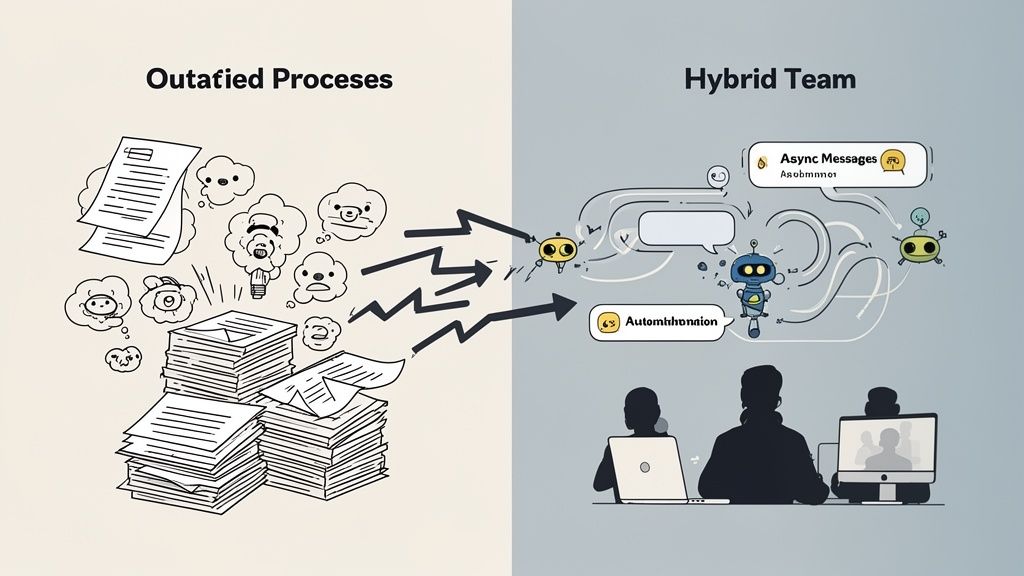
This is especially true in hybrid and flexible work environments, where the old ways of doing things simply don't translate. Modernising your workflows isn't just about buying the latest flashy software; it's a fundamental rethink of how your team communicates, collaborates, and moves projects from A to B.
Embracing Asynchronous Communication
For years, the knee-jerk reaction to any question was "let's schedule a meeting." Today, that approach is a fast track to calendar chaos and fragmented focus time. A massive leap forward in productivity comes from embracing asynchronous communication—allowing team members to respond and contribute on their own schedule.
This doesn't mean banning meetings entirely. It just means being intentional about them.
- Status Updates: Ditch the daily stand-up meeting. Instead, use a dedicated Slack channel or a project management tool for brief, written updates.
- Information Sharing: Record a quick video walkthrough of a new process instead of gathering everyone for a live demo they might not be ready for.
- Decision Making: Use collaborative documents for feedback and threaded conversations for discussions that don't need an immediate, real-time response.
Adopting this mindset frees up significant chunks of "deep work" time, which is essential for complex problem-solving and creative thinking. It empowers employees to manage their own time more effectively, a key driver for improving productivity in flexible settings.
Optimising Project Management and Task Handoffs
Another huge point of friction is the project handoff. How often does a task stall because the next person in the chain simply doesn't have the information they need? Even if you don't fully adopt agile principles, you can borrow some of the best bits to see huge benefits.
Breaking large projects into smaller, manageable sprints with clear owners for each task creates real momentum and clarity. When everyone can see the project's progress on a shared board, it eliminates confusion and reduces the need for constant check-ins. A centralised system, whether it’s a simple Trello board or a more robust platform, acts as the single source of truth.
A key part of this is clear visibility over team availability, which is where a central system shines. Check out our guide on how to implement a digital wall planner for UK businesses to see how this simple change prevents bottlenecks.
Expert Tip: Conduct a "handoff audit." For a recent project, map out every single point where work was passed from one person to another. Ask the team where things felt clunky or where they had to chase for information. This will quickly reveal your biggest workflow bottlenecks.
Automation and Intelligent Scheduling
So many of the administrative tasks that bog down a team's day can and should be automated. This isn't about replacing people; it's about freeing them from repetitive, low-value work so they can focus on what they do best. Think about sending reminder emails, generating standard reports, or routing approvals. Even tiny automations can reclaim hours each week across the team.
This same principle of intelligent design applies to working hours. Rethinking the traditional five-day, 9-to-5 structure can yield surprising productivity gains. The UK's four-day week trials delivered stunning results, with 39% of employees reporting less stress and 71% experiencing reduced burnout, all while maintaining or even improving productivity.
As a testament to its success, around 90% of participating companies were still using the model a year later. This just goes to show that focusing on output, not just hours logged, is an incredibly powerful strategy. By modernising how, when, and where work gets done, you create an environment that eliminates friction and empowers your team to perform at their peak.
Better Leave Planning to Keep Things Moving
Nothing stops a high-flying project in its tracks like an unexpected absence. A key person is suddenly off sick, or a last-minute holiday gets approved without anyone realising the gap it leaves behind. These aren't just minor diary clashes; they're genuine disruptors that kill momentum and drag down productivity.
Proper leave management is so much more than a box-ticking exercise. When you're trying to piece together who’s off and when from a mess of spreadsheets, email chains, and paper forms, you’re flying blind. This old-school approach creates a ripple effect of hidden costs, from the hours managers waste on admin to the project delays caused by someone being away at a critical time.
The Real Cost of Doing it Manually
Most teams just get used to the friction caused by outdated systems. A manager might spend half an hour cross-referencing a spreadsheet with the team calendar and a few emails just to say "yes" to a single day off. Multiply that across the whole company, and you're looking at a staggering amount of time that could be spent on work that actually matters.
This inefficiency points to a much bigger problem. The average UK employee is at their desk for 8 hours a day but is only truly productive for 2 hours and 53 minutes. This massive gap highlights how inefficient processes and constant distractions are eating away at our potential output. You can dig into the numbers in the full report on UK workplace productivity statistics.
The real cost of poor leave management isn't just the admin time. It's the project delays, the missed deadlines, and the dip in team morale when workloads are unfairly distributed due to poor planning.
When leave isn't handled centrally, you also get inconsistency. One manager might be tougher on approvals than another, which quickly leads to feelings of unfairness. Worse still, without a clear, real-time picture of who’s available, you can easily approve leave that leaves a whole department struggling during a make-or-break period.
Getting a Clear View With One System
The answer is to ditch the fragmented methods and bring everything into a single source of truth. A centralised absence management system turns leave tracking from a reactive scramble into a proactive planning tool. It gives everyone immediate, crystal-clear visibility.
This screenshot from Leavetrack shows a digital wall planner, giving you an at-a-glance overview of the whole team.
Instantly, you can see who is off, when, and why. It makes it dead simple to spot potential clashes and make sure you’ve got enough cover before you approve a new request.
This kind of clarity helps managers make smarter, faster decisions. Instead of digging through spreadsheets, they can approve or deny requests in a click, knowing they have all the context they need. It frees them up to actually lead their team, not drown in paperwork.
And for employees, the benefits are just as important:
- Transparency: They can see when colleagues are away, helping them plan their own leave more thoughtfully.
- Fairness: A single system means the rules are applied the same way for everyone. No exceptions, no favouritism.
- Simplicity: Putting in a request takes seconds, and they get a clear, quick answer.
This isn't just about saving time; it's about building trust and removing a huge point of friction between employees and their managers.
By getting a proper handle on who is available and when, you can finally put a stop to those last-minute scrambles that derail projects. You can plan resources properly, keep workloads fair, and make sure your team maintains its focus on the work that really moves the needle. It’s a foundational step in building a resilient, efficient, and genuinely productive workplace.
Fostering a Culture of Wellbeing and High Performance
For a long time, managers have been sold a false choice: you either push your team for maximum performance, or you focus on their wellbeing. The reality I’ve seen time and again is that you simply can't have one without the other. Sure, you can force a team to hit short-term targets through sheer pressure, but that approach has a very short shelf life. It’s completely unsustainable.
Lasting productivity doesn't come from burnout and stress; it's a direct result of a culture where people feel supported, valued, and psychologically safe. This isn’t about surface-level perks like a ping-pong table or free snacks. A genuine culture of wellbeing is woven into the very fabric of how you operate. When you create an environment where people can bring their best selves to work without sacrificing their health, you'll find they are more engaged, resilient, and, yes, far more productive.
Moving Beyond Perks to Psychological Safety
The absolute bedrock of any high-performance culture is psychological safety. It's that shared belief that you can speak up, suggest a new idea, or even admit you've made a mistake without fear of being shut down or humiliated. When psychological safety is low, innovation dies. People are too afraid to question a clunky, outdated process or ask for help when they're struggling. Productivity grinds to a halt, not from a lack of skill, but from a lack of trust.
You can actively build this in your team. It starts with:
- Encouraging open dialogue: Regularly ask for feedback on how things are going, and—this is the crucial part—actually act on what you hear.
- Admitting your own mistakes: When leaders are open about their own missteps, it gives everyone else permission to be human, too.
- Framing challenges as learning opportunities: Shift the conversation from "Who's to blame?" to "What can we learn from this?".
This creates a powerful positive feedback loop. A team that feels safe communicates more effectively, solves problems faster, and adapts to change with less friction. For a deeper dive, exploring effective strategies to reduce workplace stress is a great starting point for creating this kind of calm, focused environment.
Balancing Workloads and Promoting Growth
Even in the safest environment, chronic overload will crush anyone's productivity. Consistently high workloads are a fast track to burnout, which research has shown is directly linked to presenteeism—when people are physically at work but mentally checked out. One study even found that employees who rarely exercise or have an unhealthy diet show a 50-66% higher rate of presenteeism. This just underscores the deep connection between personal health and professional output.
True high performance isn't about working more hours; it's about making the hours worked more effective. This requires a culture that respects boundaries and actively prevents burnout before it takes hold.
As a manager, you have a huge role to play here. It means having regular, honest check-ins about capacity and being ruthless about prioritisation. It also means investing in your team’s growth. People who see a clear path for development are naturally more motivated. Offering training and new challenges shows you're invested in them as individuals, not just as cogs in a machine.
The Power of Recognition and Communication
Finally, never, ever underestimate the impact of meaningful recognition. A simple, specific "thank you" for a job well done can be incredibly powerful. It reinforces the behaviours you want to see and makes people feel that their hard work is noticed and appreciated.
Alongside recognition, clear and consistent communication is key. When people understand the company's goals and can see how their individual work contributes to that bigger picture, their sense of purpose and motivation skyrockets.
Building a culture that champions wellbeing is an ongoing commitment, not a one-off project. If you're looking for practical places to start, our guide on 10 effective employee wellness program ideas for 2025 has plenty of inspiration. By putting wellbeing first, you’re not just creating a nicer place to work—you’re building a more resilient, engaged, and ultimately more productive organisation.
Your Action Plan for Boosting Productivity
Knowing what to do is one thing; actually rolling it out successfully is another matter entirely. This is where your strategy moves from theory to reality. Putting together a clear, phased action plan is the only way to introduce changes smoothly, get your team on board, and build a lasting culture of high performance without causing chaos.
A rushed or poorly communicated rollout can easily do more harm than good, creating a mess of confusion and resistance. Instead, you need to think of this as a series of deliberate, well-thought-out steps. A small-scale pilot is the perfect place to start before you even think about expanding across the whole organisation. It gives you room to learn, adapt, and build real momentum.
Kicking Off Your Productivity Initiative
Your first move should be to run a small, focused pilot programme. Pick one team or department that’s generally open to change and whose work allows for clear, simple measurement. This controlled environment lets you test your new processes, tools, or schedules without turning the entire company upside down.
During this pilot phase, your main goal is to gather hard data and honest feedback.
- Set Clear Timelines: Define a start and end date for the pilot. Somewhere between 30 to 90 days is usually about right.
- Establish Baselines: Use the KPIs you defined earlier to get a clear picture of the team's performance before the pilot kicks off.
- Hold Regular Check-ins: Schedule weekly or fortnightly feedback sessions. You need to hear what’s working and, just as importantly, what isn’t.
- Document Everything: Keep detailed notes on challenges, successes, and any unexpected outcomes.
This trial period isn't about achieving perfection straight out of the gate. It's about learning what works in your specific context so you can fine-tune your approach before a wider implementation.
Communicating Change Effectively
One of the biggest pitfalls I've seen in any change management process is poor communication. It's a classic mistake. If your team doesn't understand why changes are being made, they'll naturally dig their heels in. You have to be transparent, consistent, and empathetic in your messaging.
Always frame the changes around the benefits for the team, not just the company's bottom line. Instead of saying, "We're implementing a new system to track output," try something like, "We're introducing a new tool to cut down on admin so you can spend more time on meaningful work." That small shift in language makes a huge difference.
Crucial Takeaway: Don't just announce a change; build a narrative around it. Explain the problem you’re solving, the solution you’re testing, and how it will genuinely make everyone's work life better. This simple act turns your team from passive recipients into active participants.
The journey towards a high-wellbeing, high-performance culture is a continuous process of supporting, recognising, and growing your people.
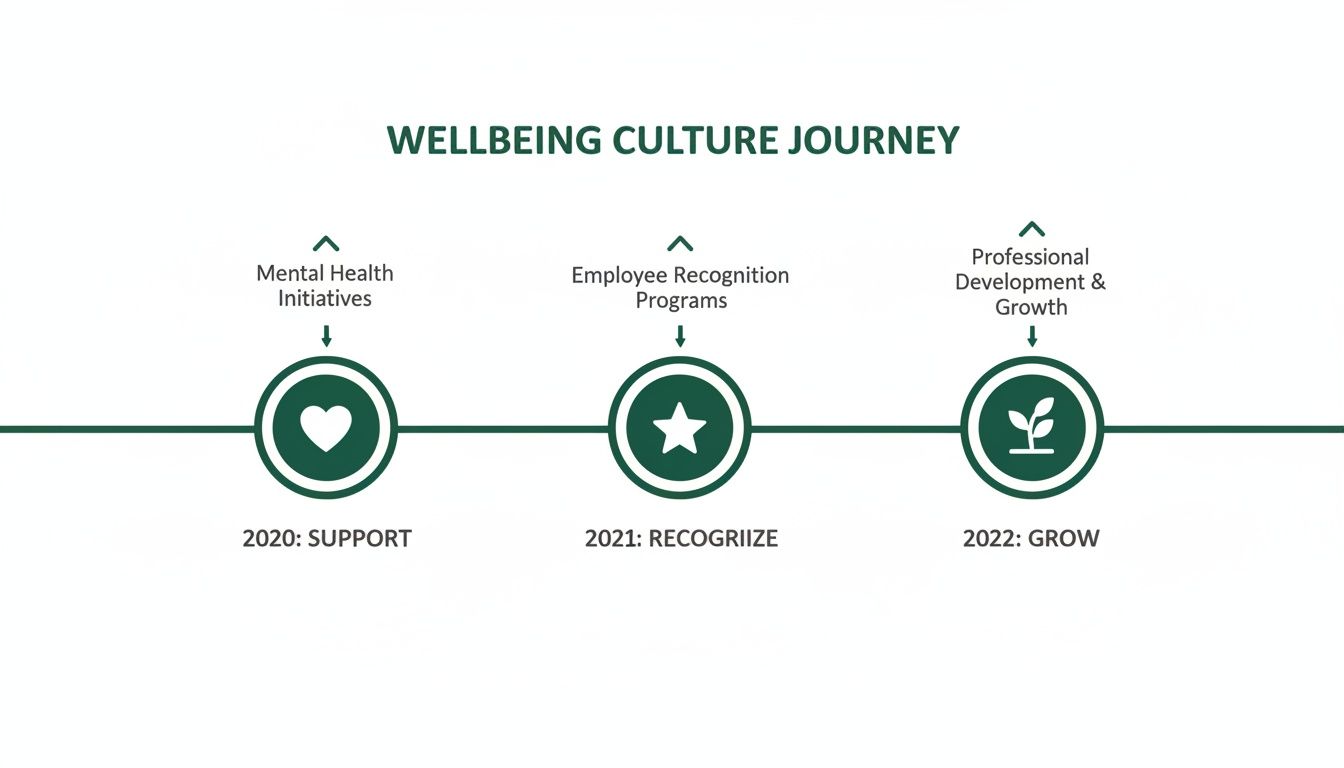
This visual journey highlights that fostering a productive environment is an ongoing commitment, built through consistent effort over time, not a one-off project.
Measuring and Iterating for Continuous Improvement
Your action plan shouldn't have a final end date. The real goal is to embed a mindset of continuous improvement deep into your company culture. After your pilot programme wraps up, analyse the results against your baseline metrics. Did the changes lead to the improvements in productivity, wellbeing, or efficiency you were hoping for?
Use the feedback from the pilot team to refine your strategy. Maybe the new software needs more training, or the asynchronous communication guidelines need to be clearer. Make these adjustments before you even consider a wider rollout.
Expand the initiative one department at a time, using the lessons learned from each phase to inform the next. This iterative approach is far more manageable and sustainable than a "big bang" launch. It allows you to build on small wins, demonstrate value, and bring people along on the journey. By following this measured, people-focused roadmap, you can implement changes that actually stick, boosting productivity for the long haul.
Bringing all these elements together—from clear KPIs to streamlined leave planning—creates a powerful system for boosting productivity. At Leavetrack, we provide the visibility and simplicity you need to manage team availability effortlessly, eliminating the bottlenecks that hold your projects back. See how our digital wall planner can keep your team moving forward by visiting Leavetrack.