

How to Work Out My Holiday Entitlement UK Guide
Posted by Robin on 27 Nov, 2025 in
Before you can even think about calculating holiday pay, you need to get your head around the legal basics here in the UK. This framework is what guarantees nearly every worker a certain amount of paid time off to rest and recharge. For a deeper dive, our comprehensive guide to UK statutory holiday allowance is a great place to start.
The whole system is built on a simple rule: every worker is entitled to a minimum of 5.6 weeks of paid holiday per year.
So, What Does 5.6 Weeks Actually Mean?
This is the statutory minimum, the legal floor. Your company can always offer more—often called contractual or enhanced leave—but they can't offer less. This entitlement starts ticking up from the moment someone joins your team.
Most people don't think in "weeks" of holiday, so let's break it down into something more practical: days.
- For a full-time employee working 5 days a week: The calculation is straightforward. 5 days multiplied by 5.6 weeks gives you 28 days of paid holiday.
- For a part-time employee working 3 days a week: The calculation is just as simple, but pro-rata. 3 days multiplied by 5.6 weeks equals 16.8 days.
This pro-rata system keeps things fair, ensuring that everyone's holiday is directly proportional to the hours they put in.

It's worth noting that the law caps this statutory paid leave at 28 days. So, even if someone works a six-day week, their legal minimum entitlement remains 28 days, not 33.6 (6 x 5.6).
Statutory Holiday Entitlement at a Glance
Here’s a quick summary of the minimum holiday entitlement based on the number of days you work each week.
| Days Worked per Week | Minimum Holiday Entitlement (Days) |
|---|---|
| 1 | 5.6 |
| 2 | 11.2 |
| 3 | 16.8 |
| 4 | 22.4 |
| 5 | 28.0 |
This table provides a clear, at-a-glance reference for the most common work patterns, making it easier to see how the 5.6-week rule applies in practice.
What About Bank Holidays?
This is a classic point of confusion. Do bank holidays count towards the 28 days? The answer is: it depends on the employer. A company can choose to include the eight bank holidays (in England and Wales) as part of the 28-day statutory minimum, or they can offer them as extra days on top. Your employment contract should make this crystal clear.
This legal minimum of 5.6 weeks has been in place since April 2009, when it was increased from the previous standard. While these are UK-specific rules, the underlying principles of ensuring fair employee rights are shared globally. For a different perspective, you can find information on topics like Australian workplace laws related to employee rights.
Ultimately, this framework ensures that everyone, from full-time staff to those on zero-hours contracts, gets a fundamental amount of paid time away from work. Now, let's get into the nitty-gritty of how to work out your entitlement.
Calculating Holiday for Full-Time and Part-Time Employees
Once you’ve got your head around the 5.6-week rule, applying it to different work patterns becomes much easier. The core principle is the same for both full-time and part-time staff, but the maths needs a slightly different touch to keep things fair and accurate. Before diving in, it’s really helpful to understand the distinction between full-time and part-time employment, as this is the foundation for getting the calculations right.
For a full-time employee on a standard five-day week, the calculation is as straightforward as it gets. Their entitlement is the maximum statutory amount of 28 days (5 days × 5.6 weeks). Most contracts will spell this out, and they should also clarify whether bank holidays are part of this total or an added extra.
Things get a bit more interesting when you need to figure out holiday for part-time staff. This is where the term ‘pro-rata’ comes into play, which simply means their holiday is proportional to the time they actually work.

The Core Formula for Part-Time Workers
For part-timers who work a consistent number of days each week, there's a reliable formula that cuts through the confusion. Using this method ensures they get the same holiday allowance, proportionally, as their full-time colleagues.
The Calculation:
(Number of days worked per week) × 5.6 = Total holiday days per year
This simple bit of multiplication takes all the guesswork out of it. It directly translates the statutory 5.6 weeks into a concrete number of days based on someone's specific work pattern, making the whole process transparent and easy to explain.
Let’s run through a couple of real-world scenarios to see it in action.
Practical Examples of Part-Time Calculations
Picture two different employees, Sarah and David. Looking at their situations shows just how neatly the formula works, no matter their weekly schedule.
Scenario 1: Sarah works three days a week.
Her calculation is: 3 days × 5.6 = 16.8 days of paid holiday per year. In practice, most employers would round this up to the nearest half or full day, so Sarah would likely end up with 17 days.Scenario 2: David works a compressed week of four longer days.
Even if his hours are similar to a full-time employee, his holiday is based on the number of days he works. His calculation is: 4 days × 5.6 = 22.4 days of paid holiday. This would typically be rounded to 22.5 days.
This is what makes the method so fair. David gets fewer holiday days than someone working five days, but each day he takes off is "worth" more in hours, perfectly reflecting his longer working days.
This approach gives you a clear and consistent way to handle pro-rata calculations every time. By focusing on the days worked, you align the part-time entitlement directly with the statutory framework, which is crucial for staying compliant and, just as importantly, treating all your staff equitably.
Dealing With Tricky Scenarios: Irregular Hours and Zero-Hours Contracts
When you work a standard nine-to-five, calculating your holiday entitlement is usually a breeze. But what happens when your hours change week by week? It’s a common headache for those on zero-hours contracts or with irregular work patterns, where figuring out your holiday rights can feel needlessly complicated.
Thankfully, there’s a standard method that brings clarity to this situation. The most common approach is to work out holiday entitlement as a percentage of the hours you've actually worked. This makes sure your leave is directly proportional to your time on the job, which is the fairest way to handle variable schedules.
Getting to Grips With the 12.07% Rule
The figure you'll see used most often is 12.07%. This isn't just a random number pulled out of thin air; it’s derived directly from the statutory 5.6 weeks of holiday everyone is entitled to.
Here’s the logic behind it:
- A calendar year has 52 weeks.
- Your statutory holiday is 5.6 weeks.
- This leaves 46.4 working weeks in the year (52 - 5.6).
To get the percentage, you just divide the holiday weeks by the working weeks: (5.6 ÷ 46.4) x 100 ≈ 12.07%. In simple terms, this means for every hour you work, you earn about 7.24 minutes of paid leave. For a deeper dive, our complete guide on holiday entitlement for zero-hour contracts offers more detail.
The 12.07% figure is just a simple way to convert the statutory 5.6 weeks of annual leave into an hourly accrual rate. It ensures that workers with irregular hours receive their fair, pro-rata holiday entitlement based on the actual time they've put in.
Let's see how this works with a real-world example. Imagine you’re a gig worker and you logged 80 hours last month. To figure out your holiday entitlement, the calculation is straightforward:
80 hours × 12.07% = 9.66 hours of paid holiday earned.
This simple formula removes all the guesswork and provides a clear, auditable way to track accrued leave, which is a win for both employees and employers.
Recent Changes and "Rolled-Up" Holiday Pay
UK holiday law has come a long way in protecting workers. What started as just 20 days in 1999 rose to 24 days in 2007, before settling at the current 28 days (5.6 weeks) in 2009. This evolution has been particularly beneficial for millions of agency and freelance workers.
A significant recent update involves "rolled-up" holiday pay. This is where an employer includes your holiday pay as an extra sum in your regular wages, rather than paying you when you actually take the time off. For a long time, this practice was unlawful because it could discourage people from taking their much-needed breaks.
However, for leave years beginning on or after 1 April 2024, the government reintroduced rolled-up holiday pay as a legal option, but only for two specific groups:
- Irregular-hours workers
- Part-year workers
If your employer uses this method, they must clearly show the holiday pay portion on your payslip. This amount should be calculated at 12.07% of your earnings for that pay period. The change is designed to simplify payroll for businesses with flexible workforces, while still ensuring you receive the holiday pay you're owed.
Managing Leave for New Starters and Leavers
It’s a rare day when an employee’s start or end date lines up perfectly with your company’s holiday year. When people join or leave part-way through, you need a fair way to calculate their holiday entitlement on a pro-rata basis. This is all about making sure they get the right amount of leave for the time they’ve actually worked.
The most common and straightforward way to handle this is by calculating leave based on the number of completed months of service. This approach is transparent and helps avoid any confusion during these key transition periods. In essence, employees accrue holiday, earning it gradually as they work.
Calculating Entitlement for New Starters
When someone new joins your team, their holiday allowance for the rest of the leave year is simply based on how much of that year is left.
For a full-time employee with the statutory 28 days of annual leave, the calculation is pretty simple:
(28 days / 12 months) × Number of months remaining in the holiday year
Let’s say your holiday year runs from January to December. A new employee starts on 1st July, meaning they have six months left in the year. Their pro-rata holiday entitlement would be:
(28 / 12) × 6 = 14 days
This simple maths ensures new starters are treated fairly from day one. Your first port of call is always the employment contract, as this dictates how you approach the calculation, especially when dealing with regular versus irregular hours. This is a crucial first step.
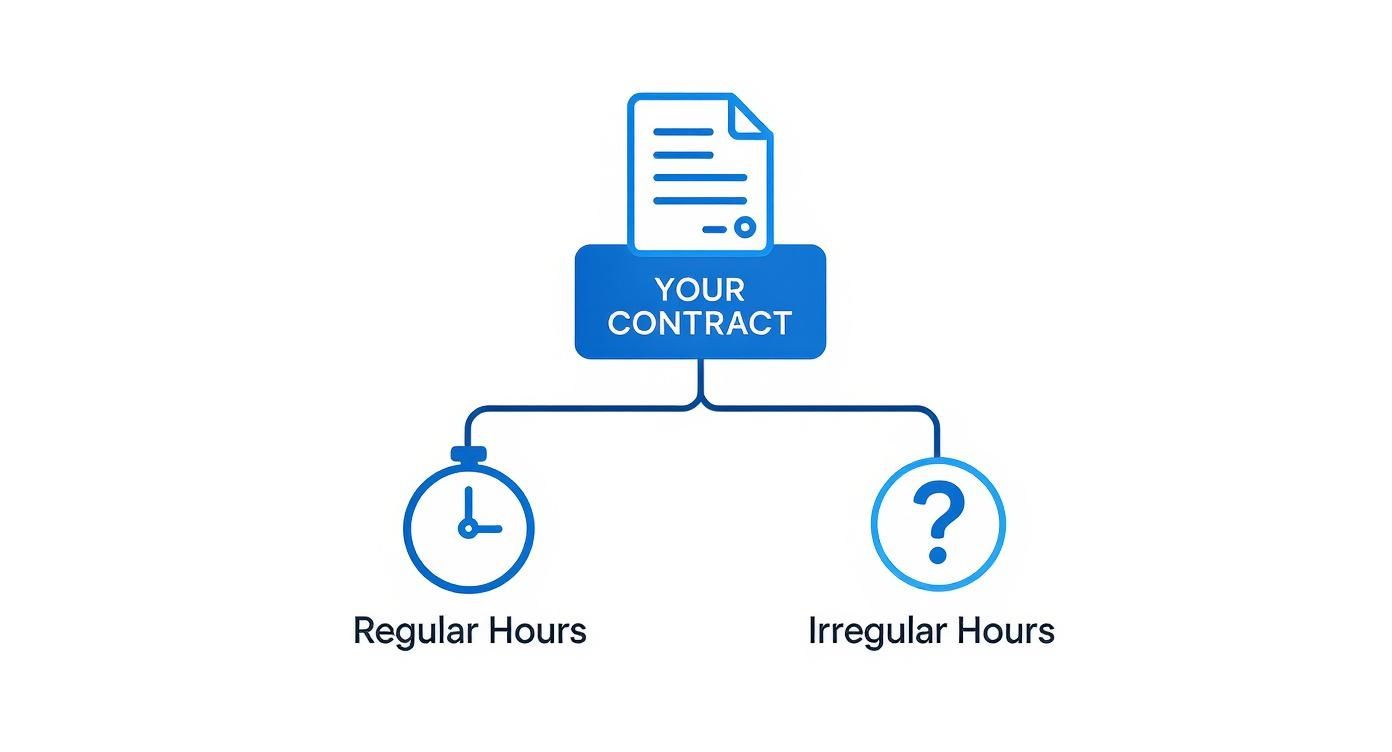
As the diagram shows, checking the contract immediately points you towards the right calculation method based on the employee's specific working pattern.
Handling Final Pay for Leavers
Working out the final holiday entitlement for someone leaving your company follows a very similar logic. You figure out how much holiday they’ve earned up to their leaving date and then compare it to how much they’ve actually taken.
Using our January-December holiday year again, imagine an employee with a 28-day allowance resigns. Their last day is 30th June, so they've completed six full months of service.
- Accrued Holiday: (28 days / 12 months) × 6 months = 14 days
Now, you just need to check their leave records. If they’ve only taken 10 days of leave, you owe them payment for the remaining 4 days. This is often called 'payment in lieu of holiday' and it must be included in their final payslip.
On the flip side, what if an employee has taken more holiday than they’ve earned? Say they’ve used 16 days instead of the 14 they accrued. You can reclaim the difference, but there’s a catch. This is only allowed if you have a specific clause in their employment contract that gives you the right to do so. Without that written agreement, you can't legally deduct the overpayment from their final salary.
Automating Holiday Calculations to Avoid Errors
Let’s be honest, manually tracking holiday entitlement in spreadsheets is just asking for trouble. It might seem manageable at first, but once you start juggling part-time staff, zero-hours contracts, new starters, and leavers, the risk of a simple human error skyrockets. A single typo can spiral into incorrect pay, compliance headaches, and seriously unhappy employees. This is where automation really changes the game.
Modern leave management systems are built specifically to handle all this complexity behind the scenes. Instead of you wrestling with formulas for pro-rata allowances or accrual rates, these tools just do the heavy lifting. This frees up an incredible amount of time for managers and HR teams, letting you focus on supporting your people instead of getting lost in admin.
The Power of a Centralised System
An automated system like Leavetrack gives you a single source of truth for everything leave-related. It completely removes the guesswork and makes sure every calculation is consistent, fair, and legally compliant.
The difference is night and day. The main benefits really boil down to:
- Accuracy: The system automatically crunches the numbers for pro-rata and accrual entitlements for every contract type, so manual errors become a thing of the past.
- Efficiency: Approving requests can be a one-click job, and the records update instantly. No more double-checking spreadsheets or manual data entry.
- Transparency: Employees can see a clear, real-time view of their holiday balance whenever they want. This cuts down on queries and helps build a lot of trust.
If you want to dive deeper into the advantages, have a look at our complete guide to employee leave management systems.

As you can see, a simple dashboard can show an employee’s total allowance, what they’ve taken, and exactly what’s left. This kind of clear visual breakdown means both managers and employees are always on the same page.
By automating these processes, businesses don't just ensure they're compliant with UK employment law; they create a fairer and more transparent environment for everyone. It’s a shift from reactively fixing problems to proactively and intelligently managing your team's time off.
A good automated tool will handle everything from enforcing carry-over rules to calculating the final pay for leavers, making sure every little detail is managed correctly. This move doesn't just save time—it gives you the peace of mind that your entire holiday management process is accurate, compliant, and running smoothly.
Common Holiday Entitlement Questions
Even when you feel you've got a handle on the main calculations, real-life situations can throw a spanner in the works. Working out holiday entitlement often comes down to knowing the answers to those tricky "what if" questions that inevitably pop up. Here are some of the most common queries we see, with clear, direct answers.
What Happens to Holiday Accrual During Sick or Family Leave?
This is a frequent point of confusion: what happens to your annual leave if you’re off work for a long time? The rule here is actually quite straightforward. Your statutory holiday entitlement continues to build up as normal while you are on sick leave, maternity, paternity, or adoption leave.
This means that even if you're not actively working, your paid holiday pot is still growing. You can’t be forced to take annual leave while you’re off sick, but you can request to use it. It's quite common for people to add this accrued leave to the end of their family leave, which is a great way to extend their time away before returning to work.
Can My Boss Tell Me When to Take Holiday?
In short, yes. Employers have the right to manage when their staff take annual leave to make sure the needs of the business are met. This could mean a company-wide shutdown over Christmas or turning down a request during a particularly busy period.
But they have to give you proper notice. The general rule is that they need to provide notice that is at least double the length of the leave they're telling you to take. For example, to make you take one week off, they must let you know at least two weeks beforehand. This kind of detail should always be clearly laid out in your employment contract.
What About Carrying Over Unused Holiday?
What happens to the days you don't manage to use? UK law is firm that workers must take at least four weeks of their statutory leave within the leave year it's earned. Your employer can allow you to carry over the remaining 1.6 weeks (which is 8 days for a full-time employee) into the next year, but only if there's a specific agreement in place.
There's a critical exception to this rule. If you were unable to take your holiday because you were on long-term sick leave, you are legally entitled to carry over up to four weeks of your statutory leave to the next leave year.
It's interesting to see that UK workers are getting better at using their leave. Recent data shows unused days have dropped by a massive 71% since 2019. You can discover more insights into how UK employees use their holiday at timetastic.co.uk.
What Is Rolled-Up Holiday Pay?
You might have heard of "rolled-up" holiday pay. This is where an employer adds an extra amount for holiday pay onto your regular wages, instead of paying you when you actually take the time off. For a long time, this practice was completely unlawful.
However, for leave years starting on or after 1 April 2024, the rules have changed. Rolled-up holiday pay has been reintroduced as a legal option, but—and this is a big "but"—it's only for workers with irregular hours or those on part-year contracts. If an employer goes down this route, the holiday pay portion must be clearly itemised on your payslip and calculated at 12.07% of your total pay.
Still wrestling with spreadsheets to figure out who’s off and when? Leavetrack automates all these complex holiday calculations, from pro-rata allowances to accruals, giving you and your team complete clarity and confidence. Simplify your leave management and ensure fairness and compliance with a single click at https://leavetrackapp.com.