

Mastering Staff Holiday Planning in the UK
Posted by Robin on 29 Nov, 2025 in
Effective staff holiday planning isn't just about marking dates on a calendar. At its core, it’s about creating a clear, fair, and legally sound annual leave policy. This document is the foundation for everything that follows, setting clear expectations for everyone on things like leave entitlements, carry-over rules, and notice periods.
Getting this right from the start prevents a world of confusion, ensures everyone is treated equitably, and crucially, protects your business from being left short-staffed at the worst possible moment.

Crafting a Fair and Compliant Holiday Policy
Think of a well-defined holiday policy as the bedrock of stress-free staff holiday planning. It becomes the single source of truth that aligns what your employees expect with what the business actually needs. This simple step helps you dodge the common headaches of last-minute requests and sudden coverage gaps.
Without a formal policy, you’re left trying to navigate a maze of individual requests without any consistent framework. That path almost always leads to inconsistent decisions, feelings of unfairness, and operational chaos.
Building this policy is about more than just meeting the statutory minimums. It’s a chance to think practically about how your business runs day-to-day and set clear ground rules that everyone understands and can follow.
Key Components of a Robust Policy
To create a policy that’s both comprehensive and easy for your team to understand, you need to cover a few essential areas. These elements work together to build a system that feels transparent and predictable for everyone.
- Annual Leave Entitlement: State clearly how many holiday days each employee gets. Don't forget to specify whether this figure includes or is separate from public holidays.
- Request and Notice Periods: Define how much notice an employee needs to give before taking leave. A common rule of thumb is to require notice that is at least twice the length of the holiday being requested.
- Carry-Over Rules: Be specific about how many unused holiday days, if any, can be carried over into the next leave year. You should also set a firm deadline for when those carried-over days must be used. This avoids that mad rush to use up leave at the end of the year.
- Approval Process: Outline who is responsible for approving leave requests and what the typical response time will be.
A great policy doesn't just list rules; it explains the 'why' behind them. When staff understand that notice periods exist to ensure proper cover, they are far more likely to adhere to them without issue. This builds a culture of mutual respect and shared responsibility.
When planning holidays in the UK, you also need to account for your legal obligations, especially with the different public holidays across England, Scotland, Wales, and Northern Ireland. Strategic planning early on is essential to ensure you're complying with employment law, which mandates fair holiday pay and statutory leave.
Ultimately, the goal is to get these rules documented in a place everyone can easily access. To get a head start, you can review our guide on how to simplify leave management with our template annual leave policy. A clear, well-communicated policy is your first line of defence against scheduling conflicts and team frustration.
Handling Peak Seasons and Blackout Periods
Let's be honest, managing the mad rush of holiday requests for summer or Christmas can feel more like crisis management than simple admin. When half the team wants the same two weeks in August, it’s a classic tug-of-war between keeping everyone happy and keeping the lights on. The only way to win is to get ahead of the chaos with a clear, proactive plan.
First things first, you need to formally identify your peak seasons and any non-negotiable blackout periods. A peak season for a retail business is obviously the frantic run-up to Christmas. For an accounting firm, a blackout period might be the last week of the tax year. Pinpointing these critical times is the bedrock of protecting your operations.
Once you know the dates, the next step is all about communication. Announce these periods well in advance and, crucially, explain why they are so important. Giving your team that context helps them see that the rules aren't just arbitrary; they’re directly linked to the company's health. It makes the restrictions a lot easier to swallow.
Creating a Fair System for Popular Dates
Simply banning all leave during busy times isn't always practical, especially during longer peak seasons like the entire summer school holidays. What you really need is a transparent system for managing leave when demand is sky-high. There's no one-size-fits-all solution here, so you'll need to think about what works for your company culture and operational needs.
To get you started, here are a few different approaches that I've seen work well in practice:
Holiday Request Management Approaches
Deciding how to allocate leave during popular periods can be tricky. You want a system that's seen as fair by your team but also ensures the business can continue to function effectively. Below is a quick comparison of some common methods to help you choose the right fit.
| Approach | How It Works | Best For | Potential Pitfall |
|---|---|---|---|
| First-Come, First-Served | The simplest method. Requests are approved in the order they’re submitted until the minimum coverage level is reached. | Predictable peak times where you can open a booking window well in advance, giving everyone a fair shot. | Can feel like a race, potentially disadvantaging those who aren't as quick to plan or submit their requests. |
| Rota or Ballot System | A rotating schedule ensures fairness over time (e.g., if you work Christmas one year, you get priority for it off the next). A ballot is a lottery for a one-off event. | Recurring high-demand periods like major public holidays where fairness over multiple years is a key concern. | Can be complex to administer and may not accommodate individual preferences in a given year. |
| Minimum Coverage Levels | Instead of a complete ban, you define the minimum number of people needed in each role and approve leave until that threshold is met. | Businesses with varied roles where some functions are more critical than others during peak times. | Requires careful capacity planning to set the right thresholds. Setting them too high defeats the purpose. |
Choosing the right approach—or even a blend of them—is about balancing the needs of the business with the well-being of your staff. Clear communication about how the chosen system works is just as important as the system itself.
Imagine a high-street bookshop during the Christmas rush. Instead of a blanket ban on all leave in December, the manager sets a minimum coverage of three staff on the shop floor at all times. They open a "first-come, first-served" booking system for the first two weeks of the month, which are busy but manageable. For the critical week leading up to Christmas, they use a rota system. As an incentive, any staff working on Christmas Eve get a small bonus and an extra day of leave to use in January.
This is what smart holiday planning looks like. It turns a potential source of conflict into a win-win. The business stays fully operational during its most profitable period, and employees feel the process is fair, transparent, and even offers a little something extra for their flexibility.
Fine-Tuning Your Holiday Request Workflow
Are you still juggling holiday requests through a messy tangle of email chains, scribbled notes, and an ever-more-confusing spreadsheet? If that sounds familiar, it’s probably time for an overhaul. A clunky, manual system isn't just a headache for the person managing it; it breeds frustration for the whole team, slows down decisions, and makes it impossible to see who’s actually available at any given time.
Getting this right means mapping out the entire journey of a holiday request. Think about it: from the moment a team member decides they need a break, to the final confirmation landing in their inbox. This involves setting up crystal-clear approval chains—does a request go to the line manager first, then HR?—and using automated notifications to keep everything moving. No more chasing people for an answer.
Building an Approval Process That Actually Works
A great workflow is all about eliminating bottlenecks. What happens if a manager is off sick or on holiday themselves? Can someone else step in and approve requests? A modern system should handle this kind of thing automatically, making the whole process transparent and quick for everyone.
This is a simple way to think about managing requests, especially when things get busy.
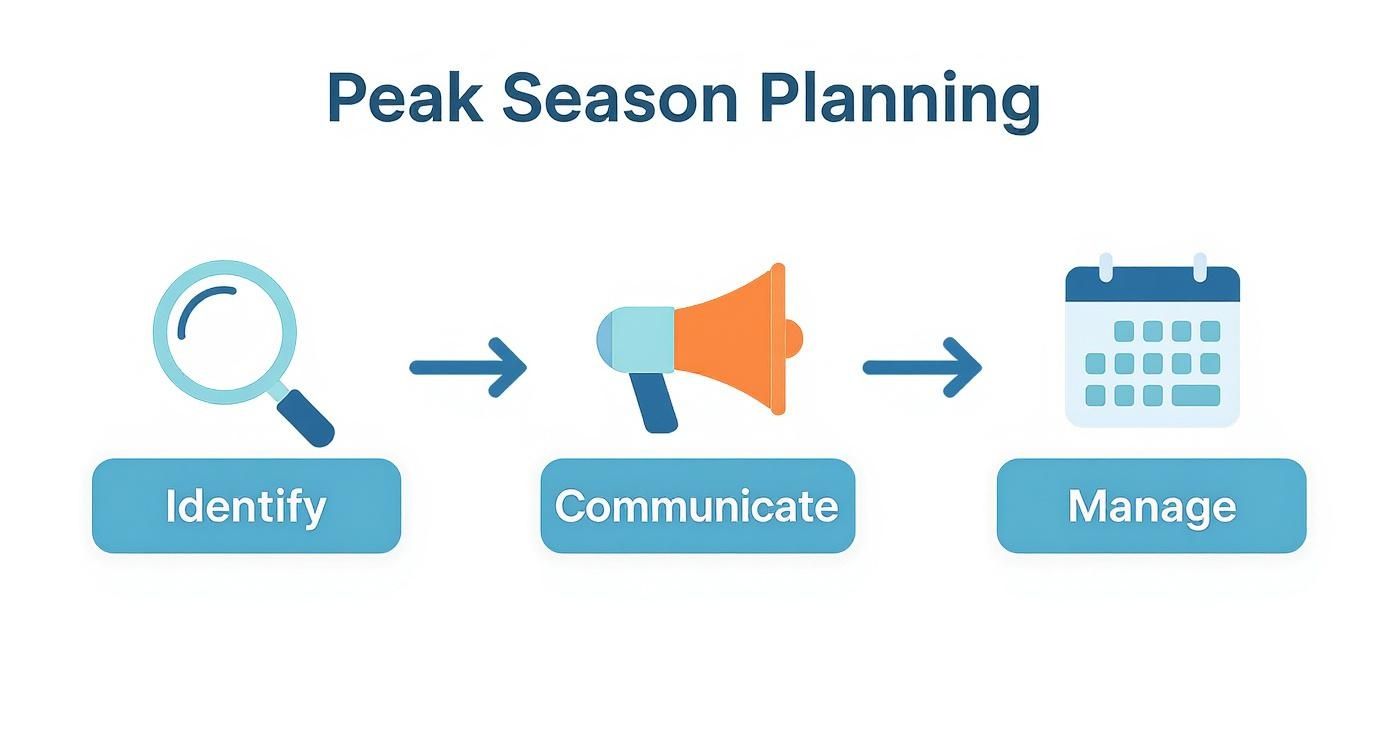
As you can see, solid management starts long before the first request even comes in. It begins with identifying what the business needs and being proactive with your communication.
Let’s walk through a real-world scenario. A marketing team is gearing up for a major product launch in the summer. The head of marketing has already blocked out the two weeks leading up to the launch as a critical, all-hands-on-deck period.
- The Request: A junior designer, unaware of the freeze, puts in a request for a week off right in the middle of this period using the company’s leave platform, Leavetrack.
- The Flag: The system instantly flags that the request clashes with a pre-defined blackout period.
- The Conversation: The manager sees the conflict immediately. Instead of just hitting 'decline', she has a quick chat with the designer, explains the importance of the launch, and helps them book a different week just after the campaign goes live.
This is the real power of having a centralised system. It gives you instant visibility, automatically enforces the rules you’ve set, and lets managers make smart decisions on the spot. It turns a potential crisis into a simple, constructive conversation.
Without a proper workflow, that request could have easily been lost in an inbox, approved by mistake, or caused a last-minute scramble when someone finally noticed the gap in cover. A slick process ensures your key people are always there when you need them, keeping projects on track and everyone on the same page.
Proactively Managing Team Coverage And Rotas
Let's be honest, the biggest headache with staff holidays isn't the requests themselves. It's that sinking feeling when you suddenly realise you're short-staffed during a critical project or a busy sales period. The secret is to stop reacting and start preparing. This is where a central, visible holiday calendar becomes your best friend, letting you spot potential coverage gaps weeks, or even months, in advance.

This kind of foresight changes your role entirely. You're no longer just a gatekeeper for leave requests; you become a strategic planner. To get that high-level view of who’s off and when, it’s worth learning how to create a shared calendar that everyone can see. With a clear picture of upcoming absences, you can make smart decisions long before a potential issue spirals into a real problem.
Building Resilience With Cross-Training And Rota Adjustments
Once you can see the gaps, you can start filling them intelligently. But proactive coverage isn't just about shuffling schedules around—it's about building a more resilient and capable team. This is where cross-training really proves its worth, ensuring that essential duties don't just grind to a halt because one key person is on a beach somewhere.
Here are a few practical ways to keep the momentum going:
- Pinpoint Critical Tasks: First, figure out the absolute non-negotiable tasks that happen daily or weekly. Who’s the only person that knows how to do them? That’s your starting point for training a backup.
- Create a Skills Matrix: It sounds formal, but a simple chart showing who can do what gives you a fantastic at-a-glance view of your team's skills. It makes reassigning work so much easier.
- Schedule Overlapping Shifts: During really busy holiday periods, like Christmas or the summer holidays, scheduling even a brief overlap between shifts can ensure a perfectly smooth handover of tasks and crucial information.
A great example is a customer support team planning for a bank holiday weekend. They schedule 30-minute overlapping shifts to prevent any drop in service as one person logs off and another logs on. They also rely on their multi-skilled agents—who have been cross-trained—to handle a wider range of queries, letting their colleagues enjoy a proper break without any lingering worries.
This forward-thinking approach is more important than ever. In the UK, workers are increasingly determined to use their full holiday entitlement. In fact, the number of unused holiday days per employee has plummeted by a massive 71% since 2019, and over half of UK employees took a full working week off in the last year. These figures show that robust coverage planning is no longer a 'nice-to-have'; it's essential.
Communicating Changes Effectively
With your coverage plan sorted, the final piece of the puzzle is clear communication. If you need to adjust rotas or temporarily reassign tasks, give your team as much notice as you possibly can and, crucially, explain why.
Frame it as a collective effort to support colleagues who are taking their well-earned time off. For a more detailed breakdown, our guide on preparing for an employee going on holiday includes a handy checklist for seamless handovers. This kind of transparent approach builds a real culture of teamwork, where everyone understands their part in keeping things running smoothly while others are away.
Foster a Culture That Encourages Time Off
A brilliant staff holiday policy is useless if your team feels guilty or stressed about actually taking their leave. Your process is only as good as the culture that supports it. Building a workplace where breaks are genuinely encouraged isn't just a nice-to-have; it's essential for preventing burnout and keeping morale high.
It all starts with proactive, positive communication. Don't wait for that last-minute scramble in December. Send out friendly reminders throughout the year, gently nudging people to get their leave booked. This simple step helps them plan and signals that you genuinely want them to use their well-deserved time off.
Lead by Example
Managers and senior leaders set the tone. When a director takes their full holiday, properly disconnects, and comes back talking about how refreshing it was, it sends a powerful message. It shows the rest of the team that switching off isn't just allowed—it's expected.
On the flip side, if managers are firing off emails from the beach, it creates an unspoken pressure for everyone else to do the same. This kind of 'always-on' behaviour quietly sabotages any official policy that champions rest.
Celebrate Time Off
Make taking a break a positive thing. When a team member goes on holiday, wish them a great trip in the team chat. When they get back, ask them how it was. These small gestures help normalise taking leave and reinforce it as a healthy part of your company culture.
This positive reinforcement is vital for staff well-being. Knowing how to foster this kind of culture is a critical management skill, and there are some great resources out there that explain how to prevent employee burnout by creating a supportive environment.
The goal is to create an environment where staff feel fully supported in taking their breaks, confident that the business is well-prepared for their absence. A well-rested team is a more engaged, creative, and productive team.
Interestingly, that common fear of productivity nosediving around the holidays might be a myth. Research found that a huge 89% of UK workers stay productive during the festive season. In fact, more than half (55%) even reported a boost in their output. It seems the drive to finish the year on a high note keeps people focused, helping them avoid burnout while maintaining business momentum. You can dig into more of the findings on holiday productivity in the full report.
Using Data and Tools for Smarter Planning
Let’s be honest, trying to plan staff holidays using guesswork is a recipe for disaster. Clunky spreadsheets and messy email chains just don't cut it anymore. Today, the smartest planning is driven by data and the right tools, helping you manage leave more efficiently and, crucially, more fairly.
When you bring everything into one dedicated system, you get a single, clear picture of who is off and when. This simple shift is huge—it instantly eliminates the risk of accidental overlaps or those dreaded coverage gaps that throw workflows into chaos and pile stress onto the team.
Harnessing Leave Management Software
The real magic of modern tools isn't just tracking days off; it's the data they unlock. An employee leave management system transforms raw data into actionable insights about your team’s leave patterns.
With just a few clicks, you can spot trends. For example, you might notice the marketing team almost always takes leave in late August. Armed with that knowledge, you can plan project deadlines and resource allocation well in advance. No more last-minute surprises.
These systems also play nicely with the tools your team already uses. Syncing with shared calendars like Outlook or Google Calendar gives everyone total visibility, making it dead simple for people to plan around their colleagues' absences.
Moving from manual tracking to a dedicated system is like switching from a paper map to a GPS. One gets you there eventually with a lot of effort, while the other guides you proactively, alerts you to potential issues, and helps you find the most efficient route forward.
From Reactive to Strategic Planning
This data-driven approach allows you to become a much more strategic manager. You can easily pull reports to see who hasn't taken a break in a while, giving you a chance to proactively encourage them to rest and recharge before they hit burnout. That's a massive part of building a healthy, sustainable work culture.
Forecasting becomes far more reliable, too. By looking at historical leave data, you can predict your staffing needs for peak periods with much greater accuracy. This means you can arrange cover well ahead of time, ensuring business continuity without the usual last-minute scramble.
Ultimately, using data properly moves your staff holiday planning from a reactive chore to a strategic function. It makes the entire process fairer, more transparent, and helps you refine and improve it year after year.
Common Questions on Staff Holiday Planning
Even with a rock-solid policy in your back pocket, you’re bound to run into some tricky situations that create a bit of confusion. Let's walk through a couple of the most frequent questions that crop up, so you can handle them with confidence and fairness every time.
Can We Say No to a Holiday Request?
In short, yes. But you absolutely must have a sound business reason for doing so.
Rejecting a request is perfectly reasonable if it falls within a pre-agreed blackout period, would leave a crucial team dangerously short-staffed, or doesn't follow the notice period you’ve clearly laid out in your policy. It's not about being a gatekeeper; it's about keeping the business running smoothly.
The trick is to be consistent and completely transparent. Don't just click 'deny'. Pick up the phone or drop them a message explaining the why behind the decision. If you can, work with them to find an alternative date that works for everyone.
Remember, the goal isn't to be difficult, but to balance employee well-being with genuine operational needs. A clear explanation turns a potentially negative interaction into a constructive one, reinforcing the fairness of your overall process.
What if an Employee Is Sick Just Before or During Their Holiday?
This is a classic one. If an employee becomes unwell right before their scheduled annual leave, they can switch that time off from holiday to sick leave. This means their holiday entitlement is untouched, ready for them to use when they're back on their feet.
And what if they fall ill during their trip? The same principle applies. They are entitled to claim that time back as sick leave instead of using their holiday allowance. However, they must follow your company’s standard sickness reporting procedure. This usually means letting their manager know as soon as possible and getting a doctor's note if that’s part of your normal process.
Managing these nuances is so much simpler when everything’s in one place. Leavetrack gives you an instant, clear view of team schedules, making it easy to see who’s where, manage requests, and adapt to last-minute changes without the usual headache. See how it all works at https://leavetrackapp.com.