
The Ultimate Bradford Score Calculator Guide
Posted by Robin on 04 Dec, 2025 in
The Bradford Score is a well-known HR tool that gets straight to the point: frequent, short-term absences are often far more disruptive than a single, longer spell of leave. Anyone who has managed a team knows this intuitively. A Bradford Score calculator simply puts a number to that disruption, using a formula that gives more weight to the number of times someone is off than the total days they’ve taken.
What the Bradford Score Actually Tells You About Absence

At its heart, the Bradford Factor is a simple but clever way to manage absence. Its main job is to shift your focus from just counting the total days an employee is away to analysing the pattern of their time off. For any business trying to keep things running smoothly, that distinction is everything.
Think about it. An employee who takes a planned two-week absence for a medical procedure is usually much easier to manage than a colleague who calls in sick for ten separate single days throughout the year. The second scenario creates a constant headache of last-minute cover, reshuffling workloads, and general uncertainty for the rest of the team. The Bradford Score captures this difference in a single number, flagging which absence patterns are causing the most friction.
To put it simply, here’s a quick breakdown of what the Bradford Factor is all about.
Bradford Factor At a Glance
| Component | What It Means |
|---|---|
| Spells (S) | The number of separate instances of absence. Each time an employee is off, no matter for how long, it counts as one spell. |
| Total Days (D) | The total number of days the employee was absent across all spells within a set period (usually 52 weeks). |
| The Formula | S² x D. Squaring the number of spells is what gives the score its power, heavily penalising repeated absences. |
| Purpose | To identify disruptive absence patterns, not just measure total time off. |
The key takeaway is that the score rises exponentially with each new instance of absence, making it a powerful indicator of potential issues.
The Origin and Purpose of the Metric
The story goes that the Bradford Factor came from research at Bradford University School of Management back in the 1980s. Interestingly, the university itself has said no such research was officially done there. Despite its mysterious roots, the formula caught on, became widely known as the Bradford Factor, and was quickly adopted by managers across the UK.
Its lasting appeal is down to its simplicity and the clarity it offers. By using a Bradford Score calculator, managers can:
- Spot Disruptive Patterns: Quickly see which employees have frequent, short absences that might otherwise go unnoticed.
- Standardise Absence Monitoring: Apply a consistent, objective measure across the board, ensuring fairness when flagging potential attendance issues.
- Trigger Conversations: Use the score as a prompt to talk to an employee, not as a disciplinary tool in itself. It encourages managers to find out why the absences are happening.
- Promote Accountability: Help employees understand how their absence patterns affect the business, which can encourage better communication.
Shifting Focus from Duration to Frequency
Getting your head around this shift from duration to frequency is crucial. Traditional absence tracking might show two employees with 10 days off and treat them the same. The Bradford Score, however, paints a very different picture.
One employee might have a single 10-day absence, giving them a very low score. Another might have ten separate 1-day absences, resulting in a sky-high score. This helps you prioritise your attention on the attendance patterns most likely to be affecting team performance and morale. If you're starting to see these kinds of trends emerge, it's often one of the top 5 signs you need help with employee absence.
The real value of the Bradford Score isn't just the number it produces; it's the conversation it starts. It prompts managers to look beyond the total days lost and explore the underlying reasons for recurring, short-term leave, fostering a more supportive and proactive approach to employee well-being and attendance.
Unpacking the Bradford Score Formula
At first glance, the formula for calculating a Bradford Score looks like something you’d find in a maths textbook: S² x D = B. It can seem a bit intimidating, but it’s actually a really straightforward way to get a clear, numerical snapshot of someone's absence patterns.
Let's quickly break down what each letter means, as this is the key to understanding why a Bradford Score calculator works the way it does.
S is for "Spells": This is simply the total number of separate times someone has been off sick over a set period, usually a rolling 52 weeks. Each new instance of absence, whether it's for one day or five, counts as a single spell.
D is for "Days": This is the total number of days the employee was absent across all those spells during the same period.
B is the "Bradford Score": This is the final number, the one that gives you a measure of the disruption caused.
The real clever bit is squaring the number of spells (S²). This is done deliberately to give more weight to the frequency of absence. It causes the score to jump up exponentially with each new instance of leave, which is what makes the formula so good at spotting the difference between a single, long-term absence and lots of short, unpredictable ones.
Seeing the Formula in Action
Theory is one thing, but seeing how it plays out in the real world is the best way to get your head around it. Let's look at two employees, Maria and David. They both work in the same team and have been off for a total of 10 days over the last year.
Scenario One: Maria's Absence
Maria had a minor operation and needed a single block of time to recover fully.
- Spells (S): 1 (just one continuous absence)
- Total Days (D): 10
- Calculation: 1² x 10 = 10
Maria's Bradford Score is just 10. Her absence, while lasting two full weeks, was a single event. The team could plan around it, arrange cover, and manage the workload with minimal fuss.
Scenario Two: David's Absence
David, on the other hand, had a string of unrelated, short-term sick days throughout the year.
- Spells (S): 10 (ten separate one-day absences)
- Total Days (D): 10
- Calculation: 10² x 10 = 1,000
David's score is a whopping 1,000 — a full 100 times higher than Maria's, even though they were off for the exact same number of days. Each of his ten absences probably required last-minute changes, disrupted workflows, and put an unexpected strain on his colleagues. The formula correctly flags his absence pattern as being far more disruptive.
This stark difference gets to the heart of the Bradford Factor. It’s not about punishing people for being genuinely ill. It’s about giving managers an objective metric that highlights patterns of frequent, unplanned absence that can seriously impact productivity and team morale.
A More Complex Example
The logic still applies when things get a bit more mixed. Let’s take another employee, Sarah, who has had a combination of short and slightly longer absences.
Over the last 52 weeks, Sarah has had:
- One absence of 3 days
- Another absence of 2 days
- Four separate absences of 1 day each
To figure out her score, we just need to add up her total spells and total days first.
- Total Spells (S): She had 6 separate instances of absence (1 + 1 + 4). So, S = 6.
- Total Days (D): Her total days off come to 3 + 2 + 1 + 1 + 1 + 1 = 9. So, D = 9.
Now, let's pop those numbers into the formula:
Sarah's Calculation: 6² x 9 = 36 x 9 = 324
Sarah’s score of 324 sits somewhere in the middle. It’s high enough to suggest there might be an underlying issue worth having an informal chat about, but it's not at a critical level. This shows how the score gives you a more nuanced view than simply counting the days someone was off.
Getting comfortable with this calculation gives managers the confidence to look at the scores from a Bradford Score calculator and use them as a helpful starting point for supportive and constructive conversations with their team.
How to Calculate and Track Bradford Scores
Knowing the theory is one thing, but putting the Bradford Factor into practice is where it really starts to matter. The good news is that calculating and tracking these scores doesn't have to be some monumental task. You can get started with tools you probably already have, like a simple spreadsheet, or you can go all-in with dedicated software that handles everything for you. Let's walk through how to get it done.
At its heart, the calculation is pretty straightforward once you have the two key figures: the number of separate absence 'spells' and the total number of days absent.
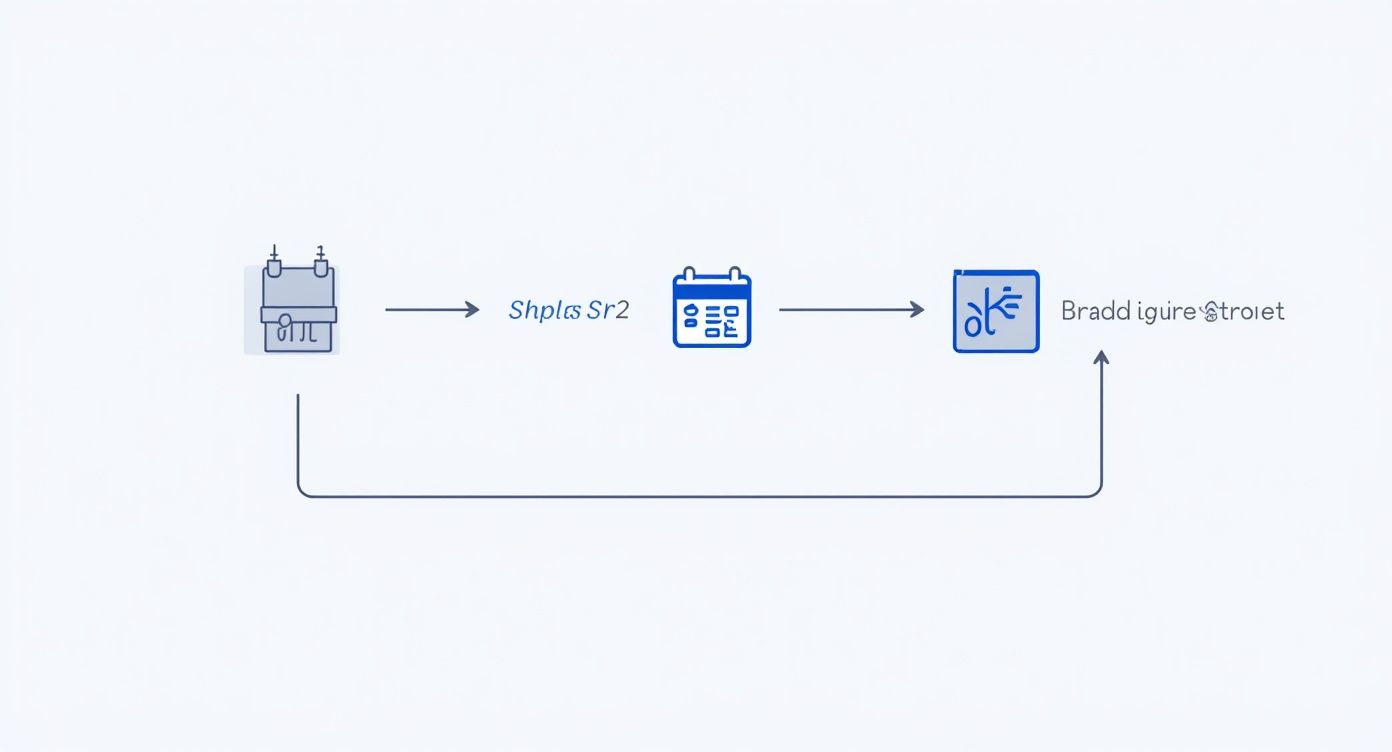
This diagram neatly shows the flow: you take the number of spells, square it, and then multiply that by the total days absent to get the score. It really drives home the point that the number of individual instances of absence is the critical factor, as it has an exponential impact on the final number.
Building Your Own Tracker in Excel or Google Sheets
For many smaller businesses, a spreadsheet is the natural first step for tracking absences. You can quite easily set up a basic Bradford Score calculator with just a couple of simple formulas.
Imagine you have a sheet listing your employees and their dates of absence. To work out the score for an individual, you'd just need a few columns:
- Employee Name
- Total Spells (S): The count of distinct absence periods.
- Total Days (D): The sum of all days they've been off.
- Bradford Score (B): The final calculated score.
If you have the number of spells in cell B2 and the total days in C2, the formula for your Bradford Score in column D2 is as simple as it gets:=(B2*B2)*C2 or you could use =B2^2*C2
Honestly, the formula isn't the tricky part. The real challenge with spreadsheets is the manual data entry—accurately logging every spell and day. It can quickly become a time-sink and is notoriously prone to human error. This is why having a solid process for the importance of accurate absence tracking from day one is so crucial.
Using a Dedicated Bradford Score Calculator
If wrestling with spreadsheets sounds like a chore, an online Bradford Score calculator is a great alternative. These are typically simple web tools where you just pop in the numbers.
You just enter the number of spells and the total days off, and it spits out the score instantly. It’s perfect for a quick, one-off check or to make sure your own spreadsheet maths is correct. It's not a sustainable solution for managing a whole team's attendance over time, though.
Choosing the Right Review Period
When you're applying the Bradford Factor, consistency is absolutely key. The most common and fairest way to do this is by using a rolling 52-week period.
A rolling 52-week period simply means your calculation always looks at the most recent year of an employee's attendance record. This avoids the "clean slate" issue you get with a fixed calendar year (e.g., Jan-Dec), where a poor record gets wiped on New Year's Day. It gives you a much more current and realistic view of someone's attendance patterns.
Automating with HR Software
For the best in both efficiency and accuracy, nothing beats dedicated HR and absence management software like Leavetrack. These platforms are designed to automate the entire process, from recording the absence to flagging a high score.
A properly integrated system will:
- Log Absences Automatically: Managers or employees record absences directly in the system the moment they happen.
- Calculate Scores in Real-Time: The software automatically updates an employee's Bradford Score based on the rolling 52-week data. No manual calculations needed.
- Flag High Scores: You can set your own thresholds, and the system will send an alert when an employee’s score crosses a trigger point, prompting a conversation.
- Generate Reports: You can easily pull up reports on individuals, teams, or the whole company to spot trends and patterns over time.
This approach practically eliminates the risk of human error and frees up a huge amount of admin time. For businesses serious about data, learning how to build an effective calculator provides a solid foundation for managing any metric, but automation is the key to making it work seamlessly. It lets managers step away from the calculator and focus on the human side of things—having supportive, constructive conversations with their team members.
Turning Scores Into Actionable Absence Policies
A number from a Bradford Score calculator is just data; it's what you do with it that really matters. Without a clear and consistent policy behind it, the scores are pretty meaningless and can even feel unfair to your staff. The real trick is to turn this data into a structured, transparent, and supportive absence management strategy.
This means you need to establish clear 'trigger points'—specific scores that prompt a defined management action. Having these thresholds creates a predictable framework, making sure every employee is treated the same way while giving managers the confidence to step in when needed. A good policy isn't about punishment; it's about starting supportive conversations at the right moment.
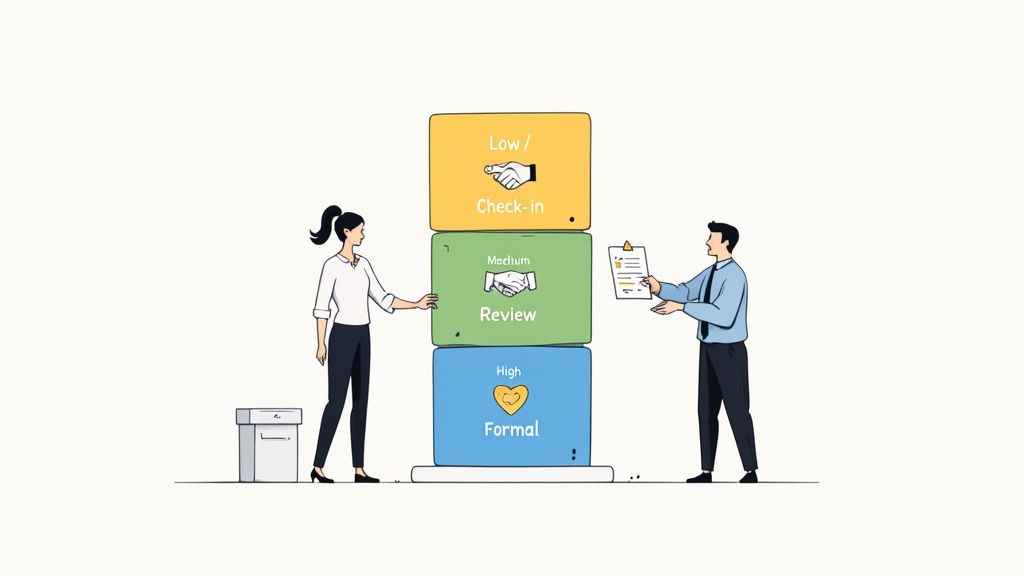
The goal is to move from simply collecting numbers to building a fair system that addresses disruptive absence patterns before they become a major issue. It helps everyone in the team understand the expectations and what happens if their attendance becomes a concern.
Setting Your Trigger Points
There are no legally mandated trigger points for the Bradford Factor here in the UK, so it's up to each organisation to define its own. The thresholds you pick should reflect your operational needs and company culture. Most businesses find a tiered system works best, where the response escalates as the score goes up.
To give you a starting point, here is a common framework that you can adapt for your own policy.
Sample Bradford Score Triggers and Responses
This table shows an example framework outlining potential Bradford Score thresholds and the management actions you might take. It's a solid base for developing your own fair and consistent absence policy.
| Score Range | Concern Level | Recommended Action |
|---|---|---|
| 0 – 49 | No Concern | This range typically means attendance patterns are fine. No action is required. |
| 50 – 199 | Low Concern | A score here might warrant an informal chat, maybe during a return-to-work interview. It's a chance to check in and offer support. |
| 200 – 399 | Medium Concern | This usually triggers a more formal discussion or a first written warning. The aim is to understand the root cause and agree on an improvement plan. |
| 400+ | High Concern | Scores this high often lead to a final written warning and a formal review. Dismissal could be a potential outcome if no improvement is seen. |
Remember, it’s crucial that these actions are not automatic. A high score should always be the start of a conversation, never the sole reason for disciplinary action without looking at the context.
From Score to Conversation
Once your thresholds are set, the focus has to shift to the human element. The real power of the Bradford Score is its ability to flag when a supportive conversation is needed.
Informal Chat (Low Score): "Hi Alex, welcome back. I saw your Bradford Score is at 95. Just wanted to check in and see if everything is okay or if there's any support you need from us."
Formal Review (Medium Score): "Thanks for meeting with me, Sam. Your score has reached 250, which is the point where we need to have a formal chat. Let's talk about the reasons for your recent absences and figure out what we can do to help you get back on track."
This approach turns what could be a confrontational topic into a supportive and constructive dialogue. It shows the company cares about employee well-being while also addressing the business impact of absenteeism.
A Bradford Score should be used as a thermometer, not a verdict. It tells you there might be a fever, but it doesn't tell you the cause. A manager's job is to investigate with empathy and offer the right support.
When it's all communicated transparently, this system can be a powerful motivator. For example, back in 2006, the UK prison service reported a significant 25% reduction in staff absences after introducing the Bradford Factor. According to analysis on LeaveWizard, this was largely because it increased accountability and awareness.
Ultimately, a Bradford Score calculator is a diagnostic tool. Your absence policy is the treatment plan. By linking clear trigger points to supportive, escalating actions, you create a system that's fair, effective, and focused on helping employees stay on track. This balanced approach protects your business operations while building a culture of trust and support.
Navigating UK Legal and Ethical Considerations
While a Bradford Score calculator gives you a useful, objective metric for absence, applying it in the UK requires careful thought and a strong ethical compass. The score itself is just a number; it can’t distinguish between a genuine, debilitating illness and a pattern of less-than-genuine absences.
This is its single biggest limitation and the source of most legal and ethical headaches for employers.
Relying solely on a raw score without digging into the context can lead to unfair treatment and, in some cases, serious legal challenges. The key is to use the score as a conversation starter, not as an automated disciplinary tool. Think of it as a flag that signals a pattern needing human investigation, empathy, and sound judgement.
The Equality Act 2010 and Disability Discrimination
The most significant legal hurdle for UK employers using the Bradford Factor is the Equality Act 2010. This legislation protects employees with disabilities from discrimination. A disability is defined as a physical or mental impairment that has a ‘substantial’ and ‘long-term’ negative effect on a person’s ability to do normal daily activities.
Plenty of chronic illnesses, both physical and mental, fall under this definition. An employee with a condition like Crohn's disease, multiple sclerosis, or severe anxiety might naturally have a higher number of short-term absences directly related to their disability.
If you apply a standard Bradford Factor policy to them without making adjustments, you're stepping into risky territory—specifically, disability discrimination. The law is clear: employers must make reasonable adjustments to accommodate an employee’s disability.
A rigid, one-size-fits-all approach to absence management is legally precarious. The Bradford Score can inadvertently penalise employees for absences that are a direct result of a protected characteristic, such as a disability. Treating these absences the same as others could be seen as discriminatory.
This doesn't mean you have to scrap the Bradford Factor entirely. It just means you have to apply it intelligently and with due care.
Practical Steps for Fair and Lawful Application
To use the Bradford Score fairly and stay on the right side of UK employment law, you need to build safeguards into your absence management policy. The system should be a guide for managers, not a rigid set of rules that ignores individual circumstances.
Here are some essential practices to adopt:
- Discount Disability-Related Absences: The most common reasonable adjustment is to simply discount or disregard absences directly linked to an employee’s known disability. For instance, if an employee needs two days off for a pre-planned hospital treatment related to their condition, you could exclude those days (and the spell) from their Bradford Score calculation.
- Adjust Trigger Points: Another route is to set different, higher trigger points for employees with known disabilities. This acknowledges they may have more frequent absences but ensures the policy is still applied fairly relative to their circumstances.
- Focus on the 'Why': Every conversation triggered by a high score should start with an open question: "I've noticed your absences have become more frequent; is everything okay?" This simple question opens the door for an employee to disclose an underlying health condition you might not have known about.
Implementing these steps requires more than just good intentions; it demands robust processes. This is why accurate absence tracking is crucial for compliance, as it provides the clear, detailed records needed to apply policies fairly and make informed adjustments.
The Critical Role of Return-to-Work Interviews
One of the most effective tools for applying the Bradford Score ethically is the return-to-work interview. A brief, informal chat after every single absence—no matter how short—is vital. This isn’t an interrogation; it's a supportive check-in.
These conversations create a consistent opportunity to:
- Understand the Reason: You can sensitively ask about the reason for the absence, which helps identify potential underlying health issues or disabilities.
- Offer Support: It’s a chance to show you care and ask if the employee needs any support, whether that’s a temporary change in duties or access to wellness resources.
- Ensure Fairness: It provides the context needed to decide whether an absence should be included in the Bradford Score calculation.
By making these interviews a standard part of your process, you gather the qualitative information needed to complement the quantitative data from your Bradford Score calculator. This balanced approach ensures you are managing absence effectively, supportively, and, most importantly, lawfully. It transforms your policy from a rigid, numbers-based system into a compassionate and legally sound management framework.
Your Bradford Score Questions Answered
Once you start using a tool like the Bradford Factor, it's only natural for a few questions to pop up. I’ve found that managers and HR pros often want to dig into the details to make sure they’re applying it fairly and getting the most out of it. This section tackles the most common queries we hear, giving you clear, straightforward answers so you can use any Bradford Score calculator with confidence.
Getting to grips with these nuances is key. It’s what turns the score from a blunt instrument into a genuinely supportive management tool. By addressing these common concerns head-on, you can build an absence management process that feels transparent and trustworthy for everyone involved.
What Is a Good Bradford Factor Score?
There's no magic number here. A "good" score is entirely down to your company's policy, as what one business considers acceptable, another might see as a red flag. It really depends on your operational needs, your culture, and what you’re trying to achieve.
That said, there are some general benchmarks. A score below 50 is usually considered very low and isn't a cause for concern. This typically points to an employee with maybe one or two very short absences over the year.
When scores start creeping into the 50 to 200 range, that’s often a prompt for an informal chat, perhaps during a return-to-work interview. It’s when scores push past 400 or 500 that a more formal review is usually triggered. The most important thing is for your organisation to define its own trigger points clearly and, crucially, apply them consistently to everyone.
Does the Bradford Factor Consider Disability Related Absences?
No, the raw formula doesn’t, and honestly, this is its single biggest legal risk in the UK. The Bradford Score is a simple calculation; it has no way of distinguishing why someone was absent.
Under the Equality Act 2010, UK employers have a legal duty to make reasonable adjustments for employees with disabilities. If you apply a rigid Bradford Factor policy to absences that are directly linked to a known disability, you could find yourself on the wrong side of a discrimination claim. For instance, penalising someone for attending a pre-planned hospital appointment related to their condition would almost certainly be unlawful.
Best practice is to either completely discount absences directly linked to a known disability from the calculation or, after a proper consultation with the employee, agree on different, higher trigger points for them. This approach ensures you’re being fair and staying legally compliant.
This is exactly why the score should never lead to automatic disciplinary action. A high score should always be the start of a conversation, not the end of one. You need to understand the context behind the numbers.
How Is the Time Period for a Bradford Score Calculation Determined?
The standard and most recommended timeframe is a rolling 52-week period. This means the calculation always looks at the immediate past year from any given date, rather than a fixed period.
Using a rolling period is far more effective and fairer than a fixed calendar year (e.g., 1st January to 31st December). A fixed year creates a strange "reset" button on New Year's Day, where a poor attendance record is suddenly wiped clean. This doesn't reflect the ongoing impact on the business at all.
A rolling 52-week window ensures that recent absence patterns are always in the picture. It gives managers a much more accurate and current view of an employee’s attendance at any point in time, helping them spot developing trends instead of waiting for an end-of-year review.
Managing absence fairly and efficiently is simple with the right tools. Leavetrack automates absence tracking and provides the clear, real-time data you need to support your team and maintain productivity. See how it works at https://leavetrackapp.com.