

UK Annual Leave Entitlement Explained
Posted by Robin on 01 Nov, 2025 in
Your annual leave entitlement is your legal right to paid time off from work. It’s a fundamental part of UK employment law designed to make sure everyone gets a proper break. For most full-time workers, this boils down to a minimum of 5.6 weeks of paid holiday each year.
This isn't just a company "perk" or a nice-to-have; it's a mandatory right that protects your well-being and helps prevent burnout. Think of it as your yearly "recharge budget," guaranteed by law.
Understanding Your Basic Holiday Rights
At its heart, the system is pretty simple. If you work a typical five-day week, that 5.6 weeks translates into 28 days of paid leave.
This figure often includes the UK's bank holidays. How that's handled can vary from one company to another. Some employers might give you 20 days of holiday plus the standard 8 bank holidays. Others might just offer a block of 28 days that you can use whenever you like, even on bank holidays if you're required to work them.
Full-Time vs Part-Time Entitlement
The system is built to be fair, scaling your entitlement based on how much you work. It’s not a one-size-fits-all deal.
- Full-Time Workers: If you're on a standard five-day week, you get at least 28 days of paid leave per year. Simple as that.
- Part-Time Workers: Your holiday is calculated on a pro-rata basis. For instance, if you work three days a week, you're entitled to 60% of the full-time allowance (3 ÷ 5), which works out to 16.8 days.
This pro-rata approach ensures that everyone, no matter their working pattern, gets the same proportional amount of paid time off. You can dig into the specific calculations and official rules in a clear guide to GOV.UK holiday entitlement.
To make it even clearer, here’s a quick breakdown of the statutory minimums.
UK Statutory Annual Leave at a Glance
This table gives you a quick summary of the minimum paid holiday you're entitled to based on how many days you work each week.
| Days Worked per Week | Minimum Paid Holiday Days per Year |
|---|---|
| 5 days | 28 days |
| 4 days | 22.4 days |
| 3 days | 16.8 days |
| 2 days | 11.2 days |
| 1 day | 5.6 days |
Remember, these are the legal minimums. Many employers offer more generous allowances to attract and retain staff.
What About Irregular Hours?
What happens if you don't have a set schedule? For people on zero-hour contracts or with variable working patterns, the calculation changes.
The government's method is to accrue holiday entitlement at a rate of 12.07% of the hours worked. This figure isn't random—it's calculated from the standard 5.6 weeks of holiday divided by the remaining 46.4 working weeks of the year. It’s a clever way to make sure that even with an unpredictable schedule, your right to paid rest is protected and calculated fairly.
Your annual leave is more than just a break; it's a legal right that supports mental health, prevents exhaustion, and ultimately contributes to a more productive and engaged workforce. Understanding this foundation is the first step towards confidently managing your time off.
This legal framework provides a solid baseline for all employees, but it's worth noting that while the law sets the floor, many companies build on it with more generous packages. For a deeper dive into the broader concept of paid time off, this Define PTO: A Comprehensive Guide is an excellent resource.
How to Calculate Your Holiday Allowance
Figuring out your annual leave entitlement can sometimes feel like you’re trying to crack a code, but the methods are actually quite simple once you get the hang of them. Whether you work a standard five-day week or your hours chop and change, there’s a clear path to working out the paid time off you've rightfully earned.
It really just comes down to matching the right calculation method to your specific work pattern. For most people, it's a breeze, but it does get a little more fiddly for those with variable schedules.
Calculating for Full-Time Employees
If you work a standard five-day week, you've got the easiest calculation of all. The statutory minimum you're entitled to is 5.6 weeks of paid holiday per year.
To get your entitlement in days, you just multiply the number of days you work each week by 5.6.
- Calculation: 5 days/week × 5.6 weeks = 28 days of paid annual leave.
This 28-day figure is the legal floor, not a ceiling. Lots of companies offer more holiday as a perk, but they can never legally offer less than this.
Calculating for Part-Time Employees
For part-time staff, the principle is exactly the same—everyone gets 5.6 weeks of leave. The only difference is that it’s calculated on a pro-rata basis to make sure it’s fair and reflects the hours you actually work.
Let's say you work three days a week. The calculation is identical to the full-time method, just using your specific work schedule.
- Calculation: 3 days/week × 5.6 weeks = 16.8 days of paid annual leave.
Your employer might round this up to the nearest half or full day (so, 17 days in this case), but they are not allowed to round it down. This ensures your annual leave entitlement is always proportional and fair.
This infographic lays out a simple decision tree to help you see which calculation path is the right one for your work situation.
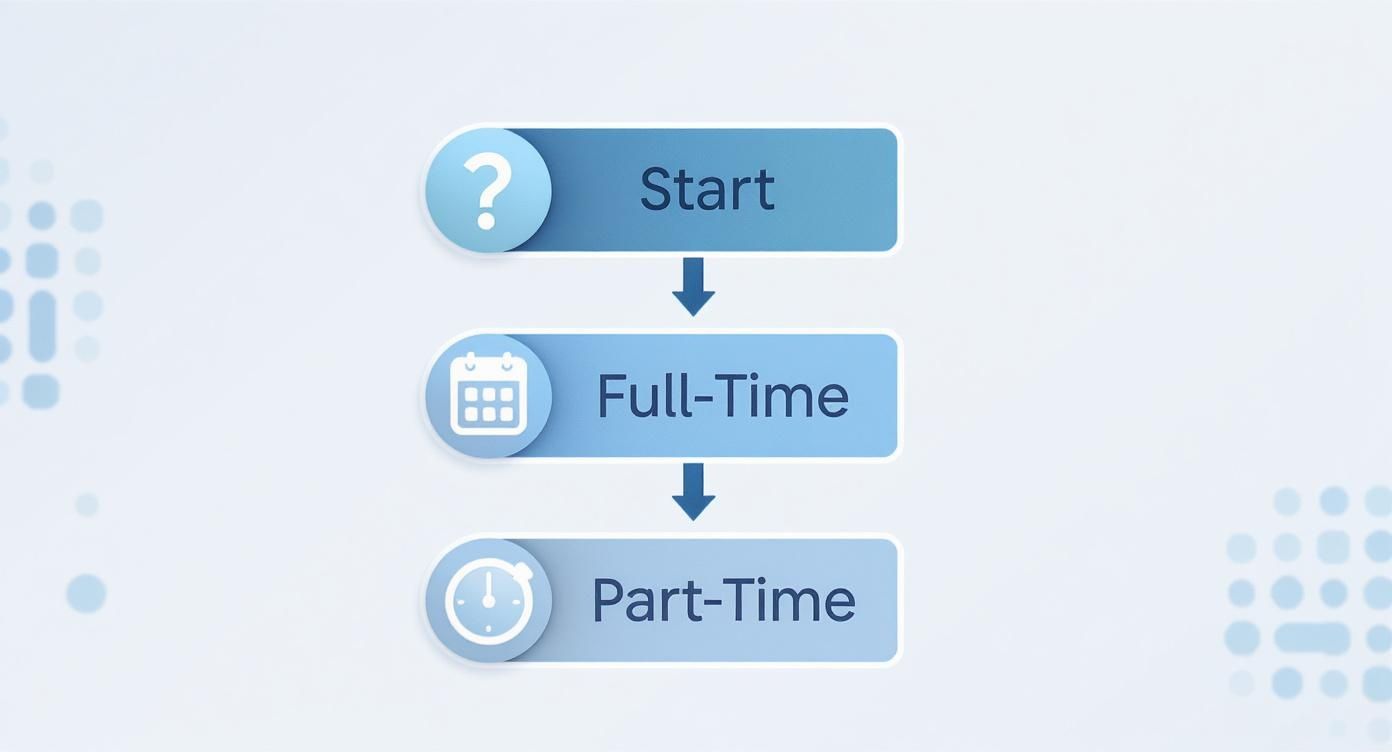
As you can see, the visual breakdown makes it clear how your employment type—whether you're full-time, part-time, or on a less predictable schedule—points you to the correct method for working out your holiday pay.
The 12.07% Method for Irregular Hours
But what if you're on a zero-hour contract or your shifts are all over the place? For these situations, your holiday is earned as you work, based on a set percentage.
The standard method is to calculate holiday entitlement as 12.07% of the hours you've worked. This number isn't just pulled out of thin air; it represents 5.6 weeks of holiday taken from the 46.4 working weeks in a year (52 weeks - 5.6 weeks = 46.4).
Calculation Breakdown: (5.6 weeks ÷ 46.4 weeks) × 100 = 12.07%
So, if you worked 100 hours in a month, you would build up 12.07 hours of paid leave for that period (100 hours × 0.1207). This system makes sure your leave is directly tied to the hours you put in, offering a fair approach for non-standard work patterns. For a deeper dive into more complex situations, check out our guide to calculate annual leave under UK rules.
Holiday Accrual Throughout the Year
Your holiday entitlement doesn't just land in your lap on day one. It's earned, or accrued, as you progress through the year. The most common way this works is that you accrue one-twelfth of your total annual leave for each month you're with the company.
This is especially important to remember if you start or leave a job part-way through the holiday year. Your final allowance will be based on the proportion of the year you were actually employed.
Let’s imagine your full entitlement is 28 days, and your company's holiday year runs from January to December.
- Starting in July: If you join on 1st July, you'll have worked for 6 months of the year. Your entitlement would be half of the annual total: 28 days ÷ 12 months × 6 months = 14 days.
- Leaving in September: If you leave at the end of September, you've completed 9 months. Your accrued holiday would be: 28 days ÷ 12 months × 9 months = 21 days.
If you've taken less holiday than you've earned by the time you leave, your employer has to pay you for the outstanding days in your final payslip. On the flip side, if you've taken more than you've accrued, they may be able to deduct the difference, depending on what your contract says.
The Hidden Costs of Untaken Annual Leave
Annual leave isn't just a number on a payslip; it's a vital part of maintaining wellbeing, productivity, and a healthy balance between work and life. But a worrying trend has started to emerge across the UK. More and more employees are not using their full holiday allowance, turning a crucial benefit into a missed opportunity for rest and recovery.
This isn’t a small problem. When your team doesn’t take the time off they’ve earned, it quietly racks up significant costs for everyone involved. For the individual, it can lead to burnout. For the business, it can mean a company-wide drop in productivity.
The Declining Use of Annual Leave
Recent data shows a surprising and significant fall in the number of annual leave days UK employees are actually taking. Despite having a clear legal entitlement, many are leaving valuable time off on the table.
A 2023 report, which analysed data from over 3,000 UK companies, found the average number of holiday days taken by employees fell from 38 days in 2020 to just 33.9 days in 2023. That’s a massive drop of nearly 12% in only three years. This trend raises serious questions about the pressures of the modern workplace and the long-term impact on employee health. You can dig into the full industry breakdown and read the detailed report on UK annual leave trends.

So, what's really going on here? The reasons are complex and often tangled together, reflecting both economic strain and shifts in workplace culture.
Why Are Employees Skipping Their Holidays?
Several key factors are contributing to this growing reluctance to take time off. For any business wanting to build a healthier, more sustainable working environment, understanding these drivers is the first step.
- Financial Pressures: With the cost of living on the rise, some employees feel they simply can't afford a holiday. Others might be tempted by policies allowing them to sell back unused leave, choosing immediate financial gain over long-term rest.
- Overwhelming Workloads: Many people feel too swamped to step away. The fear of coming back to an unmanageable mountain of work is so stressful that taking a holiday feels more like a burden than a break.
- "Unlimited Holiday" Confusion: It sounds counterintuitive, but policies offering unlimited time off can sometimes make people take less leave. Without a clear, defined annual leave entitlement, employees often feel uncertain about what’s "acceptable" and worry about being seen as less committed than their colleagues.
These issues feed into a cycle where employees feel they can never truly switch off, leading to serious consequences that ripple through the whole organisation.
"Untaken leave is a silent drain on a company's greatest asset—its people. It’s not a sign of dedication but an early warning of burnout, disengagement, and declining innovation."
When employees don't use their full holiday allowance, the negative effects are pretty much unavoidable. The most immediate impact, of course, is on the individual's own wellbeing.
The Consequences of a No-Break Culture
A workplace culture that discourages taking leave, or simply fails to actively promote it, pays a heavy price. This goes way beyond just having a tired workforce; it fundamentally chips away at performance, creativity, and staff retention.
The risks include:
- Increased Burnout: Working nonstop without proper breaks leads to mental, physical, and emotional exhaustion. Burnout is a leading cause of lower productivity, more mistakes, and higher staff turnover.
- Reduced Productivity and Creativity: Rest is fuel for the brain. An overworked mind struggles with problem-solving, innovation, and thinking strategically. Time and again, well-rested teams are shown to be more effective and creative.
- Poor Mental and Physical Health: The chronic stress from never getting a proper break is linked to a host of health problems, from anxiety and depression to heart disease. This leads to more sickness absence, which puts even more strain on the rest of the team.
Ultimately, failing to use annual leave is a lose-lose situation. Employees suffer from burnout and poor health, while businesses are left with a disengaged, less productive, and unhealthy workforce. Encouraging staff to take their full holiday allowance isn't just about ticking a legal box—it’s a critical business strategy.
Navigating Common Leave Policies and Rules
Knowing your basic annual leave entitlement is one thing, but the real test often comes when you try to use it. Every workplace has its own specific set of rules for how time off is requested, approved, and managed. While it might feel like a complex web of procedures, they’re all built on a common framework of legal rights and employer responsibilities.
From rules about carrying over unused days to what happens if you fall ill on holiday, getting to grips with these policies is the key to managing your time off without any stress. It means you can plan your breaks with confidence, knowing exactly where you stand.
Carrying Over Unused Leave
So, what happens if you get to the end of the holiday year with days left in the bank? Whether you can roll this leave over into the next year is almost always down to your employment contract.
The law does say that employees must be allowed to carry over some leave if they couldn't take it because they were on another type of statutory leave, like maternity leave. For pretty much every other situation, though, it’s up to the employer.
Here are a few common approaches you might see:
- A "use it or lose it" policy: Many companies require you to take all your leave within the holiday year, full stop.
- Limited carry-over: A popular rule is allowing a set number of days (say, up to five) to be carried over, but they often have to be used by a certain date in the new year, like 31st March.
- No carry-over: Some businesses don't allow any leave to be carried over at all, encouraging staff to take their full break to support their wellbeing.
Your contract or staff handbook should spell out the rules clearly. If it doesn’t, it’s always best to ask your HR team for clarification.
The Process for Booking Time Off
Requesting annual leave isn't as simple as just deciding not to show up. Businesses need to manage staffing to keep things running smoothly, so there’s always a formal process to follow. Usually, this involves giving a minimum amount of notice.
The standard legal rule is that your notice should be at least twice as long as the leave you want to take. So, for a week off (five days), you’d need to give at least two weeks' (ten working days') notice. But be aware, many companies set their own, often longer, notice periods in their internal policies.
An employer has the right to refuse a holiday request, but they must have a good business reason for doing so. This might be because of clashing requests from too many team members or needing everyone on deck during a peak business period.
They also have to give you notice of the refusal. This notice must be at least as long as the leave you requested. For example, if you asked for a week off, they have to tell you "no" at least a week before your holiday was due to start.
Leave Rights in Specific Situations
Your annual leave rights are protected, even when life throws other things your way. Here’s a quick look at how leave works in a few common—but often confusing—scenarios.
- During Sick Leave: You continue to build up your holiday entitlement as normal while you're off sick, no matter how long you're away. If you get sick just before or even during a pre-booked holiday, you can ask to take it as sick leave instead and save your annual leave for another time.
- During Maternity Leave: Just like with sick leave, your statutory holiday entitlement keeps accruing throughout your maternity, paternity, or adoption leave. Since you can’t take annual leave and maternity leave at the same time, many people choose to take their accrued holiday before their maternity leave begins or tack it on at the end.
- When Leaving a Job: When your time with a company ends, you’re entitled to be paid for any statutory annual leave you’ve accrued but haven't taken. This is worked out on a pro-rata basis right up to your final day of employment.
Having clear and accessible policies is vital for handling these situations fairly and without fuss. You can learn more about building a straightforward framework by reading our guide on how to simplify leave management with our template annual leave policy. This helps ensure everyone knows their rights and responsibilities from day one, preventing any confusion down the line.
Strategies for Smarter Leave Management
Let's be honest, managing annual leave can feel like a chore. But when you get it right, it stops being a logistical headache and becomes a powerful tool for boosting morale, preventing burnout, and actually improving business performance. It's a two-way street, needing real effort from both sides of the desk.
The goal is to build a system where taking time off isn't just allowed but actively encouraged. For managers, that means creating a culture where your team feels genuinely comfortable disconnecting. And for employees, it means planning your time off thoughtfully so your breaks are truly restorative—benefiting you and your team.

Building a Positive Leave Culture
A great leave culture always starts at the top. When leaders visibly take their own holidays and properly switch off, it sends a powerful message: rest is valued here. That single action often does more to encourage staff to use their annual leave entitlement than any written policy ever could.
Managers can back this up with fair and transparent approval processes. This isn't complicated—it just means setting clear expectations for notice periods and having an objective way to handle clashing requests, like a simple first-come, first-served system. Using modern software to track leave takes the guesswork out of it and ensures everyone is treated the same, getting rid of any whispers of favouritism.
Even so, a surprising number of UK workers don't take all their time off. Recent data shows the average employee leaves about five days of holiday unused each year. This points to a gap between what people are entitled to and what they actually take, often driven by workload pressure or a culture that subtly discourages absence. You can explore detailed annual leave statistics to see how UK holiday habits are shaping up.
Tips for Effective Leave Management
Smart leave management relies on clear communication and a shared understanding that rest isn't a luxury—it's essential for peak performance. Here’s a look at how both sides can contribute to a smoother process.
| Area of Focus | Best Practice for Employees | Best Practice for Employers |
|---|---|---|
| Planning & Booking | Book holidays well in advance, especially for longer breaks. This gives everyone plenty of notice. | Establish a clear, fair policy for requesting and approving leave (e.g., first-come, first-served). |
| Team Coordination | Have a quick chat with your immediate colleagues before booking to avoid skill gaps and ensure smooth cover. | Use a central calendar or leave management tool to maintain visibility over team schedules and prevent clashes. |
| Burnout Prevention | Don't forget about short breaks. Taking regular long weekends can be more effective than one single long holiday. | Actively encourage staff to use their full entitlement and lead by example by taking your own holidays. |
| Handover Process | Prepare a clear handover document with project statuses, key contacts, and urgent tasks so you can truly disconnect. | Foster a culture where handovers are standard practice, ensuring work continues smoothly during absences. |
| Communication | Be upfront about your holiday plans and communicate your availability (or lack thereof) clearly before you go. | Communicate the leave policy regularly and ensure everyone knows how to request time off and what to expect. |
By working together, employers and employees can create an environment where taking a proper break is the norm, leading to a healthier, happier, and more productive workplace for everyone.
A well-planned holiday benefits everyone. The employee returns refreshed and re-energised, while the team avoids the chaos of an unplanned absence. It’s a clear win-win.
Of course, managing leave is just one piece of the puzzle. A holistic approach to workforce management means tracking other vital activities. For instance, getting your approach right for employee training tracking is just as critical for development and compliance.
Your Annual Leave Questions Answered
Even when you think you've got the basics down, annual leave can throw up some curly questions. The world of work is full of unique situations, and knowing your rights is the key to handling them with confidence. Here, we'll tackle some of the most common questions we hear, giving you clear, straightforward answers.
Think of this as your go-to guide for those tricky scenarios. We'll break down common but confusing situations, helping both employees and managers understand their obligations without needing to decipher dense legal documents.
Can My Employer Dictate When I Take My Holiday?
Yes, they can. While it might feel a bit odd, your employer has the right to tell you when to take some or even all of your annual leave. A classic example is a company-wide shutdown over the Christmas period, where everyone is required to use their holiday allowance.
The key thing, however, is that they must give you proper notice. The rule of thumb is that the notice period must be at least twice as long as the leave they're asking you to take. So, for a one-week shutdown, they need to let you know at least two weeks beforehand.
What Happens to My Holiday if I Go on Sick Leave?
This is a frequent point of confusion, but the rules are there to protect your right to a proper break. You continue to build up your statutory holiday entitlement as normal while you're on sick leave, no matter how long you're off.
Annual leave is for rest and relaxation, while sick leave is for recovery. The law sees these as two very different things, making sure you don't have to sacrifice one for the other.
If you happen to fall ill just before or during a pre-booked holiday, you have the right to cancel that annual leave and take the time as sick leave instead. You can then reschedule your holiday for a later date. If there isn't enough time left in the current leave year, you can usually carry it over to the next one.
Is My Employer Required to Pay Me for Bank Holidays?
This one surprises a lot of people: there's no automatic legal right to have bank holidays off as paid leave. An employer can absolutely require you to work on a bank holiday.
However, most full-time workers in the UK get at least 28 days of statutory paid leave, and employers often wrap the standard eight bank holidays into this total. Your employment contract is the crucial document here; it must clearly spell out how bank holidays are handled and whether they form part of your core entitlement or are given on top of it.
Can I Be Paid for Holiday I Haven’t Taken?
The rules around this are very strict, and for good reason. Under the Working Time Regulations, you can't be paid in lieu of taking your statutory paid holiday (the first 5.6 weeks). This is to make sure people actually take the time off they need to rest and recharge.
The only time you can get a payout for untaken statutory leave is when you leave your job. In that situation, your employer must pay you for any holiday you've accrued but not used up to your final day.
What if My Holiday Request Is Rejected?
Your employer can refuse a leave request, but they must have a solid business reason for doing so. This might be due to staff shortages during a particularly busy period or too many overlapping requests from other team members.
They also have to give you enough notice. The notice for a rejection must be at least as long as the holiday you requested. For instance, if you asked for two weeks off, they need to tell you "no" at least two weeks before your holiday was due to start. A good employer will usually explain why and work with you to find another date that works for everyone.
Juggling all these rules is far simpler with the right tools. Leavetrack gives you a clear, central hub for requests, approvals, and tracking, making sure your company's leave management is always fair, transparent, and compliant. Say goodbye to confusing spreadsheets and see a better way to handle time off at https://leavetrackapp.com.