

UK Annual Leave Entitlements Explained
Posted by Robin on 24 Nov, 2025 in
Trying to get your head around UK annual leave rules can feel like a bit of a maze. But at its heart, the system is designed to do one simple thing: make sure everyone gets a proper break from work. It's a legal right, and for good reason – we all need time to recharge.
Think of your holiday allowance not as a company perk, but as a mandatory rest period. It's crucial for your well-being and, frankly, for you to do your best work when you're back.
Your Essential UK Holiday Rights Explained
The law that governs all this is the Working Time Regulations. It sets a clear, non-negotiable minimum amount of paid time off that every employer has to provide.
For almost every worker in the UK, that entitlement is 5.6 weeks of paid holiday each year. If you're working a standard five-day week, that works out to a straightforward 28 days of paid time off.
The Foundation: The 5.6 Weeks Rule
This 5.6-week rule is the bedrock of UK holiday law. It’s the same baseline for everyone, whether you’re full-time, part-time, or on a zero-hours contract. The only thing that changes is how that 5.6 weeks translates into actual days off, which all depends on your specific working pattern.
For a typical employee working five days a week, the maths is simple:
- 5.6 weeks x 5 days per week = 28 days of paid annual leave.
This legal minimum provides a stable and reliable foundation for everyone. If you want to dive deeper into the official calculations, the government's own guidance on holiday entitlement is the best place to look.
Are Bank Holidays Included?
This is probably one of the most common questions we hear. Does the statutory 28 days include bank holidays? The honest answer is: it depends.
An employer has the choice to include the 8 UK bank holidays as part of your statutory 28 days. Or, they can offer them on top. For instance, a contract offering "20 days holiday plus bank holidays" is perfectly legal, as is one that offers "28 days holiday including bank holidays". Both meet the minimum requirement.
For a more detailed breakdown, you can check out our simple guide to the GOV.UK holiday entitlement framework.
The key takeaway is that your total paid time off must add up to at least 5.6 weeks. How bank holidays are handled within that total is up to your employer, and it must be clearly spelled out in your employment contract.
To make things even clearer, let's look at how the entitlement breaks down based on the number of days you work.
Statutory Annual Leave at a Glance
Here's a quick summary showing the minimum legal holiday entitlement based on your weekly work schedule.
| Days Worked Per Week | Statutory Leave Entitlement (Weeks) | Statutory Leave Entitlement (Days) |
|---|---|---|
| 5 Days | 5.6 Weeks | 28 Days |
| 4 Days | 5.6 Weeks | 22.4 Days |
| 3 Days | 5.6 Weeks | 16.8 Days |
| 2 Days | 5.6 Weeks | 11.2 Days |
| 1 Day | 5.6 Weeks | 5.6 Days |
As you can see, the 5.6-week rule is applied proportionally. No matter how many days you work, your fundamental right to that period of paid rest stays the same. Getting this basic principle right is the first step for both staff and managers to make sure everyone is on the right side of the law.
Calculating Leave for Different Work Patterns
The days of the standard nine-to-five, Monday to Friday work week being the only model are long gone. Today's businesses thrive on a mix of part-time staff, hybrid workers, and people on flexible contracts. This variety is great for business, but it means a one-size-fits-all approach to holiday calculations just won't cut it anymore—it’s not fair, and it’s not legal.
The core principle here is proportionality. Every single worker is entitled to 5.6 weeks of paid leave. The key is that the number of days this translates to must accurately reflect the time they actually work. Getting this right is about more than just ticking a compliance box; it’s crucial for morale and avoiding messy disputes down the line.
This decision tree gives you a quick visual on how the calculations split for different work patterns.
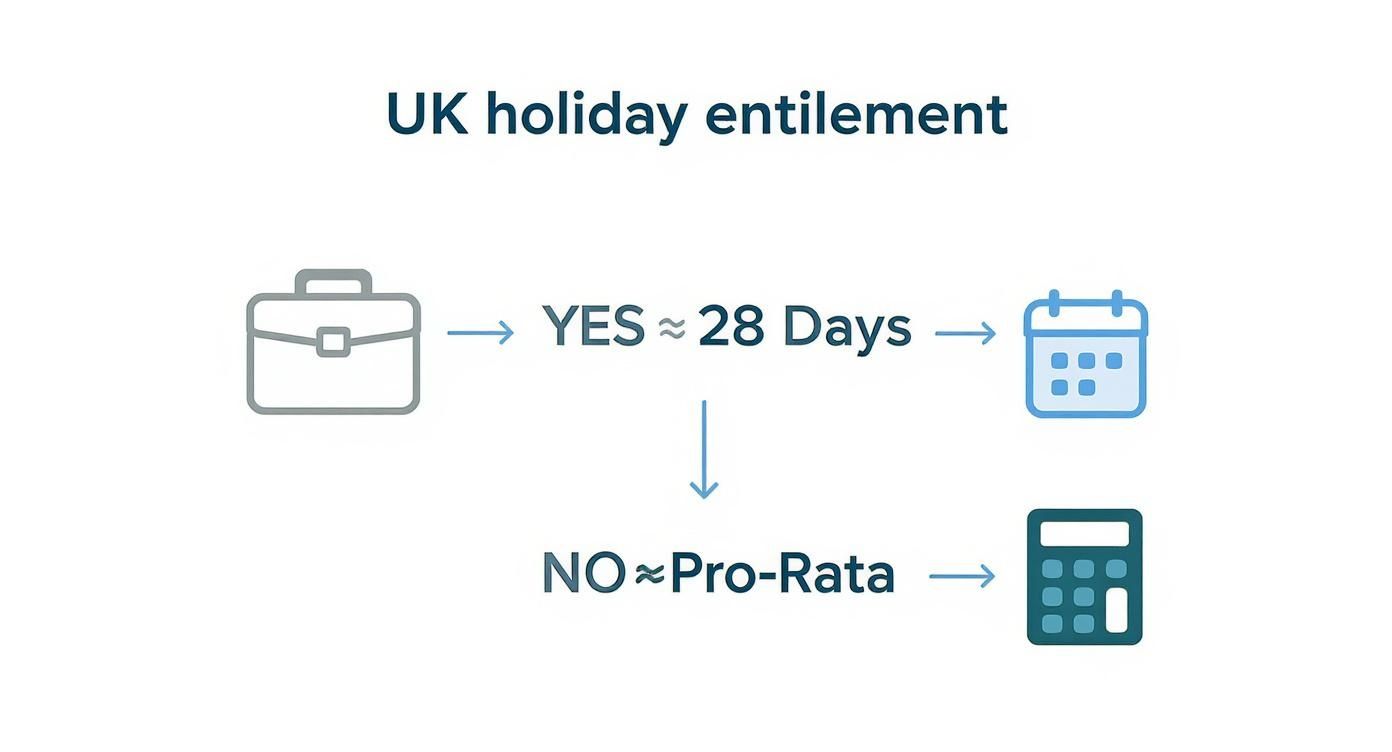
As the flowchart shows, while a full-timer’s entitlement is a straightforward number of days, everyone else’s holiday is worked out on a pro-rata basis to keep things fair and square.
Calculating Pro-Rata Holiday for Part-Time Staff
For part-timers who work a set number of days each week, the maths is nice and simple. You just multiply the number of days they work per week by the statutory entitlement of 5.6 weeks.
- The sum: (Days worked per week) x 5.6 = Total annual leave days.
Let’s run through a quick example. Say you have an employee who works a consistent three days every week.
3 days x 5.6 weeks = 16.8 days of paid holiday per year.
It’s really important to be precise here. Rounding up or down without a clear policy can easily lead to confusion or incorrect pay. For a deeper dive into these sums, including how to handle bank holidays for part-timers, check out our detailed guide on how to calculate pro-rata holiday.
The Challenge of Irregular and Zero-Hours Work
Things get a bit trickier when you have workers whose hours change week to week, like casual staff or those on zero-hours contracts. For these team members, it’s best to think of holiday as something they 'earn' as they go. This is known as the accrual method.
Using accrual ensures their holiday entitlement is a direct reflection of the hours they’ve put in, keeping everything proportional. As of April 2024, the government has formalised a clear method for calculating this based on a percentage of hours worked.
Holiday entitlement for irregular-hours and zero-hours workers is calculated as 12.07% of the hours they have worked in a pay period. This figure is derived from the statutory 5.6 weeks of leave, divided by the remaining 46.4 working weeks of the year (5.6 ÷ 46.4 ≈ 12.07%).
This percentage is your go-to tool for getting your UK annual leave entitlements spot-on for your most flexible staff.
Putting the 12.07% Rule into Practice
So, how does this work in the real world? Let's say you have a team member on a zero-hours contract who logged 80 hours last month.
- Calculate the leave accrued in hours: 80 hours x 12.07% = 9.656 hours.
- Round appropriately: You’d then round this to a practical figure, like 9.7 hours or 9 hours and 40 minutes, depending on your payroll system and policy.
This time is then added to their holiday balance for them to use as paid time off. When they do take leave, their holiday pay should be based on their average pay rate, ensuring fairness no matter their working pattern.
Getting these calculations right isn't just about staying compliant; it builds trust and shows every team member they're valued equally. As workplace models continue to evolve, understanding the nuances of leave calculations for remote and hybrid teams is more important than ever.
How Sickness and Holiday Carry-Over Mix (and When They Don't)

On the surface, annual leave rules seem pretty straightforward. But throw sickness into the equation, and things can get murky very quickly. What if someone gets ill during their planned holiday? What if a long-term absence means they can't use up their leave by the end of the year? These aren't edge cases; they're common situations that every manager will face.
The first thing to remember is that sick leave and annual leave are completely separate pots. An employee's right to their paid holiday is protected by law, even when they're unwell. Getting the interplay between these two right is a cornerstone of fair and compliant people management.
When an Employee Falls Sick on Holiday
Picture this: one of your team is off on a two-week break and, five days in, comes down with a nasty flu. They're stuck in bed, not exactly enjoying their time off. In this scenario, they have the right to reclaim those holiday days.
Legally, they can treat those five days as sick leave. To do this, they must follow your company’s usual sickness reporting process—that means calling in to notify their manager, just as they would if they were supposed to be at work. Once they've done that, those five days of annual leave should be credited back to their balance, ready to be booked at a later date.
A crucial point here: the employee is officially on sick leave from the moment they report their illness, not from when they eventually return to the office. Their holiday is effectively paused, and their sick leave begins, ensuring they don’t lose out on their valuable rest time.
Holiday Still Builds Up During Sick Leave
Here’s another point that catches many employers out: UK annual leave entitlements continue to build up while an employee is off sick, no matter how long they're away. It doesn't matter if they're on Statutory Sick Pay (SSP), company sick pay, or even no pay at all. Their legal right to accrue holiday time is protected.
So, if an employee is on long-term sick leave for six months, they will still accrue half of their full annual entitlement during that time. This is a vital protection, ensuring they have a bank of leave available for rest and recuperation once they're well enough to use it.
The Rules Around Carrying Holiday Forward
Whether an employee can carry over unused holiday depends entirely on why it wasn't taken. For the most part, your employment contract and company policies will set the rules.
As a baseline, the law says workers must take at least four weeks of their statutory leave within the leave year. This is the bit of our law that comes from the European Working Time Directive. The remaining 1.6 weeks of UK-specific statutory leave can be carried over, but only if you have a written agreement in place allowing it.
However, the rules bend for certain situations:
- Sickness: If someone can't take their holiday because of a long-term illness, they are legally allowed to carry over up to four weeks of statutory leave. This leave doesn't just disappear; they must be given the chance to use it within 18 months from the end of the year it was accrued.
- Family-Related Leave: Staff on maternity, paternity, adoption, or shared parental leave who couldn't take their leave can carry forward their entire 5.6-week statutory entitlement.
- Contractual Leave: Any holiday you offer on top of the legal minimum is a different story. These extra days are governed entirely by your own company policy. Your contract can—and should—state clearly whether this additional leave can be carried over and what the limits are.
Having a crystal-clear, written policy on holiday carry-over is non-negotiable. It avoids confusion, manages expectations, and makes sure everyone is on the same page as the end of the leave year approaches.
Managing Holiday Pay and Final Pay Entitlements
Getting UK annual leave right is about more than just tracking days off. It's about making sure your people are paid correctly for their holiday, which can get tricky when pay isn't a fixed monthly figure.
Think about staff who earn overtime, commission, or bonuses. When they take a week off, their holiday pay needs to reflect what they would have actually earned if they'd been at work.
For salaried staff with fixed hours, this is a piece of cake. But for anyone with variable pay, you need to calculate their 'week's pay' based on their average earnings over the previous 52 paid weeks. You only count the weeks they actually worked and got paid, so you might have to look back further than 12 months to get the full 52-week picture. This ensures their holiday pay is a fair reflection of their typical earnings.
This isn't just a nice-to-have; it's a legal requirement. Paying an employee only their basic rate for a holiday when they usually earn much more from commission isn't just unfair—it's unlawful and can seriously damage trust.
Calculating Final Pay When an Employee Leaves
One of the most frequent and critical calculations you'll face is sorting out leave when someone's contract ends. More often than not, a departing employee will have accrued holiday they haven't yet used. You’re legally required to pay them for this untaken leave in their final salary.
The calculation itself is a straightforward pro-rata sum. You just need to figure out what fraction of the leave year the employee has worked, and from there, work out how much holiday they've earned up to their leaving date.
Let's walk through a simple, real-world example:
- Employee Details: An employee works a standard five-day week and gets the full 28 days of annual leave.
- Leaving Date: They hand in their notice and leave exactly six months into your company's holiday year.
- Holiday Accrued: Having worked for half the year, they've earned half their entitlement: 28 days / 2 = 14 days.
- Holiday Taken: Looking at your records, you see they've already taken 8 days off.
- Payment Due: Simply subtract the leave taken from the leave accrued: 14 days - 8 days = 6 days.
In this case, you'd add the pay for 6 days of holiday to their final payslip. For a deeper dive into the specifics, our guide covers all the rules on holiday pay when an employee leaves.
It's worth noting that while many employees now use most of their leave, a significant number still have days left over. Recent data shows that in 2024, around 65% of UK workers did not use their full holiday entitlement, though the average number of unused days has fallen sharply since 2019. You can discover more insights about annual leave statistics and trends.
When an Employee Has Taken Too Much Leave
Though less common, you might find yourself in a situation where a departing employee has taken more holiday than they've actually earned. For instance, if the employee in our example had taken 16 days of leave before leaving halfway through the year, they'd be 2 days in the red.
Can you reclaim the money for this over-taken leave? That depends entirely on what your employment contract says.
- If you have a clear clause: Your contract must explicitly state that the company has the right to deduct the value of any excess holiday from the employee's final pay.
- If there is no clause: Without this specific provision in writing, you have no legal right to make the deduction. You'll likely have to write it off.
This really highlights how crucial a well-drafted employment contract and a clear holiday policy are. Getting this right from the start, backed by accurate tracking, is your best defence against these kinds of financial loose ends.
On the surface, managing UK annual leave seems straightforward. But as any seasoned manager knows, tiny missteps can snowball into massive headaches. We’re talking about everything from disgruntled employees and payroll errors right through to the daunting prospect of an employment tribunal. Getting this stuff wrong can be seriously costly.
Think of it like maintaining your car. If you ignore the small things – topping up the oil, checking the tyres – you're setting yourself up for a major breakdown. It’s the same principle here. A bit of proactive, careful management now prevents expensive problems down the road.
Most of these pitfalls crop up in a few common areas: ambiguous policies, dodgy calculations, and sloppy record-keeping. By getting wise to where things usually go wrong, you can build solid processes that protect your business and make your team feel they’re being treated fairly.
The Problem of Vague or Unwritten Policies
One of the most frequent mistakes I see is businesses not having a clear, comprehensive, and easily accessible annual leave policy. When the rules are fuzzy or just exist as "how we've always done it," you're practically inviting confusion and disputes.
Without a formal policy, employees are left to guess about the important details. How much notice do I need to give for a holiday? Is there a cap on how many of us can be off at once? What are the exact rules for carrying leave over? When there are no clear answers, you get inconsistency, and that opens the door to claims of unfair treatment.
A solid policy is your single source of truth. It sets clear expectations for everyone. It should spell out, in no uncertain terms:
- The Request and Approval Process: Detail exactly how someone requests time off and how their manager signs it off.
- Notice Periods: Be specific about the minimum notice required for booking leave.
- Peak Time Restrictions: If you need to limit holidays during your busiest periods, this needs to be stated upfront.
- Carry-Over Rules: Outline precisely how much leave (if any) can be carried into the next year and the deadline for using it.
Miscalculating Entitlements for Part-Time Staff
Incorrectly calculating holiday for part-time workers is another major tripwire, especially when it comes to bank holidays. A classic error is to just give a part-timer the day off if a bank holiday lands on their normal working day, and do nothing if it doesn't. This approach simply isn't compliant with UK law.
Part-time employees are legally entitled to a pro-rata share of all bank holidays, regardless of whether they were scheduled to work on that particular day. If you don't do this, you're underpaying their legal holiday entitlement.
The only correct way to handle this is to calculate their total statutory leave (including all bank holidays) on a pro-rata basis. They then book bank holidays off from that total allowance, just like any other day of leave. This guarantees fairness and compliance for everyone on the team.
This method completely avoids the unfair situation where a part-timer working Mondays gets more paid time off than a colleague who works Wednesdays, just because of how the UK's bank holidays fall.
Fostering a Culture of Presenteeism
Beyond the admin, a huge pitfall is creating a culture where employees feel like they can't actually take the leave they're entitled to. This can happen without you even realising it – through crushing workloads, pressure from managers, or simply a lack of cover when people are away. When your staff don't take proper breaks, you get burnout, plummeting productivity, and terrible morale.
This is a growing worry. The amount of annual leave taken by UK workers has dropped off a cliff recently. In 2023, employees took an average of 33.9 days, a huge fall from 38 days in 2020. This trend should be a wake-up call for employers to actively encourage and monitor leave usage to support their team's wellbeing. You can read more about UK annual leave trends to get a better sense of the shifting landscape.
By tackling these common pitfalls, you're doing more than just ticking a compliance box. You're building a system for managing UK annual leave entitlements that is not only legally sound but also fosters a positive, transparent, and supportive place to work.
Getting Leave Management Right With The Right Tools
Trying to track annual leave with spreadsheets and paper forms is a bit like doing your accounts in a dusty old ledger book. It gets the job done for a while, but it’s slow, full of potential for costly mistakes, and creates a huge amount of admin. Every single pro-rata calculation or final pay settlement becomes a high-stakes task where one broken formula can lead to compliance nightmares, payroll blunders, and unhappy employees.
This manual approach isn't just a bit inefficient; it's a genuine risk when it comes to managing UK annual leave entitlements. All the complexities we've covered—like different work patterns, sickness leave, and carry-over rules—are incredibly tricky to juggle without a system built for the job. Thankfully, technology offers a way out of this high-risk environment and into a smooth, accurate, and compliant process.
The Power of Automated Leave Management
Modern leave management software is your central hub for everything holiday-related. It takes care of the complex maths for part-time and irregular-hours staff, wiping out the human error that always creeps into spreadsheets. This isn't just about saving a bit of time; it's about guaranteeing precision and fairness for every single person on your team.
Instead of getting tangled in endless email chains and calendar clashes, these systems offer a better way:
- A Centralised Calendar: Everyone can see who’s off and when, making it dead simple for managers to check team coverage before hitting ‘approve’.
- Automated Accrual Tracking: The system automatically calculates and updates leave balances as they’re earned, stopping employees from accidentally booking more holiday than they’re entitled to.
- One-Click Approvals: Managers can approve or deny requests in an instant, often straight from their email or a Slack notification, which speeds the whole thing up.
This dashboard from Leavetrack is a perfect example of how a clear, visual interface gives you immediate insight into who’s available and what leave balances look like.

Having this kind of data at your fingertips turns leave management from a reactive chore into a strategic part of planning your workforce.
Building a Foundation of Trust and Well-being
When you bring in a solid system, you create a transparent and reliable process that your people can actually trust. Giving staff clear visibility of their own entitlement and a simple way to book time off is empowering, and it cuts down the admin headache for HR and line managers. This clarity and efficiency feed directly into a healthier work environment where taking a break is simple and straightforward.
Moving to an automated system is more than just an operational tweak; it’s a commitment to being accurate, fair, and compliant. It frees up valuable time, slashes legal risk, and makes sure every employee gets exactly what they're owed.
Of course, it’s not just about getting the legal minimums right. Fostering employee well-being through things like corporate wellness programs can have a huge knock-on effect on compliance and staff satisfaction. At its core, an organised, error-free approach to holiday management ensures your team can properly rest and recharge—and that’s the whole point of a good leave policy.
Your Annual Leave Questions Answered
To wrap things up, let's dive into some of the questions that crop up time and again around UK annual leave. These are the practical, real-world queries that we see managers and employees wrestling with all the time.
Can My Employer Tell Me When to Take My Holiday?
In a word, yes. An employer can absolutely tell you when you need to take your annual leave. The classic example is a company-wide shutdown over the Christmas period, where everyone is required to use their holiday allowance.
But they can't just drop it on you at the last minute. The law is clear: they must give you proper notice. This notice has to be at least twice as long as the leave they're making you take. So, if they want to enforce a one-week shutdown, they need to tell you at least two weeks beforehand.
How Do Bank Holidays Work if I'm Part-Time?
This is a big one. Part-time workers are entitled to a pro-rata share of paid bank holidays, just like the rest of their annual leave. This is crucial for fairness, so it doesn't matter which days of the week someone happens to work.
If a bank holiday falls on a day you don't normally work, you haven't lost out. You're still entitled to that pro-rata time off, which you can simply take on another day. The cleanest way to handle this is to calculate the total statutory leave (28 days for a full-timer, for instance) and give the part-time worker a proportional slice of that total pot.
An employee then uses their total allowance to book off both normal holidays and any bank holidays that fall on their working days. This method prevents unfairness and ensures full compliance with UK law.
Can I Get Paid for My Holiday Instead of Taking It?
While you're still employed, no. You cannot be paid in lieu of taking your statutory minimum leave of 5.6 weeks. The whole point of the legislation is to make sure people get a proper rest and break from work.
The only time you can receive a payment for untaken statutory holiday is when you leave your job.
Now, if your contract gives you more holiday than the legal minimum (say, 30 days plus bank holidays), your employer might have a policy that allows you to "sell back" any untaken 'contractual' leave above that 5.6 weeks. But this is entirely up to them and has to be clearly laid out in your employment contract.
Still wrestling with leave spreadsheets? Leavetrack takes the pain away by automating calculations, handling requests in one place, and giving you a crystal-clear view of who's off when. Keep your business compliant and your team happy. Discover a simpler way to manage absence at https://leavetrackapp.com.