

Understanding Your Bradford Factor Score A Practical Guide
Posted by Robin on 04 Jan, 2026 in
The Bradford Factor is a simple formula used by HR teams to get a handle on employee absenteeism. Its main purpose is to highlight the disruptive impact of frequent, short-term absences, which it penalises more heavily than a single, longer period of sickness.
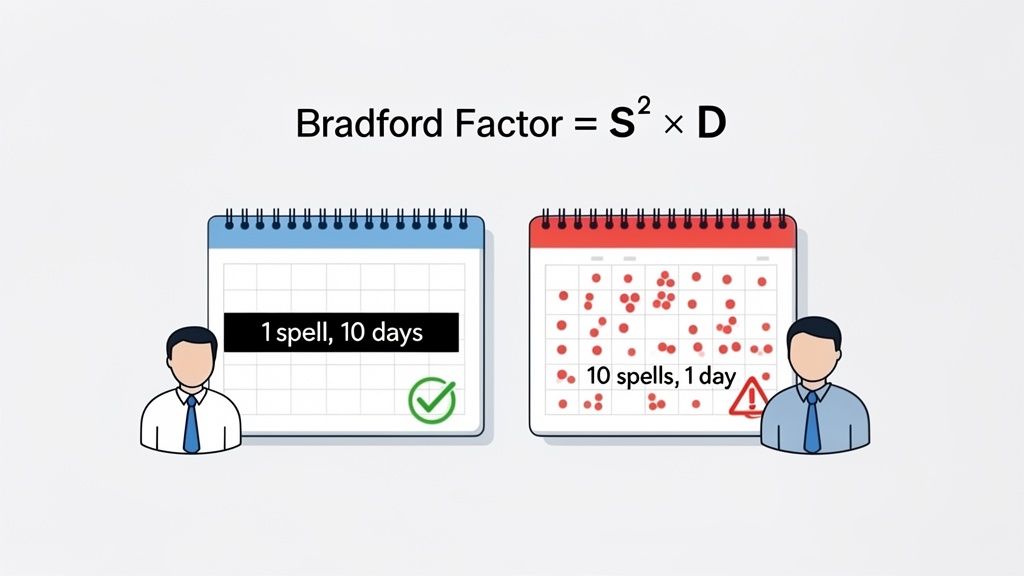
The calculation itself is straightforward: S² x D. Here, 'S' stands for the number of separate absence spells, and 'D' is the total number of days an employee has been absent.
Understanding The Bradford Factor Score
Think of the Bradford Factor as a management tool that provides a quick, mathematical snapshot of an employee's attendance. It’s built on a really important idea: lots of short, unplanned absences are often far more disruptive to a business than one continuous chunk of leave.
A high score doesn't just mean someone's been off sick a lot. It points to a pattern of recurring, short-term absences that can really mess with workflow, drag down team morale, and throw schedules into chaos.
Let's look at a classic example. Imagine two employees are both off for 10 working days over a year.
- Employee A: Takes one continuous two-week (10-day) period off for a planned operation.
- Employee B: Takes ten separate Mondays off, one day at a time, throughout the year.
While they both missed the same amount of work, the impact on the business couldn't be more different. You can plan around Employee A's absence. But Employee B's recurring absences create constant, last-minute headaches. The Bradford Factor is designed to put a number on that difference, giving managers an objective way to spot these tricky attendance patterns.
Why This Score Is A Staple In Absence Management
The real beauty of the Bradford Factor is that it standardises how you first approach absence management. Instead of relying on a manager's gut feeling about someone's attendance, the score provides a consistent data point for everyone. This helps strip out unconscious bias and ensures fairness across the board, at least in the initial stages.
By focusing on the pattern of absence rather than just the total days, the Bradford Factor helps businesses pinpoint the kind of attendance issues that most severely impact productivity and team stability. It transforms raw attendance data into actionable insight.
It's crucial to remember that the score isn't a disciplinary tool on its own. It's more of a "trigger" for a supportive conversation. A high score should prompt a manager to check in with their team member, find out what's going on, and offer support. It's often the first step in a wider process, which might include things like fitness for work assessments to understand an employee's capability to do their job.
Turning Data Into Action
Ultimately, the goal isn't to punish people, but to understand what's happening and find a way forward. Modern absence management systems, like Leavetrack, completely automate the calculation of the Bradford Factor score. This removes the admin headache and the risk of human error.
These tools give HR teams and line managers real-time dashboards and alerts. It means you can be proactive, addressing attendance trends before they snowball into bigger problems. It turns a complex HR task into a much more straightforward, data-driven process that supports both your people and the business.
The History And Origins Of The Bradford Factor
The Bradford Factor isn’t some modern HR fad; it's a formula born out of a very specific, real-world problem. Its story didn't start in a slick corporate boardroom but in the academic halls of the Bradford University Management Centre back in the 1980s.
Researchers there were wrestling with a common business headache. They knew that just counting the total number of days an employee was off sick didn't tell the whole story. What they needed was a smarter, more insightful tool.
Their goal was to find a way to mathematically separate a single, long-term sickness from the flurry of short, sharp, unpredictable absences that really throw a spanner in the works for managers. The formula they came up with was designed to flag these disruptive patterns, giving managers a clear, objective place to start a conversation about attendance.
Early Adoption And Proving Its Worth
It didn’t take long for the concept to jump from academic theory into practice, proving its mettle in some pretty demanding environments. One of the most prominent early adopters was the UK’s own HM Prison Service.
In May 2001, the service introduced the Bradford Factor score to tackle high rates of sickness absence. Managing thousands of staff in uniquely tough conditions, they used the formula to create 'attendance scores' over a rolling 52-week period, pinpointing problematic patterns. You can explore more about this pioneering initiative and see the impact it had on public sector management.
This was a major test case that really showed the formula's power. It provided a standard, consistent way to spot attendance issues that might otherwise fly under the radar, allowing for fair and timely intervention.
By boiling complex absence patterns down to a simple score, the Bradford Factor gave organisations a credible, data-driven way to manage attendance. It was a move away from gut feelings and towards a more structured, fair approach.
From University Project To Business Staple
Understanding this history is important because it gives the Bradford Factor credibility. It wasn't just an idea plucked out of thin air; it was a carefully developed tool built to solve a persistent management challenge.
Its journey from a university research project to a staple in many HR departments shows just how relevant it remains. The core problem it addresses—the outsized disruption caused by frequent, short-term absences—is just as real today as it was in the 1980s. This solid foundation is why the Bradford Factor score continues to be a trusted metric for businesses of all sizes looking to improve staff reliability and keep things running smoothly.
How To Calculate And Interpret Your Score
At its heart, the Bradford Factor is powered by a simple but surprisingly potent formula. Getting your head around how it works is the first step to turning this raw number into a genuinely useful management tool. The whole point is to focus less on the total days missed and more on the disruptive pattern of absences.
The calculation itself is actually pretty straightforward:
S² x D = Bradford Factor Score
Let's quickly break down what those letters mean in the real world.
Understanding Spells and Days
To work out a Bradford Factor score, you only need two bits of information, usually tracked over a rolling 52-week period:
- S (Spells): This is just the total number of separate times someone has been off sick. Each continuous period of absence, no matter how long, counts as just one spell. So, if someone is off sick on a Monday, that's one spell. If they're off from Monday all the way through to Friday, that is still just one spell.
- D (Days): This one's easy – it's the total number of working days an employee was absent across all their spells within that 52-week window.
The real magic of the formula is in squaring the spells (S²). This simple bit of maths is what gives frequent, short-term absences a much heavier weighting, reflecting the serious operational headache they can cause.
Worked Examples Uncovering The Real Impact
The difference this formula makes really comes to life when you compare two employees who've missed the exact same number of days. Let's look at a couple of scenarios where both employees were off for a total of 10 days over the year.
Employee One: A Single Long-Term Absence
- Absence Pattern: Takes a single, two-week block of time off to recover from a minor operation.
- Spells (S): 1
- Days (D): 10
- Calculation: 1² x 10 = 10 (Bradford Factor Score)
Employee Two: Frequent Short-Term Absences
- Absence Pattern: Takes ten separate, individual days off for various reasons throughout the year.
- Spells (S): 10
- Days (D): 10
- Calculation: 10² x 10 = 1000 (Bradford Factor Score)
See the difference? Even though both employees missed 10 days of work, Employee Two's score is a whopping 100 times higher. This huge gap mathematically flags how disruptive their frequent, unpredictable absences really are. If you want to play around with your own scenarios, you can find a complete walkthrough in the ultimate Bradford Score calculator guide.
This decision tree helps to visualise the different paths that planned and unplanned absences can take within a typical attendance policy.
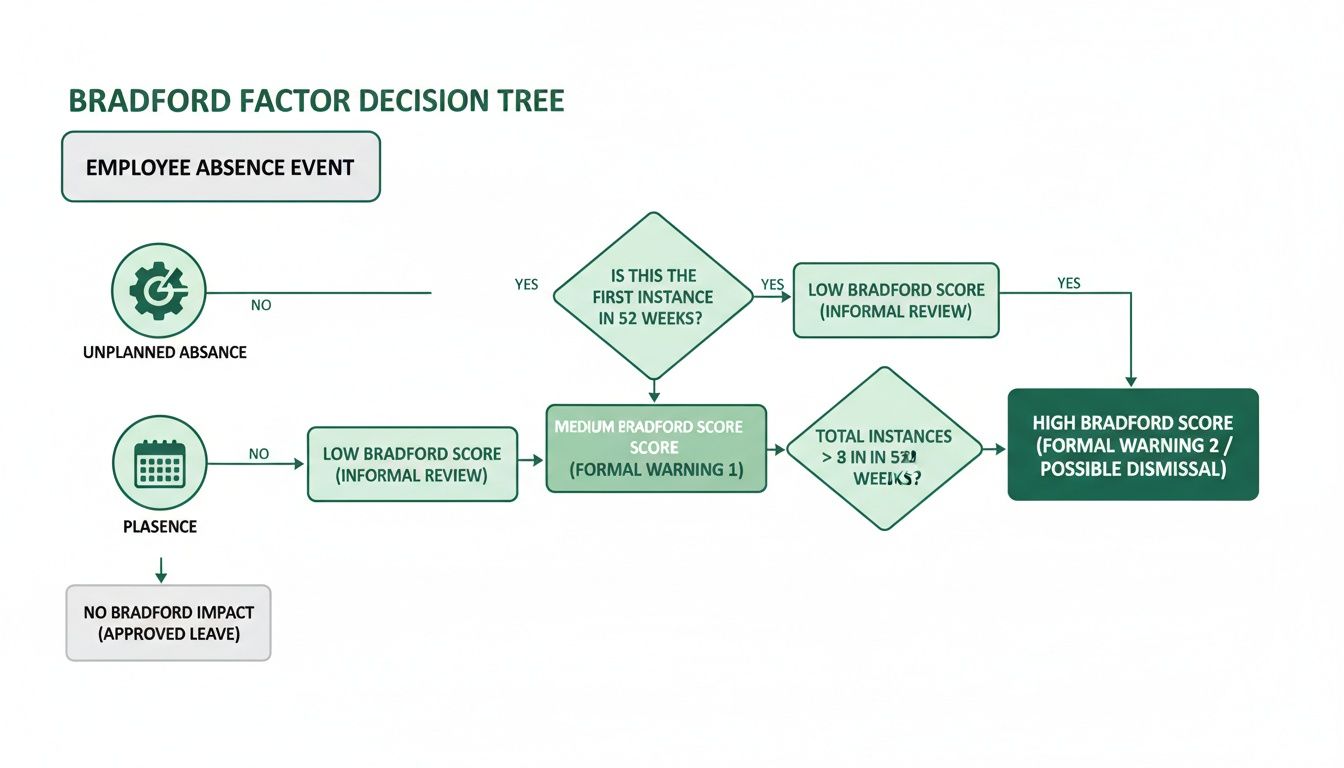
The key thing to notice here is how unplanned absences, shown by the disrupted gear icon, often lead down a path that requires more immediate management intervention.
Translating Scores Into Action With Trigger Points
A score is just a number until you attach some meaning to it. That's where "trigger points" come in. These are simply predefined score thresholds that prompt a specific management action, making sure your response is consistent and fair for everyone.
It’s crucial to remember that there's no "one size fits all" set of triggers. They should be tailored to your company's culture, operational needs, and the specific demands of different roles.
That said, here’s a look at a common framework for trigger points and the actions they might prompt.
Example Bradford Factor Trigger Points And Actions
This table provides a guide to common Bradford Factor score thresholds and the corresponding management actions, helping organizations create a fair and consistent absence policy.
| Bradford Factor Score Range | Interpretation | Recommended Action |
|---|---|---|
| 0 - 50 | No Concern: This generally indicates good attendance with minimal disruption. | No action is required. Positive reinforcement during reviews is encouraged. |
| 51 - 200 | Initial Concern: This score may indicate an emerging pattern of absence that warrants attention. | An informal, supportive chat to understand the reasons behind the absences. |
| 201 - 400 | Medium Concern: The pattern is becoming more frequent and causing noticeable disruption. | A formal meeting is held, and a verbal warning may be issued. |
| 401 - 600 | Serious Concern: Absences are now significantly impacting the team and operations. | A formal review meeting, which could lead to a first or final written warning. |
| 601+ | Critical Concern: The level of absence has become unsustainable and unacceptable. | Formal disciplinary proceedings, which could potentially lead to dismissal. |
Remember, these are just examples. Your own policy must be clearly communicated to all staff. It's also vital that managers are trained to use these triggers as the start of a conversation, not as an automated disciplinary button. The score flags an issue; it's the manager's job to investigate with empathy and fairness.
The Pros And Cons Of Using The Bradford Factor
No management tool is perfect, and the Bradford Factor is definitely no exception. While its neat mathematical formula gives you a clear, objective starting point for looking at absence, it’s crucial to understand both its strengths and its very real weaknesses. The key is to see it as just one piece of a much larger puzzle – that’s how you use it fairly and effectively.
If you can hold a balanced view, you can get the benefits of the Bradford Factor score without stumbling into its potential traps. Let's break down the good, the bad, and how to find that sensible middle ground.
The Advantages Of A Data-Driven Approach
The biggest plus point for the Bradford Factor is its objectivity. By applying the exact same formula to every single employee, it strips out any subjective manager feelings from the initial glance at attendance, helping to create a consistent standard across the business.
This data-first method is brilliant at spotting something that manual tracking often misses: the sheer disruption caused by frequent, short-term absences. The whole point of the calculation is to shine a spotlight on these patterns, giving managers a clear and immediate flag.
Key benefits include:
- Objective Measurement: The formula gives you a straightforward number. This helps get rid of personal bias when you first start looking into someone's absence record.
- Consistency: It applies the same yardstick to all employees. This makes sure you have a consistent way of flagging attendance issues across different teams and departments.
- Highlights Disruptive Patterns: It is particularly good at flagging the kind of frequent, unplanned days off that cause the most operational headaches, even if the total number of days lost isn't that high.
The real value of the Bradford Factor isn't just in the score itself. It’s in its power to provide an impartial, data-backed trigger for a necessary and supportive conversation between a manager and their employee.
By using the score as a prompt for a chat, rather than as an automatic disciplinary trigger, companies can stay fair while tackling attendance trends before they get worse. This makes sure that any action taken is based on a proper understanding of the individual's situation.
The Disadvantages And Potential Pitfalls
For all its benefits, the Bradford Factor comes with some serious criticisms that you simply can't ignore. Its rigid, mathematical nature is also its greatest weakness. The formula has zero context and can lead to some seriously unfair outcomes if it’s just applied blindly. It treats every single absence the same, making no distinction between a genuine illness and anything else.
This total lack of nuance can be especially harsh on certain groups of employees, creating significant risks around fairness and even discrimination. A rigid application of the policy can end up penalising people for circumstances that are completely out of their control.
Here are some of the most significant drawbacks:
- Unfair to Chronic Conditions: It can disproportionately penalise employees with long-term health conditions or disabilities that might mean they need frequent, short appointments or the occasional sick day.
- Impact on Caregivers: Parents and other caregivers, who often need to take time off at short notice to look after sick children or relatives, can quickly rack up a high Bradford Factor score.
- Encourages Presenteeism: Fearing a high score, employees might drag themselves into work when they are genuinely ill. This risks their own health and can lead to them spreading illnesses to colleagues.
- Ignores Context: The score is just a number. It tells you nothing about why someone was off, which could be anything from a minor cold to a serious personal issue that needs support.
At the end of the day, relying only on the score without any human oversight can damage trust and create a culture of fear instead of one of support. A high score should always be the start of a conversation, never the end of one. By putting clear exception policies in place and training your managers to lead with empathy, you can get the benefits of the tool while avoiding its considerable risks.
Legal Considerations And Best Practices For UK Companies
While the Bradford Factor gives you a consistent, data-driven way to flag attendance issues, you can't just apply it like a mathematical formula. In the UK, how you use this tool is tightly controlled by legal frameworks designed to protect employees from unfair treatment. Using it bluntly, without any nuance, can land your business in some serious legal and financial hot water.
At the absolute centre of these legal issues is the Equality Act 2010. This is a major piece of legislation that protects employees against discrimination based on what are called "protected characteristics," which include disability, age, and pregnancy. A blanket, one-size-fits-all Bradford Factor policy can very easily lead to indirect discrimination.
Think about it: an employee with a chronic illness or a disability might naturally have a higher number of short, unpredictable absences linked to their condition. If you penalise them based on a high score without making any allowances, you could find yourself facing a claim for disability discrimination.
The Equality Act And Reasonable Adjustments
The Equality Act 2010 puts a legal duty on employers to make "reasonable adjustments" for employees with disabilities. This is a critical point to grasp when using the Bradford Factor. If an employee's disability is the root cause of their absence pattern, you are legally required to think about adjusting your policy for them.
This doesn't have to be complicated. It could mean:
- Discounting disability-related absences: You might agree to exclude any time off for hospital appointments or treatment from their Bradford Factor calculation.
- Adjusting trigger points: It could be as simple as setting higher, more flexible trigger thresholds for employees with known health conditions.
Ignoring this duty isn't really an option. A failure to make reasonable adjustments can lead to expensive and reputation-damaging employment tribunal claims. The key is to see the score as a prompt for a supportive conversation, not an automatic disciplinary trigger.
Pregnancy And Maternity Protections
Another minefield is pregnancy. Any and all absences related to a pregnancy-related illness must be recorded separately and should never be included in any Bradford Factor calculation.
Treating an employee unfavourably because of a pregnancy-related absence is unlawful. Taking disciplinary action based on a score that’s been pushed up by those absences would be a clear-cut case of discrimination.
Making sure your systems and managers understand this distinction is vital. This is where accurate absence tracking becomes crucial for compliance, because clear, correct records are your best defence if a claim ever arises.
Best Practices For A Fair And Legal Policy
To use the Bradford Factor score properly and legally, it needs to be part of a much broader, supportive, and transparent attendance management strategy. It should be a tool for understanding, not just for punishment.
Stick to these best practices for a smooth and fair rollout:
- Communicate Transparently: Your absence policy, including how you use the Bradford Factor and what the trigger points are, needs to be crystal clear to all employees from day one. No surprises.
- Train Your Managers: Managers need to be trained to handle these sensitive conversations with empathy. They have to understand the legal risks and know that a high score is the start of a conversation, not the end of it.
- Set Realistic Triggers: Don't set your trigger points so low that you end up penalising people for catching a common cold. Your thresholds should be sensible and reflect the needs of your business.
- Always Investigate: Never, ever take disciplinary action based on a number alone. Always hold a return-to-work interview to get the full story behind the absences.
- Be Consistent: Apply the policy fairly and consistently across the board. This is your best protection against claims of favouritism or victimisation.
By following these guidelines, you can make the Bradford Factor a constructive part of your management toolkit—one that helps you support your people while protecting your business.
How To Automate Bradford Factor Score Tracking
Let's be honest, manually tracking absences in spreadsheets isn't just a chore; it's a recipe for disaster. Trying to keep a rolling Bradford Factor score updated for every employee is a constant battle with complex formulas and the ever-present risk of human error. This admin headache means that by the time you spot a worrying pattern, the disruption has already hit your team.
If you want to move the Bradford Factor from a neat theory into a practical tool, it's time to leave the spreadsheets behind. Modern software offers a much smarter, more accurate way to handle employee attendance, turning the formula from a reactive calculation into a proactive management tool.
The Power of Real-Time Calculation
Dedicated absence management software, like Leavetrack, takes the entire process off your hands. As soon as an employee logs an absence, the system instantly recalculates their score in real-time and flags any potential issues. This completely removes the risk of miscalculation and saves you from the administrative nightmare of maintaining those sprawling spreadsheets.
This immediate feedback loop gives managers the power to act quickly and consistently. Instead of waiting for a month-end report, they can see an employee's score at a glance, paving the way for timely and supportive conversations. To really nail this, many businesses now use AI-powered workflow automation to track Bradford Factor scores without lifting a finger.
Customising Triggers and Automating Alerts
One of the best things about an automated system is setting up your own custom triggers. You can define specific score thresholds that match your company's absence policy perfectly. When an employee's score crosses one of these points, the system automatically pings their line manager or HR.
This guarantees your policy is applied fairly to everyone, every single time. It takes all the guesswork out of monitoring and ensures nobody slips through the cracks. This kind of automation is a cornerstone of any modern employee leave management system, helping you stay compliant and fair.
Automation turns your absence policy into a living, active process. It moves from a document that sits on a shelf to an integrated system that actively helps managers support their teams and protect the business from disruption.
This visual dashboard from Leavetrack shows just how clearly automated software can display employee scores and attendance patterns.

The dashboard gives managers an immediate, colour-coded overview, letting them spot high scores and emerging trends without ever having to run a manual report.
Gaining Deeper Insights with Visual Reporting
Beyond just tracking individual scores, these platforms offer powerful reporting tools. Features like visual attendance planners and built-in analytics help you spot the bigger picture—trends across different teams, departments, or even the whole company.
With just a few clicks, you can:
- Identify Team-Specific Trends: Are short, frequent absences piling up in one department? This could point to issues with workload, management style, or team morale.
- Analyse Absence Types: See if certain kinds of leave are more common at specific times of the year, which helps you plan for those seasonal staffing dips.
- Track Policy Effectiveness: Monitor how scores change over time after you've introduced a new policy or support initiative. Now you've got real data to measure its success.
Achieving this level of strategic oversight is nearly impossible with spreadsheets. By embracing automation, you can implement a fair, efficient, and compliant absence strategy built around the Bradford Factor score, turning a simple formula into a powerful business insight tool.
Answering Your Bradford Factor Questions
Even once you've got the formula down and understand its purpose, a few practical questions always pop up when it's time to put the Bradford Factor into action. Let's tackle some of the most common queries to help you use the tool with confidence.
Is The Bradford Factor a Legal Requirement in the UK?
In a word, no. There is absolutely no law that says a UK company must use the Bradford Factor. Think of it as just one tool in your management toolkit, not a piece of legislation.
While it's perfectly legal to use the score as part of a broader absence management policy, how you act on it is what really matters under UK employment law. For example, any disciplinary action you take has to be fair and reasonable. You also have to follow the Equality Act 2010, especially when it comes to making reasonable adjustments for employees with disabilities.
What Does a Bradford Factor Score of Zero Mean?
A Bradford Factor score of zero is the gold standard. It's the best score an employee can have.
It simply means they have had zero instances of sickness absence during the measurement period, which is usually a rolling 52 weeks. A score of zero is a clear sign of perfect attendance (from a sickness perspective), showing reliability and consistency. While it should be the standard we all aim for, it's definitely worth acknowledging as a real positive during performance reviews.
A zero score is a clear sign of an employee's excellent attendance record. It reflects commitment and minimal disruption to the team and business operations over the preceding year.
Recognising great attendance helps build a positive culture. It shifts the focus from just managing absence to also appreciating presence, which is great for morale and reinforcing how much every team member's contribution matters.
What Should an Employee Do If They Disagree With Their Score?
If an employee feels their Bradford Factor score is unfair or just plain wrong, the first step should always be an open conversation with their line manager or HR. Good, honest communication is the key to sorting out any issues and maintaining trust.
Here are the practical steps an employee can take:
- Review Their Absence Record: The employee should ask for a breakdown of the dates that contributed to their score. Sometimes, a simple admin error is all it takes to inflate a score, so checking the records is the logical starting point.
- Explain Mitigating Circumstances: The score itself is just a number; it has no context. An employee must have the chance to explain the story behind their absences, particularly if they relate to a chronic health condition, a disability, or serious personal problems.
- Discuss Reasonable Adjustments: If the absences are linked to a disability, this is the perfect time to review whether the right reasonable adjustments are in place to support the employee at work.
A good absence policy uses the score as a conversation starter, never as a final verdict delivered without discussion. A fair process always makes room for context and individual circumstances before any action is even considered.
Ready to replace spreadsheets and gain real-time insights into employee attendance? Leavetrack automates Bradford Factor calculations, sends timely alerts, and provides a clear visual planner to make absence management simple, fair, and effective. Discover how Leavetrack can transform your approach by visiting https://leavetrackapp.com.