

What Does Annual Leave Mean in the UK?
Posted by Robin on 30 Nov, 2025 in
So, what actually is annual leave? At its core, it's the paid time off from work that every single employee in the UK is legally entitled to. It’s not just a nice-to-have perk; it’s a fundamental right designed to support rest, recovery, and a healthy work-life balance.
This ensures everyone has the chance to properly step away from their duties without taking a hit to their income.
What Exactly Is Annual Leave in the UK?
Think of annual leave as a mandatory "recharge" period for your team, legally protected to prevent burnout and promote well-being. It’s a cornerstone of UK employment law that recognises just how vital downtime is for both mental and physical health. Crucially, this time is completely separate from other types of leave, like sick days or maternity leave.
The whole point of this entitlement is to make sure employees get a sufficient break from the workplace. By providing this paid time off, the law helps businesses maintain a productive, healthy, and motivated team. For employers, getting this right isn't just about ticking a compliance box—it's about fostering a positive culture where people feel genuinely valued.
The Legal Minimum Entitlement
In the UK, the law sets a clear statutory minimum for annual leave. Right now, that’s 5.6 weeks of paid holiday per year.
For a typical employee working a five-day week, this works out to 28 days of paid time off. This figure is made up of 20 days of standard leave plus an extra 8 days, which often cover the UK's public and bank holidays. It's always worth checking the employment contract, as some companies offer these bank holidays in addition to the 28 days.
For anyone working part-time or with irregular hours, the entitlement is calculated on a pro-rata basis to keep things fair. You can dive deeper into the specifics in our comprehensive guide to UK statutory holiday allowance.
To make it even clearer, here’s a quick summary of the minimums.
UK Statutory Annual Leave at a Glance
This table breaks down the minimum legal holiday entitlements for different full-time working patterns in the UK.
| Working Pattern | Statutory Minimum Leave (Days) |
|---|---|
| 5 days a week | 28 |
| 4 days a week | 22.4 |
| 3 days a week | 16.8 |
| 2 days a week | 11.2 |
| 1 day a week | 5.6 |
Remember, these are the absolute minimums required by law—many employers choose to offer more.
This legal framework ensures every worker, no matter their role or industry, gets a baseline amount of rest. It prevents a culture of overwork by making paid time off a non-negotiable part of the job.
Juggling these entitlements can feel complex, especially when you have team members with different work schedules. That's why many organisations now use specialised software to automate the calculations and track leave, ensuring they stay compliant while keeping everything running smoothly.
How to Calculate Your Holiday Entitlement
Figuring out your exact holiday entitlement can sometimes feel like solving a tricky maths problem. But honestly, it’s much simpler than you might think once you get your head around the basic formulas.
The method changes depending on your work schedule, but the goal is always the same: making sure you receive your fair, legal minimum of 5.6 weeks of paid time off.
For most full-time employees, the calculation is refreshingly straightforward. If you work a standard five-day week, your annual leave is simply 5.6 weeks multiplied by 5 days, which gives you 28 days of paid holiday per year. This is the baseline that covers millions of workers across the UK.
The Holiday Savings Account Analogy
One of the most helpful ways to understand how you earn this time off is by thinking about accrual.
Imagine your annual leave is a "holiday savings account." With every hour, day, or month you work, you're depositing a small amount of holiday time into that account. It builds up steadily throughout the year.
For a full-time employee, this means you're "saving" roughly 2.33 days of leave each month (that's 28 days ÷ 12 months). This system is brilliant because it ensures that if you start a new job mid-year, your entitlement is calculated fairly right from your first day.
This is how the law is designed to translate into proper rest and balance for employees.
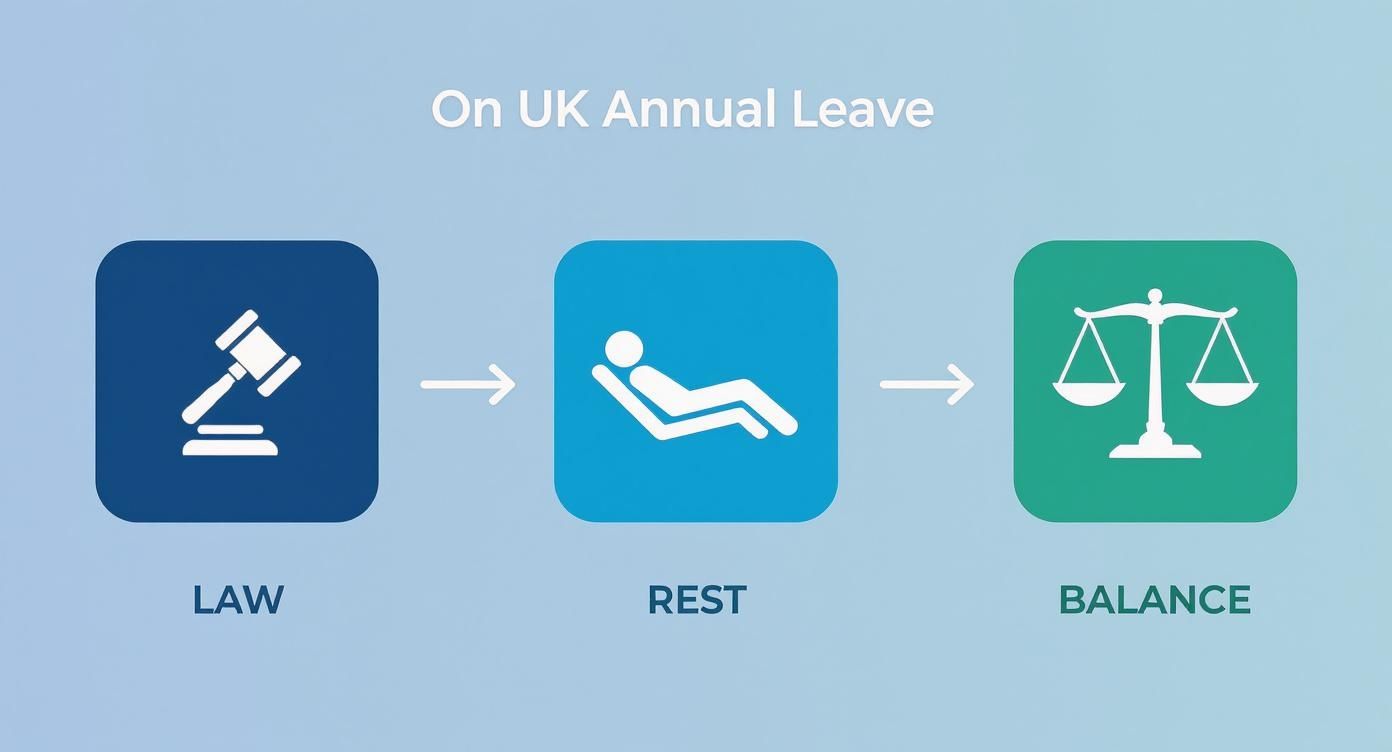
This flow from legal rights to personal well-being is exactly why getting your head around annual leave is so important for maintaining a healthy work-life balance.
Pro Rata Calculations for Part-Time Staff
But what if you don't work five days a week? That's where pro-rata calculations come in. This method just ensures your holiday entitlement is proportional to the time you actually work.
The formula is simple: multiply the number of days you work each week by 5.6.
- Working 3 days a week: 3 days × 5.6 weeks = 16.8 days of annual leave.
- Working 2 days a week: 2 days × 5.6 weeks = 11.2 days of annual leave.
This approach guarantees fairness, meaning a part-time employee gets the same amount of holiday, relative to their schedule, as a full-time colleague. For more complex situations, it can be a real help to use a dedicated tool. Our comprehensive UK holiday calculator helps you determine your annual leave with total precision.
Calculating Leave for Irregular Hours
For workers on zero-hour contracts or with very variable shift patterns, the calculation method is different. The standard approach here is to use a percentage based on the hours worked.
The legal holiday entitlement for irregular hours is 12.07% of the hours you’ve worked. This percentage comes from calculating 5.6 weeks of holiday as a proportion of the working year (52 weeks - 5.6 weeks = 46.4 working weeks).
So, for example, if you worked 100 hours in a month, you would accrue 12.07 hours of paid leave (100 hours × 0.1207). This method provides a solid, reliable way to calculate holiday pay when a fixed weekly schedule just doesn't apply, making sure everyone gets the time off they've rightfully earned.
Why Your Annual Leave Might Be Different
While UK law gives us a clear minimum for holiday entitlement, the actual number of days you get can vary wildly from person to person. That statutory 28 days is just the starting line, not the finish. Many companies offer much more generous packages to stand out from the crowd.
This is what we call contractual leave—an enhanced allowance offered by an employer as a perk of the job. It's a powerful tool for attracting and keeping top talent, especially in competitive industries. If you're getting more than the legal minimum, that extra time off is a benefit defined by your employer, not by law.
You'll always find the nitty-gritty details of your holiday entitlement laid out in your employment contract or company handbook. Think of this document as the ultimate source of truth for what annual leave means at your specific workplace.
Industry and Company Size Influence
Where you work plays a huge part in shaping your time off. It’s no secret that some industries are known for offering better leave packages than others. Sectors like technology, finance, and professional services, for example, often provide well above the statutory minimum to compete for the best people.
On the other hand, industries with tighter margins or different operational demands might stick closer to the legal baseline. It's also pretty common for larger, more established companies to offer more days than smaller businesses or startups. These differences create a landscape where your holiday allowance can look very different from your friend's in another sector.
Your annual leave entitlement is a direct reflection of both legal standards and your employer's approach to staff well-being and market competitiveness. Understanding this difference is key to knowing the true value of your benefits package.
Recent UK data really highlights these industry trends. A 2023 report revealed that the average UK employee took 33.9 days of annual leave, including bank holidays. But this was actually a drop, with sectors like construction seeing average entitlements fall from 34.85 days to 32.55 days. You can discover detailed insights into UK leave statistics by industry to see how different sectors stack up.
Factors Inside Your Organisation
Even within the same company, not everyone will necessarily have the same holiday allowance. Several internal factors can lead to different entitlements among colleagues.
- Length of Service: Many organisations reward loyalty. It's common to see policies that increase an employee's holiday allowance after they've been with the company for a certain number of years, like adding an extra day for every two years of service.
- Seniority or Role: Senior-level positions or roles that come with greater responsibility often include an enhanced leave package as part of the overall compensation.
- Working Patterns: As we’ve touched on, your working hours directly impact your allowance. Part-time employees will have their leave calculated differently from full-time staff to keep things fair. You can learn more about how to calculate pro-rata holiday in our UK guide.
Because of these internal policies, the answer to "what does annual leave mean" can be slightly different for each person, even if you all work for the same employer.
Navigating Common Annual Leave Scenarios
Life is rarely straightforward, and the same can be said for annual leave plans. Understanding your rights and your company's policies is absolutely crucial when things don't go as expected. This guide tackles the most common 'what if' scenarios, giving you clear advice on how to handle them fairly and legally.
From carrying over unused days to the frustration of falling ill while you're away, knowing what to do helps both employees and managers navigate these situations with confidence. Let's break down the rules for these tricky but all-too-common situations.
Can I Carry Over Unused Holiday Days?
This is one of the most frequent questions we see: can I roll over unused leave into the next holiday year? The answer really depends on the type of leave and, more importantly, your employer's specific policy.
Legally, there are a couple of layers to this. The four weeks of leave that come from the EU's Working Time Directive generally cannot be carried over. The whole point is for it to be used for rest within the year it's granted. However, the additional 1.6 weeks of UK statutory leave (that’s 8 days for a full-time employee) can be carried over, but only if there's a written agreement in place with your employer.
Key Takeaway: Many companies are more flexible than the legal minimum. Your employment contract or staff handbook is the ultimate guide here. It should detail exactly how many days you can roll over and, crucially, the deadline for using them.
What Happens if I Get Sick on Holiday?
Falling ill during your annual leave is incredibly frustrating, but you don't have to write off your precious time off. If you're genuinely unwell, you have the right to reclaim your holiday days.
To do this, you must follow your company's standard sickness reporting procedure as soon as you can—just as you would if you were scheduled to be at work. This usually means calling your manager and might require a doctor's note, depending on how long you're ill and what the company policy says. The days you were sick can then be converted to sick leave, and your annual leave days are credited back to your allowance to be taken at a later date.
How Does Payment in Lieu Work When I Leave?
When your employment comes to an end, your employer has to pay you for any statutory annual leave you've accrued but haven't taken. This payout is known as payment in lieu of holiday.
The calculation is usually quite straightforward. It’s a simple process to ensure you’re compensated for all the time off you’ve rightfully earned.
Here’s a quick table to show you how the calculation typically works.
Payment In Lieu Calculation Example
| Step | Calculation | Example Value |
|---|---|---|
| 1. Total Annual Entitlement | Your full holiday allowance for the year. | 28 days |
| 2. Pro-Rata Accrual | Calculate how much leave you've earned up to your leaving date. If you leave 6 months into the year, you've earned 50%. | 28 days x 50% = 14 days |
| 3. Subtract Leave Taken | Deduct any holiday you've already used in the current leave year. | 14 days - 5 days |
| 4. Final Payout | The remaining days are paid at your normal rate in your final salary. | 9 days to be paid out. |
This process provides a fair and clean financial end to your employment, making sure nothing is left outstanding.
The Real Story Behind UK Holiday Habits
Knowing the legal definition of annual leave is one thing. Seeing how it actually works in the real world? That’s a completely different story. The UK has a unique culture around taking time off, shaped by professional pressures, an 'always-on' environment, and habits that often stop people from taking the breaks they're entitled to.

While the law gives us a foundation for rest, workplace culture often builds a very different reality. The pressure to appear committed, combined with heavy workloads, can make booking a holiday feel more like a luxury than a right. This has led to a surprising trend: employees leaving valuable holiday days on the table every year.
A Culture of Unused Leave
It sounds strange, but a huge portion of the UK workforce doesn't use all of their allocated leave. This isn't just a small oversight; it points to a wider cultural issue where stepping away from the desk is sometimes seen as a lack of dedication.
Recent data paints a fascinating picture. In 2024, despite their legal entitlements, roughly 65% of UK workers left some of their holidays unused, with an average of 5.3 days going spare per person. Interestingly, this is a massive improvement from 2019, when employees left an average of 18.5 days unused—a figure that has dropped by about 71% in five years. This suggests a positive shift towards prioritising time off, even if we've still got a way to go. You can explore more insights into the state of annual leave in the UK to see the full trends.
This reluctance to take leave isn’t just a UK phenomenon, but our patterns are distinct. For instance, in 2024, over 50% of UK employees took at least one full workweek off in a single block. Compare that to just 33% in the United States, and you can see we have a greater tendency to take longer, more restorative breaks when we finally get around to them.
The most popular day for annual leave in 2024 was 27 December, highlighting a strong national trend of strategically extending the Christmas holiday period to maximise family and festive time.
This analysis shows that understanding annual leave is about more than just legal rules and payroll calculations. It's deeply connected to the human and cultural factors that dictate how, when, and even if we choose to properly rest and recharge.
Your Annual Leave Questions, Answered
Even after you've got the basics down, you’ll find that specific, real-world questions about annual leave pop up all the time. This section tackles some of the most common queries head-on, giving you clear, practical answers to handle these scenarios with confidence.
From company shutdowns to how major life events affect your time off, let's clear up the confusion.
Can My Employer Tell Me When to Take Annual Leave?
In short, yes. An employer can absolutely require you to take your holiday on specific dates. A classic example is a company-wide shutdown over Christmas. They can't just spring it on you, though.
The law is very clear on this: they must give you proper notice. The notice period has to be at least twice as long as the amount of leave they want you to take. So, if they’re closing for one week (five working days), they need to tell you at least two weeks beforehand. This kind of policy should always be spelled out in your employment contract or company handbook to make sure everyone's on the same page.
What Happens to My Annual Leave During Maternity Leave?
This is a big one, and the protection here is strong. Your statutory holiday entitlement continues to build up (or accrue) completely as normal while you're on maternity, paternity, or any other type of family-related leave. You don't lose a single day.
You can't take annual leave at the same time as maternity leave, but you can work with your employer to use it strategically. Many people choose to take their accrued holiday right before their family leave starts, or tack it onto the end to extend their time away from work.
If you can't use all your holiday because you're on maternity leave, your employer is legally required to let you carry it over to the next leave year. This ensures you get the full benefit of the paid rest you've earned.
Does My Holiday Entitlement Include Bank Holidays?
This all comes down to the exact wording in your employment contract. The legal minimum of 5.6 weeks can include bank holidays, but it doesn't automatically.
Your contract should make the company's approach clear. You'll typically see one of two things:
- "28 days including bank holidays": This means the public holidays are already counted as part of your total allowance.
- "20 days plus bank holidays": This is more generous. It means you get 20 days to book whenever you like, and the bank holidays are given on top of that.
What if you have to work on a bank holiday? Your employer must make sure you get that paid day off at another time. The bottom line is that you must always receive your full statutory entitlement of 5.6 weeks of paid leave.
Trying to manage all these rules manually is a recipe for headaches and mistakes. Leavetrack automates everything from accruals during maternity leave to bank holiday policies, ensuring your company stays compliant and every employee gets the correct entitlement, every single time. See how it simplifies everything at https://leavetrackapp.com.