

What is delegated authority? A Quick Guide to Empowerment and Efficiency
Posted by Robin on 10 Dec, 2025 in
Delegated authority is all about entrusting specific responsibilities and decision-making power to your team members, while you still hold the reins for the overall outcome. It’s a bit like a head chef in a busy restaurant who empowers the line cooks to perfect their own stations. The cooks are trusted with key decisions, but the chef is ultimately responsible for the dish that goes out to the customer. This whole process hinges on three things: trust, clear communication, and defined control.
What Delegated Authority Really Means
To get to grips with delegated authority, we need to think beyond just handing off tasks. At its heart, it’s a deliberate act of empowerment. It’s about building up your team’s skills, making the whole operation more efficient, and allowing leadership to scale. This is the mechanism that lets a business grow beyond what one person can handle alone. When you delegate, you're not just offloading work; you're investing in your team's potential.
This isn’t some niche management fad, either. It’s a practice that extends right up to the highest levels of government. In the UK, for instance, Parliament frequently uses delegated authority to manage the sheer volume of modern lawmaking. Instead of debating every tiny detail, it passes Acts that grant powers to government ministers to create the specific rules. Between 1950 and 2019, an average of 2,500 of these 'statutory instruments' were laid before Parliament each year. Compare that to an average of just 33 Acts of Parliament per year from 2006 to 2018. If you want to dive deeper, you can explore more about the legislative process and see this principle in action on a national scale.
The Foundation of Effective Delegation
Real, successful delegation stands on three pillars. These work together for both the leader (the delegator) and the employee (the delegatee). Get these right, and you create a system that fosters growth instead of confusion. Without this solid foundation, delegation can quickly turn into abdication—which is basically just abandoning a task and hoping for the best.
This framework makes sure everyone understands their role, the limits of their authority, and how their piece of the puzzle fits into the bigger picture. It turns delegation from a simple command into a collaborative partnership, which is what you need for long-term success.
Delegated authority isn't about losing control; it's about gaining leverage. By empowering your team, you multiply your own effectiveness and build a more resilient, skilled organisation.
Let's break down these core components to see how they apply to both sides of the coin. Getting this clarity from the start helps prevent any misunderstandings and sets the stage for a positive outcome where the employee feels empowered and the manager feels confident.
The Core Components of Delegated Authority
Here’s a look at the essential elements of effective delegation, outlining what’s expected from both the person delegating the task and the person receiving it.
| Component | Description for the Delegator | Description for the Delegatee |
|---|---|---|
| Trust | You must trust the employee's skills and judgement to handle the task. Provide the necessary resources and then step back. | You need to demonstrate reliability and competence to earn and maintain that trust. |
| Clear Communication | Clearly define the task, the expected outcomes, deadlines, and the scope of authority. Leave no room for ambiguity. | Actively listen, ask clarifying questions, and provide regular progress updates to ensure alignment. |
| Defined Control | Establish clear boundaries and reporting mechanisms. Retain ultimate accountability for the final outcome. | Understand and respect the limits of your given authority. Know when to make a decision and when to escalate. |
Nailing these three components creates a supportive environment where delegated tasks are completed successfully and team members grow in their roles. It’s the difference between simply assigning work and truly empowering people.
Finding the Right Level of Delegation
Delegation isn't a simple on-or-off switch. Think of it more like a dial you can turn up or down, giving you a whole spectrum of empowerment to work with. How far you turn that dial really depends on the task's complexity, the team member's experience, and frankly, the level of risk involved.
Just telling someone to "handle it" without clear boundaries is a recipe for confusion and mediocre results. A more structured approach, on the other hand, helps you build skills and confidence within your team without feeling like you've completely lost control. The trick is to match the level of autonomy to the specific situation, ensuring you provide just the right amount of support and oversight.
This turns delegation from a risky gamble into a smart management strategy.
Understanding the Five Levels
Thinking about delegation in stages can make it much easier to assign tasks effectively. Each level represents a different degree of trust and responsibility, letting you tailor your approach to both the person and the project at hand.
Most experts agree on five common levels of delegation:
- Level 1: Research and Report Back. At this most basic level, you're asking a team member to simply investigate a topic and present their findings. You keep all the decision-making power, but you empower them to gather the crucial information.
- Level 2: Research and Recommend. This takes it a step further. The employee not only gathers the information but also analyses it and suggests a course of action. You still make the final call, but their input becomes a vital part of the process.
- Level 3: Advise and Act (with Approval). Here, the employee does the prep work and creates a plan they're ready to execute, but they need your final green light before they can move forward. This shows a significant jump in trust.
- Level 4: Act and Report. You give the employee the freedom to get on with it independently. Their main responsibility is simply to keep you in the loop on their progress and the results.
- Level 5: Handle It Completely. This is the highest form of empowerment. You hand over full ownership of the task and its outcome, trusting their judgement to manage it from start to finish without your intervention.
The relationship between a manager and their team member is built on trust, clear communication, and well-defined control.
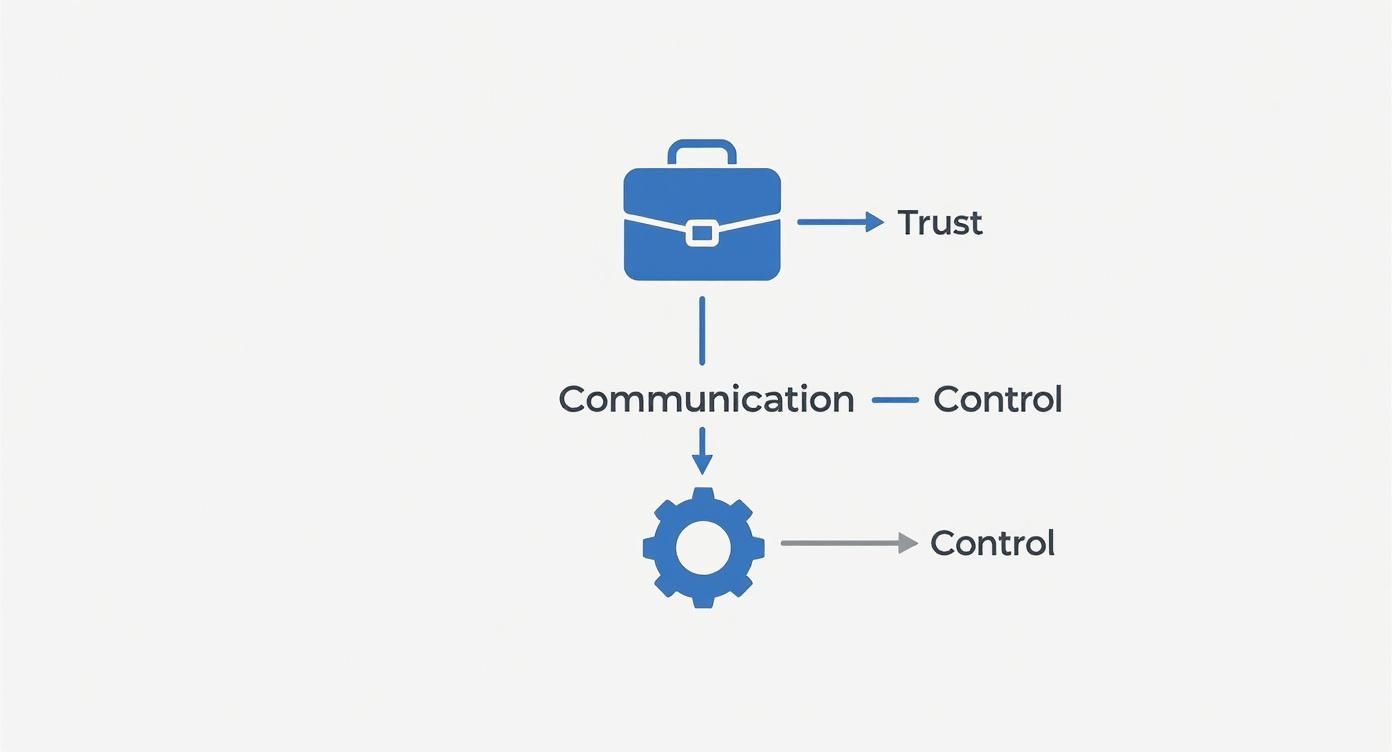
As this shows, when trust and communication flow from the leader, the employee gains the autonomy to act, which is then balanced by the right amount of oversight.
Matching the Level to the Situation
Choosing the right level is a critical management skill. For a junior team member tasked with exploring new software options, Level 1 or 2 is a perfect fit. It gives them a chance to learn and contribute without the pressure of making the final decision.
But for a senior project manager launching a major marketing campaign? Level 4 or even 5 would be far more appropriate, allowing them to leverage their expertise without being micromanaged. Mastering this is a key part of growing as a leader, and you can explore some top tips that will make you a better people manager to develop this skill.
By progressively increasing the level of authority as an employee demonstrates competence and reliability, you create a powerful pathway for professional development and build a more capable, self-sufficient team.
Ultimately, understanding these levels transforms delegation from a simple task-offloading exercise into a strategic tool for developing your talent and boosting your team's efficiency.
How Smart Delegation Drives Business Growth

Effective delegation is so much more than just a time-management hack; it's a strategic engine for growth. When leaders truly get to grips with delegated authority, they stop being overworked doers and become impactful developers of talent. This single shift creates a powerful ripple effect, delivering real benefits for everyone involved.
For managers, the most obvious win is getting valuable time back. Instead of drowning in routine tasks, they can finally focus on high-level strategy, innovation, and actually steering the ship. This isn't just about preventing burnout; it ensures the business is guided by a forward-looking vision, not constant day-to-day firefighting.
Empowering People and Strengthening the Business
For your team members, being on the receiving end of delegated authority is a direct investment in their professional future. It gives them a clear path to developing new skills, boosting their engagement, and making real progress in their careers. When people are trusted with genuine responsibility, they feel more valued and connected to the company's success.
The result is a more resilient and agile organisation. By spreading decision-making around, you build a strong internal leadership pipeline and get rid of those dangerous single points of failure. The business transforms into a place where talent is actively nurtured, not just managed.
Delegation is the ultimate act of trust. It tells your team, "I believe in your potential to not only do this task but to grow from it." This belief is the foundation of a high-performing culture.
A Quick Case Study in Growth
Imagine a marketing manager who used to approve every single social media post, email, and ad creative. Their team was capable but felt completely stifled, and the manager was a constant bottleneck. By putting a clear delegation framework in place, they empowered a junior marketer to manage the social media calendar and a senior specialist to run the email campaigns.
The results were almost immediate. The manager freed up 10 hours a week to chase strategic partnerships, which quickly led to a major new client. The team, energised by their new autonomy, launched a creative campaign that boosted engagement by 30%.
The business didn't just get more efficient; it became more innovative. This shows that smart delegation isn’t about offloading work—it’s about unlocking growth and potential at every level of the company.
Navigating the Risks and UK Legal Landscape
While delegated authority can be a game-changer for growth, just handing over responsibilities without a solid framework is a recipe for trouble. When delegation goes sour, you often see inconsistent quality, communication breakdowns, or a dangerous slide from empowerment into outright abandonment. Team members end up feeling unsupported and overwhelmed, while managers lose the plot on project progress, leading to costly mistakes and blown deadlines.
These risks get even bigger when you factor in the legal and HR side of things, particularly in the UK. A business is always legally accountable for what its employees do, even when a task is delegated. If a delegated decision leads to a breach of contract or a regulatory slip-up, the buck stops with the company and its leadership. This is why having clear, well-documented HR policies isn't just good practice—it's essential for protecting both the organisation and your people.
To get a handle on these challenges, you need a structured approach. It's about knowing how to apply principles from compliance and risk management to build a strong foundation. For anyone navigating this complex area, digging into resources on topics like Navigating AI Ethics, EPPA Compliance, and Risk Management in Human Resources can be a huge help in creating a framework that’s both compliant and ethical.
Lessons from UK Governance
You can actually draw a powerful parallel from the UK's own system of governance. Parliament often delegates law-making powers to government ministers, but this authority doesn't come without strings. Committees are set up specifically to scrutinise these powers to prevent overreach and ensure everyone is held accountable. This model of checks and balances offers a valuable lesson for any business leader.
Take the Delegated Powers and Regulatory Reform Committee (DPRRC), for example. It actively challenges overly broad powers that could undermine transparency. In one high-profile case, the committee pushed back hard against government proposals that would have granted sweeping delegated authority, arguing it would weaken parliamentary control. The government eventually narrowed these powers, proving just how important proper scrutiny is.
Just as parliament maintains oversight of delegated legislation, a manager must implement checks and balances. This isn't micromanagement; it's responsible governance that ensures delegated authority remains effective and compliant.
By setting up clear approval workflows, scheduling regular check-ins, and defining clear escalation paths, businesses can create their own internal system of scrutiny. This kind of foresight transforms delegation from a potential liability into a secure and strategic asset for sustainable growth.
A Practical Framework for Delegating Effectively

Knowing the theory is one thing, but putting it into practice is where things get real. The trick to making delegated authority work isn't just hoping for the best; it's about having a repeatable, scalable process. When you build a solid framework, you turn delegation from a risky gamble into a smart business move that empowers your team and frees you up for more strategic work.
Following a clear process means nothing gets left to chance. It creates clarity for everyone involved and sets every delegated task up for success right from the start.
1. Define the Task and What 'Done' Looks Like
First things first, you have to get specific. A vague instruction like "handle this" is a recipe for disaster. You need to paint a crystal-clear picture of what success looks like.
What’s the exact, measurable outcome you’re after? Who is the work for, what are the absolute deadlines, and what should the final result look like? Ambiguity is the enemy of good delegation. A clear brief kills the guesswork and makes sure you're both aiming at the same target.
2. Pick the Right Person for the Job
This is about more than just finding someone with free time in their calendar. You’ve got to think about their skills, their experience, and what's already on their plate. Is this a great development opportunity for a junior team member, or does it need the steady hand of a seasoned pro?
Matching the task to the person's skills and career goals is crucial. For smaller businesses without a dedicated HR team, these decisions need careful thought. Our guide offers three top tips for managing a small business without an HR department that can help you navigate this.
To make this step even more concrete, here's a quick checklist to run through before you hand anything over.
Delegation Checklist Before You Hand Over a Task
Before you officially delegate, a quick mental run-through of these points can save a world of trouble later on. It helps confirm you've covered all the bases.
| Checklist Item | Consideration / Action Needed |
|---|---|
| Clarity of Outcome | Have I defined what "success" looks like with a measurable result? |
| Person-Task Fit | Does this person have the right skills, or is it a good stretch goal? |
| Authority Levels | Have I explained what decisions they can make and when to check in? |
| Resources Provided | Do they have access to the necessary tools, information, and budget? |
| Timeline Agreed | Is the final deadline and are any interim milestones clear and realistic? |
| Support System | Do they know who to ask for help if they get stuck? |
| Feedback Plan | How will we track progress without me micromanaging? |
Working through this checklist ensures you’re not just delegating a task, but also delegating the confidence and support needed to get it done right.
3. Communicate Boundaries and Offer Support
Once you’ve got your person, you need to be explicit about the scope of their authority. What decisions are theirs to make? At what point do they need to loop you in? Just as important, make sure they have all the resources, information, and support they need to actually succeed.
This is about empowerment, not abandonment.
Delegation without ongoing support is just abdication. You're trying to build a safety net that encourages confidence and smart risk-taking, not leaving someone to sink or swim on their own.
4. Create a Feedback Loop (Without Micromanaging)
Finally, set up a system to monitor progress that doesn't feel like you’re constantly looking over their shoulder. This could be regular check-in meetings, simple progress reports, or a shared project board. A clear feedback loop lets you stay in the loop, offer guidance when needed, and gently steer things back on course if they start to drift.
This structured process helps you implement delegated authority thoughtfully and effectively. To really master handing off responsibilities and empowering your team, check out this brilliant practical guide to effective task delegation.
How Technology Can Simplify Your Delegation Process
Let's be honest, trying to track delegated tasks manually is a recipe for chaos. It usually descends into a messy trail of emails and spreadsheets that offer zero real oversight. But modern tools can change all that, embedding effective delegation right into your daily operations. This isn't just a management theory anymore; it can be a seamless, secure part of your workflow.
Using software to manage delegation brings a much-needed formality to the process. This isn't just about convenience—it's about empowering your team leads or deputies with clear, auditable responsibility. Think about it: automated approval workflows can instantly solve those classic bottlenecks that happen when a manager is on leave, making sure the business doesn't grind to a halt.
Automating Approvals for Consistency
When you set up a system where leave requests are automatically routed to a designated deputy, you're building resilience into your team. This kind of thinking is at the heart of platforms designed to make operations smoother, as we explore in this comprehensive guide to employee leave management systems.
For example, here’s a look at Leavetrack’s delegated approvals feature. You can see how easily a manager can assign someone else to approve requests for a specific period.
What’s brilliant here is the blend of simplicity and control. The system creates a transparent, unchangeable record of who approved what and when. This reinforces accountability without adding any administrative headaches.
Technology transforms delegation from a personal, informal arrangement into a structured, reliable business process. It creates a transparent system that ensures the principles of good delegation are applied consistently and effortlessly.
This shift means that routine decisions get handled efficiently and—crucially—with a clear audit trail. It builds trust by providing a reliable framework that just works, even when key people are out of the office.
Got Questions About Delegation?
Even with the best framework in place, a few questions always pop up when you start putting delegation into practice. Let's tackle some of the most common ones I've come across.
Is This Delegation or Am I Just Dumping My Work?
This is the big one. It’s the difference between empowering someone and just dropping a problem in their lap.
Think of it this way: Delegation is entrusting responsibility with clear goals, the right support, and checking in along the way. You still own the final outcome, so you stay involved.
Abdication, on the other hand, is walking away from a responsibility entirely. No guidance, no resources, no follow-up. It's a recipe for failure that breeds confusion and kills trust. Proper delegation is active management, not just making a task disappear from your to-do list.
What if My Team Member Doesn't Want the Responsibility?
When someone seems hesitant to take on a new task, it's rarely about a lack of skill. More often than not, it’s a confidence issue. The trick is to build them up, not throw them in at the deep end.
Start with small, low-risk tasks. Maybe ask them to research a few options and come back with a recommendation, but you still make the final call.
- Talk about it as a chance for them to grow, not just another job to get done.
- Check in regularly and offer plenty of positive encouragement.
- Make a big deal of their early wins. It helps build momentum.
Getting over that initial reluctance is all about making them feel safe and supported as they step into a bigger role.
Can I Delegate Something I Don't Know How to Do Myself?
You absolutely can, and honestly, this is where delegation gets really powerful. When you hand over a task that’s outside your own area of expertise, your job changes. You’re no longer the technical expert; you’re the strategic guide.
Your role is to define the ‘what’ and the ‘why’. You set the goal, and then you trust the expert on your team to figure out the ‘how’. This shows a huge amount of trust and makes the most of the unique skills everyone brings to the table.
This is a fantastic way to spark new ideas and better problem-solving. It gives your team genuine ownership of not just the work, but the entire solution. You provide the vision, and they bring the specialised talent to make it happen.
Ready to empower your team and take the headache out of absence management? Leavetrack is built for clarity and control. You can set up delegated approvals in minutes, keeping things moving while ensuring everyone is accountable. See how it works at https://leavetrackapp.com.