

Zero Hour Contract Holiday Entitlement Explained
Posted by Robin on 22 Oct, 2025 in
Of course. Here is the rewritten section, crafted to sound completely human-written, following all your specified requirements.
Yes, absolutely. If you're on a zero-hour contract, you have a legal right to paid holidays. You earn your holiday entitlement just like any other worker in the UK—it’s all based on the hours you actually work. This means you are entitled to 5.6 weeks of paid leave per year, a right that's firmly protected by law.
Your Holiday Rights on a Zero Hour Contract

Trying to figure out your rights on a zero-hour contract can sometimes feel like you’re navigating a maze. The flexibility is fantastic, but it often creates confusion around the basics, like holiday pay. So, let’s clear up the biggest misconception right away: not having guaranteed hours does not mean you give up your right to paid time off.
This principle is a cornerstone of UK employment law. Every single hour you work adds to your holiday entitlement. Think of it like a piggy bank for your leave; each payslip is another deposit. The more you work, the bigger your pot of paid time off gets, ready for you to use whenever you need a break.
The Foundation of Your Entitlement
The law is designed to protect everyone who works, no matter what their contract says. The core idea couldn't be simpler: if you work, you earn the right to rest without losing out on pay. This is a crucial protection, especially as more and more people move to flexible contracts.
The legal landscape in the UK is always evolving to keep up, particularly around zero hour contract holiday entitlement. In fact, official data confirmed that in late 2024, around 1.13 million people were on these contracts, making fair and clear treatment more critical than ever.
The law is clear: all workers are entitled to a statutory paid holiday of 5.6 weeks a year, which can include public holidays. You can dive into the full government report and data on zero-hour contracts and workers' rights if you want the finer details.
The key takeaway is that your status as a 'worker' is what grants you these rights. It's not about having a fixed schedule but about the work you perform.
Before we dive into the calculations, it's helpful to have a quick summary of the fundamental rights that protect you.
Table: Key Rights for Zero Hour Contract Workers
| Right | What It Means for You |
|---|---|
| Right to Paid Holiday | You accrue 5.6 weeks of paid annual leave, just like permanent employees. |
| National Minimum Wage | You must be paid at least the National Minimum Wage or National Living Wage for your age. |
| Protection from Detriment | Your employer cannot treat you unfairly for refusing work or for working for another employer. |
| Statutory Sick Pay (SSP) | If you meet the eligibility criteria, you are entitled to Statutory Sick Pay. |
| Rest Breaks | You're entitled to statutory rest breaks, including a 20-minute break for shifts over 6 hours. |
Understanding these core protections is the first step toward ensuring you get what you're owed.
Why This Matters
So many workers on zero-hour contracts either don't know their rights or aren't sure how to calculate their holiday pay, which can leave them vulnerable to being underpaid. It's time to change that.
This guide will break down everything you need to know, giving you the confidence and knowledge to manage your holiday entitlement properly. We’ll cover:
- The specific laws that have your back
- Step-by-step methods for calculating your holiday pay
- How to tackle common problems you might run into
The Legal Rules for Holiday Pay in the UK
To get to grips with zero-hour contract holiday entitlement, we first need to understand the legal rulebook that protects workers in the UK. This isn't about company perks or manager goodwill; it's about the law.
The foundational piece of the puzzle is the Working Time Regulations 1998. Think of this as the bedrock that establishes a legal right to paid time off for almost everyone who works, no matter their role or industry.
These regulations act as a universal safety net. They make sure that, regardless of your contract type, you're entitled to a minimum amount of paid leave to rest and recharge. When it comes to this fundamental right, the law doesn't see a difference between a full-time employee and a zero-hour worker.
Statutory vs Contractual Holiday Leave
It’s crucial to understand the two different types of holiday leave you might come across. The law sets a minimum standard, but some employers choose to be more generous.
- Statutory Leave: This is the legal minimum everyone gets. In the UK, it’s set at 5.6 weeks per year. This is your non-negotiable right, protected by law.
- Contractual Leave: This is any extra paid leave an employer offers on top of the statutory minimum. For example, if a company gives you 30 days of holiday instead of the minimum 28 (which is 5.6 weeks x 5 days), those extra two days are contractual.
For zero-hour workers, the focus is almost always on making sure the statutory 5.6 weeks are calculated and paid correctly, as extra contractual leave is far less common. For a more detailed look at this, our comprehensive guide to UK legal holiday entitlement explained covers these distinctions for all kinds of workers.
Your Status as a Worker Unlocks Your Rights
So, what is it that actually gives you these holiday rights? It all comes down to your legal classification as a ‘worker’.
This is a really important point. You don't need to be a permanent 'employee' with a fixed-hour contract to qualify for paid holidays.
If you have a contract to personally do work or provide services for a company, you are almost certainly classified as a worker. It's this status that activates your entitlement under the Working Time Regulations. The number of hours you happen to work is irrelevant to whether you have the right—it only affects how much holiday pay you build up.
Your employment status, not your working pattern, is the key that unlocks your legal right to paid annual leave. The law is designed to protect people based on the work they do, not the rigidity of their schedule.
This protection has been strengthened over the years by a number of landmark court cases that have consistently clarified the rights of people with irregular working patterns. These rulings have upheld the principle that holiday pay should reflect what a worker would have normally earned. While we're focused on the UK, it's also helpful to see the bigger picture when it comes to navigating international employment law to understand how different countries approach worker protections.
Recent government guidance has aimed to simplify the rules even further, especially for irregular-hours workers, by confirming clear methods for calculating what you've accrued. This solid legal framework ensures your right to paid time off isn't just a theory, but a practical and enforceable benefit. It's your guarantee that every hour you work contributes towards a well-deserved break.
How to Calculate Your Zero Hour Holiday Pay
Alright, you know you’re entitled to paid holiday on a zero-hour contract. Now for the important part: turning that right into actual time off and pay in your pocket.
Working out what you're owed can feel a bit murky, but it really comes down to two main approaches. We'll walk through both, step-by-step, using simple examples to make it all crystal clear.
This flow chart gives a great overview of how your status as a worker connects to the law and your employer's duties when it comes to holiday pay.
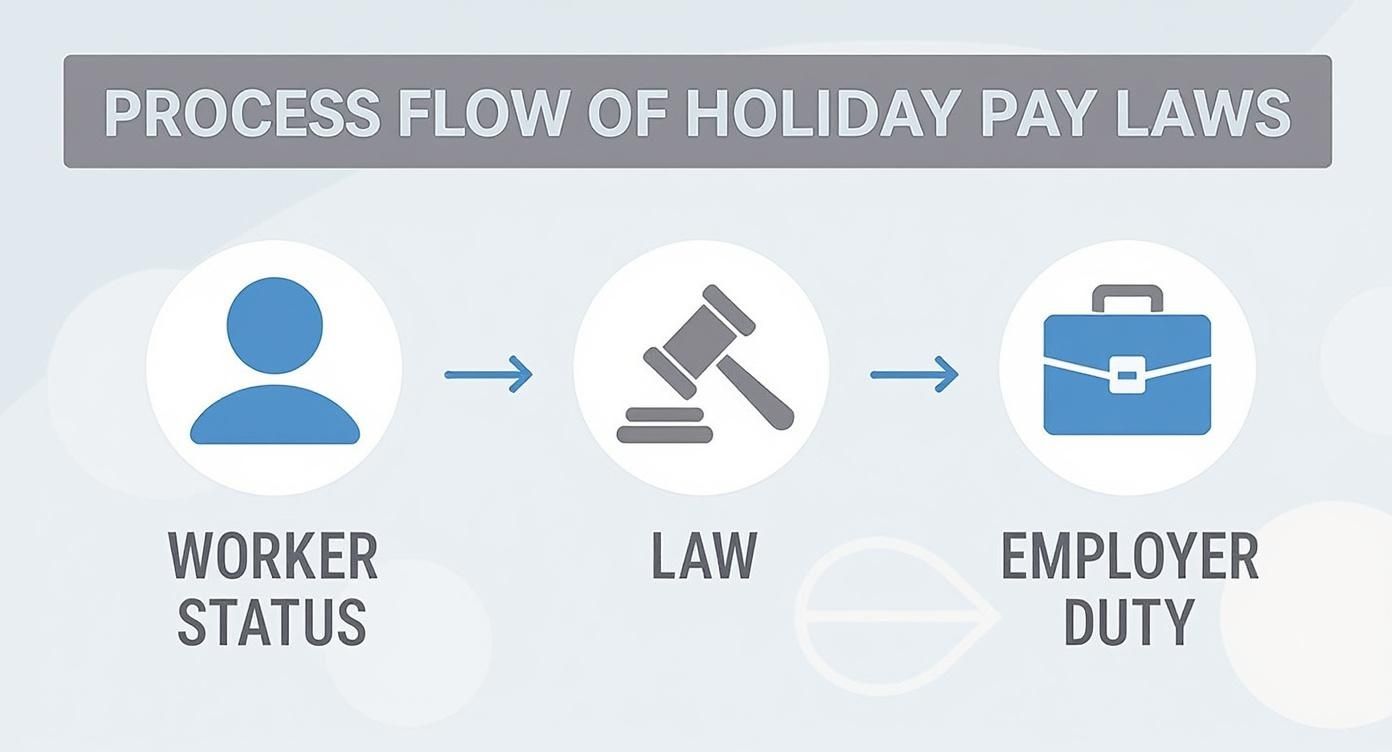
As you can see, everything starts with confirming your legal 'worker' status. Once that’s established, the legal protections kick in, and your employer has a clear responsibility to follow the rules.
The 12.07 Percent Accrual Method
For years, the go-to way to figure out holiday time for zero-hour workers was a simple percentage calculation. This method treats your holiday entitlement as a direct percentage of the hours you put in.
That magic number is 12.07%.
Where on earth does that come from? It's actually quite logical. A standard working year has 52 weeks. Full-time staff get 5.6 weeks of holiday, leaving 46.4 weeks of work. Divide the holiday by the working weeks (5.6 ÷ 46.4), and you get 12.07%.
So, to find out how many holiday hours you've banked, you just multiply the total hours you’ve worked by 12.07%.
Example of the 12.07% Method
Let's say you worked 80 hours last month.
- Calculation: 80 hours × 0.1207 = 9.656 hours
- Result: You've earned just over 9.6 hours of paid holiday from that month’s work.
It's a really straightforward way to watch your holiday pot grow with every shift you complete. This is especially handy for working out pro-rata holiday, a topic we cover in our guide on how to calculate pro-rata holiday in the UK.
The 52-Week Reference Period Method
The second, and now standard, method is using a 52-week reference period. This is designed to make sure your holiday pay is a fair reflection of your normal earnings, which is vital when your hours and pay go up and down.
Think of it as looking back over the last year of your payslips to find a true average for a week's pay.
The process involves tallying up your pay over the last 52 weeks where you actually earned money. Crucially, any week you didn't work and weren't paid is ignored, and your employer has to go back further to find another paid week to include in the average.
This system is all about fairness. For anyone with irregular hours, this is the legal standard for working out holiday pay. If someone has been with the company for less than 52 weeks, the reference period is simply shortened to however many weeks they’ve worked. The whole point is to ensure a week of holiday pay matches a week of normal pay.
Example of the 52-Week Method
Imagine you want to book a week off. To work out your pay, your employer would:
- Add up your total pay from the last 52 weeks you worked. Let’s say that comes to £10,400.
- Divide that total by 52 to get your average weekly pay.
- Calculation: £10,400 ÷ 52 = £200.
- Result: Your pay for that week of holiday would be £200.
This method is fantastic because it stops your holiday pay from being unfairly low just because you took time off after a quiet spell. It gives a much more balanced picture of your typical earnings.
Comparison of Holiday Pay Calculation Methods
So, you have two methods. While they both deal with holiday entitlement, they're used for different things and it's important to know when to use which. Getting this right is key for both workers and employers to ensure everyone is treated fairly.
This quick table breaks down the main differences.
| Feature | 12.07% Accrual Method | 52-Week Reference Period |
|---|---|---|
| Best For | Calculating holiday accrual in hours for irregular-hours workers. | Calculating the rate of pay for a week's holiday. |
| How It Works | Multiplies hours worked by 12.07% to find hours of leave earned. | Averages your pay over the last 52 paid weeks to set holiday pay rate. |
| Main Advantage | Simple and transparent for tracking accrued leave. | Ensures holiday pay reflects actual average earnings over time. |
| Key Consideration | This method is for calculating entitlement, not the pay rate itself. | This is the legally required method for calculating the pay for a week's holiday. |
Ultimately, understanding these calculations is empowering. It gives you the confidence to check your payslips, ask the right questions, and make sure you’re getting the zero hour contract holiday entitlement you’ve legally earned.
Common Holiday Pay Problems and How to Fix Them

Getting your head around zero hour contract holiday entitlement is one thing, but dealing with the messy reality is another story entirely. The very flexibility of these contracts can, unfortunately, open the door to confusion and bad practice, leaving workers wondering if they're getting a fair deal.
Think of this section as your practical troubleshooting guide. We're going to tackle the most common headaches head-on, giving you clear, actionable steps to spot problems and sort them out. From unlawful pay practices to arguments over final pay, our goal is to give you the confidence to stand up for your rights.
The Myth of Rolled-Up Holiday Pay
One of the most stubborn issues we see is 'rolled-up' holiday pay. This is where an employer simply adds a bit extra to your hourly rate, claiming it covers your holiday pay, instead of paying you when you actually take a break.
For a long time, this was flat-out unlawful. A landmark European Court of Justice ruling decided it could discourage people from taking the time off they need, which defeats the whole point of annual leave. However, the rules have recently changed. For leave years starting on or after 1 April 2024, the government has permitted rolled-up holiday pay for irregular-hours and part-year workers, but only under very strict conditions.
To be lawful now, it must be calculated at 12.07% of a worker's total pay in that pay period, and—crucially—it has to be shown as a separate item on their payslip.
Any employer who was using this method before that date was breaking the law, and even now, they have to follow the new rules to the letter. You can dig into the details in the official government guidance on holiday pay and entitlement reforms on GOV.UK. Bottom line: if it's not clearly itemised on the payslip, it’s not compliant.
What to Do If You're Not Being Paid Correctly
That sinking feeling when you realise your holiday pay is wrong is horrible. Maybe you took a week off but your wages were short, or the amount just seemed way too low. Don't panic; there's a clear process to follow.
Here’s a step-by-step plan:
- Check Your Records: First things first, gather your payslips and any records you have of the hours you've worked. Use the 52-week average calculation method we covered earlier to work out what you think you're owed.
- Start with an Informal Chat: Pop over to your manager or HR for a friendly conversation. It could genuinely be a simple payroll error. Calmly explain why you think there’s a mistake and show them your calculations.
- Put It in Writing: If the chat doesn't get you anywhere, it's time to send a formal letter or email. Stick to the facts, mention your legal right to paid holiday, and clearly state the amount you believe is outstanding.
- Raise a Formal Grievance: Still no luck? The next step is to raise a formal grievance by following your company’s official procedure.
- Contact Acas: If all internal routes fail, you can get in touch with Acas (the Advisory, Conciliation and Arbitration Service). They offer free, impartial advice and can help with early conciliation.
The key is to handle this professionally and systematically. Document everything—every conversation, email, and calculation. This will be your evidence if you need to take things further.
Unpaid Leave When You Leave a Job
Another common flashpoint is when you leave a job. You are legally entitled to be paid for any statutory holiday you've accrued but haven't taken. This payment absolutely must be included in your final payslip.
If your final pay packet is missing this amount, the process is much the same as the one above. Contact your former employer straight away, first informally and then in writing, to ask about the missing payment. Remind them of their legal duty to pay for all untaken statutory leave. This isn't a bonus; it's a non-negotiable part of your final settlement.
By understanding these common problems and knowing the steps to take, you can make sure your zero hour contract holiday entitlement is always respected.
Best Practices for Managing Holiday Entitlement
Getting holiday entitlement right for your zero-hour contract workers isn't just a box-ticking exercise for legal compliance. It’s about building a fair and trusting relationship with your flexible team. A proactive, organised approach stops disputes before they start, boosts morale, and frankly, protects your business. It means getting out of a reactive mindset and setting up a crystal-clear system from day one.
Think of it this way: a clear system is like a well-maintained road, making the journey smooth for everyone. A confusing one is a road full of potholes, causing frustration and breakdowns in the employer-worker relationship. The guiding principle here is simple: clarity and consistency are your best friends.
Maintain Meticulous Records
This is the absolute bedrock of managing holiday pay. You need to keep detailed, accurate records. Without a precise log of every single hour someone has worked, it's impossible to calculate their holiday entitlement correctly. This isn’t just good practice—it's your legal safety net.
Your records need to track:
- Hours Worked: Log every hour for each pay period. No exceptions.
- Pay Received: Document the gross pay that goes with those hours.
- Holidays Taken: Keep a straightforward record of all annual leave taken.
- Holiday Pay Paid: Make sure holiday payments are itemised separately on payslips.
This paper trail becomes the single source of truth, protecting both you and the worker. It gets rid of the guesswork and stops potential arguments in their tracks.
Communicate Policies Clearly
Most conflicts over holiday pay stem from simple misunderstandings. You can head these off at the pass by making sure your policies are clearly communicated and easy for every worker to find, right from their first day. Don't hide this information in dense legal jargon nobody understands.
Your employment contracts and staff handbooks must spell out exactly how zero hour contract holiday entitlement is managed. Explain the calculation method you use in plain English. For example, clarify how you'll apply the 52-week reference period. This involves using the average pay from the last 52 weeks they were actually paid. If they had a week with no work, that week doesn't count, and you have to go back further to find 52 weeks of pay data. Acas has some great guidance on this legal requirement.
A transparent policy leaves no room for doubt and shows you’re committed to treating people fairly.
"A proactive approach to holiday pay management is not an administrative burden; it's an investment in a stable and positive relationship with your flexible workforce. Clarity in process builds trust in practice."
Invest in the Right Tools
Trying to track all this manually on spreadsheets can quickly become a tangled mess, riddled with errors, especially as your team gets bigger. Investing in a proper absence management system like Leavetrack takes away the administrative headache and guarantees accuracy. For a deeper look into common mistakes and how to sidestep them, check out our guide to ensuring your holiday planning doesn't go wrong.
While getting statutory leave right is essential, some businesses are also looking at the bigger picture of employee wellbeing. Though it's a different beast to statutory entitlements, looking into alternative leave models like unlimited PTO can be part of a wider benefits strategy, particularly for salaried staff. An automated system makes tracking all types of leave much simpler, ensuring everyone is treated fairly and consistently. By putting these best practices into place, you're not just staying compliant—you're building a culture of respect and clarity.
Why Getting This Right Matters More Than Ever
Figuring out holiday pay for zero-hour contracts isn't just a niche HR problem anymore; it’s a core part of navigating the modern UK workplace. The world of work has fundamentally shifted, and these ultra-flexible contracts have become a major feature for both companies and the people who work for them.
For businesses, they're a way to scale the workforce up or down with demand, avoiding the overheads of a fixed payroll. For workers, they can be a great fit, offering a way to work around studies, family, or other gigs. But that flexibility cuts both ways, especially when it comes to financial security and fair treatment. And that’s where holiday rights come squarely into the picture.
The New Reality of Work
The rise of zero-hour contracts isn't a passing trend—it's a deep-rooted change in our economy. The numbers tell a clear story. In the UK, the number of people on zero-hour contracts shot up to a new peak of 1.17 million in 2025, a big jump from the 1.03 million just the year before. You can dig into the data behind the marked increase in zero-hour contracts and what it means for the workforce.
This growth isn't happening evenly, either. The same data shows that women made up 81% of that recent annual increase. This tells us that certain groups are far more likely to be in these roles, making it even more crucial that their rights—like paid holidays—are calculated and paid correctly to ensure a basic level of economic fairness.
When work is unpredictable, predictable rights are essential. Fair holiday pay isn't just a legal detail—it's a crucial piece of financial security and worker wellbeing in an increasingly flexible economy.
Why Fair Holiday Pay Is a Crucial Safety Net
Think about it: if your income swings wildly from one month to the next, paid holidays are more than just a nice-to-have. They become a critical financial safety net.
Without correctly paid leave, taking a break means accepting a 100% loss of income for that time. That forces a tough choice between getting much-needed rest and paying the bills. Making sure you get the holiday pay you’ve legally earned helps to smooth out those financial peaks and troughs, giving you a more stable footing. It’s a recognition that every single hour you work is building towards your right to a paid break, reinforcing your value no matter what your contract says.
Frequently Asked Questions
When you're dealing with the nuts and bolts of zero-hour contract holiday entitlement, a few common questions always seem to pop up. Let's walk through some of the most frequent real-world scenarios you're likely to face.
Do I Still Accrue Holiday if I Don't Work for Weeks?
This is a great question, and the rules got a lot clearer for leave years starting after 1 April 2024. For workers on irregular hours, your holiday entitlement now builds up at a simple rate of 12.07% of the hours you actually work in a pay period.
Put simply, if you don't work, you don't accrue holiday. If you have a month with zero hours on your timesheet, you'll accrue zero holiday for that month. Your entitlement is directly tied to your working time, which keeps things straightforward.
What Happens to My Holiday Pay if I Leave My Job?
When you hand in your notice, your employer is legally required to pay out any statutory holiday you've earned but haven't taken. This payment should be part of your final payslip.
The calculation is based on how far into the holiday year you are when you leave. On the flip side, if you've taken more holiday than you've officially accrued, your employer might be able to deduct the difference from your final pay. This is only allowed if it's explicitly mentioned in your contract, so it's always worth checking the small print.
Key Takeaway: An employer can't just refuse to pay you for statutory leave you've earned. It's a fundamental right that ensures you're compensated for the time you've worked and the leave that comes with it.
Can My Employer Force Me to Take Holidays on Specific Dates?
Yes, they can. A classic example is a company-wide shutdown over the Christmas and New Year period where everyone is required to take leave.
However, they can't just spring it on you. There are rules around notice. The standard is that they must give you at least twice as much notice as the length of the holiday they want you to take. So, if they want you to take one week off, they need to tell you at least two weeks in advance.
Trying to manage all these calculations and rules with spreadsheets is a recipe for headaches. Leavetrack takes the pain away by automating holiday calculations for every type of contract, ensuring you're always accurate and compliant. See how it works at https://leavetrackapp.com.