
Absence Sickness Policy: UK Workplace Guide
Posted by Robin on 06 Nov, 2025 in
An absence sickness policy is, at its core, a formal document outlining the rules of the road for employees when they're too ill to work. Think of it as a crucial 'fair play rulebook' for health-related absences. It ensures everyone knows the process and is treated consistently and fairly.
Why a Clear Sickness Policy Is a Business Essential

Many businesses see creating an absence sickness policy as just another bit of HR admin, but it’s so much more than that. It's a vital tool for business stability and employee trust. Without clear guidelines, managing sickness becomes a reactive, inconsistent, and often stressful job for managers. A well-defined policy shifts your organisation from putting out fires to proactive, fair, and legally sound absence management.
This structured approach isn't just about ticking compliance boxes; it’s about building a supportive and transparent culture. When employees feel secure and managers feel empowered, you reduce misunderstandings and the potential for conflict down the line.
The True Cost of Poorly Managed Absence
Letting sickness absence go unmanaged, or handling it poorly, carries some serious financial and operational weight. These costs stretch far beyond just the sick pay leaving your bank account. The wider economic impact is huge; as of 2025, around 2.78 million people in the UK were economically inactive due to long-term sickness, costing the economy an estimated £212 billion annually. You can read the full government report on how sickness absence impacts the UK economy for the full picture.
For your business, the direct consequences are just as damaging:
- Operational Disruption: Unplanned absences can bring projects to a grinding halt, push back deadlines, and throw customer service into chaos.
- Reduced Productivity: Team members left to cover for absent colleagues often face heavier workloads, leading straight to burnout and a drop in their own output.
- Lower Team Morale: If policies are applied inconsistently, it can quickly breed resentment and a sense of unfairness among staff.
- Legal Risks: Without a formal policy, your business is far more vulnerable to discrimination claims or disputes over pay and conditions.
A robust absence sickness policy is your first line of defence against these risks. It provides a consistent framework that protects your business, supports your managers, and ensures employees are treated with fairness and respect when they're unwell.
Navigating Your Legal Duties as a UK Employer
Getting to grips with your legal duties is the absolute baseline for any effective absence sickness policy. It’s non-negotiable. Here in the UK, employment law gives us a solid framework designed to protect everyone – both employees and employers – making sure things are fair and keeping disputes to a minimum. Ignoring these duties isn't just a bit of bad practice; it can land you in hot water with costly legal challenges and seriously damage your company’s reputation.
Think of your legal obligations as the guardrails on the road. They guide how you manage sick pay, how you handle sensitive medical information, and ultimately, how you support your team. Get this right, and you'll build a policy that isn't just compliant but also helps create a culture of trust and support.
Statutory Sick Pay and Fit Notes
One of the most fundamental duties you have is managing Statutory Sick Pay (SSP). This is the minimum amount you’re required to pay eligible employees when they're off sick for four or more days in a row. The rules around who’s eligible, the waiting days before it kicks in, and the payment rates are all very specific. Getting them wrong is a fast track to payroll errors and unhappy employees. For instance, you need to know how the rules apply to different contract types. You can find more detail on that in our guide explaining Statutory Sick Pay for part-time workers.
Alongside SSP, you need a crystal-clear process for handling medical certification. This usually breaks down into two parts:
- Self-Certification: For shorter absences of seven days or less, an employee can simply self-certify their illness. No doctor's note needed.
- Fit Notes: Once an absence goes beyond seven days, you must ask for a 'fit note' (what we used to call a 'sick note') from their GP or another healthcare professional. This note confirms their fitness for work and might even suggest ways you can help them return.
The Equality Act and Reasonable Adjustments
Beyond the nuts and bolts of sick pay, the Equality Act 2010 is a critical piece of the puzzle. This Act is all about protecting employees with disabilities from discrimination. A disability is defined as a physical or mental impairment that has a 'substantial' and 'long-term' negative effect on someone's ability to do normal daily activities.
A crucial point to remember here: deciding if an employee has a disability is ultimately a legal decision for you, the employer, not just a medical one. While advice from Occupational Health is vital, the responsibility to assess the situation and comply with the law rests squarely on your shoulders.
If an employee's sickness is linked to a disability, you have a legal duty to make reasonable adjustments. These are simply changes to their workplace or their role that help them get back to work or stay in work. Failing to make these adjustments can be seen as a form of discrimination.
What does that look like in practice? It could be things like:
- Altering their work hours or letting them come back gradually on a phased return.
- Providing specialised equipment, like a proper ergonomic chair.
- Reallocating a few minor duties that they find particularly difficult.
Baking these legal requirements directly into your absence sickness policy ensures you’re not just ticking boxes. You're building a supportive environment where every single employee is treated fairly.
Building Your Absence Sickness Policy Framework
Think of your absence sickness policy as the architectural blueprints for your organisation. Every beam and support has a purpose; if one is missing or poorly drawn, the whole structure can feel wobbly. This framework isn't just about laying down rules—it's about creating clear, fair, and predictable processes that everyone, from the newest hire to the senior team, can understand and rely on.
Clarity is everything here. Ambiguity is the enemy. When procedures are vague, managers apply them inconsistently and employees get confused, which quickly erodes trust. A well-built framework maps out every step of the journey, from that first "I'm not well" phone call to the final return-to-work chat.
Defining Your Reporting and Certification Rules
The first piece of the puzzle is the reporting procedure. Your people need to know exactly who to contact, how to contact them, and by what time if they can't make it into work. Vague instructions like "just let your manager know" are a recipe for chaos.
Get specific. Should they ring their line manager's mobile? Is an email okay? Can they send a message through the company app? Nailing down a clear protocol prevents no-shows and gives managers the heads-up they need to arrange cover without a last-minute panic.
Next up, you need to be crystal clear about medical certification. This usually breaks down into two distinct scenarios, and your policy must separate them to avoid any mix-ups.
- Self-Certification: For any sickness lasting up to seven calendar days, employees can certify their own absence. It’s best practice to have a standard form ready for them to complete when they get back.
- Fit Notes: If an illness stretches beyond seven days, you're in formal territory. A 'Statement of Fitness for Work'—what we all know as a fit note—from a GP or another registered healthcare professional is a legal requirement.
The infographic below really helps visualise how the legal duties you have as an employer form the foundation of your policy framework.
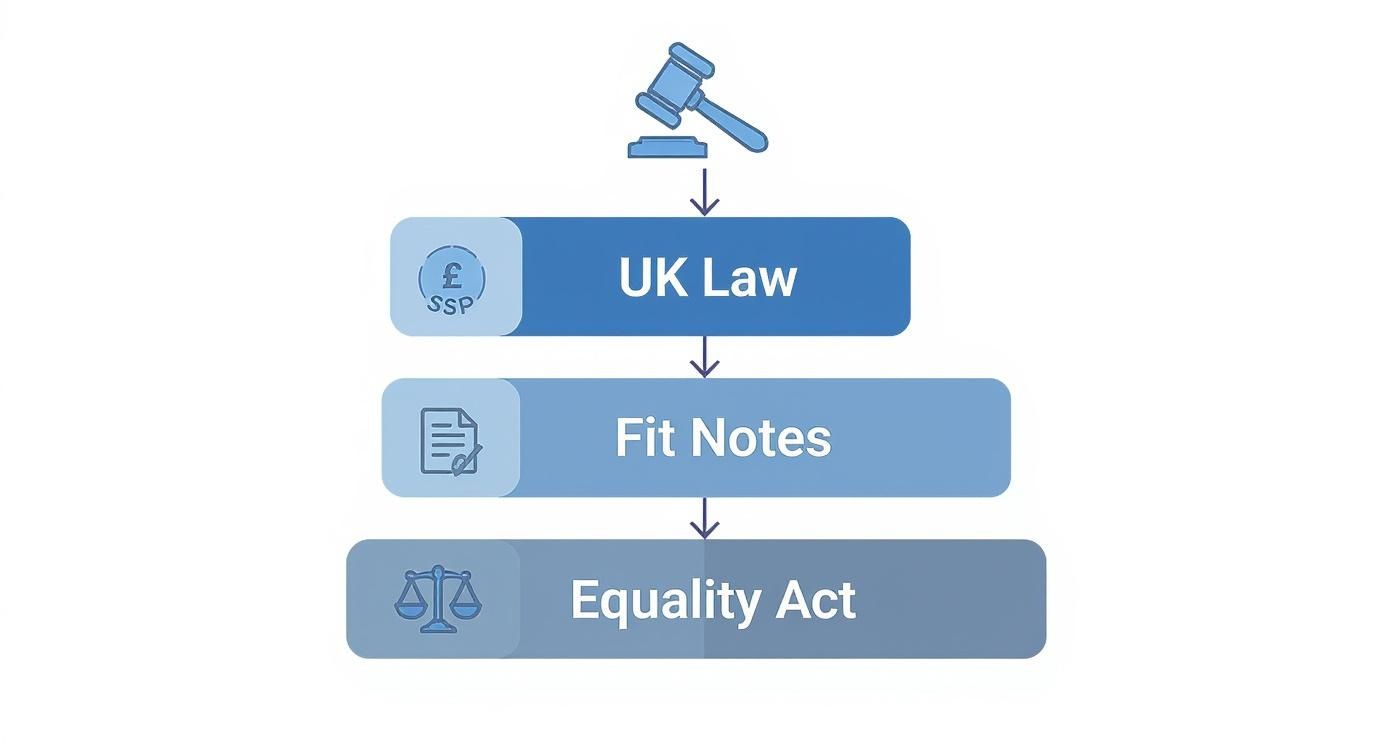
As you can see, core legal duties like SSP and the Equality Act are the bedrock. Everything you build on top of that must be compliant.
Outlining Pay and Communication Expectations
Nothing causes friction quite like confusion over pay. Being upfront about sick pay is non-negotiable for managing expectations and avoiding disputes down the line. Your policy must clearly explain both statutory and any company sick pay schemes you offer.
If you have a company sick pay (CSP) scheme, spell it out. Who is eligible? How long does it last? What's the rate of pay? If it’s discretionary or depends on employees following the right procedures, you absolutely must state that in black and white.
A truly comprehensive policy looks beyond the basics. For example, considering support for employees undergoing fertility treatment shows a real commitment to wellbeing. The Fertility Network UK's workplace initiative offers excellent guidance on this, helping you go beyond the legal minimums.
Finally, set out what you expect in terms of communication during an absence. It’s perfectly reasonable to ask for periodic updates, but the frequency needs to be sensible and appropriate for the situation. Regular, supportive contact helps the employee feel valued and connected, and it gives the business a clearer picture for planning their return.
To make sure you've covered all the essentials, here’s a quick checklist of the core components every robust UK absence sickness policy should include.
Essential Elements of Your Absence Sickness Policy
| Policy Component | What to Include | Why It Matters |
|---|---|---|
| Reporting Procedure | Who to contact, by what method, and by when on the first day of absence. | Ensures prompt notification, allowing for operational adjustments and consistent tracking. |
| Certification Rules | Details on self-certification (up to 7 days) and when a fit note is required. | Provides clear evidence for absence and complies with legal standards for SSP. |
| Sick Pay Details | A clear explanation of both Statutory Sick Pay (SSP) and any Company Sick Pay (CSP) scheme. | Manages employee expectations and ensures payroll accuracy and legal compliance. |
| Communication Plan | Expectations for keeping in touch during short-term and long-term absences. | Fosters a supportive connection and helps managers plan for the employee’s eventual return. |
Getting these elements right from the start creates a policy that’s not only compliant but also fair, supportive, and easy for everyone to follow.
Putting Your Sickness Policy into Practice
A brilliantly written absence sickness policy is a fantastic start, but let's be honest, it’s just a document until you bring it to life across your organisation. Effective implementation is what turns that framework from theory into a consistent, living practice. This means doing more than just uploading it to the company intranet and hoping for the best.
The real goal is to weave the policy into the fabric of your company culture. That journey begins with clear and constant communication. Every single employee, from their first day, needs to understand the nuts and bolts: how to report an absence, the rules around certification, and what’s expected of them. Don't just fire off an email; think about running workshops, discussing it in team meetings, and making it a cornerstone of your onboarding for all new hires.
Equipping Your Line Managers for Success
Your line managers are the most crucial players in making your sickness policy stick. They’re on the front line, dealing with absences every day, which means they have the biggest impact on its success or failure. Without proper training, even the best-written policy can be applied inconsistently, quickly leading to confusion and claims of unfair treatment.
Manager training needs to be practical, focusing on skills and building their confidence. They need to be comfortable and competent in several key areas:
- Conducting sensitive conversations: This includes knowing how to handle that first absence call with empathy and professionalism.
- Managing return-to-work interviews: These are crucial for understanding why someone was off and spotting any support they might need.
- Spotting absence patterns: Training helps managers recognise potential underlying issues, like those recurring short-term absences that might hint at a bigger problem.
- Providing support within legal boundaries: They must know how to offer support without veering into giving medical advice or making assumptions about an employee's health.
Remember, the purpose of a return-to-work interview isn't to interrogate an employee. It's a supportive conversation designed to welcome them back, check they are fit for work, and discuss any adjustments that might ease their return. This is a core part of proactively managing absence at work and preventing future issues.
Ultimately, by investing in clear communication for all staff and targeted training for your managers, you ensure your policy is applied fairly and consistently. This doesn't just protect your business; it reinforces a culture where employee wellbeing is genuinely valued.
Managing Short-Term and Long-Term Absence
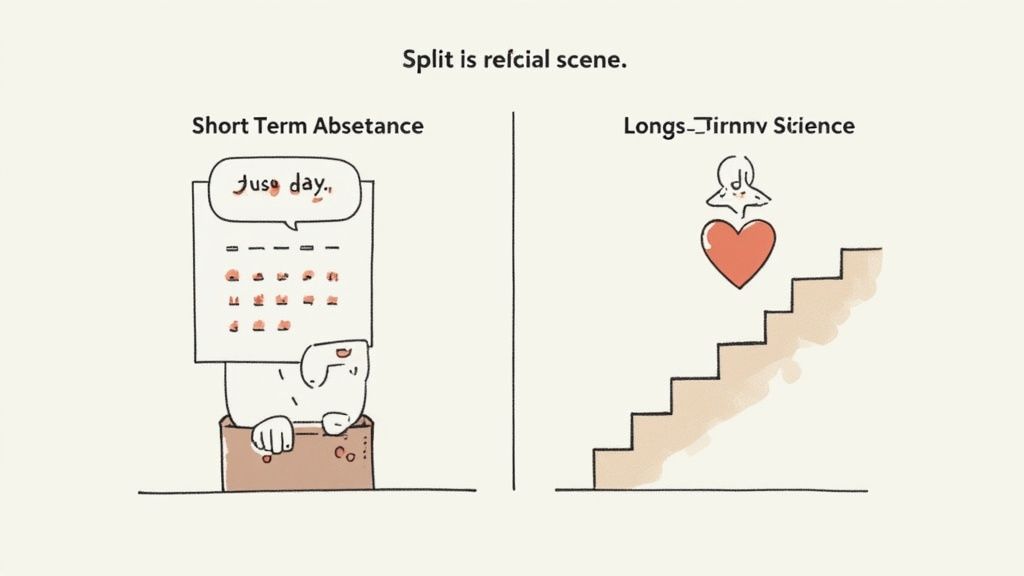
Let's be honest: a one-size-fits-all approach to managing sickness just doesn't cut it. How you handle a two-day cold should be miles apart from how you support an employee facing a six-month recovery. A truly effective absence sickness policy needs to make a clear distinction between short-term and long-term absence, with tailored strategies for each.
Getting this right has never been more critical. The UK has seen a worrying spike in workdays lost to sickness, with the average worker taking 9.4 sickness days in 2024. That’s a significant jump from 7.8 days in 2023 and the highest level the CIPD has recorded since 2010, with mental ill health a major driving force.
Strategies for Short-Term Absence
Short-term absences are the quick, frequent ones, usually lasting less than a week. While they might seem like small hiccups on their own, a pattern of recurring absences can point to bigger problems and cause real disruption to your operations. The key here is consistency and early, gentle intervention.
One of the best tools in your kit is the return-to-work interview. This isn't an interrogation; it's a supportive chat to welcome the employee back. It's a chance to check they're fit for work and to softly explore if any patterns or workplace issues are contributing to their time off. Holding these interviews every single time shows you take all absences seriously and, more importantly, that you genuinely care about your team's wellbeing.
Supporting Employees Through Long-Term Absence
When an absence stretches to four weeks or more, it enters long-term territory. This calls for a much more strategic and compassionate response. Your focus needs to pivot from simple monitoring to active case management, all geared towards helping them make a successful return.
This means maintaining regular, sensitive contact and often working with medical professionals. Key strategies include:
- Occupational Health (OH) Referrals: Bringing in OH specialists is a game-changer. They provide expert, impartial advice on an employee’s fitness for work and suggest practical adjustments to help them come back.
- Reasonable Adjustments: If the absence is linked to a disability, you have a legal duty under the Equality Act 2010 to make reasonable adjustments. This could be anything from modified duties to specialised equipment.
- Phased Returns: This is one of the most powerful tools for supporting recovery. Letting an employee ease back into their hours and duties can make all the difference. Our guide explains exactly how to manage a phased return to work for the best outcome.
For long-term sickness, the goal is always a sustainable return to work. It requires a partnership between the employer, the employee, and healthcare providers, ensuring support is tailored to the individual's needs.
To offer that extra layer of support during difficult times, you might also consider financial safety nets. Many companies find it valuable to explore accident and sickness insurance options to give their team an added cushion of security.
Answering Common Questions About Your Sickness Absence Policy
Even the most carefully written sickness absence policy can throw up questions. It's only natural for your team (and even other managers) to have queries when they're faced with a real-life situation. Getting ahead of these common sticking points is the best way to build trust and make sure your policy actually works.
Let’s tackle some of the most frequent questions that pop up. Clearing the air on these issues stops small misunderstandings from turning into bigger headaches down the line.
How Should We Handle Pay During Sickness?
Let's be honest, when an employee is unwell, one of their first worries is about their pay. Your policy needs to be absolutely clear on this.
You’re legally required to pay Statutory Sick Pay (SSP) to eligible employees after the first three 'waiting days' of an absence. That’s the baseline. However, many companies choose to offer a more generous company sick pay (CSP) scheme to better support their staff.
If you have a CSP scheme, your policy must spell out:
- Who gets it: Is it for everyone, or only for employees who have passed their probation?
- How much they get and for how long: For example, is it full pay for four weeks, then half pay for another four?
- Any strings attached: Do they need to follow the reporting procedure to the letter to qualify?
Being upfront about pay manages everyone's expectations and prevents any nasty surprises or disputes. It's a cornerstone of a fair and effective policy.
What Can We Do About Frequent Short Absences?
A pattern of short, frequent absences can often be more disruptive to the business than one longer period of sickness. Think of those recurring Monday or Friday absences. While often genuine, a clear pattern is worth looking into—not to punish, but to understand what’s really going on.
Your first move should always be a return-to-work interview. It’s a simple, fair, and consistent way to open up a conversation. This isn't an interrogation; it's a chance to show you care about their wellbeing and gently check if something at work, like stress or workload, might be a factor. If the pattern continues, your policy should clearly outline what happens next, whether that’s an informal chat or, if you suspect the absences aren't genuine, a more formal process.
The real goal here is to manage the situation, not just the absence. A supportive chat can uncover the root cause, which could be anything from a hidden health issue to a simple need for a reasonable adjustment.
Whose Advice Do We Follow: Our Doctor or the Employee's GP?
This is a classic dilemma, especially with long-term sickness. Your Occupational Health (OH) adviser might suggest an employee is ready for a phased return, but the GP's fit note still says they're not fit for work. So, who do you listen to?
Generally, UK law allows employers to rely on their own medical advice from an OH specialist, as long as it's relevant and current. OH advisers have a unique advantage: they understand your specific workplace and can offer practical, tailored advice. If there’s a major disagreement, the best course of action is to ask your OH provider to look at the GP's report and explain their differing opinion. Ultimately, the final call on workplace adjustments and return-to-work plans rests with you, the employer.
How Do Absence Rates Vary Across Different Roles?
It's also worth remembering that sickness absence isn't a one-size-fits-all issue. Rates can vary wildly depending on the industry and the nature of the job.
For instance, official NHS data for Wales showed an average sickness absence rate of 6.3% for the 12 months ending March 2025. But dig into the details, and you see a huge difference: healthcare assistants had a rate of 9.6%, while medical and dental staff were much lower at 2.4%. You can learn more about these NHS sickness absence findings to see just how much a person's role can influence absence trends.
Still trying to manage leave with spreadsheets and a messy inbox? It’s a recipe for mistakes and inconsistency. Leavetrack gives you a simple, central system to track every type of absence, so you can be sure your policies are applied fairly, every single time. See how you can save time and get a clearer picture by visiting https://leavetrackapp.com.