
Bank Holiday Allowance for Part Time Workers: A Practical Guide
Posted by Robin on 23 Feb, 2026 in
At its core, the principle behind bank holiday allowance for part time workers is simple: they get a fair, pro-rata share of public holidays, just like their full-time colleagues. But as anyone who's ever managed a payroll knows, turning that simple principle into practice can get complicated, fast.
Why Part Time Bank Holiday Pay Is So Confusing

Figuring out bank holiday entitlement for part-time staff often feels like you're trying to solve a particularly tricky puzzle. The real challenge boils down to one question: how do you stay fair and legally compliant without getting lost in a sea of spreadsheets?
This is a real headache for many businesses, especially when so many UK bank holidays fall on a Monday. If you have part-time team members who don't work Mondays, they could miss out on most of the public holidays. On the flip side, someone who always works Mondays might end up with more paid days off than their allowance fairly covers.
This isn't just an admin problem. It's an inconsistency that can quickly lead to claims of unfair treatment and really start to chip away at team morale.
The Principle of Fair Treatment
At the end of the day, it's all about preventing 'less favourable treatment'. The law is crystal clear: part-time workers should never be at a disadvantage compared to their full-time colleagues. This means they must receive a proportional amount of paid time off for bank holidays, no matter which days of the week they happen to work.
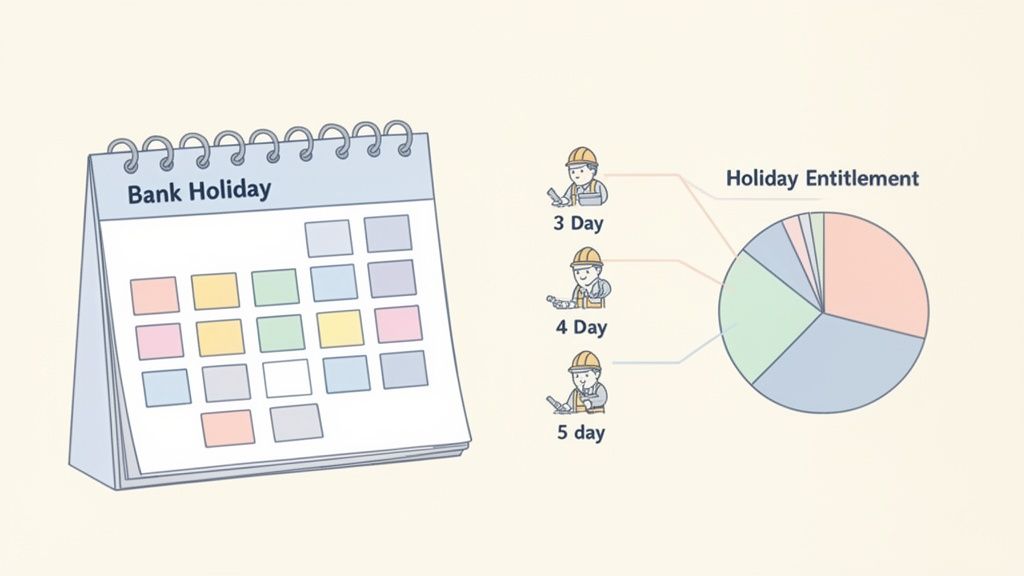
Think of it this way: if a full-time employee gets 8 paid bank holidays, their part-time colleague who works three days a week is entitled to a fair slice of that pie. It’s about splitting a company-wide benefit fairly, based on the hours people work.
The only way to solve this puzzle properly is to establish a clear pro-rata entitlement for everyone. This approach ensures every single person receives the correct holiday allowance, creating a transparent and equitable system for your entire team.
In the UK, part-time workers' bank holiday allowances are prorated based on their working hours, just like annual leave, ensuring fairness under employment law. This approach is rooted in the Working Time Regulations 1998. You can find more insights about making bank holidays fair for part-time staff on menzies.co.uk.
This guide is here to give you clear, practical solutions to cut through the confusion. We'll walk through the legal must-knows, break down the calculation methods with real-world examples, and show you how to build a policy that just works. Once you grasp the core ideas, you’ll be able to manage bank holiday allowance for part time workers with total confidence.
Getting to Grips with Your Legal Obligations
Navigating the rules around bank holiday allowance for part time workers can feel like a headache, but it all boils down to one simple idea: being fair. The law isn't there to trip you up; it’s designed to make sure part-time employees aren't getting a raw deal compared to their full-time colleagues.
This principle is baked into UK law, specifically the Part-time Workers (Prevention of Less Favourable Treatment) Regulations 2000. This bit of legislation is clear: part-time staff are entitled to the same benefits as full-time staff, just on a pro-rata basis. That includes paid public holidays.
Think about it this way. A bank holiday falls on a Monday, and your full-time team gets a paid day off. Great for them. But what about your part-time employee, Sarah, who only works Tuesday to Friday? Without a fair system, she gets absolutely no benefit from that public holiday. That's a textbook example of the 'less favourable treatment' the law is designed to stamp out.
The All-Important 5.6 Weeks Rule
In the UK, nearly every worker is entitled to a minimum of 5.6 weeks of paid annual leave. For a standard full-time employee working five days a week, this works out to 28 days (5.6 weeks x 5 days). As an employer, you can decide whether to include the usual bank holidays within this 28-day pot or grant them on top of it.
The crucial point here is that this 5.6-week entitlement is for everyone, part-timers included, but calculated pro-rata. The law doesn't give an automatic right to have bank holidays off. Instead, it ensures part-timers receive a proportional holiday allowance, so they aren't penalised if a public holiday happens to land on one of their non-working days.
This is a really important distinction. Your legal duty isn't to give every part-timer the specific bank holiday off. It's to make sure their total paid holiday for the year is a fair slice of what a full-timer gets. To get deeper into the nuts and bolts, check out our ultimate guide to UK statutory holiday allowance.
Side-Stepping Common Legal Traps
Getting this calculation wrong isn't just a simple admin slip-up; it can lead to real legal trouble. If an employee feels they've been short-changed, they could raise a formal grievance or even take a claim to an employment tribunal.
And this isn't just a hypothetical risk. The data shows that part-time workers in the UK often miss out on the holiday allowance they're due. For instance, in 2023, only 39% of UK adults used their full annual leave. This trend affected over 18 million workers, many of them part-timers whose pro-rata allowance is already smaller to begin with.
Your core legal duty is to prevent a part-time worker from being at a disadvantage simply because of their working pattern. The safest way to ensure fairness and stay compliant is to calculate a pro-rata entitlement for all public holidays and add it to their total leave.
By understanding these fundamentals, you can build a holiday policy that’s not only fair and compliant but also builds trust and transparency across your whole team.
How to Correctly Calculate Pro-Rata Bank Holidays
Moving from legal theory to practical application is where many businesses get tripped up. The good news is that calculating the correct bank holiday allowance for part-time workers isn't as daunting as it seems once you have a clear method. The whole point is to make sure every employee gets their fair share of paid time off, no matter their work pattern.
This process levels the playing field, moving away from the old-fashioned "luck of the draw" approach where someone's entitlement depended purely on which days bank holidays happened to fall. This visual flow shows how the principle of fairness is applied to both full-time and part-time staff.

Ultimately, you land on a pro-rata calculation that puts part-time workers on an equal footing with their full-time colleagues, keeping you compliant and your team happy.
There are two main, reliable methods for working this out: one based on the number of days an employee works and another based on their total hours. Both get you to the same fair result, but each is better suited to different types of work patterns.
Method 1: Calculating Based on Days Worked
This is the most common and straightforward method, especially for staff who work a set number of full days each week. The calculation is simple and transparent, which makes it dead easy to explain to your team.
The formula compares the part-timer's working week to a standard full-time week (typically 5 days) and then applies that ratio to the total number of bank holidays in a year (usually 8 in England and Wales).
The Formula: (Number of days worked per week ÷ 5) × Total bank holidays = Pro-rata bank holiday entitlement
Let's see this in action with a quick example.
Example 1: The Three-Day Worker Imagine you have an employee, David, who works three full days a week. A full-timer in your company gets 8 bank holidays per year.
- Calculation: (3 ÷ 5) × 8 = 4.8 days
- Result: David is entitled to 4.8 days of paid leave to cover the bank holidays.
This calculation is fundamental to getting this right. To dig deeper into the wider principles, you can explore our detailed guide on how to calculate pro-rata holiday in the UK.
Method 2: Calculating Based on Hours Worked
The days-based method is great for consistent schedules, but what about employees with more variable hours? If someone works different hours each day, a calculation based on their total weekly hours gives a much more accurate and fair result.
This approach compares the part-timer's weekly hours to the hours of a full-time employee. To get started, you'll need to know what a full-time week looks like at your company (e.g., 37.5 or 40 hours).
The Formula: (Part-timer's weekly hours ÷ Full-timer's weekly hours) × Total bank holidays (in hours) = Pro-rata bank holiday entitlement (in hours)
To use this, you first need to convert the bank holiday entitlement from days into hours. If a standard workday is 8 hours, then 8 bank holidays equal 64 hours (8 days × 8 hours).
Example 2: The 24-Hour Week Worker Let's say another employee, Maria, works 24 hours a week, while a full-time contract is 40 hours. Your company's standard workday is 8 hours.
- First, convert bank holidays to hours: 8 bank holidays × 8 hours/day = 64 hours.
- Then, apply the formula: (24 ÷ 40) × 64 = 38.4 hours.
- Result: Maria is entitled to 38.4 hours of paid leave for bank holidays.
Solving the Bank Holiday Paradox
Here’s where it gets interesting. What happens when a bank holiday lands on an employee's normal working day? Or, more commonly, when it doesn't? This is what we call the 'bank holiday paradox'.
A part-time employee who works every Monday might find that 6 of the 8 bank holidays fall on their working day. If their pro-rata entitlement is only 4.8 days, they're effectively getting more paid public holidays than they are strictly entitled to.
Conversely, an employee who never works Mondays might find that none of the bank holidays fall on their working days. They are still entitled to their 4.8 days, but they won't automatically get them off.
The solution is simple: you balance the books using their overall annual leave allowance.
- For the Monday Worker: You deduct the difference from their general holiday pot. They've taken 6 bank holidays but were only entitled to 4.8, so you would subtract 1.2 days from their remaining annual leave.
- For the Non-Monday Worker: You add their entitlement to their general holiday pot. They've taken 0 bank holidays but were entitled to 4.8, so you add 4.8 days to their annual leave for them to take at another time.
This adjustment ensures that everyone receives their correct total paid time off for the year, perfectly balancing fairness and compliance.
Handling Complex Scenarios and Edge Cases
Real-world leave management is rarely a straight line. Just when you’ve got the standard pro-rata sums down, you’ll inevitably run into a situation that doesn’t quite fit the formula. These edge cases can throw a spanner in the works, but with a clear and consistent approach, they’re perfectly manageable.
Let's walk through some of the trickiest scenarios involving bank holiday allowance for part time workers, from staff on family leave to those with irregular hours.
Staff on Maternity or Family Leave
This is a big one. An employee on maternity, paternity, adoption, or shared parental leave continues to build up their holiday entitlement just as if they were still at work. That absolutely includes their pro-rata share of bank holidays.
Their employment contract is still active, which means their right to paid leave is fully protected. You’ll need to calculate their pro-rata bank holiday allowance for the entire leave period and add it to their holiday pot. They can then take this time either before their leave starts or when they return to work.
- Action: Calculate their full pro-rata bank holiday entitlement for the year, regardless of their time off for family leave.
- Implementation: Make sure this is added to their total accrual, ready for them to use when they’re back.
Getting this wrong isn't just a mistake; it can be discriminatory. It’s vital to handle it correctly. The same rules apply to employees on long-term sick leave, too.
The key takeaway here is that an employee’s right to statutory paid holiday keeps accruing throughout periods of statutory family leave. This protection ensures they aren't put at a disadvantage for taking time off to care for their family.
New Starters and Leavers Mid-Year
When someone joins or leaves part-way through your holiday year, you can’t just give them the full year’s allowance. Their entire leave pot, including bank holidays, needs to be calculated on a pro-rata basis for the portion of the year they actually worked for you.
First, figure out how many bank holidays fall within their employment dates. From there, you can calculate their pro-rata entitlement for that specific period.
Example: A Part-Time Leaver Let's imagine a part-time employee works 3 days a week and leaves your company on 30th June. Your holiday year runs from January to December, and there were 4 bank holidays between the start of the year and their last day.
- Work out their full-year pro-rata bank holiday entitlement: (3 days ÷ 5 days) × 8 bank holidays = 4.8 days.
- Now, pro-rata that for the period they worked (6 months): 4.8 days × (6 months ÷ 12 months) = 2.4 days.
- Compare what they're owed to what they've taken: If 3 of those bank holidays fell on their usual working days, they’ve actually taken 0.6 days more than they were entitled to. You would normally deduct this overpayment from their final salary.
The same logic works in reverse for new starters, ensuring they get the right allowance from day one.
Zero-Hour and Casual Contracts
Calculating holiday for workers on zero-hour or casual contracts can feel like a headache, but the legal principle is the same: they are entitled to fair, pro-rata paid holiday, which includes bank holidays.
The simplest and most common way to handle this is by calculating their holiday entitlement as 12.07% of the hours they’ve worked. This figure isn’t random; it’s derived from the statutory 5.6 weeks of holiday, divided by the remaining 46.4 working weeks of the year (5.6 ÷ 46.4 gives you roughly 12.07%).
- How it Works: For every hour an employee works, they earn a small slice of paid holiday time.
- Application: At the end of each pay period, you just multiply the total hours they worked by 12.07% to see how much paid holiday they’ve accrued.
This method makes sure their bank holiday allowance for part time workers on variable contracts is directly tied to the hours they actually put in, keeping everything fair, transparent, and compliant.
Building a Fair and Transparent Company Policy
A clear, well-written policy is your best defence against confusion and the number one tool for making sure every team member is treated fairly. When it comes to the bank holiday allowance for part time workers, transparency isn't just a nice-to-have—it's essential for building trust and heading off disputes before they start. A strong policy becomes the single source of truth for everyone.
This means getting specific and ditching any vague statements. You need a document that spells out exactly how entitlements are handled. Applying solid principles of drafting in law can be a huge help here, ensuring your policy is clear, accurate, and leaves no room for misinterpretation. The goal is simple: any employee, no matter their work pattern, should be able to read it and know exactly where they stand.
Core Components of a Strong Policy
To be truly effective, your policy needs to cover a few key areas. It has to be specific enough to handle the usual situations without leaving anything to guesswork. Think of it as the instruction manual for your company's approach to leave.
Your policy must explicitly state:
- The Calculation Method Used: Be upfront about whether you calculate pro-rata entitlement based on days or hours worked. Pop a simple, worked example right into the policy itself—it can make a world of difference for employee understanding.
- Handling of Bank Holidays on Non-Working Days: Explain what happens when a public holiday falls on an employee’s normal day off. Make it clear that they will receive their pro-rata entitlement as time off in lieu (TOIL) to be taken at another time.
- The Adjustment Process: Detail how you'll square things up when an employee's schedule means they take more or fewer bank holidays than their pro-rata entitlement. This manages expectations for everyone involved and prevents any end-of-year surprises.
Sample Policy Language You Can Adapt
Drafting policy from scratch is tough, so here are a couple of sample clauses you can adapt for your own employee handbook. They’re designed to be clear, direct, and unambiguous.
Example Clause 1: Pro-Rata Entitlement
"All part-time employees are entitled to a pro-rata equivalent of all company-paid public holidays. This is calculated based on the number of hours you are contracted to work compared to a full-time employee. Your specific pro-rata bank holiday allowance is detailed in your employment contract and updated annually."
This clause immediately sets a clear foundation, confirming the principle of pro-rata entitlement right from the start.
Example Clause 2: Adjusting for 'Too Many' or 'Too Few' Bank Holidays
"If a bank holiday falls on your normal working day, you will receive that day off with pay. At the end of the holiday year, we will reconcile the number of bank holidays you have taken against your pro-rata entitlement. Any deficit will be added to your annual leave allowance as time off in lieu; any surplus will be deducted from your remaining annual leave."
This language tackles the 'bank holiday paradox' head-on and explains the reconciliation process perfectly. No surprises, no confusion. Clear communication like this is the bedrock of a fair and successful system.
How to Automate Bank Holiday Allowances

Let's be honest: calculating part-time bank holidays by hand is a recipe for disaster. It’s slow, tedious, and dangerously prone to human error. One simple slip-up in a spreadsheet can easily lead to incorrect pay, frustrated employees, and even serious legal compliance headaches. It's an administrative burden that smart businesses are actively moving away from.
Switching to an automated system gets rid of these risks entirely. It guarantees that the complex pro-rata rules are applied fairly and consistently for every single person on your team. This shift from spreadsheets to a dedicated system ensures every calculation is spot on, saving countless hours and, just as importantly, building trust with your employees. For businesses looking to manage this kind of complexity, solutions for Automated Data Processing can make all the difference.
A proper absence management system is built specifically to handle the fiddly details of calculating bank holiday allowance for part time workers. It turns what was once a confusing manual chore into a seamless background process that just works.
Streamlining Entitlements with Technology
One of the biggest wins from automation is setting up rules that run on their own for every employee. You can configure specific pro-rata entitlements based on individual work patterns—whether someone works fixed days, variable hours, or a compressed week. The system simply does the maths for you.
Key features make the whole process effortless:
- Automatic Pro-Rata Calculation: The software calculates each part-timer’s bank holiday entitlement based on their contracted hours or FTE, taking all the guesswork out of it.
- Real-Time Balances: Both managers and employees get a clear, up-to-date view of holiday balances, including the specific allowance for bank holidays. Total transparency.
- Integrated Team Calendars: A shared calendar gives you an instant snapshot of who is off and when, which makes scheduling around public holidays a breeze.
Moving to an automated system isn't just about being more efficient; it's about being fair. Automation ensures every part-time employee receives exactly the entitlement they are legally owed, without the risk of manual errors creating unfair inconsistencies.
By adopting this approach, you build a system that’s not only compliant and accurate but also frees up valuable time for HR and managers to focus on more important, strategic work. Having a clear and precise process, powered by the right tools, is fundamental. Our guide to automated leave management systems dives into these benefits in much more detail.
Frequently Asked Questions
Even with a clear policy, real-world situations can throw a spanner in the works. Let's tackle some of the most common questions we see crop up when managing bank holiday allowance for part time workers.
Getting these everyday scenarios right is crucial. It’s all about applying the core principles of fairness and making sure everyone on the team understands exactly how their entitlement works in practice.
What Happens If a Bank Holiday Falls on a Part-Timer's Day Off?
This is probably the most common question, and thankfully, the answer is simple. If a bank holiday lands on a day your part-time employee isn't scheduled to work, they can't be put at a disadvantage. They are still entitled to their fair, pro-rata share of that holiday.
The best way to handle this is to give them the equivalent time off in lieu (TOIL). They can then book this time off later, in line with your company’s usual process. This simple step ensures they get the exact same holiday benefit as their full-time colleagues over the course of the year.
Are We Legally Required to Give Part-Time Staff Paid Bank Holidays?
Here's a nuance that often trips people up: there's no absolute law stating that any employee, full-time or part-time, must have bank holidays as paid leave. The real legal hook is the Part-time Workers Regulations 2000, which says part-timers must not be treated less favourably than full-timers.
So, if your full-time staff get paid bank holidays, you must give a pro-rata equivalent to your part-time staff. For most businesses, the easiest way to do this is to roll the bank holiday allowance into the total statutory 5.6 weeks of annual leave. The key is consistency.
The legal obligation isn't about granting specific days off. It's about making sure the total paid leave entitlement is proportional and fair. Getting this wrong is a direct route to a claim of less favourable treatment.
My Employee Works Every Monday, What Do I Do?
This is another classic. An employee whose regular working pattern includes Mondays will naturally be off for more bank holidays than colleagues who don't work Mondays. You absolutely must pay them for these public holidays, as they fall on their contracted working days.
But this can sometimes mean they use up more paid leave than their pro-rata entitlement actually covers. Let's say their pro-rata bank holiday allowance is 4.8 days, but 6 bank holidays fall on a Monday that year. To keep things fair, you'd simply deduct the extra 1.2 days from their general annual leave pot. This 'balancing act' ensures their total paid leave for the year is correct and equitable for everyone on the team.
Trying to juggle these calculations with spreadsheets is a recipe for mistakes and wasted time. Leavetrack takes the headache out of it by automating pro-rata calculations and tracking bank holiday allowances, giving everyone a clear, real-time view. It's fairness and compliance without the fuss. Discover how Leavetrack can simplify your absence management today.