

Bradford Points Sickness A Guide to Fair Absence Management
Posted by Robin on 15 Jan, 2026 in
Let's be clear: a Bradford points system isn't about punishing people for being ill. It’s a tool—nothing more, nothing less—for measuring the operational impact of staff absences.
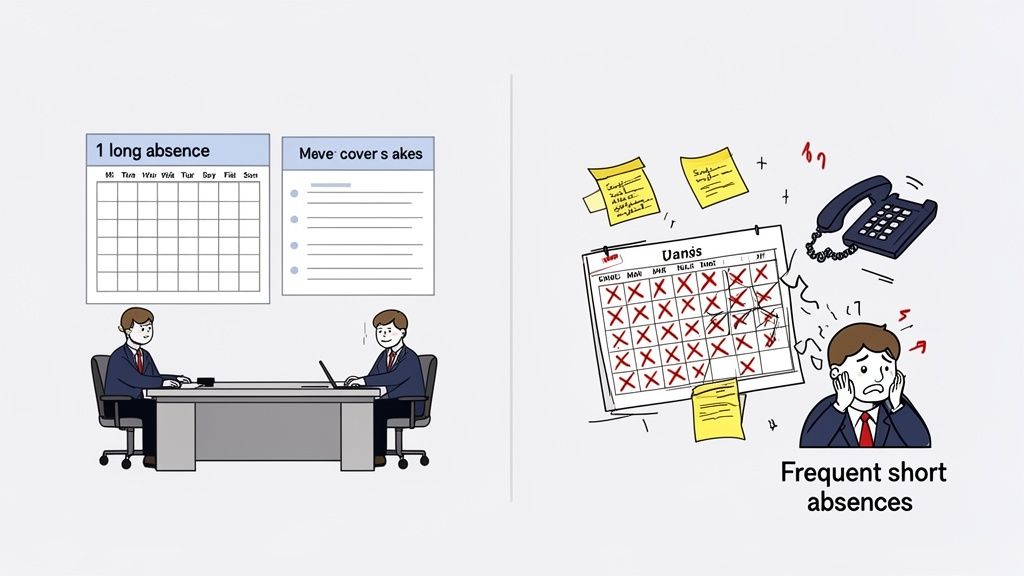
The whole idea is built on a simple truth that every manager knows: frequent, short-term, unplanned absences are often far more disruptive than one single, longer period of leave. This system, known as the Bradford Factor, just gives HR and line managers a data-driven way to spot potentially problematic attendance patterns.
Unpacking the Impact of Frequent Sickness
When people talk about Bradford points sickness, they’re referring to the score generated by the Bradford Factor formula. It’s a popular method used by UK businesses to bring some objectivity to absence management.
The formula itself is straightforward: S² x D. Here, 'S' stands for the number of separate absence instances (or spells), and 'D' is the total number of days the employee was absent.
Why Frequency Matters More Than Duration
Think about it from a practical standpoint. If a team member is off for a planned two-week absence for surgery, you can manage it. You can adjust schedules, delegate their work, and let clients know what’s happening. It’s a disruption, for sure, but it’s a contained one.
Now, imagine that same person is unexpectedly off for one day, ten different times over a few months. Each of those days forces a last-minute scramble to cover their work. It can create gaps in customer service and definitely piles the pressure onto their colleagues. This pattern creates a constant, low-level chaos that eats away at productivity and team morale.
The Bradford Factor formula is designed to reflect this reality by giving more weight to the frequency of absences. It helps you to:
- Identify patterns of recurring, short-term sickness that might otherwise slip under the radar.
- Provide an objective starting point for a conversation with an employee about their attendance.
- Ensure your absence policy is applied consistently across the entire business.
The goal isn’t to penalise genuine illness but to understand the operational reality of employee absence. A high score acts as a trigger, prompting a supportive conversation to uncover any underlying issues, rather than an automatic disciplinary action.
By using a clear metric like this, businesses can shift from constantly fire-fighting absences to having a more structured, fair, and consistent approach to managing them. It helps you maintain a reliable and engaged team without getting bogged down in endless spreadsheet tracking.
How to Calculate an Employee's Bradford Factor Score
Right, so you understand the concept behind the Bradford Factor. But to really see why it’s so widely used, you need to see it in action. The calculation itself is surprisingly simple, but its effect is what makes it such a powerful tool for flagging disruptive absence patterns.
The formula is: S² x D = Bradford Factor Score
Let's break that down into plain English:
- S stands for "Spells" (or separate instances) of absence over a set period. This is usually a rolling 52-week window.
- D is the total number of "Days" the employee was absent during that same period.
The magic ingredient here is squaring the number of spells (S²). This is what gives the formula its punch, making it heavily penalise frequent, short-term absences far more than a single, longer period of sickness. This mathematical quirk is the whole point—it’s designed to highlight disruption, not just duration.
Putting the Formula into Practice
To get a real feel for this, let's look at a classic comparison. Imagine you have two employees, Alex and Ben. Over the last year, both have been off sick for a total of 10 days.
On the surface, you might think their impact on the business was identical. Ten days is ten days, right? But their absence patterns tell two completely different stories.
- Alex was off for one continuous, 10-day period after a minor operation.
- Ben was off five separate times, for two days each, due to various minor bugs.
When we run these numbers through the Bradford Factor formula, the difference is night and day.
It's crucial to remember that a high Bradford Factor score isn't a disciplinary tool in itself. Think of it as an objective, data-driven flag that prompts a manager to sit down with their team member, have a supportive conversation, and find out what's really going on.
Bradford Factor Score Calculation Examples
Here’s a table showing the calculations for Alex and Ben, plus a couple of other common scenarios. It really highlights how the frequency of absence (S) dramatically inflates the final score.
| Employee | Absence Pattern | Total Days Absent (D) | Number of Instances (S) | Calculation (S² x D) | Bradford Factor Score |
|---|---|---|---|---|---|
| Alex | One 10-day absence | 10 | 1 | 1² x 10 | 10 |
| Ben | Five 2-day absences | 10 | 5 | 5² x 10 | 250 |
| Chloe | Four 1-day absences | 4 | 4 | 4² x 4 | 64 |
| David | Two 5-day absences | 10 | 2 | 2² x 10 | 40 |
As you can see, Ben’s score is a whopping 25 times higher than Alex’s, even though they were both absent for the same number of days. This is the Bradford Factor doing exactly what it was designed to do: quantify the significant operational headache caused by frequent, unplanned time off.
Thankfully, you don't need to be digging out your calculator every time someone calls in sick. Any good absence management software will handle these calculations automatically in the background. It takes the admin burden and risk of human error away, letting your managers focus on the people, not the paperwork. If you're still relying on spreadsheets, you can learn more about using a Bradford Factor calculator to make life easier.
Setting Fair Trigger Points for Your Absence Policy
A Bradford Factor score is just a number until you give it some meaning. That's where trigger points come in. Think of them as predefined thresholds in your absence policy that prompt a specific, consistent action whenever an employee's score hits a certain level.
Crucially, these triggers aren't about automatic punishment. It’s better to see them as conversation starters. They give a manager an objective, data-driven reason to check in with an employee, perhaps uncover a wellbeing issue, or tackle disengagement before it becomes a bigger problem. A well-thought-out system builds trust by showing everyone is treated fairly.
Establishing a Clear Framework
There aren't any legally mandated standards for Bradford Factor trigger points, so it's up to each business to set its own. Most UK companies find a tiered approach works best. A common and pretty effective framework usually looks something like this:
- Score 0-50: No Action Needed. This is the green zone. This kind of score is generally considered normal and reflects the odd day of low-impact sickness.
- Score 51-200: Informal Conversation. Once a score creeps into this range, it’s a good signal for a line manager to have a supportive, informal chat. This is often best done during a return-to-work interview to understand what’s going on and offer support.
- Score 201-400: First Formal Review. A score in this bracket points to a more significant pattern of disruption. This would usually trigger a more formal meeting to go over their attendance, review the absence policy, and set clear expectations for improvement.
- Score 401+: Final Warning & Further Action. A score this high flags a serious issue. It typically warrants a final formal warning and could lead to disciplinary procedures if attendance doesn't get better.
This flowchart maps out the basic decision-making process for tracking the absences that feed into an employee's score.
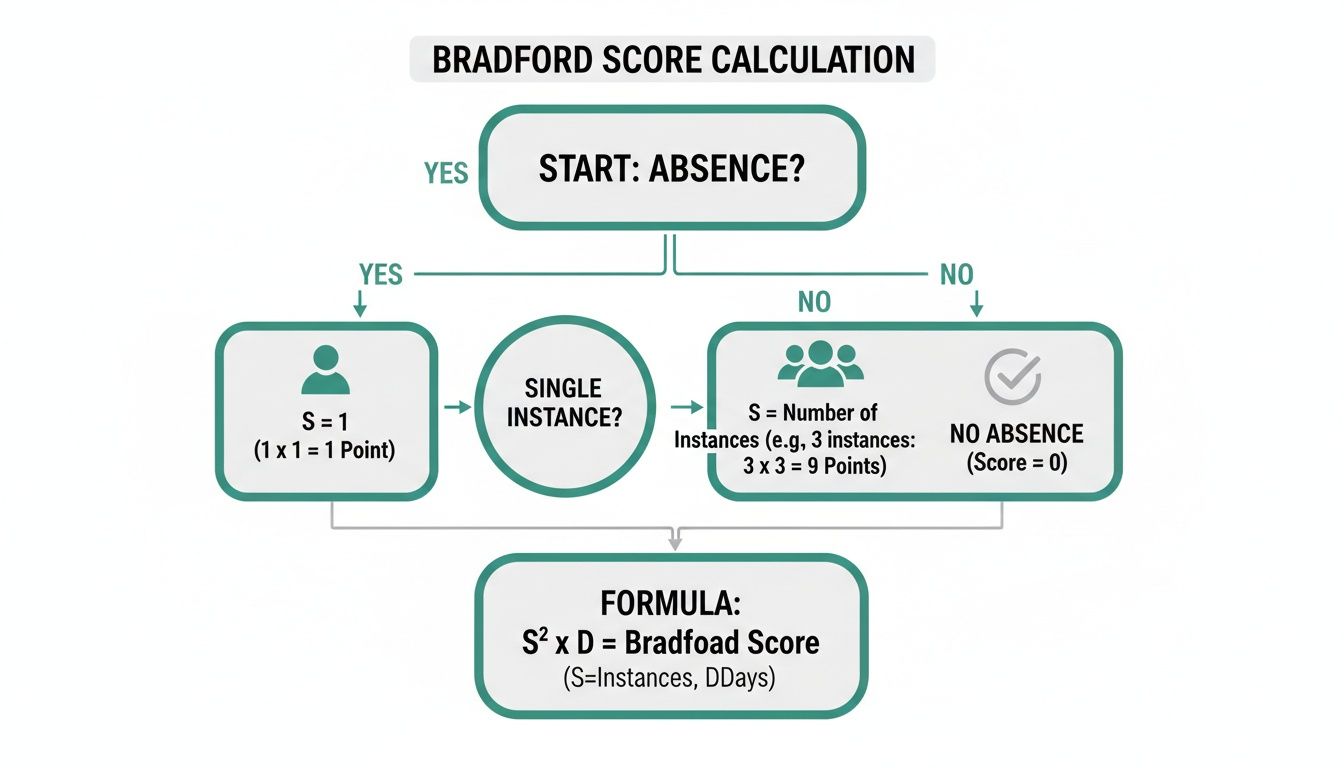
The key takeaway here is that you need to classify every absence properly. This ensures the calculation is accurate and correctly distinguishes between a single long-term issue and multiple, short-term ones.
Context Is Crucial
While these numbers are a helpful guide, applying them rigidly is a huge mistake. The data shows that some sectors and demographics naturally have higher rates of absenteeism. For example, the average UK Bradford Factor score for HR and accounting professionals is 113 – a figure that would already cross the first trigger point in many companies. For Gen Z workers in those same fields, the average score shoots up to a massive 185. This might suggest that things like early-career stress or gaps in wellbeing support are playing a part. You can explore more findings about sickness rates across different UK professions.
The best absence policies use bradford points sickness scores as a signal, not a verdict. They give managers objective data to start a human conversation, making sure fairness and empathy are always at the heart of the process.
At the end of the day, your trigger points need to be clearly documented in your company's absence policy. Communicating them transparently means every employee understands what’s expected and knows the process, which is fundamental to building a fair and supportive workplace culture.
The Pros and Cons of Using the Bradford Factor
No HR tool is a silver bullet, and the Bradford Factor is no exception. While it’s a powerful method for flagging disruptive absence patterns, you have to approach it with a clear-eyed view of its strengths and weaknesses. Getting this balance right is crucial for building a fair, compassionate, and legally sound absence management strategy.
Its greatest strength is its objectivity. By applying the same mathematical formula to everyone, it gives you a consistent and unbiased starting point for managing sickness absence. This really helps to stop personal biases from creeping into decisions and ensures all employees are treated the same way under your policy.
The Advantages of the Bradford Factor
The system offers some clear wins for managers who need consistency and data to back up their decisions. It's particularly good at highlighting those nagging patterns of absence that might otherwise fly under the radar.
The main advantages are:
- Objective Measurement: It provides a simple, numbers-based way to spot recurring short-term absences, taking subjectivity out of that initial assessment.
- Fair and Consistent Application: When it's used correctly, the formula is applied uniformly across the board, which promotes fairness and transparency in how you manage absence.
- Early Intervention: Think of it as an early warning system. It gives managers a heads-up, allowing them to step in and address potential wellbeing or engagement issues before they become much bigger problems.
The Disadvantages and Risks
On the flip side, the Bradford Factor’s biggest weakness is its complete inability to understand context. The formula is a blunt instrument; it sees numbers, not people or their individual circumstances. This is where a purely data-driven approach can get you into trouble if you're not careful.
The score is a data point that should inform human judgement, not replace it. Relying on it as the sole basis for disciplinary action is not only unfair but also legally risky.
The most significant drawbacks include:
- Lack of Context: It can’t tell the difference between a genuine illness and someone pulling a sickie. It can inadvertently penalise employees with chronic health conditions, disabilities, or those caring for dependents with frequent illnesses.
- Encourages Presenteeism: A major risk is that staff will drag themselves into work when they're genuinely ill, just to avoid hitting a trigger point. This can make them sicker for longer, tank their productivity, and spread germs around the office.
- Potential for Discrimination: Without careful management, it could lead to discriminatory practices. This is a particular risk for employees protected under the Equality Act 2010.
Ultimately, the Bradford Factor is a useful diagnostic tool, but it's not a complete management solution on its own. It should always be paired with supportive return-to-work interviews and compassionate conversations to understand the story behind the numbers.
Navigating Legal Risks and UK Best Practices
While the Bradford Factor can be a useful, data-driven tool for managing absence, using it without careful thought can land you in serious legal hot water. In the UK, any absence management policy has to sit squarely within the rules of employment law, especially the Equality Act 2010.
A rigid, automated approach to bradford points sickness can easily lead to discrimination. The formula itself is blind; it can't tell the difference between a one-off sick day and an absence tied to a long-term health condition or disability. That's a critical distinction you are legally required to make.
The Equality Act and Reasonable Adjustments
Under the Equality Act 2010, employers have a legal duty to make reasonable adjustments for employees with disabilities. This isn't optional. Applying a blanket Bradford Factor policy without any flexibility could put disabled employees at an unfair disadvantage, as their score might climb due to absences directly linked to their condition.
A high Bradford score should never be an automatic trigger for disciplinary action. Instead, think of it as a flag—a prompt to start a supportive, confidential conversation and understand the story behind the numbers.
To stay on the right side of the law, your policy needs to be flexible enough to handle these situations. Good practice looks like this:
- Discounting Disability-Related Absences: Any absence that's a direct result of an employee's known disability should be recorded, but it must be excluded from their Bradford Factor calculation.
- Excluding Protected Leave: Sickness related to pregnancy, as well as time off for maternity, paternity, or dependency leave, also needs to be kept out of the score.
- Conducting Return-to-Work Interviews: These chats are your best opportunity to understand the real reasons for an absence. It’s often when an employee might feel comfortable disclosing an underlying health issue you didn't know about.
Adopting a Fair and Supportive Approach
A legally sound policy uses the Bradford Factor as just one piece of a much bigger, more human-centred puzzle. It’s about shifting the focus from punishment to support. When you get this right, the system can actually be a powerful tool for positive change.
Take the UK Prison Service, for example. They introduced the Bradford Factor as part of a wider initiative to manage their 48,000 employees. By pairing it with things like better occupational health services and supportive return-to-work processes, they saw a massive 25% reduction in sickness absence over five years.
Building a solid policy means documenting everything and treating every case with consistency and empathy. For a deeper dive into creating a policy that balances business needs with your legal duties, check out our guide to a fair absence and sickness policy. To get a broader view on how businesses meet various legal requirements, including health and safety, you can explore the principles behind the ISO 45001 standards for legal compliance. By combining data with compassion, you can build a system that works, is fair, and keeps you compliant.
Using Absence Management Software To Bring Your Policy To Life
Trying to track sickness, calculate scores, and flag trigger points on a spreadsheet is an administrative headache waiting to happen. It’s clunky, wide open to human error, and makes applying your policy fairly a real challenge. This is where modern absence management software completely changes the game.
Instead of fighting with formulas, these tools do all the heavy lifting for you. When an employee’s sickness is logged, the system instantly recalculates their Bradford Factor score behind the scenes. This shifts managing bradford points sickness from a reactive, paper-shuffling exercise to a proactive, real-time strategy.
Automation for Consistency and Clarity
The biggest win here is creating a single source of truth. Managers get a central dashboard that shows absence trends, flags high scores, and gives them an objective starting point for any follow-up conversations. This frees them up to actually support their team instead of getting bogged down in admin.
A good dashboard, for example, will instantly show you which employees are getting close to a trigger point, letting you step in early with support.
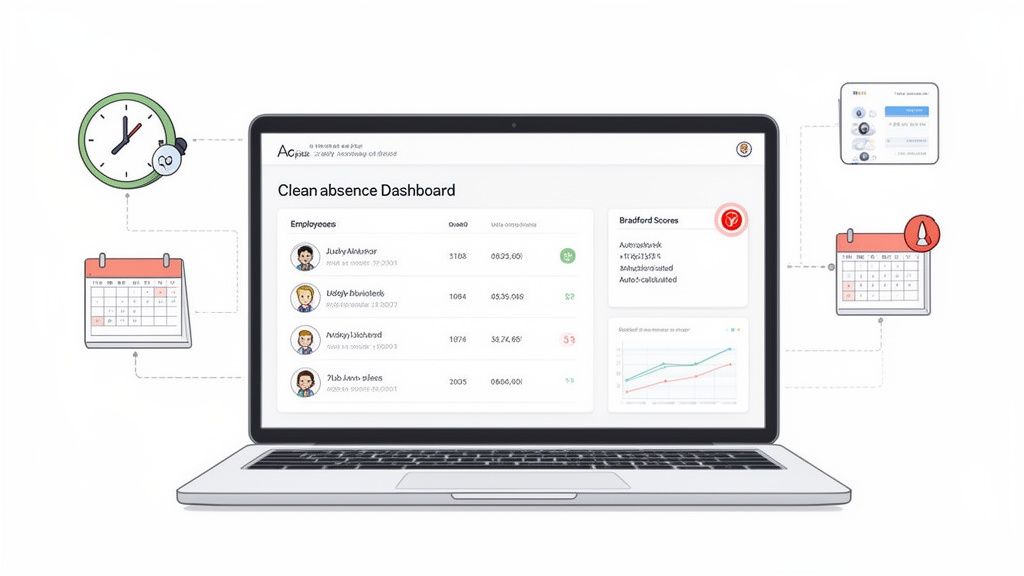
This kind of clear, visual data ensures every manager is working from the same playbook, making it much easier to apply your absence policy consistently across the whole business.
This automation also builds a clear audit trail for every absence, which is absolutely vital for running a fair and transparent process. If you want to dive deeper into how tech can help you stay on the right side of the rules, check out our guide on how absence management software can streamline UK compliance.
Software ensures the rules are applied the same way for everyone, every time. It strips out the guesswork and bias, providing objective data that empowers managers to act confidently and fairly.
Getting your systems talking to each other is also key. To keep all your records straight and stay compliant, it's worth looking into modern HR document management solutions that can link up with your main absence platform. This helps you build a solid, well-documented process from start to finish.
Common Questions About Bradford Sickness Points
Rolling out any new system, especially one that tracks absence, is going to bring up questions. That's perfectly normal. Getting ahead of these and providing clear, consistent answers is the key to making sure everyone feels the policy is fair and transparent.
Let's walk through some of the most common queries that come up around Bradford sickness points.
Should Absences Related to a Disability Count?
In a word: no. Under the Equality Act 2010, UK employers have a legal duty to make reasonable adjustments for employees with disabilities. This isn't just good practice; it's the law.
Discounting absences that are a direct result of a known disability from the Bradford Factor calculation is a crucial part of this. Your absence policy needs to spell this out clearly. Remember, the score is just a trigger for a supportive conversation, not an automatic penalty. This is doubly true when someone is managing a long-term health condition.
What Is a Good or Bad Bradford Score?
There isn't a universally agreed "bad" number, but most UK companies use a system of triggers to prompt action. While the exact thresholds will vary from one business to another, a common setup often looks something like this:
- Under 50: Generally seen as fine. No action needed.
- 50-200: This might trigger an informal chat during a return-to-work interview.
- Over 200: Could lead to a more formal review, potentially a first warning.
- Over 600: This would likely kick off a more serious disciplinary process, always following a proper investigation.
The most important thing is to communicate your company's specific thresholds in your absence policy. No one should be left guessing where the lines are drawn.
A high Bradford score should never, ever lead to an automatic dismissal. It's just one piece of evidence, not the final verdict. Using it as the sole reason for termination is a legal minefield and completely ignores an individual's personal circumstances.
Can Someone Be Fired for a High Score Alone?
Dismissing an employee based purely on a number generated by the Bradford Factor is incredibly risky and ill-advised from a legal standpoint. The score should only ever be the catalyst for a fair, thorough, and compassionate investigation into their attendance.
That process has to include formal meetings, discussions about the reasons for their absence, and a real consideration of any medical or personal context. Crucially, it must follow your company's formal disciplinary procedure to the letter, and the employee must always have the right to appeal any decision made.
With UK sickness absence hitting its highest rate in over a decade, averaging 7.8 days per employee in 2023, it's clear that managing absence fairly and effectively is more critical than ever. You can learn more about the latest sick days trends in the UK here.
Ready to ditch the spreadsheets and start managing absence with fairness and consistency? Leavetrack gives you the tools to automate Bradford Factor scores, spot trends, and spend your time supporting your team, not drowning in admin. Discover how Leavetrack can simplify your absence management today.