

Holiday Allowance UK: Master Leave Rules & Calculations
Posted by Robin on 21 Jan, 2026 in
In the UK, every full-time worker is legally entitled to 5.6 weeks of paid annual leave. For most people, that works out to 28 days a year. This isn't just a nice-to-have perk; it's a legal minimum designed to ensure everyone gets paid time off to rest and recharge.
Getting to Grips with Your UK Holiday Allowance
The bedrock of UK holiday rights is the Working Time Regulations 1998. This piece of legislation sets out the absolute minimum paid holiday your employer must provide. It’s a legal requirement, not a suggestion, and it’s there to protect your well-being.
Think of this statutory minimum as the ground floor for your company's holiday policy. They can always offer more—and many do to attract top talent—but they can never offer less.
For someone working a standard five-day week, this 5.6-week entitlement is straightforward: it’s 28 days of paid time off. One crucial detail often trips people up: employers are allowed to include bank holidays within this 28-day total. They don't have to be given as extra paid days off unless it's in your contract.
To get a clearer picture of how this works across different working patterns, here's a quick summary.
UK Statutory Holiday Entitlement at a Glance
This table breaks down the minimum legal entitlement for different types of workers, based on the standard 5.6 weeks.
| Worker Type | Statutory Entitlement (Weeks) | Equivalent Days (For 5-day week) |
|---|---|---|
| Full-Time | 5.6 weeks | 28 days |
| Part-Time | 5.6 weeks (pro-rata) | Varies based on days worked |
| Irregular Hours | 5.6 weeks (pro-rata) | Calculated based on hours worked |
As you can see, the core principle of 5.6 weeks applies broadly, ensuring that nearly all workers, including agency staff and those on zero-hours contracts, are covered.
Your Rights Under the Working Time Regulations
The rules are pretty simple and apply to almost everyone classified as a 'worker'. This wide definition is intentional, offering consistent protection across many kinds of employment.
Here are the core principles you need to know:
- Minimum Entitlement: You must receive at least 5.6 weeks of paid holiday each year.
- Accrual from Day One: Your holiday allowance starts building up (or 'accruing') from the very first day you start your job.
- Paid at Your Normal Rate: When you take holiday, you must be paid your normal weekly wage.
For a deeper dive into the nitty-gritty, our guide to GOV.UK holiday entitlement breaks down these foundational rules even further.
How Does the UK Stack Up Internationally?
While 28 days provides a solid base, it's interesting to see how we compare to our European neighbours. The truth is, the UK's provision is less generous than many.
For example, Spain mandates 36 days of statutory paid leave. Sweden, France, and Denmark each provide 25 working days plus their public holidays on top. This puts the UK in the bottom tier among European nations for statutory holiday allowance, a point worth noting for companies trying to attract international talent. You can see more insights on European holiday comparisons on Statista.
How to Calculate Holiday for Different Work Patterns
Calculating holiday for a full-time employee who works Monday to Friday is pretty simple. But what about part-time staff, casual workers, or team members with all sorts of irregular hours? The thing to remember is that the statutory entitlement of 5.6 weeks applies to everyone—it’s just the maths that changes.
Think of holiday allowance as a pot of paid time off that everyone builds up as they work. For some, it's a straightforward multiplication. For others, it involves tracking hours and applying a set percentage. Getting this right isn't just good practice; it's a legal must.
Calculating Part-Time Holiday Pro-Rata
After full-time, part-time is the most common scenario you'll come across. The principle is simple: part-time employees get the same 5.6 weeks of holiday, but it's scaled down to match the days they actually work. This is known as a pro-rata calculation.
The easiest formula to use is:
Number of days worked per week x 5.6 = Total annual holiday entitlement (in days)
Let's take an example. Sarah works three days a week. To figure out her annual leave, you’d do this calculation:
3 days x 5.6 weeks = 16.8 days of paid holiday per year.
It’s pretty common for employers to round this up to the nearest half or full day, making it 17 days, just to keep things neat. This isn't a legal requirement, but it's a nice touch. For a deeper dive into different scenarios, check out our complete guide on how to calculate pro-rata holiday.
This infographic gives you a quick decision tree to help visualise how entitlement works for different types of employees.
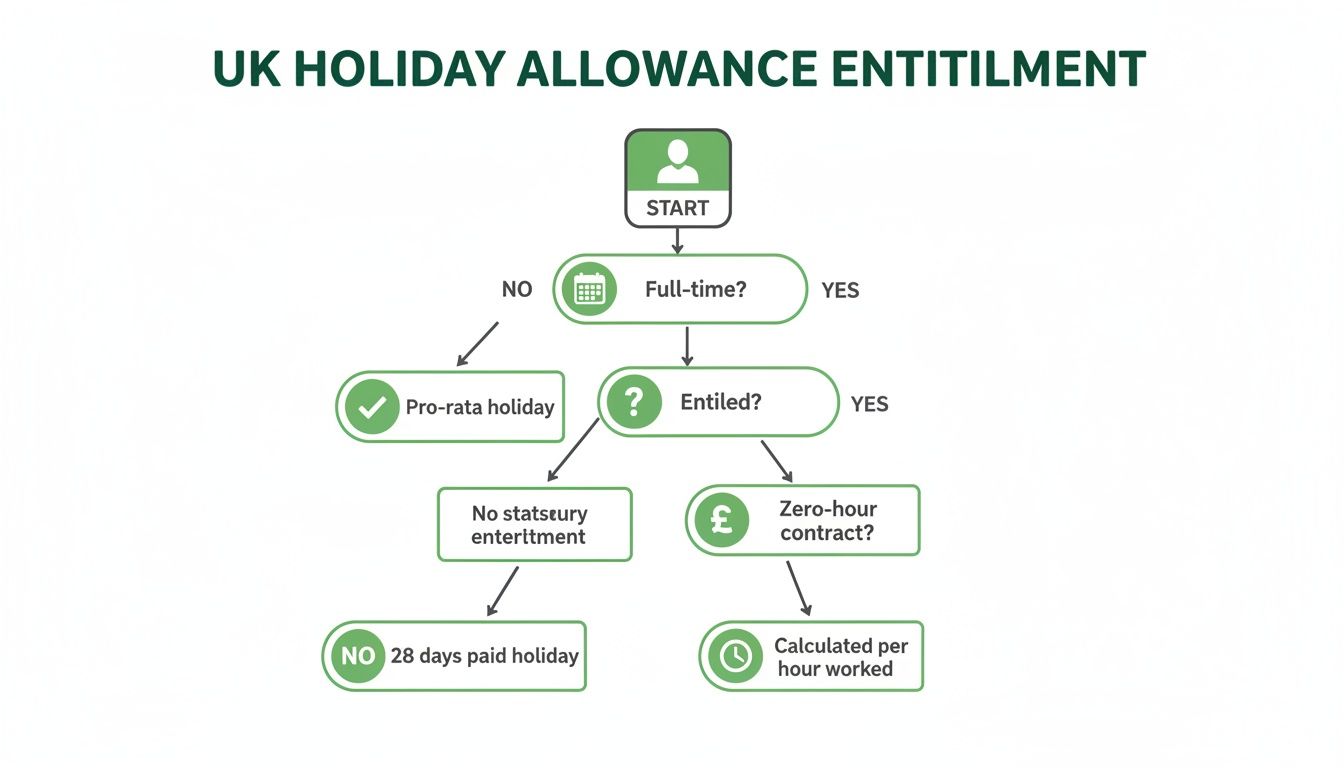
As the flowchart shows, it doesn't matter if someone is full-time or part-time—they are legally entitled to paid leave. It just points you down the right path for the calculation.
The Method for Irregular and Zero-Hours Workers
Working out holiday for staff with no fixed hours, like those on zero-hours contracts, can feel a bit tricky. Since you can’t predict their schedule, the simple days-per-week formula is out. Instead, their holiday is accrued based on the hours they actually clock in.
The standard method here is the 12.07% calculation. This figure isn't just plucked out of thin air. It comes directly from the legislation when the UK's holiday entitlement was increased to 5.6 weeks back in 2009. The percentage is worked out by dividing the statutory leave (5.6 weeks) by the number of working weeks in a year (46.4, which is 52 weeks minus the 5.6 weeks of leave). So, (5.6 / 46.4) x 100 gives you 12.07%.
To put this into practice, you just multiply the total hours someone worked in a pay period by 12.07%. This tells you exactly how much paid holiday they've earned.
Example Calculation:
David, an agency worker, put in 80 hours last month.
To calculate his accrued holiday: 80 hours x 12.07% = 9.656 hours of paid holiday earned for that month.
This "earn-as-you-go" approach makes sure that holiday entitlement is always perfectly in line with the work done. It's a fair and compliant way to manage leave for a flexible workforce.
Handling Accrued Holiday for Starters and Leavers
So what happens when people join or leave part-way through your company's holiday year? In these cases, their holiday is calculated on a pro-rata basis, depending on how much of the year they’ve been with you. Holiday entitlement accrues at a rate of 1/12th of their annual total for each full month of service.
For a new starter, this means they build up their holiday pot month by month. If a new full-time employee joins on 1st July and your leave year runs from January to December, they'll be working for 6 months of that year.
Their accrued holiday would be:
- Step 1: Calculate their monthly accrual: 28 days / 12 months = 2.33 days per month.
- Step 2: Multiply by months worked: 2.33 days x 6 months = 14 days of holiday for the rest of the year.
For someone leaving, the process is basically the same. You calculate the holiday they've accrued up to their last day and then subtract any leave they’ve already taken. If they have holiday left over, it must be paid out in their final payslip. If they’ve taken more than they’ve earned, you might be able to deduct it, but only if their employment contract specifically allows for it.
Navigating Holiday Carry-Over and Termination Pay
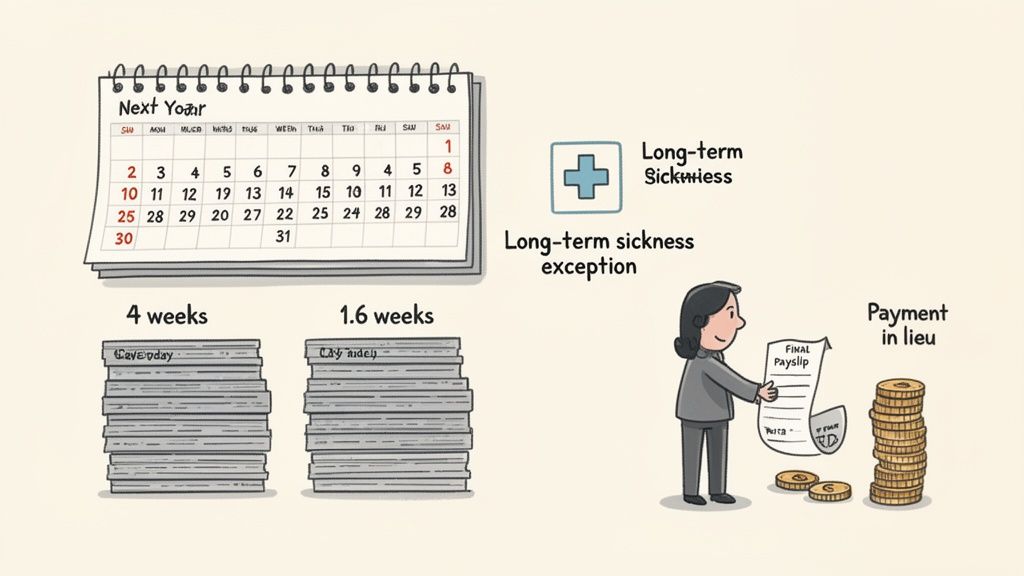
Managing unused annual leave is one of the trickiest parts of UK holiday admin. You'll inevitably face questions from employees wanting to save days for a big trip next year, or you'll need to figure out the final payment for someone leaving the company. Getting these rules right is crucial for staying compliant.
The regulations aren't always as simple as they first appear, mainly because they treat different parts of the statutory entitlement in different ways. Once you grasp this distinction, you can build a fair, clear, and legally sound policy for your team.
Understanding Holiday Carry-Over Rules
The statutory 5.6 weeks of annual leave is split into two distinct pots when it comes to carrying days over. It’s a detail many employers miss, which can quickly lead to confusion and disputes.
The First 4 Weeks: This chunk comes from the EU's Working Time Directive. UK law is clear: this leave is for rest and recovery. It cannot be carried over into the next leave year, except in very specific situations. You also can't pay an employee in lieu of taking it, unless they're leaving their job.
The Additional 1.6 Weeks: This extra entitlement is a purely UK-specific right. As a business, you have the flexibility to decide whether your staff can carry over some or all of this portion. Whatever you decide, make sure it’s spelled out clearly in your company holiday policy so everyone knows where they stand.
This two-tiered system gives you some wiggle room while still making sure your team gets the minimum time off they need for their wellbeing.
Key Takeaway: The first four weeks of statutory leave must be taken within the leave year. It’s only the additional 1.6 weeks where you can offer the flexibility for staff to carry it over, by agreement.
Exceptional Circumstances for Carry-Over
There is one major exception to the rule about not carrying over those initial four weeks: long-term sickness. If an employee is physically unable to take their holiday because they’re on sick leave, the law protects their right to that time off.
In these cases, they must be allowed to carry over up to four weeks of their statutory leave into the next holiday year. This carried-over leave then has to be used within 18 months from the end of the leave year in which it was accrued.
Calculating Pay for Untaken Holiday on Termination
When an employee leaves, you must pay them for any statutory holiday they've built up but haven't used. This is often called 'payment in lieu,' and getting the calculation right is vital for a smooth exit process.
The calculation is really just a continuation of the accrual method we looked at earlier. You figure out their total entitlement for the part of the year they worked, then simply subtract any holiday they’ve already taken.
Here’s a simple example:
- An employee gets 28 days of annual leave and leaves six months into the year.
- Accrued Holiday: 28 days / 2 = 14 days.
- They’ve already used 5 days of holiday during that time.
- Holiday Pay Owed: 14 days - 5 days = 9 days.
This final figure of nine days' pay must be added to their final payslip. A clear and accurate calculation helps manage the employee's departure professionally and avoids any last-minute friction. For a more detailed breakdown, you can learn more about holiday entitlement when leaving a job in our dedicated guide.
Crafting a Holiday Policy That Stands Out
The statutory minimum holiday allowance in the UK is the floor, not the ceiling. Think of it as the starting block. In a fiercely competitive job market, a thoughtfully designed holiday policy can be one of your most compelling assets for bringing in—and keeping—the best people. It’s a clear signal that you trust your team and genuinely care about their well-being.
Going beyond the legal basics shows you’re committed to building a supportive and human-centric workplace. This isn’t just about tacking on a few extra days off; it's about embedding flexibility and benefits that make a real difference to your team's work-life balance. When people feel properly rested and valued, you'll see it reflected in their creativity, engagement, and loyalty.
Popular Ways to Enhance Your Holiday Policy
There are plenty of creative ways to build on the standard holiday allowance. Each comes with its own perks for your team and different administrative considerations for you.
- Extra Days for Long Service: This is a classic for a reason. Rewarding loyalty with an extra day's holiday for every two, three, or five years of service is a simple yet powerful way to show your appreciation for long-term commitment.
- Holiday Purchase Schemes: This flexible option lets employees 'buy' additional holiday days, usually through a salary sacrifice arrangement. It’s a great perk for those who prioritise time off over a slightly higher paycheque, and it comes at no direct cost to the business.
- 'Duvet Days' or Wellness Days: These are unplanned, no-questions-asked leave days. They’re perfect for when someone just needs a mental health day to recharge without any hassle. They help build a culture of trust and acknowledge that we all have days where we're not at our best.
- Unlimited Holiday: It might sound radical, but an unlimited paid time off (PTO) policy is becoming more common. It completely removes the admin of tracking days and places the ultimate trust in your team to take the time they need while still delivering on their responsibilities.
The Importance of a Clear and Fair Policy
No matter which enhancements you choose, it's absolutely crucial to document everything in a clear, easy-to-find holiday policy. This document needs to be the single source of truth for everyone, ensuring fairness and consistency across the board.
A well-written policy is your best defence against future misunderstandings and disputes. It should spell out everything from accrual rates and approval processes to carry-over rules and how to book time off. Transparency is the bedrock of trust.
Interestingly, there’s been a noticeable shift in how UK employees are using their leave. While the average number of holiday days taken dropped from 38 in 2020 to 33.9 in 2023, the number of unused days has plummeted by 71% since 2019. This suggests people are now taking a much larger portion of their allowance, likely thanks to better policies and more encouragement from employers. You can dive deeper into these annual leave trends in the UK.
Below is a quick comparison of some of the most common policy enhancements to help you weigh up the options.
Comparing Common Enhanced Holiday Policies
| Policy Type | Primary Employee Benefit | Key Employer Consideration |
|---|---|---|
| Extra Days for Long Service | Feels valued and recognised for their loyalty to the company. | Simple to administer but needs a reliable system for tracking service anniversaries. |
| Holiday Purchase Scheme | More control and flexibility over their work-life balance. | Requires payroll coordination for salary sacrifice and clear communication on scheme rules. |
| 'Duvet Days'/Wellness Days | Reduces stigma around mental health and empowers staff to take needed rest. | Needs a culture of trust to prevent misuse; clear guidelines on frequency are helpful. |
| Unlimited Holiday | Ultimate autonomy and trust, removing the stress of counting days. | Requires a high-performance culture and managers trained to spot burnout or under-utilisation. |
Ultimately, by putting real thought into your holiday allowance, you can turn a simple legal requirement into a strategic asset that helps you build a happier, more committed, and more resilient workforce.
Automating Holiday Management to Reduce Errors
Knowing the rules for holiday allowance in the UK is one thing, but applying them flawlessly across an entire business is a completely different ball game. For many, the trusty spreadsheet is still the default tool for tracking leave. While it seems simple enough, this manual approach is often hiding risks and inefficiencies that can come back to bite you.
Manual calculations, especially for part-time staff or those on irregular hours, are a breeding ground for human error. A simple slip-up can lead to incorrect holiday pay and, worst-case scenario, legal disputes. Then there's the inconsistency problem, where policies get applied differently across teams, creating a feeling of unfairness. Beyond the compliance headaches, there's the sheer admin drain – hours upon hours spent updating records, checking calendars, and chasing approvals.
This is where dedicated software like Leavetrack comes in, turning holiday management from a messy administrative chore into a simple, automated process. By centralising and automating everything, you can stamp out errors, ensure fairness, and win back a huge amount of valuable time.
Setting Up an Automated System
Getting a modern leave management system up and running is surprisingly quick and intuitive. It's really just a matter of configuring a few key details that form the foundation for accurate, automated tracking that fits your specific holiday policy.
A typical setup usually involves these core steps:
- Configure Your Leave Year: First things first, you define your company’s holiday year. Whether it runs from January to December, April to March, or follows each employee’s start date, the system uses this as the bedrock for all its calculations.
- Set Statutory and Company Entitlements: You can lock in the baseline statutory entitlement of 5.6 weeks and then layer any extra company perks on top, like additional days for long service. This makes sure the correct allowance is assigned to every single employee automatically.
- Create Custom Pro-Rata Rules: For part-time staff, you just need to input their working pattern (e.g., three days a week). The system instantly works out their correct pro-rata holiday allowance, completely removing any need for manual maths.
- Manage Accruals Automatically: The software handles accruals for new starters and leavers without you lifting a finger. It calculates exactly what an employee has earned up to their start or end date, guaranteeing that final payslips are always spot on.
Gaining Real-Time Visibility and Control
One of the biggest wins with automation is the instant visibility it gives you. Instead of squinting at an out-of-date spreadsheet, managers and HR teams get a live, accurate picture of team availability at a glance.
By automating holiday management, businesses don't just reduce the risk of costly payroll errors; they also build a culture of transparency and trust. When employees can clearly see their own allowance and team schedules, the entire process becomes smoother and more collaborative.
Features like a team-wide wall planner provide a clear visual overview of who is off and when, making it easy to spot potential clashes and manage staffing levels effectively.
Here’s a quick look at how a digital wall planner provides an instant overview of team leave.
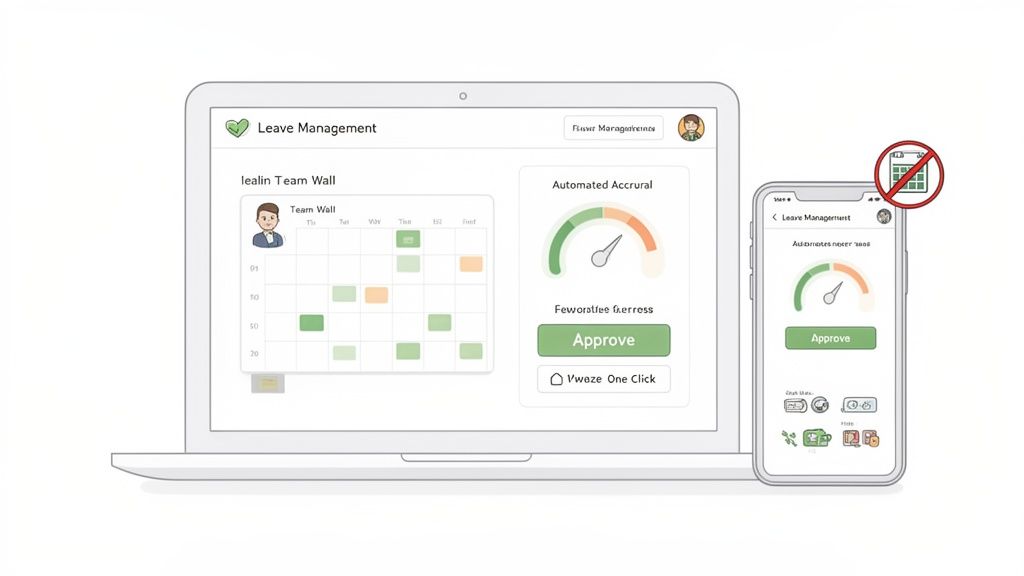
This kind of centralised view makes resource planning so much simpler and more strategic, preventing any last-minute staffing panics.
Simplifying Requests and Approvals
The old back-and-forth of email requests and paper forms is a huge time sink. Automation completely transforms this workflow into a seamless, efficient process that helps everyone out.
- Employee Self-Service: Team members can check their remaining holiday balance and pop in requests directly through the system. This empowers them to manage their own time off without any hassle.
- One-Click Approvals: Managers get pinged with new requests and can approve or decline them with a single click, often straight from their email inbox or a Slack notification.
- Automated Calendar Updates: As soon as a request is approved, the system can automatically update both the team wall planner and the individual's personal work calendar (like Outlook or Google Calendar).
This streamlined process not only saves time but also ensures that requests are handled quickly and nothing gets lost in a cluttered inbox. The benefits of getting your processes in order go far beyond just leave, too. Businesses can see huge time savings by automating employee-related processes like onboarding, which shares many of the same efficiency principles as smart holiday management.
By embracing automation, you can transform your UK holiday allowance management from a source of administrative pain into a real strategic advantage, creating a more organised, compliant, and supportive work environment for everyone.
Your Top UK Holiday Allowance Questions, Answered
Once you get your head around the basics of holiday allowance, the real-world scenarios start popping up. It's navigating these tricky situations that separates good leave management from the great. Here are some of the most common questions we hear, with clear, straightforward answers.
Think of this as your quick reference guide. It’s here to cut through the confusion and give you practical advice you can use right away.
Can We Tell Our Staff When to Take Their Holidays?
This is a big one, and the short answer is yes, you absolutely can. An employer has the right to tell employees when to take their holiday, which is especially common for things like a Christmas shutdown or a quiet period in the business.
But you can't just spring it on them. The rule is that you have to give proper notice, and the law is very specific about this: you must provide at least double the notice for the length of leave you want them to take. So, if you need someone to take a full week off, you need to let them know at least two weeks in advance.
What Happens to Holiday Allowance During Maternity Leave?
Your holiday rights are completely protected while you're on maternity leave. It continues to build up (or 'accrue') for the entire time you're away, covering both Statutory and any additional contractual holiday. It’s as if you were still at work.
A popular and smart move for new parents is to tag their accrued holiday onto the start or end of their maternity leave. It’s a great way to extend that precious time with their newborn while still receiving full pay. Remember, you can't pay an employee in lieu of this holiday unless their employment is ending.
How Do We Calculate Holiday Pay Correctly?
It's a common myth that holiday pay is just your basic salary. A few landmark legal cases have changed the game, and now, for the first four weeks of statutory leave, holiday pay needs to reflect what you'd normally earn.
This means you have to factor in extras like:
- Regularly worked overtime
- Commission payments
- Some types of performance-related bonuses
The whole point is to make sure people aren't financially worse off for taking a well-deserved break. The remaining 1.6 weeks can be paid at the basic rate, although for the sake of simplicity, many employers just pay the full 5.6 weeks at the higher 'normal pay' rate.
How Do Bank Holidays Work for Part-Time Staff?
To keep things fair, part-time workers are entitled to a pro-rata share of bank holidays. It doesn’t matter if they would normally work on the day the bank holiday falls.
For example, if a full-time employee gets 8 bank holidays, a colleague who works three days a week (which is 60% of a full-time week) is entitled to 4.8 days of paid leave for those bank holidays. This is simply added to their overall allowance.
Juggling all these rules is exactly where modern software steps in. With Leavetrack, all these fiddly calculations—from pro-rata bank holidays to maternity leave accruals—are automated. It keeps your business fair, accurate, and compliant, without all the administrative headaches. Discover how Leavetrack can simplify your leave management today.