
How Many Working Days in a Year UK A Guide for HR Managers
Posted by Robin on 02 Jan, 2026 in
For anyone in HR, getting your head around the number of working days in a year is step one for pretty much everything. From sorting out payroll and holiday leave to planning projects, it's the baseline figure you can't do without.
So, let's cut to the chase. For a typical full-time employee in England and Wales, you're looking at 253 working days in a standard year. When a leap year rolls around, that bumps up to 254 days.
Your Quick Answer to UK Working Days
This number isn't just plucked out of thin air. It’s the result of a simple calculation that strips out all the non-working days from the calendar, giving you the foundation for all your annual HR planning.
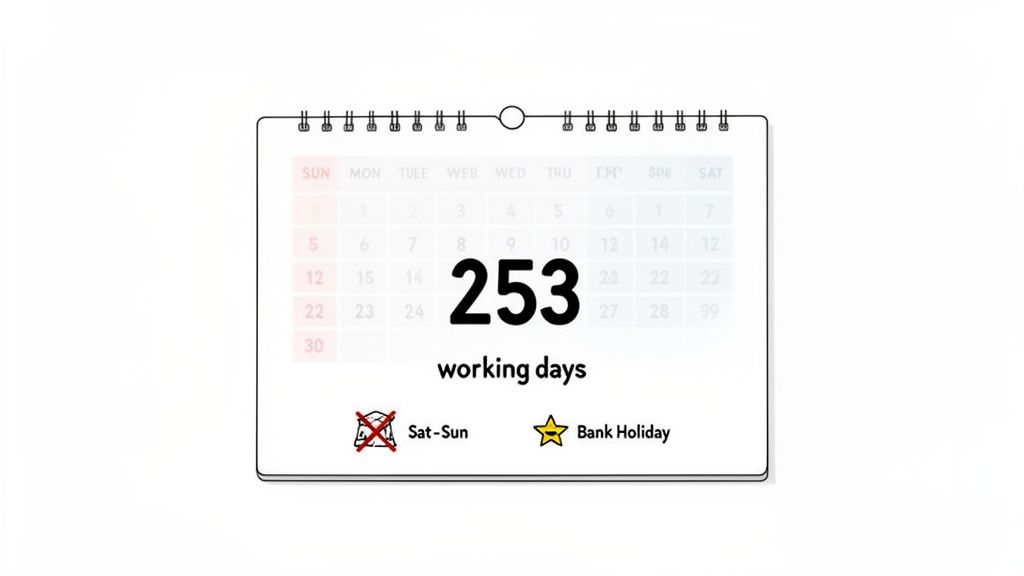
The formula is straightforward: you take the total number of days in the year, then subtract all the weekends and the statutory bank holidays. For England and Wales, that means taking 365 days and removing 104 weekend days and 8 bank holidays, landing you on that magic number of 253. You can find some more great insights on how UK working days are calculated over at LeaveTrackApp.com.
To give you a clear, at-a-glance view, here’s how the numbers stack up for England and Wales.
UK Working Days at a Glance for England and Wales
This table shows the standard calculation for working days in a typical year versus a leap year, based on the statutory bank holidays for England and Wales.
| Calculation Step | Standard Year | Leap Year |
|---|---|---|
| Total Calendar Days | 365 | 366 |
| Less Weekend Days | -104 | -104 |
| Less Bank Holidays | -8 | -8 |
| Total Working Days | 253 | 254 |
Think of this as your starting point. Now that we've got the basics down, we can dig into the details that change things up for different employees and regions across the UK.
The Simple Formula for Calculating Working Days
Figuring out how many working days a UK business has in a year might sound like a headache, but it actually boils down to a simple, repeatable formula. Getting this right is a core skill for any HR professional because it’s the foundation for everything from payroll and holiday allowances to project planning.
Think of it like starting with a full calendar and just crossing off the days people aren't expected to work. It's a straightforward bit of subtraction that gives you the clarity you need to manage your team effectively.
The Core Equation:
Total Calendar Days - Total Weekend Days - Total Bank Holidays = Total Working Days
This simple formula is the bedrock for getting a realistic grip on your team's availability over the next twelve months.
Breaking Down the Numbers
Let's pull apart each part of that equation to see how it works in practice. The good news is that most of these figures are pretty consistent, making the calculation easy to master for any given year.
Total Calendar Days: This is your starting block. It's 365 for a normal year or 366 when a leap year rolls around every four years.
Total Weekend Days: This one is nicely reliable. With 52 full weeks in a year, you can almost always count on 104 weekend days (Saturdays and Sundays) to subtract from your total.
Total Bank Holidays: This is the only real variable, and it changes depending on where you are in the UK. For a business in England and Wales, you will typically subtract 8 bank holidays.
Once you have these three numbers, you just need to plug them into the formula. For a standard year in England, the maths looks like this: 365 days - 104 weekend days - 8 bank holidays = 253 working days.
It’s the same logic you'd use when you need to calculate working days in a month, just applied on a smaller scale.
Navigating Bank Holiday Differences Across The UK
It's a classic mistake to assume a single number for working days fits the entire UK. While it feels like it should be straightforward, the reality is a little more complex. England and Wales might share a bank holiday schedule, but Scotland and Northern Ireland each have their own unique public holidays.
This means the final count of working days changes depending on where your employees are based.
For any business with teams spread across the UK, getting a handle on these regional differences isn't just a "nice to have" – it's crucial for compliance and fairness. A simple miscalculation can easily ripple into payroll errors, incorrect holiday allowances, and even a feeling of inequality between staff in different offices.
The chart below breaks down the basic calculation, starting from the total days in a year and whittling it down.
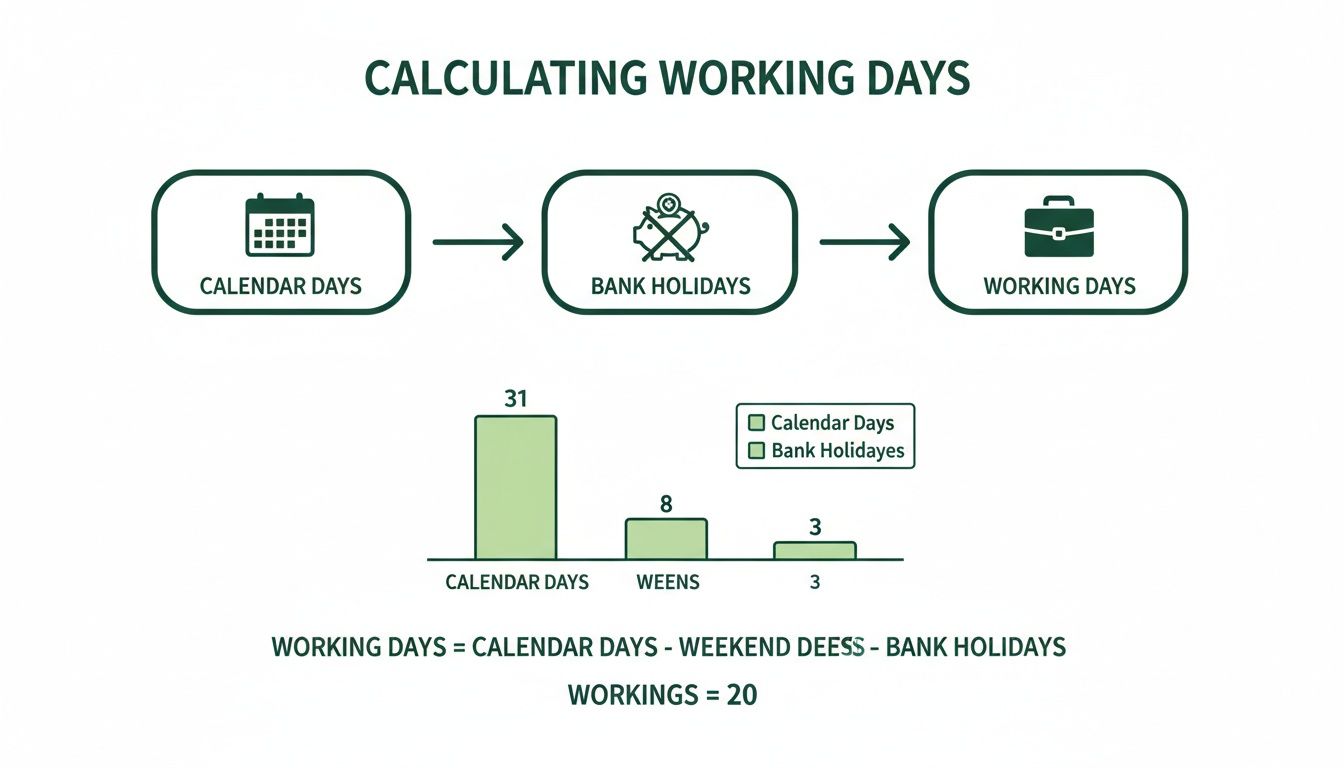
As you can see, once you’ve stripped out the weekends, the number of bank holidays is the key variable that changes the final total from one nation to the next.
Key Holiday Variations By Country
So, where do the numbers actually land? The differences come down to specific national holidays that aren't observed UK-wide. This is why the answer to "how many working days are in a UK year?" really depends on where you're asking about.
- England and Wales: Share a schedule with 8 bank holidays, which usually sets the baseline at around 253 working days.
- Scotland: Gets 9 bank holidays, observing St Andrew's Day and an earlier summer bank holiday. This brings their typical total to 252 working days.
- Northern Ireland: Enjoys the most public holidays with 10, including St Patrick's Day and the Battle of the Boyne (Orangemen's Day). This reduces their standard working year to approximately 251 working days.
For a full list of the specific dates, you can find everything you need in our complete guide to 2025 UK bank holidays.
Working Day Totals Across UK Nations
To make it crystal clear, here’s a simple table showing how those different bank holiday schedules impact the final count in a standard year.
| Country | Standard Bank Holidays | Typical Working Days (Standard Year) |
|---|---|---|
| England & Wales | 8 | 253 |
| Scotland | 9 | 252 |
| Northern Ireland | 10 | 251 |
While a difference of one or two days might seem minor, it has a direct impact on everything from pro-rata holiday calculations for part-timers to project planning for teams that span different countries. An employee in Belfast simply has fewer standard working days in their year than one in Bristol.
These regional differences are embedded in local traditions and legal frameworks. For those interested in the broader regulatory picture, external resources like guides on navigating labor law regulations can provide deeper context.
Ultimately, recognising and respecting these variations isn't just good practice—it's a fundamental part of managing a modern, geographically diverse UK workforce with the accuracy and care it deserves.
How to Handle Calculations for Part-Time and Atypical Workers
Things get a little more complicated when you're dealing with part-time employees or those on less conventional schedules. A full-time, Monday-to-Friday calculation just won't cut it. Instead, you need to shift your thinking from a single company-wide number to an individual's specific work pattern.
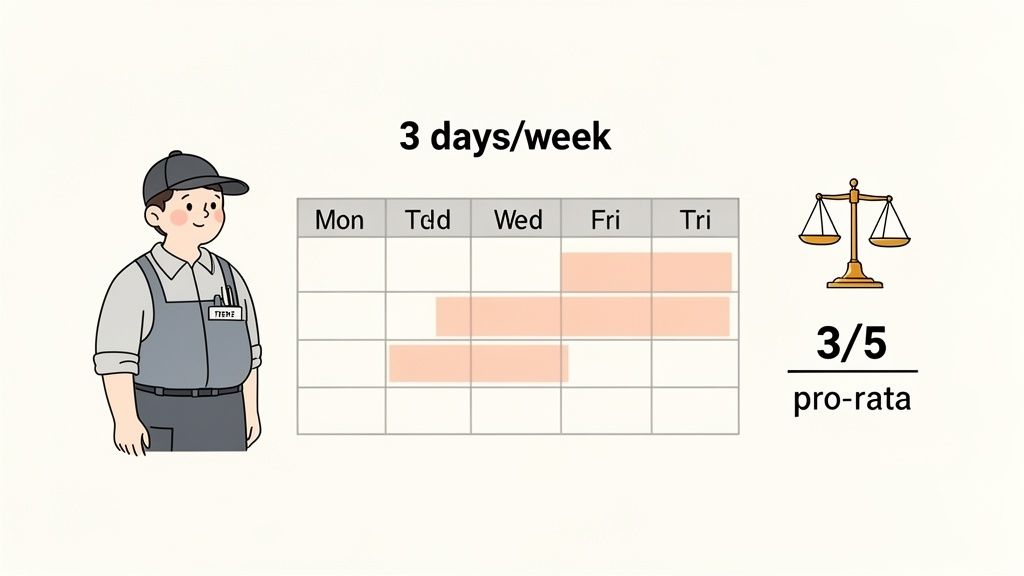
The magic word here is pro-rata. This is all about making sure things are fair and legally sound, particularly when it comes to holiday entitlement. If a full-time employee works five days a week and their colleague works three, that part-timer is on a 0.6 FTE (full-time equivalent) contract. This simple fraction is the key to all their pro-rata calculations.
A Quick Pro-Rata Example
Let’s say you have an employee, Alex, who works Tuesday, Wednesday, and Thursday every week. To figure out their total working days for the year, you just need a quick bit of maths:
- Total full-time working days (e.g., 253) x Alex's FTE (0.6) = 151.8 working days.
That number – 151.8 – now becomes the foundation for managing their schedule and, most importantly, their holiday leave. If you need a more detailed walkthrough, our guide on how to calculate pro-rata holiday for UK staff is a great place to start.
The Bank Holiday Headache
Here’s where a lot of businesses trip up: bank holidays. What happens when a bank holiday falls on a Monday, but Alex never works Mondays? It’s not fair for them to simply miss out, and UK law agrees. Part-time workers are entitled to a pro-rata share of bank holidays, just like their full-time colleagues.
Trying to track these details on a spreadsheet is a recipe for disaster. It’s far too easy to miss an employee's proper entitlement, leading to unfairness and some serious compliance headaches, especially for staff on variable or annualised hours.
While the average UK full-timer worked 36.6 hours per week in Q2 2024, many of the 2.1 million people on annualised contracts have far more complex schedules where manual sums just don't work. These complexities really show why a reliable, automated system is no longer a 'nice-to-have' but an essential tool for getting it right.
The Evolution of the UK Working Year
The idea of a standard working year, hovering around 253 days, feels like a permanent part of UK professional life. But it's actually a pretty modern concept. The five-day week and bank holidays we all plan our lives around are the result of a long, slow move away from much more gruelling schedules.
Before the Industrial Revolution, the rhythm of work wasn't dictated by HR software and spreadsheets; it was all about the seasons and daylight hours. In fact, if you look back at pre-industrial England around 1700, the average person worked about 270 days a year. By 1750, that number had climbed to a tough 300 days. You can dig deeper into this history over at EHS.org.uk.
The Shift to a Structured Work Week
The move from fields to factories brought with it relentless six-day work weeks, which naturally sparked calls for reform. These demands led to some crucial changes that started to shape the calendar we recognise today.
A huge milestone was the Bank Holidays Act of 1871. It introduced the first four official bank holidays in England, Wales, and Ireland, marking a landmark moment. For the first time, it was formally recognised that workers deserved structured, paid time off.
This history frames what HR teams do today not just as admin, but as part of a long tradition of improving working life and striking a much healthier work-life balance.
Stop Guessing and Start Automating
Relying on spreadsheets to figure out how many working days in a year UK staff have is a recipe for trouble. As we've seen, doing it all by hand is just asking for errors, especially when you're juggling different bank holidays for team members in England and Scotland, calculating pro-rata leave, or dealing with unexpected one-off national holidays. A single slip-up can easily lead to incorrect pay, compliance headaches, and a sense of unfairness creeping into the team.
This is exactly why modern absence management systems were invented. Instead of battling with complex formulas and trying to remember who gets which day off, these tools handle the entire process for you. They do all the heavy lifting in the background, freeing up valuable HR time and taking all the guesswork out of the equation.
A good system will, for example, automatically apply the correct UK bank holiday calendar to each employee based on their location.
A simple dashboard gives you a clear view of who’s in and who’s out, with all the tricky calculations handled behind the scenes. This ensures every detail—from working out leave for a new starter to tracking regional holidays for a remote worker—is spot on and legally sound.
By letting technology handle these complexities, you build a system that's transparent and fair for everyone. You move from putting out fires to proactive, error-free workforce management. It saves countless admin hours and gives you the peace of mind that your records are always 100% accurate.
FAQs About UK Working Days
When it comes to calculating working days, some common questions always pop up. Here are the clear-cut answers to help you handle those tricky situations with confidence.
What Happens With One-Off Bank Holidays?
Every so often, a special, one-off bank holiday comes along for an event like a royal jubilee. When this happens, it simply reduces the total number of working days for that specific year.
For instance, a year in England with a surprise extra holiday would typically have 252 working days instead of the usual 253. It's a small change, but it's crucial for HR and payroll teams to adjust their calculations. This ensures that pro-rata holiday entitlements and pay stay perfectly accurate for everyone.
Does the Number of Working Days Change My Statutory Holiday Entitlement?
No, the total number of working days in a year is just the starting point for your calculations; it doesn't change the legal entitlement itself.
Full-time UK workers are entitled to 5.6 weeks of paid holiday, which works out to 28 days. The working days figure is essential for getting the pro-rata calculation right for part-time staff, but the legal entitlement is fixed. It’s the calculation method that adapts based on an employee's work pattern, not the entitlement.
What's the Best Way to Handle Employees Who Start Mid-Year?
This is a classic HR puzzle. For any employee who joins part-way through the year, you need to calculate their holiday entitlement on a pro-rata basis, running from their start date to the end of your company's holiday year.
Getting this wrong can cause real headaches for payroll and compliance. The simplest way to avoid discrepancies is to automate the process. Using a smart employee time off app can handle these calculations for you, keeping everything neat and tidy.