
How Many Working Days Per Year UK A Guide for HR Professionals
Posted by Robin on 24 Jan, 2026 in
Figuring out the exact number of working days in a year is one of those fundamentals for anyone in HR or payroll. Get it wrong, and everything from holiday entitlement to project planning can go sideways. The good news? The calculation itself is pretty straightforward once you know the moving parts.
For a typical full-time employee in the UK, you're looking at around 253 working days in a standard year and 254 in a leap year. This is the magic number, your starting point for almost everything else.
Your Quick Answer to UK Working Days
Without a solid baseline, you’re essentially guessing when it comes to staff scheduling, calculating pro-rata leave, or forecasting labour costs. This simple number provides the clarity you need to ensure fairness and compliance across the board.
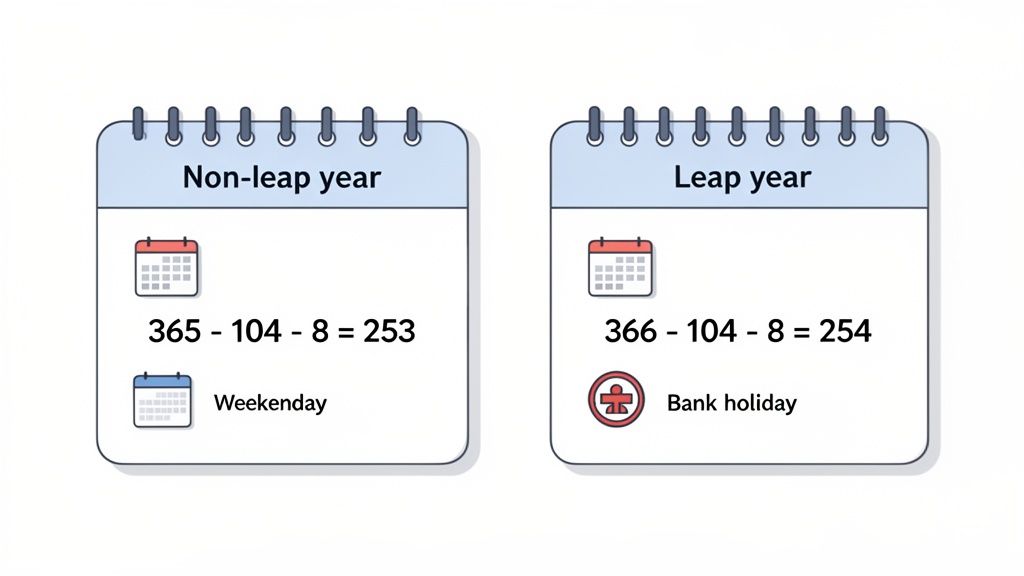
It all starts by taking the total days in the year and then stripping out the non-working ones. We subtract the weekends first, and then the public holidays.
This baseline is the foundation for everything else, from managing part-time staff entitlements to planning for company-wide shutdowns.
The Standard UK Calculation
The formula itself is beautifully simple: start with the total days in the year, then subtract weekends and bank holidays. While the number of public holidays can vary slightly depending on where you are in the UK, the core logic remains the same.
Here's how it breaks down:
- Total Days in the Year: This is either 365 or, in a leap year, 366.
- Weekend Days: With 52 weeks in a year, you always have 104 weekend days (Saturdays and Sundays).
- Public Holidays: England and Wales get 8 bank holidays, Scotland has 9, and Northern Ireland has 10.
For a quick reference, the table below shows the calculation for a standard full-time employee in England and Wales, which is the most common scenario.
UK Working Days At a Glance (Standard Full-Time)
| Year Type | Total Days | Weekend Days | Public Holidays | Total Working Days |
|---|---|---|---|---|
| Standard Year | 365 | 104 | 8 | 253 |
| Leap Year | 366 | 104 | 8 | 254 |
As you can see, once you account for weekends and bank holidays, you're left with a clear, reliable figure to work with. This is your cornerstone for accurate leave and payroll management.
Getting to Grips with the Manual Calculation
While a quick Google search gives you an answer, truly understanding the nuts and bolts of how working days are calculated gives you the confidence to check any figure yourself. This is essential if you’re relying on spreadsheets or just need a foolproof way to handle planning and stay compliant.
It all boils down to three key numbers.
First, you need the total number of days in the year. That’s your starting block. It’s either 365 for a standard year or 366 for a leap year. Everything else gets subtracted from this figure.
Next up are the weekend days. This part is nice and consistent. With 52 full weeks in a year, you’ll always be subtracting 104 days for weekends (52 weeks x 2 days). Think of this as the reliable constant in your calculation.
Factoring in Public Holidays
The final variable, public holidays, is where you need to be precise. The number of bank holidays changes depending on where you are in the UK, and this directly impacts an employee's final working day count for the year.
For a full-time employee in England and Wales, you’ll factor in 8 public holidays. This is the number we use for the standard calculation, which lands us at 253 working days in a normal year (365 - 104 - 8).
But it’s a different story elsewhere in the UK:
- Scotland: Employees here get 9 public holidays, meaning they have one less working day than their colleagues in England.
- Northern Ireland: With 10 public holidays, employees work two fewer days per year compared to those in England and Wales.
These regional differences aren't optional; they have to be reflected accurately in your sums to ensure everything is fair and legally sound. For a bit more context on how these calculations are handled in other parts of the world, you might find a complete guide to calculating working days useful.
The core formula is always the same: Total Days - Weekend Days - Public Holidays = Total Working Days. The only piece of the puzzle that changes is the number of public holidays, which is tied to an employee’s main place of work.
Let’s put this into practice with a real-world example for a standard year. Imagine an employee based in Glasgow. You'd start with 365 days, take away 104 for the weekends, and then subtract Scotland's 9 public holidays. Their total comes to 252 working days (365 - 104 - 9).
That one-day difference might seem tiny, but it has real implications for payroll, calculating pro-rata holiday, and resource planning. Getting this manual process right means you can handle any regional variation with complete accuracy.
Navigating Part-Time Staff and Pro-Rata Rules
Calculating working days for full-time staff is one thing, but let's be honest, the modern workforce is far more varied. Many businesses rely on part-time employees, and that’s where you need to get your head around pro-rata calculations to keep things fair and accurate.
It all comes down to the principle of pro-rata, a Latin term that simply means "in proportion". This ensures that part-time employees get their entitlements, like holiday pay, in fair proportion to their full-time colleagues. If a full-time employee gets 28 days of annual leave, someone working half the hours should rightly receive half the leave.
Getting this right is crucial for fairness and legal compliance. After all, every UK worker is entitled to a statutory minimum of 5.6 weeks of paid holiday, no matter their working pattern.
The simple flowchart below shows the basic steps for working out the total working days in a year before you even start thinking about pro-rata rules.
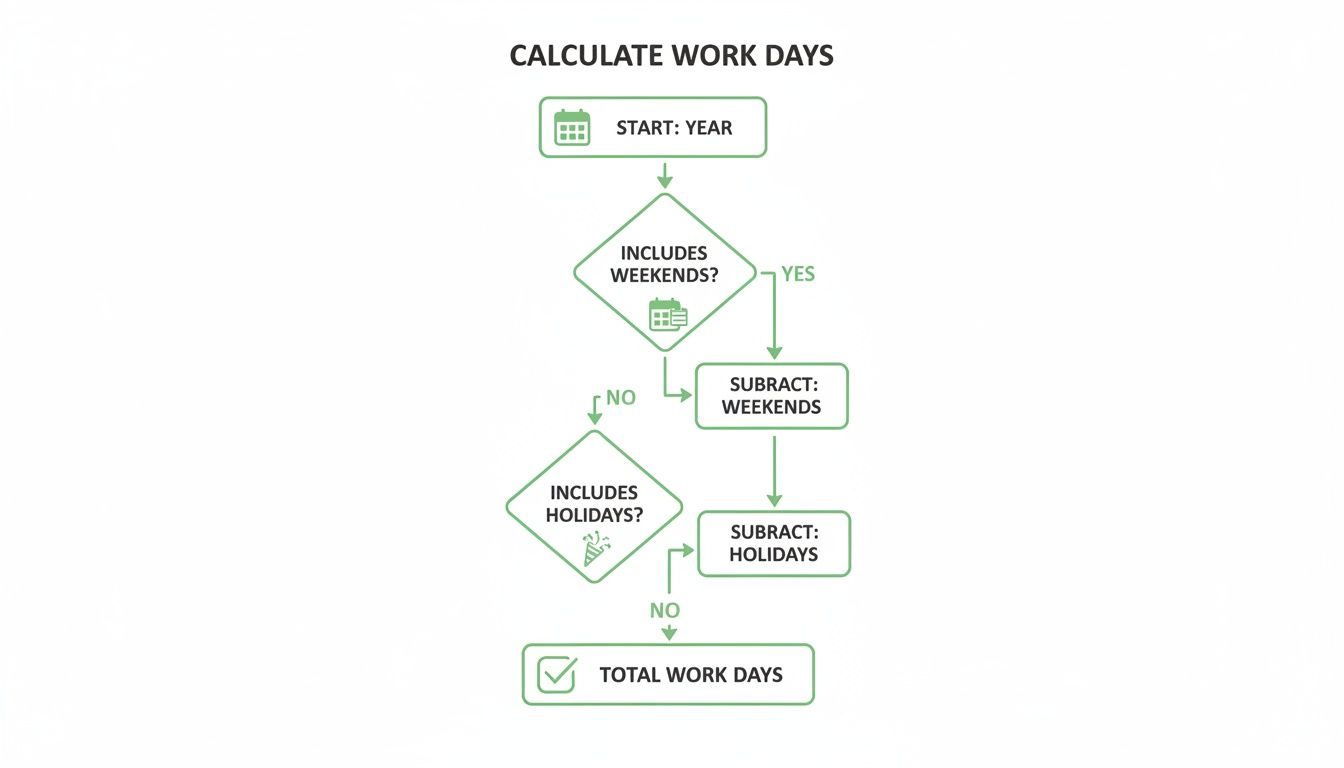
As you can see, the foundation is always the same: take the total days in the year, then subtract weekends and public holidays. This gives you the baseline for everyone.
Calculating for Different Work Patterns
Let's put this into a real-world scenario. Imagine you have an employee, David, who works three days a week—Monday, Tuesday, and Wednesday. At his company, a full-time week is five days, and the full-time annual leave entitlement is 28 days.
To work out David’s pro-rata holiday, we can use a straightforward formula:
(Days worked per week ÷ Days in a full-time week) x Full-time leave entitlement = Pro-rata leave
For David, the calculation looks like this: (3 ÷ 5) x 28 days = 16.8 days of annual leave.
In practice, it’s common to round this figure up to the nearest half or full day, meaning David would get 17 days of holiday.
Dealing with Mid-Year Starters and Leavers
The same pro-rata logic applies when someone joins or leaves part-way through your holiday year. You’ll need to calculate their working days and holiday entitlement based on the portion of the year they were actually employed.
Let’s take another example. Sarah starts her new full-time job on 1st July in a non-leap year. She'll be with the company for exactly half of the year.
Her calculation is based on that fraction of the year worked:
- Full-time working days in the year: 253
- Fraction of the year she worked: 6 months ÷ 12 months = 0.5
- Sarah’s working days: 253 x 0.5 = 126.5 working days
This same approach applies to her holiday. If the full-year allowance is 28 days, she’d be entitled to 14 days (28 x 0.5). For a more detailed walkthrough, you can learn more about how to calculate pro-rata holiday entitlements in our UK guide.
Manually keeping track of these variable calculations across multiple employees is a huge administrative headache. It’s incredibly easy for small errors to creep in, which can lead to incorrect holiday pay and compliance risks. This really highlights the value of having a reliable system to manage these complexities automatically.
Translating Days Into Hours for Better Planning
Knowing the number of working days in a year is a great starting point, but for the kind of detailed planning that really drives a business forward, you need to zoom in. Translating those days into actual working hours gives you the granularity for everything from project management and shift scheduling to forecasting labour costs with real precision.
It’s this deeper level of detail where strategy happens. A "working day" isn't a one-size-fits-all measure; its length varies depending on company policy and individual employment contracts. Understanding what this means in hours is the key to managing your resources effectively and building fair, transparent leave policies that prevent burnout.
The Standard UK Working Week in Hours
So, what does a typical working day actually look like in the UK? Recent data paints a pretty clear picture. On average, full-time UK workers are clocking in 36.5 hours per week, which works out to about 7.3 hours daily across a standard five-day pattern. This is a crucial number, as it helps us contextualise how much of the year is really spent on work. You can find more insights on this from UK working hours on Statista.com.
This average gives us a practical baseline to work with. Taking our standard year with 253 working days, a full-time employee would work roughly 1,847 hours (that’s 253 days × 7.3 hours). This is the kind of figure that finance teams can plug into salary calculations and operations managers can use for resource allocation.
Getting a handle on this hourly breakdown is also vital when you're planning monthly or quarterly targets. For a deeper dive into that, check out our guide on how many working hours are in a month.
Why This Hourly View Matters
Breaking down the year into hours isn't just a numbers game. It has tangible benefits for HR managers and team leaders who are constantly juggling staff availability and project deadlines.
- Accurate Costing: For roles paid by the hour or for projects billed on time, knowing the total annual working hours is absolutely essential for accurate budgeting.
- Fair Leave Policies: It ensures that pro-rata holiday policies for part-time staff are calculated fairly, as their leave is often accrued based on hours worked, not days.
- Productivity Metrics: This data gives you a solid baseline to measure team productivity and helps you spot potential burnout risks if overtime starts creeping up.
Ultimately, looking at the working year through the lens of hours instead of just days allows for much more effective workforce management. It helps ensure that employee workloads are balanced, projects are resourced correctly, and financial forecasts are built on reliable data. This level of detail removes the guesswork and empowers managers to make smarter decisions.
The Evolution of the UK Working Year
The five-day work week feels like a permanent fixture of modern life, but it's actually a pretty recent invention. Digging into its history gives us some valuable context for why we’re so meticulous about tracking working days today. It's not just admin for the sake of it; it’s the result of a long fight for a better work-life balance.
Before the industrial revolution, the idea of a "weekend" as we know it simply didn't exist. Labourers in England typically worked around 266-270 days per year. By 1750, as factories ramped up production, that number shot up to over 300. If you're curious about the historical details, the Economic History Society's website has some fascinating insights.
From Toil to Time Off
It was the tireless efforts of labour movements and social reformers that slowly chiselled away at this relentless schedule. Their campaigns led to massive changes, establishing weekends and creating the public holidays we now automatically factor into our annual leave calculations. For an up-to-date list, you can check out our complete guide to 2025 UK bank holidays.
This story is still unfolding. Today, conversations are shifting again with new ideas like the evolving concept of the 4-day work week. Understanding how these new models impact the total number of working days is crucial for any business trying to plan ahead and stay compliant.
This long journey from relentless labour to structured time off underscores a critical point: accurately calculating working days isn’t just an administrative task. It’s about upholding a hard-won standard of fairness and well-being in the modern workplace.
Automating Your Calculations for Total Accuracy
Let's be honest, manually calculating working days is a massive time sink, especially when you're juggling different work patterns and regional holidays. Many of us start with spreadsheets, but they quickly become a minefield of human error, leading to dodgy holiday pay and compliance headaches. It’s the kind of admin burden that pulls HR teams away from the work that really matters.
The real challenge kicks in when you add all the complexities we've covered. You have to remember leap years, keep track of different public holiday schedules for someone in England versus Scotland, and correctly apply pro-rata rules for every single part-time team member. One slip-up in a formula can have a serious knock-on effect across the board.
This is exactly where dedicated absence management software comes in, taking you from manual guesswork to automated precision.
How Software Solves the Complexity
An automated system like Leavetrack is built from the ground up to handle all these variables without you having to lift a finger. Think of it as your single source of truth, making sure every calculation for how many working days per year an employee has is consistently accurate and fair.
Instead of fighting with spreadsheet updates, the software automatically gets it right for you:
- Regional Public Holidays: It already knows the different bank holidays for England, Scotland, Wales, and Northern Ireland. It just applies the correct set to each employee based on where they work. Simple.
- Leap Year Adjustments: The system automatically factors in the extra day in a leap year, ensuring every calculation for that year is spot on from day one. No more
IFstatements in your spreadsheet. - Pro-Rata Entitlements: It instantly works out the correct holiday allowance for part-time staff, new starters, and leavers, completely removing the risk of manual miscalculation.
This dashboard from Leavetrack gives you an idea of how a clear, automated system offers instant visibility into who's in and who's out.
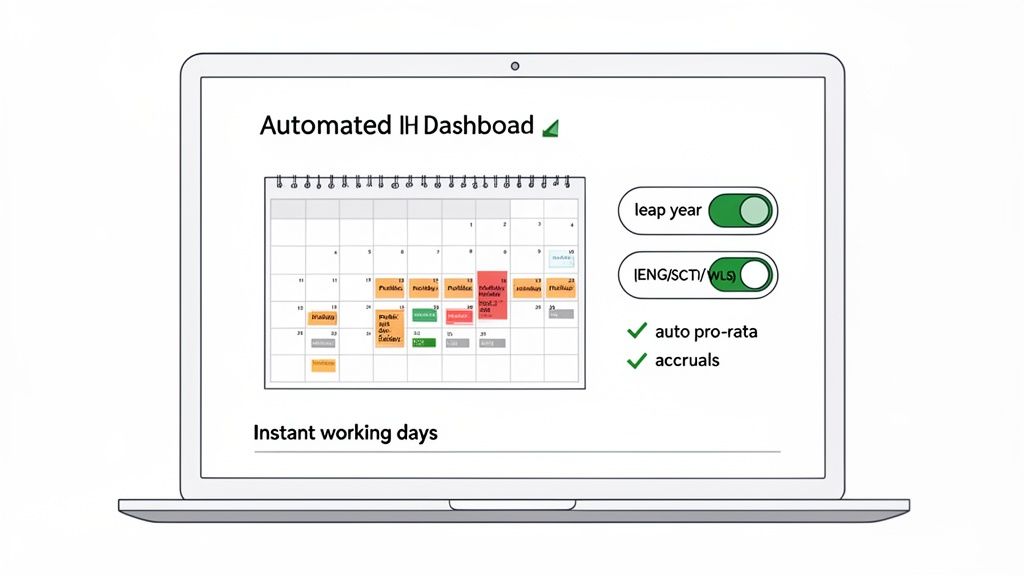
The integrated calendar view immediately tells managers who is off and when, which makes resource planning so much more straightforward.
The Real-World Impact of Automation
Picture this: an HR manager is looking after a team spread across the UK. A new employee starts part-time in the Glasgow office halfway through the year. Manually, this would mean calculating their remaining working days, remembering to factor in the specific Scottish bank holidays, and then figuring out their pro-rata holiday entitlement.
With an automated system, the manager just plugs in the employee's start date, location, and work pattern. The software does the rest, instantly providing an accurate, compliant leave balance.
The real benefit here is the shift from reactive problem-solving to proactive management. Instead of spending hours double-checking spreadsheet data, managers get immediate, reliable insights that empower them to make smart decisions about staffing, project deadlines, and general operational readiness.
This automation isn't just about the initial setup, either. The software continuously tracks leave as it's taken, providing real-time updates to both the employee and their manager. This kind of transparency cuts down on disputes and makes sure everyone is on the same page.
When you add in features like integrated calendars and one-click approvals straight from email or Slack, you start to see how much administrative friction disappears. The result is a more efficient, compliant, and transparent way to manage everyone's leave.
Answering Your FAQs on UK Working Days
Once you've got the basic calculation down, you’ll inevitably run into those tricky edge cases and specific questions from your team. Getting these details right is what separates a good HR process from a great one, ensuring everything stays fair, compliant, and easy to manage.
Knowing how to handle these variations is the key to truly mastering the how many working days per year calculation for every employee.
How Do I Account for Extra Company Holidays?
This one’s nice and simple. If your business is generous enough to offer extra days off – maybe a company-wide shutdown between Christmas and New Year – you just subtract them from your baseline total.
For instance, a standard year in England gives you 253 working days. If you add two extra closure days to the calendar, your team’s effective working days for that year drop to 251. It’s a straightforward subtraction.
Does the Number of Working Days Change Across the UK?
Absolutely. The total number of working days isn't the same everywhere in the UK, and the difference comes down to public holidays. Each nation has its own official list.
- England and Wales: 8 public holidays
- Scotland: 9 public holidays
- Northern Ireland: 10 public holidays
This means an employee in Scotland typically has one less working day than their counterpart in England, and someone in Northern Ireland has two fewer. It’s a small but crucial detail, especially for remote or multi-location teams.
What’s the Best Way to Handle Zero-Hour Contracts?
Trying to pin down a fixed number of working days for someone on a zero-hour contract is a non-starter. Their work is variable by nature, so their holiday entitlement has to be as well. The focus shifts from days to hours.
The standard approach is to have holiday entitlement accrue at 12.07% of the hours they work. Manually tracking this can quickly become a tangled mess of spreadsheets and potential errors. We strongly recommend using a dedicated payroll or absence management system to handle this automatically. It ensures fairness and keeps you compliant without the administrative headache.
Juggling all these nuances by hand is a recipe for mistakes and wasted hours. Leavetrack automates everything—from regional bank holidays to complex pro-rata rules—so you get instant, accurate visibility into who’s off and when. Simplify your absence management with Leavetrack today.