

How to Calculate Holiday Entitlement in the UK
Posted by Robin on 29 Oct, 2025 in
Calculating holiday entitlement in the UK all starts with one key figure: 5.6 weeks of paid leave per year. For someone working a typical five-day week, that translates to a straightforward 28 days of paid time off, which can include bank holidays. This core rule is the foundation for ensuring almost every worker gets a fair amount of leave, no matter their work pattern.
Getting to Grips with UK Holiday Entitlement
To get your holiday calculations spot on, you first need to understand the basics. The UK’s ‘week-based’ system is specifically designed to be fair to everyone, whether they're full-time staff, part-time, or even an agency worker.
While it's simple for a full-time employee, the entitlement is adjusted proportionally for anyone on a non-standard schedule. For instance, if someone is contracted for three days a week, their entitlement is 16.8 days off (5.6 weeks x 3 days).
Getting this right is a crucial part of the job for any finance or HR team. For professionals working in remote payroll jobs, a rock-solid understanding of these rules is non-negotiable, as they're often managing calculations for a widely distributed workforce.
For a handy reference, here’s a quick breakdown of the statutory minimums.
Statutory Holiday Entitlement at a Glance
This table shows the minimum legal holiday you must provide based on the number of days an employee works each week.
| Days Worked Per Week | Calculation (5.6 weeks x days worked) | Minimum Paid Holiday Days Per Year |
|---|---|---|
| 5 | 5.6 x 5 | 28 |
| 4 | 5.6 x 4 | 22.4 |
| 3 | 5.6 x 3 | 16.8 |
| 2 | 5.6 x 2 | 11.2 |
| 1 | 5.6 x 1 | 5.6 |
Remember, these are the absolute minimums required by law.
What About Bank Holidays?
One of the most common points of confusion is how bank holidays fit into the statutory 28 days. The short answer is: an employer can legally include the eight UK bank holidays within this total. A very common setup is to offer 20 days of selectable leave plus the 8 bank holidays.
However, the employment contract is always the final word. If it specifies "25 days holiday plus bank holidays," then the total entitlement is much higher than the statutory minimum. You should always, always refer back to the contract to confirm the exact policy. To dive deeper into this, check out our ultimate guide to UK statutory holiday allowance.
Key Takeaway: The statutory 5.6 weeks is the legal floor, not a fixed amount. Your employment contract can offer more generous terms, but it can never offer less. Grasping this distinction is the very first step toward accurate and compliant leave management.
With this foundational knowledge, you're well on your way to making sure your calculations are always accurate and, most importantly, legally sound.
Calculating Leave for Part-Time Workers
When it comes to calculating holiday for your part-time staff, the key principle is simple: proportionality. They get the same amount of holiday as their full-time colleagues, just adjusted for the hours they actually work. It’s all about fairness and making sure no one is disadvantaged.
The law is built around a standard of 5.6 weeks of paid leave. By applying this to everyone's specific working pattern, you remove any guesswork and ensure your calculations are consistent across the board.
Let's take a common scenario. Say you have an employee who works a steady three days every week. The calculation is surprisingly straightforward.
Applying the Pro-Rata Formula
Here’s the simple formula you'll need:
5.6 weeks x (Number of days worked per week) = Annual leave entitlement in days
For our employee working three days a week, the maths looks like this:
5.6 x 3 = 16.8 days
This means they’re entitled to 16.8 days of paid holiday each year. It's crucial to remember you can't round this number down. Company policy might allow you to round it up to the nearest half or full day for simplicity, but never down. If you want to dive deeper into these kinds of scenarios, our guide on how to calculate pro-rata holiday has more detailed examples.
Key Insight: The focus is always on weeks, not days. Using the 5.6-week standard ensures that someone working fewer but longer days isn't penalised compared to someone working more frequent, shorter days.
This pro-rata system keeps things equitable. Let’s look at another situation. Imagine an employee works 20 hours a week, but those hours are spread unevenly over four days. Their holiday is still based on the number of days they work, not the total hours.
So, for that person, the calculation would be:
- 5.6 x 4 = 22.4 days
Their annual entitlement comes out to 22.4 days, reflecting their four-day working week. Sticking to this consistent formula ensures your calculations are not just correct, but also transparent and easy to explain. That goes a long way in building trust with your part-time employees.
Handling Zero-Hours and Irregular Work Patterns
Figuring out holiday entitlement for workers on unpredictable schedules can be a real headache. For your team on zero-hours contracts or with genuinely irregular work patterns, a fixed number of days off just doesn't add up.
The most common and government-approved way to tackle this is to base their leave on the hours they’ve actually worked.
This is where the magic number 12.07% comes in. It’s not just plucked out of thin air; it comes directly from the statutory holiday entitlement rules. A standard year is 52 weeks, and staff are entitled to 5.6 of those weeks as paid leave. Simple maths tells us that they're working for the remaining 46.4 weeks (52 - 5.6).
Divide the holiday weeks by the working weeks, and you get your percentage: (5.6 ÷ 46.4) x 100 = 12.07%. This means for every single hour someone works, they build up holiday time at this rate.
Applying the 12.07% Accrual Method
Let's put this into a real-world context. Say a gig worker puts in 50 hours one month. To work out their holiday entitlement for that period, the calculation is straightforward:
50 hours x 12.07% = 6.035 hours of holiday accrued
If they only managed 20 hours the next month, their accrual would be just 2.414 hours. This approach keeps things fair, ensuring their leave is always directly tied to the time they've put in. If you need a deeper dive, our complete guide covers everything on managing holiday entitlement on a zero-hour contract.
This infographic gives you a quick visual guide for deciding which calculation method to use.
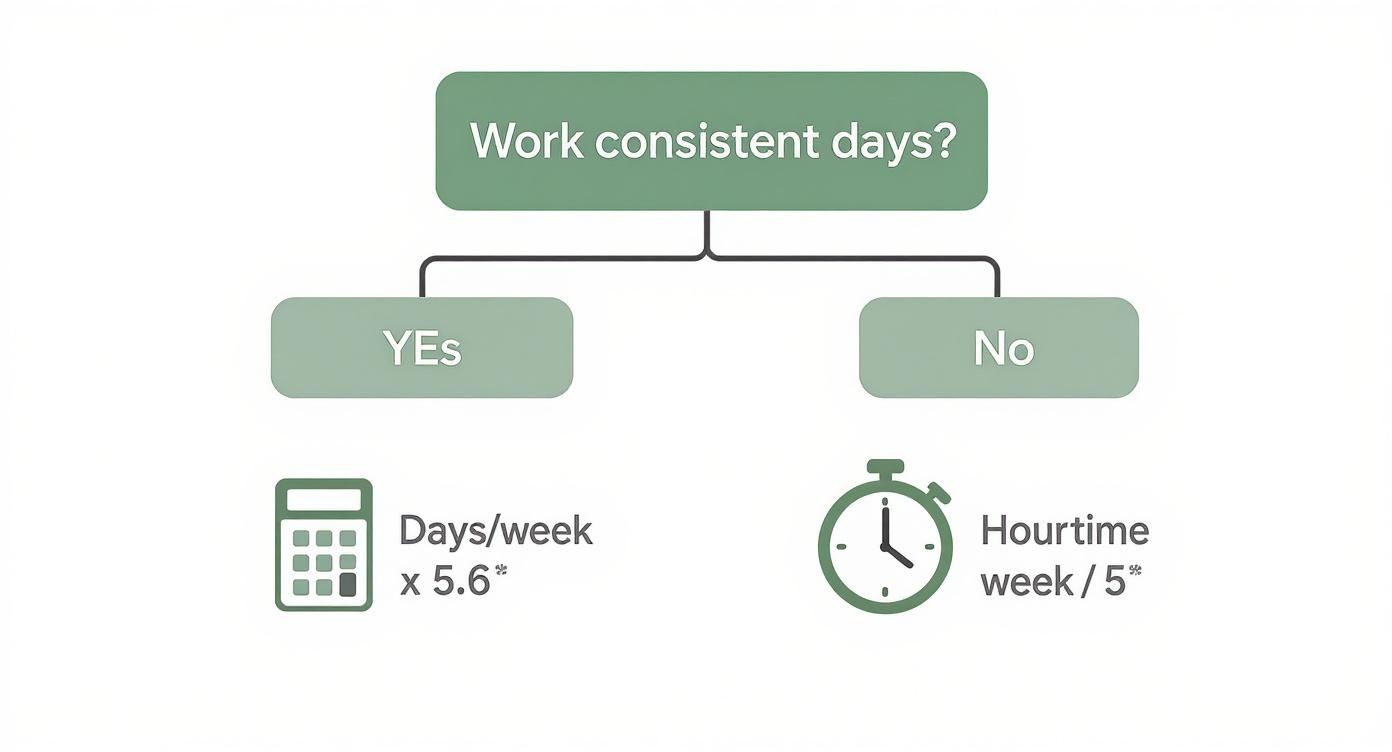
As you can see, as soon as work patterns become unpredictable, you have to switch from thinking in days to calculating in hours to be fair and accurate.
Important Note: When it comes to paying for this accrued time off, the rate has to reflect their typical earnings. For workers with variable pay, you must calculate their holiday pay using an average of their last 52 paid weeks, making sure to skip over any weeks they weren't paid. This ensures their holiday pay is a true reflection of their normal income.
Managing Holiday for New Starters and Leavers

Employee turnover is a natural part of running any business. When people join or leave part-way through the holiday year, you’ll need to work out their holiday entitlement with care to ensure a fair and smooth transition.
Their leave isn't based on their full annual allowance, but on how much of the holiday year they've actually completed. For new starters, this entitlement starts building up from day one. Clearly explaining this is a crucial part of streamlining the employee onboarding process, as it makes sure everyone is on the same page from the beginning.
Calculating Accrued Leave
The most common way to handle this is to calculate what fraction of the year the employee has worked and then apply that to their total annual entitlement. It's a fairly straightforward calculation once you get the hang of it.
Let’s run through an example. Imagine a full-time employee with a 28-day annual allowance leaves the company after working exactly seven full months of the holiday year. Here’s how you’d work out the holiday they’ve earned:
- First, figure out their monthly accrual rate:
- 28 days ÷ 12 months = 2.33 days per month
- Then, multiply that by the number of months they've worked:
- 2.33 days x 7 months = 16.31 days accrued
In this situation, the employee is entitled to 16.31 days of leave. It's a legal requirement that you don't round this figure down, though you can choose to round it up to the nearest half or full day for goodwill.
Untaken or Over-Taken Holiday
Once you have that accrued figure, the next step is to compare it to the amount of leave they’ve already taken. This is what determines if any adjustments are needed in their final payslip.
Final Pay Adjustments: If a leaver has untaken holiday, you must pay them for it – this is known as payment in lieu of holiday. On the flip side, if they've taken more leave than they've accrued, you can usually deduct the excess from their final pay. Just make sure this is clearly stated in their employment contract.
Getting this right prevents messy disputes and ensures that final paycheques are spot on.
Using our previous example, if the employee had taken 14 days of leave, you would owe them payment for the remaining 2.31 days. But if they had already taken 18 days, you would need to deduct 1.69 days’ pay from their final salary.
Common Holiday Calculation Mistakes to Look Out For
Even with the best of intentions, tiny errors in your holiday calculations can snowball into some serious headaches—we're talking everything from legal challenges to a demoralised team. Getting ahead of these common slip-ups is the key to building a fair and compliant holiday system from the ground up.
One of the most frequent missteps I see is messing up bank holidays for part-time staff. It's easy to forget, but they are legally entitled to a pro-rata equivalent of these public holidays. This holds true even if the bank holiday doesn't land on one of their usual working days. Overlook this, and you're almost certainly short-changing them on their overall leave.
Another major tripwire is simply getting the holiday pay rate wrong. You can't just pay someone their basic salary when they're off. Holiday pay has to reflect what an employee normally earns, and that means including regular overtime, commission, and even some bonuses. Paying the basic rate is a classic mistake and an easy way to end up with underpayment claims.
Letting Carry-Over Policies Get Vague
A vague or, worse, non-existent policy for carrying over unused holiday is just asking for trouble. When the end of the year rolls around, you need everyone to be on the same page. Your policy needs to be absolutely clear on:
- How many days (if any) can be carried over into the next leave year.
- The deadline for when any carried-over leave must be taken.
- The exact process for an employee to request carrying their leave over.
Without these ground rules, you’re setting yourself up for disputes and a whole lot of confusion when the holiday year ends.
It’s a strange trend, but even though the statutory minimum for full-time workers is 28 days, the amount of holiday people are actually taking has been dropping. Recent data showed the average UK employee took 33.9 days of leave in 2023. That’s a noticeable dip from 38 days back in 2020, with sectors like construction and finance seeing the biggest declines. You can dig into more of the data in this UK annual leave report.
This decline really brings home how important it is for us to encourage our teams to properly switch off. And that all starts with a holiday policy that’s transparent and easy to wrap your head around. By keeping an eye out for these common traps, you can audit your own processes and build a system that’s robust, fair, and actually supports your team.
Common Holiday Pay Questions
Even with a solid grasp of the rules, specific scenarios can throw a spanner in the works. Here are some quick answers to the questions that crop up most often when calculating holiday entitlement.
What Happens During Maternity Leave?
An employee on maternity leave keeps building up their holiday entitlement just as they would if they were at work. This applies throughout both the Ordinary and Additional Maternity Leave periods because their employment contract is still active.
This accrued time off can be taken before they go on leave or tacked on at the end when they return. It's important to remember that you can't offer payment instead of this holiday, unless the employee is leaving the company for good.
Can My Boss Tell Me When to Take My Holiday?
In short, yes. An employer has the right to dictate when employees take their leave, which is common for things like a company-wide Christmas shutdown.
However, they can't just spring it on you. The rule is they have to give you notice that's at least double the length of the holiday they're requiring. So, for a one-week shutdown, they need to give everyone at least two weeks' notice.
A Quick Note on Pay: For workers whose income varies—perhaps due to overtime or commission—their holiday pay must reflect their average earnings. The calculation looks back over the previous 52 weeks where they were paid, skipping any weeks with zero earnings, to find a fair average. This ensures their holiday pay is a true reflection of their normal income.
Do Bank Holidays Count in My 28 Days?
This one comes down to what's written in your employment contract. The statutory minimum of 5.6 weeks (which is 28 days for a full-timer) can legally include the eight standard bank holidays. A very common setup you'll see is 20 days of leave plus bank holidays.
But, if your contract says something like "25 days holiday plus bank holidays," then your total entitlement is higher than the legal minimum. When in doubt, your contract is the ultimate source of truth.
Tired of wrestling with spreadsheets for holiday calculations? Leavetrack simplifies your entire absence management process, making sure you get it right every single time. See how our online system can save you hours and prevent costly mistakes. Learn more and start your free Leavetrack trial.