
How to Calculate Working Days Per Year UK
Posted by Robin on 29 Jan, 2026 in
For any full-time UK employee, the magic number is usually 253 working days in a year. That’s your starting point. It’s calculated by taking the 365 days in a standard year, then stripping out the 104 weekend days and the 8 bank holidays. This isn't just trivia; it's the bedrock for everything from planning projects to calculating annual leave.
How Many Working Days Are In a UK Year?
Figuring out the number of working days in a year is more than a simple maths problem. It's fundamental to running a business smoothly. Get this wrong, and you could easily mess up holiday entitlements, miscalculate payroll, or create completely unrealistic project deadlines.
Think of the year as a whole block of time. Before you can plan what to do with it, you need to chip away the bits you can't use – the weekends and public holidays. What's left is your actual productive time. This simple subtraction is the first step to scheduling work effectively and making sure your team gets the downtime they’re entitled to.
The Baseline Calculation Explained
So, how do we get to that number? It all starts with the total days in the year, which is either 365 or 366 in a leap year. From that total, we just need to subtract the days most full-time staff aren't expected to be at their desks.
Here’s a quick breakdown of the components:
- Total Days: 365 for a standard year, 366 for a leap year.
- Weekend Days: With 52 weeks in a year, you get 104 weekend days (52 Saturdays and 52 Sundays).
- Bank Holidays: England and Wales get 8 permanent bank holidays. This number can differ for Scotland (usually 9) and Northern Ireland (10), and sometimes an extra one is thrown in for special events like a royal jubilee.
To give you a clearer picture, here’s a quick reference table showing the calculation for both standard and leap years.
UK Working Days Calculation At a Glance
| Calculation Component | Standard Year | Leap Year |
|---|---|---|
| Total Days in the Year | 365 | 366 |
| Less: Weekend Days | -104 | -104 |
| Less: Bank Holidays (England) | -8 | -8 |
| Total Working Days | 253 | 254 |
As you can see, the only thing that really changes is the extra day in a leap year, which bumps up the total working days by one.
So, for a typical non-leap year like 2025, you're looking at exactly 253 working days. This is the baseline HR managers and team leads will use. For a leap year like 2024, that number nudged up to 254 working days because of the extra day in February. This is the kind of detail that matters, as explained by the team at LeaveWizard who help UK businesses plan their calendars.
Of course, this yearly figure is just the starting point. For more granular, short-term planning, it's often helpful to break this down even further. You can check out our guide on working days in a UK month to get a better handle on your monthly scheduling.
The Simple Formula for Working Days
Getting a handle on the baseline number of working days is a great first step, but being able to calculate it yourself is where the real power lies. It means you can adapt to any year, whether you're dealing with a leap year or an extra bank holiday. The good news is, the core formula is refreshingly straightforward.
The fundamental calculation for working days per year UK is a simple, three-step subtraction:
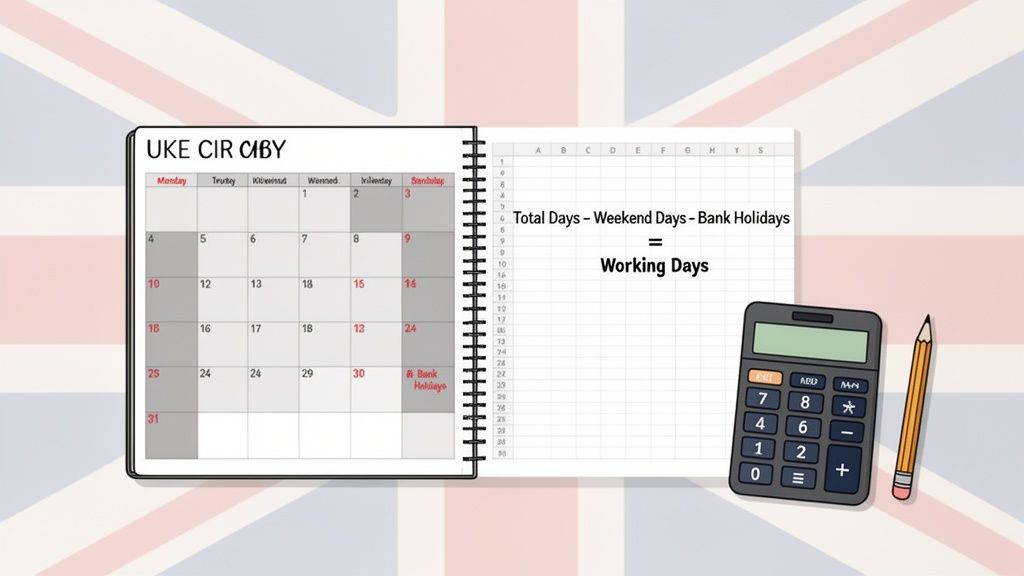
Total Days in Year - Total Weekend Days - Total Bank Holidays = Total Working Days
Think of it like carving a sculpture. You start with a big block of stone (the whole year) and carefully chip away the bits you don't need (weekends and holidays). What you're left with is the final, usable shape—your total number of working days.
Breaking Down Each Component
To get an accurate result, you need to be confident about each number you're plugging into the formula. Let's walk through the three key parts one by one.
Total Days in the Year: This one's the easiest. For most years, this number is a neat 365. But don't forget about leap years like 2024 or 2028, where it bumps up to 366.
Total Weekend Days: A standard year has 52 full weeks plus one extra day. This gives you 52 Saturdays and 52 Sundays, for a total of 104 weekend days. This figure stays the same even in a leap year because that extra day doesn't magically create a new weekend.
Total Bank Holidays: Here's where it gets a bit more variable. For England and Wales, the standard is 8 bank holidays. However, Scotland usually has 9, and Northern Ireland has 10. You've got to use the right number for your specific region to get this right.
This infographic helps visualise how the standard 365 days in a year shrink once you account for weekends, giving you a baseline to work from before even thinking about bank holidays.
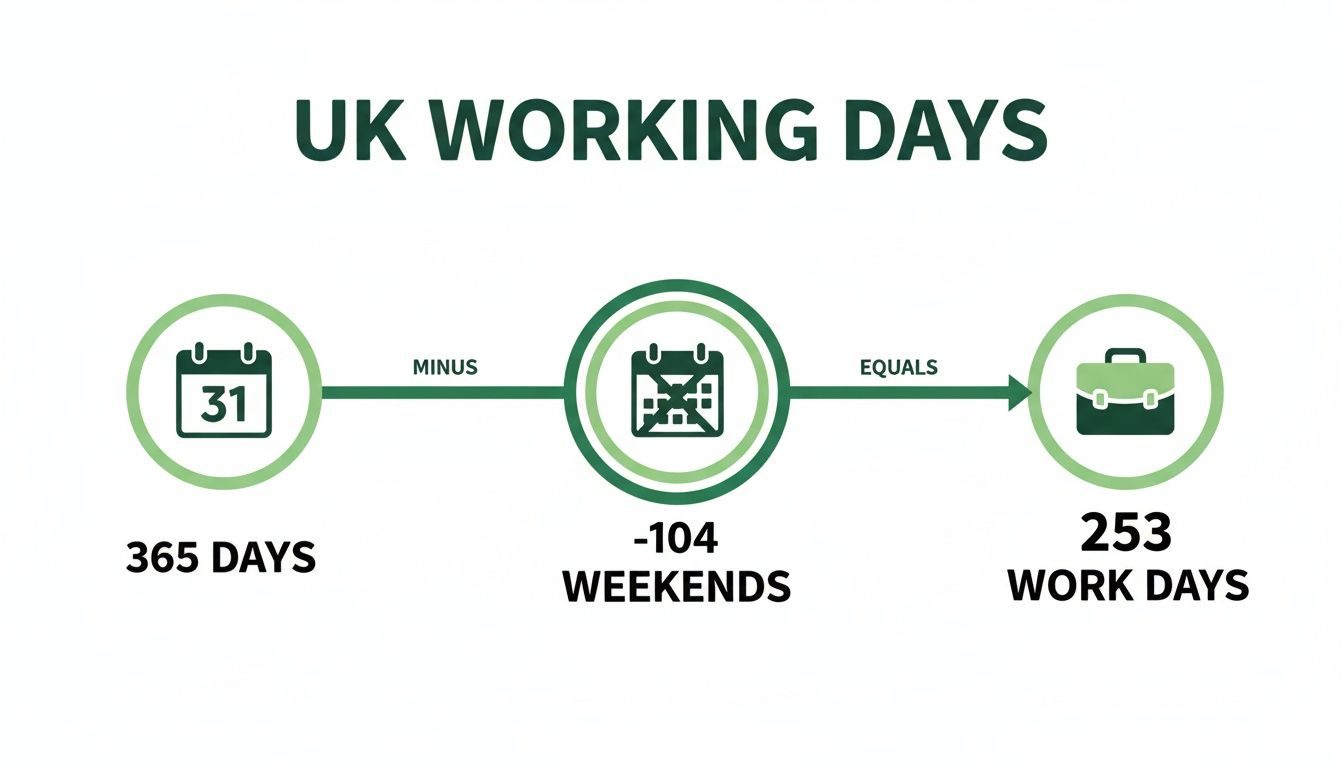
This visual breakdown makes it crystal clear that once weekends are taken out of the equation, you’re left with a much smaller pool of potential workdays.
Putting the Formula into Practice
Right, let’s see this in action with a real-world example for a standard, non-leap year in England.
Calculation Example (Standard Year in England):
365 (Total Days) - 104 (Weekend Days) - 8 (Bank Holidays) = 253 Working Days
This simple sum is your go-to method for figuring out the working days per year UK from scratch. It cuts out the guesswork and ensures that your resource planning and holiday calculations are built on a solid foundation.
Mastering this formula is a key skill for any HR professional or manager responsible for team scheduling. It’s the essential tool for building a clear, fair, and accurate operational calendar.
Calculating For Part-Time and Pro-Rata Staff
The standard five-day model works a treat for your full-time employees, but what about the growing number of people on part-time contracts? This is where understanding pro-rata becomes absolutely essential. It’s simply a way of making sure entitlements are calculated fairly, in direct proportion to the hours or days someone works.
Think of it like sharing a cake. A full-time employee gets a whole slice representing their five-day week. Someone working three days a week gets a proportionally smaller but equally fair piece—in this case, three-fifths of a full slice. This simple principle ensures everyone gets their legal entitlements without being penalised for working fewer days.
Applying this logic correctly to working days and holiday leave is critical. Get it wrong, and you could be underpaying staff or facing messy disputes over holiday allowances. It’s a cornerstone of fair and compliant people management.
The Pro-Rata Calculation in Action
The formula for working out pro-rata holiday entitlement is refreshingly straightforward. All you need to do is multiply the full-time equivalent (FTE) holiday allowance by the employee's FTE percentage. An employee’s FTE is just their working days divided by the standard five-day week.
Let's walk through a common scenario:
- An employee works 3 days per week.
- Their FTE is 3 ÷ 5 = 0.6.
- The statutory minimum holiday for a full-time employee is 28 days.
- The pro-rata calculation is: 28 days x 0.6 = 16.8 days of annual leave.
This simple bit of maths ensures that someone working 60% of a full-time week receives 60% of the holiday entitlement. This approach scales perfectly for any part-time setup, from two days a week to more complex compressed hours. If you want to dive into more detailed examples, you can learn more about how to calculate pro-rata holiday entitlement in our UK guide.
Visualising Pro-Rata Entitlement
While you can do the maths yourself, using a dedicated tool is the best way to handle these calculations automatically and remove the risk of human error. This screenshot from Leavetrack, for example, shows how a system can clearly display leave allowances for different team members side-by-side.
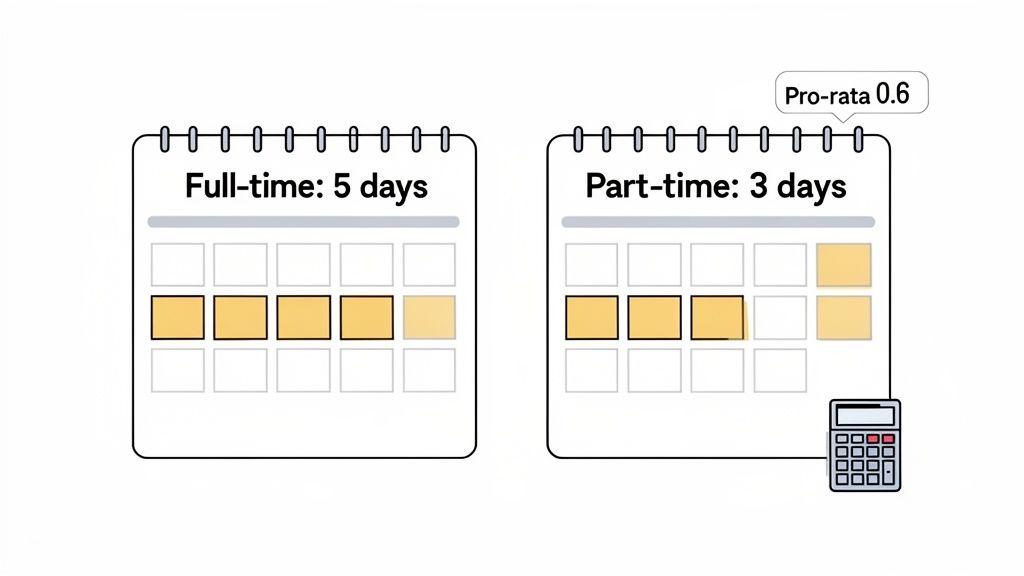
The image illustrates the proportional difference, making the concept of a 0.6 FTE easy to grasp in a single glance.
By correctly applying pro-rata principles, you ensure legal compliance and show a real commitment to fairness for every member of your team, no matter their working pattern. This builds trust and removes any ambiguity from your leave management process.
Getting the working days per year UK calculation right for part-time staff isn't just about ticking a box; it's about building a fair and transparent workplace culture.
How Working Days Affect Holiday and Payroll
Figuring out the number of working days per year in the UK is so much more than just an admin chore. Think of it as the engine driving two of the most critical parts of your business: holiday entitlement and payroll. Get it right, and you’ve got a solid foundation for legal compliance and financial stability.
Your total working days figure is the master key for all your resource planning. It’s what lets you turn the legal requirement for holiday weeks into a real number of days off for your team. It’s also how you convert an employee’s time into an accurate salary payment. Mess this up, and you’re looking at anything from unhappy staff arguing over leave days to serious payroll blunders.
Turning Working Days into Annual Leave
Here in the UK, full-time employees are legally entitled to at least 5.6 weeks of paid holiday each year. That’s the statutory minimum. Your working days calculation is what helps you translate this "week" measurement into a concrete number of days.
For a typical full-time employee on a five-day week, the maths is pretty simple:
- 5.6 weeks x 5 working days per week = 28 days of paid annual leave.
This 28-day entitlement includes bank holidays. It’s the absolute minimum you have to provide, and it all hinges on that basic understanding of a standard working week. Without a clear definition of working days, you're just guessing at this crucial entitlement, and that's a risky game to play.
An incorrect leave calculation doesn't just frustrate employees; it can lead to legal challenges and damage your reputation as an employer. Precision here is non-negotiable for maintaining a fair and lawful workplace.
The Financial Knock-on for Payroll
The link to payroll is just as direct. Your working days calculation is the bedrock for everything from daily pay rates to figuring out payments for untaken leave when someone moves on. For salaried staff, their annual salary is divided by the total working days to get a daily rate, which is vital for calculating pay for partial months or mid-month starters.
It’s even more critical when you think about hourly workers. As of late 2025, full-time UK workers were putting in an average of 36.5 hours a week. Multiply this by the standard 253 working days in a year, and you’re looking at a baseline of over 1,800 working hours. That’s a key figure for forecasting your wage costs and budgeting properly. You can dig into more UK working hours insights from Statista.
And when an employee leaves, you’re legally required to pay them for any holiday they’ve accrued but not taken. That calculation depends entirely on how many working days have passed in the current leave year. An inaccurate count means you’ll either overpay or underpay them, creating a financial mess and an admin headache. Ultimately, getting a firm grip on working days is essential for both HR and finance to keep things accurate and above board.
The True Cost of Unplanned Absences
Nailing down your total working days per year in the UK gives you a solid baseline. It's the number you use to plan projects, set targets, and schedule holidays. But that neat, predictable number often gets blown apart by a far more chaotic factor: unplanned absences. Sickness, family emergencies, and other unexpected leave aren’t just minor hiccups; they hit your business with real, significant costs.
Every unplanned day off is a direct hit to your team's productive output. When someone is unexpectedly out, work grinds to a halt, deadlines slip, and their colleagues have to pick up the slack. This isn't just about covering tasks; it adds pressure, fuels burnout, and poisons morale. What starts as a simple absence can easily spiral, sending ripples of lost productivity and stress across the entire team.
The Scale of Lost Productivity
When you zoom out and look at the national picture, the impact of unplanned leave is genuinely staggering. The latest data lays bare the sheer scale of the problem and what’s driving it.
In 2024/25, an astonishing 40.1 million working days were lost in Great Britain due to work-related ill health and non-fatal injuries. That averages out to 1.46 days lost for every single worker—a figure that has barely budged since before 2020. You can dig into the full findings from the Health and Safety Executive.
This isn't just a number on a page; it's a reflection of the daily struggle businesses are facing. And when you look at the main cause for these absences, you get an even clearer insight into the pressures of the modern workplace.
Why a Reactive Approach Always Fails
So many businesses are stuck in a reactive loop, treating each unplanned absence as a one-off fire to be put out. This is a huge mistake. Just dealing with problems as they crop up does absolutely nothing to fix the underlying causes, leaving you constantly vulnerable to disruption.
The most common reasons for absence in the UK tell their own story:
- Stress, Depression, or Anxiety: These mental health challenges accounted for a massive 22.1 million of the total lost days. It’s a stark reminder of the immense pressure many employees are under.
- Musculoskeletal Disorders: Things like back pain or repetitive strain injuries are another huge contributor to people being off work.
- Minor Illnesses: The usual suspects—colds, flu, and stomach bugs—consistently cause short-term chaos.
Simply logging these days off after they’ve happened is pointless. You need a proactive strategy. That means shifting your focus from just tracking absence to actively managing attendance. By spotting trends, getting to the root causes, and fostering a supportive workplace, you can start to minimise these disruptions and protect your business. It’s about building a resilient team, not just constantly reacting to problems.
Why Automated Tools Beat Spreadsheets Every Time
Trying to calculate working days per year in the UK using a spreadsheet feels a bit like navigating with a paper map in the age of GPS. Sure, the map will probably get you there in the end, but it’s slow, full of potential wrong turns, and can’t adapt when the road ahead is closed. A GPS, on the other hand, is fast, smart, and reroutes you in real-time.
That’s what dedicated leave management software is for your business. It’s your GPS for leave tracking, moving you far beyond clunky, error-prone spreadsheets. It handles everything automatically, from complex pro-rata holiday calculations for part-timers to adjusting for different bank holidays across the UK. This completely sidesteps the risk of human error that always seems to creep into even the most carefully organised spreadsheets.
Freeing Up Time and Reducing Risk
The most immediate win is getting back all that admin time. Instead of your team spending hours double-checking formulas and cross-referencing calendars, they can get back to doing more valuable work. Knowing how to automate repetitive tasks is a game-changer for productivity, and this is a prime example.
Automated systems also have fairness and compliance baked right in. The software applies your company’s leave policies the same way for every single employee, every single time. This removes any chance of accidental bias or miscalculations that could easily escalate into messy, time-consuming disputes.
By switching to an automated tool, you’re not just saving time; you're building a more reliable, compliant, and transparent system for managing your team’s most valuable resource—their time off.
Look at the difference. A clear, central dashboard gives you an instant, visual overview of who’s off and when—something a spreadsheet just can’t do without a ton of manual work.
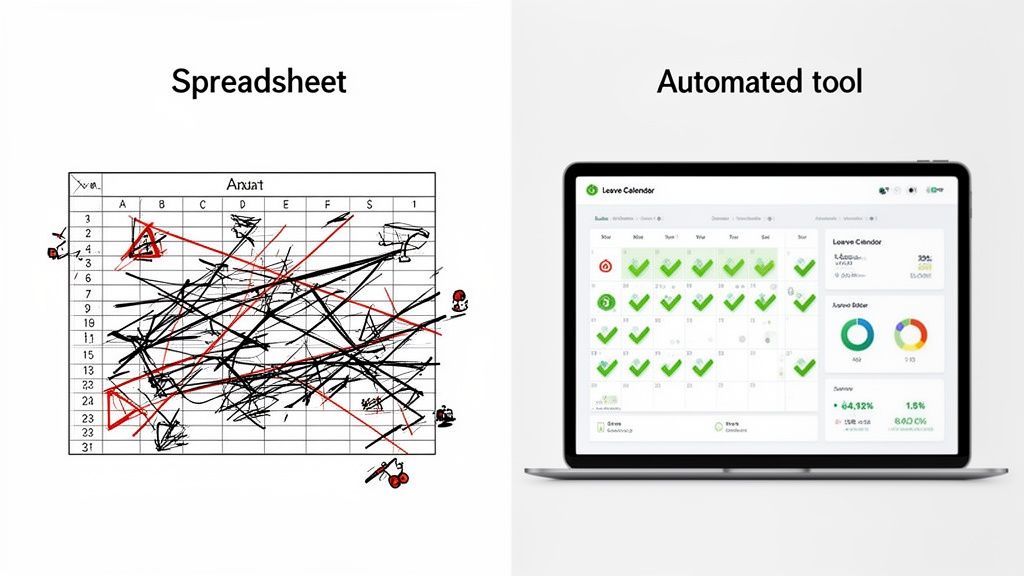
To really see how the two stack up, let’s break down the differences.
| Feature | Spreadsheets | Leavetrack |
|---|---|---|
| Accuracy | Prone to human error, broken formulas, and typos. | Automated calculations eliminate mistakes. |
| Time Investment | Requires hours of manual data entry and checking. | Saves significant admin time with instant updates. |
| Accessibility | Often saved locally, hard to access on the move. | Cloud-based, accessible from anywhere, anytime. |
| Visibility | Hard to get a clear overview of team schedules. | Centralised dashboard with team calendar view. |
| Compliance | Easy to make mistakes with pro-rata and legal leave. | Automatically applies policies consistently and fairly. |
| Reporting | Manual report creation is slow and cumbersome. | Generates detailed absence reports in seconds. |
The conclusion is pretty clear. While spreadsheets might seem like a free and easy option to start with, they quickly become a source of errors, wasted time, and compliance headaches.
If you’re thinking about making the switch, our guide to online leave management systems is the perfect place to start your journey away from spreadsheet chaos.
Common Questions About UK Working Days
Even with the formulas down, a few tricky scenarios always seem to pop up. Let’s tackle some of the most common questions managers and employees have when figuring out the working days per year in the UK. We'll get you some clear answers to help navigate these spots.
One of the first questions we always hear is whether bank holidays are included in the statutory 28-day holiday entitlement. The short answer is yes. The legal minimum of 5.6 weeks' leave for a full-timer works out to 28 days, and your employer can absolutely include the standard 8 bank holidays as part of that total.
Another classic point of confusion is what happens when people start or leave part-way through the year. How do you work out their holiday? Simple – their leave is calculated on a pro-rata basis for the amount of time they actually worked. This makes sure they get a fair, proportional allowance for their time with the company.
Do Weekends Ever Count As Working Days?
For the vast majority of us in Monday-to-Friday office jobs, weekends are never counted as working days. That's a firm no. But this all changes if you work in sectors like retail, hospitality, or healthcare, where weekend work is just part of the normal routine.
In these industries, an employee's "working days" are defined by their specific rota, not the traditional calendar week. Their employment contract will lay out their work pattern, and all their holiday and pay calculations will be based on that agreement.
The key takeaway is that a "working day" is determined by an individual’s employment contract. For standard contracts, it’s Monday to Friday, but for shift-based roles, it’s whichever days are designated for work in their rota.
To get away from the headache of tracking all this manually, using one of the best vacation trackers can seriously streamline how you manage leave and boost accuracy for any work pattern. It ensures your calculations are always spot on, whether you’re dealing with a standard week or a complex rota system.
Trying to manage these details with a spreadsheet is a drain on time and a magnet for errors. With Leavetrack, you can automate all your leave calculations—from pro-rata entitlements to bank holiday adjustments—with total confidence. See how Leavetrack simplifies your absence management.