
The Bradford Factor: Master the the bradford factor for absence management
Posted by Robin on 31 Jan, 2026 in
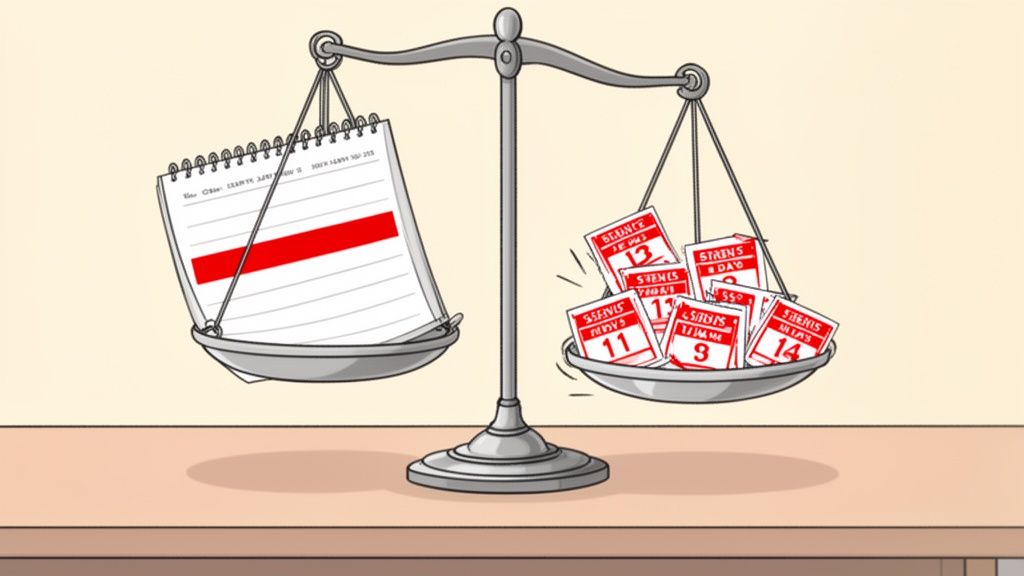
The Bradford Factor is a simple HR formula used to get a clearer picture of employee absence. But it’s not just about counting the total number of days someone is off. Instead, it zeros in on the frequency of absences, highlighting just how disruptive lots of short, unplanned spells of leave can be for a business.
What Is The Bradford Factor and Why Does It Matter?
Let's imagine you have two employees. Both are absent for a total of five working days over a year.
Employee A takes one continuous week off. Maybe it was a nasty flu, but it was one single event.
Employee B, on the other hand, is absent for five separate, single days. Each one is unplanned, often called in at the last minute. The total number of days is identical, but I think we can all agree that the headache and operational chaos caused by Employee B is far greater. This is precisely the problem the Bradford Factor was designed to measure.
It helps managers see past the simple total of days absent. Its real value is in spotting those patterns of frequent, short-term absences that put the most strain on productivity, team morale, and the general flow of work. To really get a handle on it, you need solid data, which all comes down to how to track employee attendance in the first place.
Highlighting Disruption Over Duration
The formula itself, S² x D (Spells squared, multiplied by Days), is deliberately designed to penalise frequency. One long-term, predictable absence is much easier for a business to plan around than multiple, sudden ones that leave everyone scrambling. A high score acts as an immediate flag, suggesting a pattern that’s worth a supportive conversation.
The tool gives you an objective, data-driven starting point for managing absence. Instead of relying on a manager's memory or gut feeling, it applies the same calculation to everyone. This helps to:
- Identify hidden patterns: It brings recurring issues to the surface that you might otherwise miss if you only look at the total days someone has been off.
- Promote fairness: Everyone is measured by the same yardstick, creating a standard and consistent basis for starting a conversation.
- Encourage proactive management: It provides clear trigger points for HR and line managers to check in with employees, offering support before a small issue becomes a much bigger one.
The Bradford Factor isn't a disciplinary tool in itself; it’s a diagnostic one. It's designed to flag a potential issue for further, compassionate investigation, not to automate punishment.
The Business Impact of Frequent Absence
So why does this focus on frequent, short-term absence matter so much? Because the cost isn't just about lost hours. Unplanned absences send ripples across the entire organisation.
They force meetings to be rescheduled, projects get delayed, and colleagues have to pick up the slack, which can breed resentment. Customer service can take a nosedive. A 2019 study even found that UK businesses lost £5.6 billion because of staff falsely calling in sick, which really drives home the financial stakes.
By using the Bradford Factor, managers can pinpoint the most disruptive patterns and open up a supportive dialogue. It’s about understanding the root causes—whether it’s a health issue, a wellbeing concern, or a motivation problem—and finding a constructive way forward that helps both the employee and the business.
How To Calculate Bradford Factor Scores
Knowing the theory is one thing, but putting it into practice is where it counts. The good news? The Bradford Factor calculation is surprisingly straightforward once you get your head around the basic bits. It’s designed to be a simple, repeatable process that turns complex absence data into a single, easy-to-compare score.
The formula is just S² x D. Let's break that down.
- S stands for Spells. A 'spell' is just a single, continuous chunk of absence. It doesn't matter if an employee is off for one day or ten days straight – it still counts as only one spell.
- D stands for Days. This is simply the total number of days the employee was off sick across all their spells, usually within a set period like a rolling 12 months.
The real power of the formula comes from squaring the number of spells. This one mathematical step deliberately places a much heavier emphasis on how often someone is off, not just for how long.
The Bradford Factor Formula In Action
To really see how this works, let's walk through a few real-world examples. Imagine three different employees, who have all been absent for a total of eight days over the past year.
Employee 1: One long-term absence
This person was off for a single, continuous period of eight working days.
- Spells (S) = 1
- Days (D) = 8
- Calculation: 1² x 8 (which is 1 x 1 x 8)
- Bradford Factor Score: 8 points
A very low score, reflecting a pattern that’s not particularly disruptive. While the absence was long, it was a single event the business could plan for.
Employee 2: Two short absences
This employee had two separate absences, each lasting four days.
- Spells (S) = 2
- Days (D) = 8
- Calculation: 2² x 8 (which is 2 x 2 x 8)
- Bradford Factor Score: 32 points
The score is higher now. It reflects the increased disruption caused by two separate incidents, even though the total time off was identical to Employee 1.
Employee 3: Lots of single-day absences
This person was off sick eight different times, for just one day on each occasion.
- Spells (S) = 8
- Days (D) = 8
- Calculation: 8² x 8 (which is 8 x 8 x 8)
- Bradford Factor Score: 512 points
Now the score skyrockets. This extremely high number immediately flags a highly disruptive pattern of frequent, unplanned absences that definitely warrants a supportive conversation.
To really nail this down, the table below shows how wildly the scores can differ, even when the total number of days off is the same.
Bradford Factor Score Comparison for Different Absence Patterns
| Absence Scenario | Number of Spells (S) | Total Days Absent (D) | Calculation (S² x D) | Bradford Factor Score |
|---|---|---|---|---|
| Employee A | 2 | 10 | 2² x 10 | 40 |
| Employee B | 5 | 10 | 5² x 10 | 250 |
| Employee C | 10 | 10 | 10² x 10 | 1000 |
As you can see, ten days off spread across ten separate instances results in a score 25 times higher than the same number of days taken in just two spells. It perfectly illustrates how the formula penalises frequency over duration.
This visual makes the point crystal clear – frequent, short absences cause far more disruption than a single, longer one.
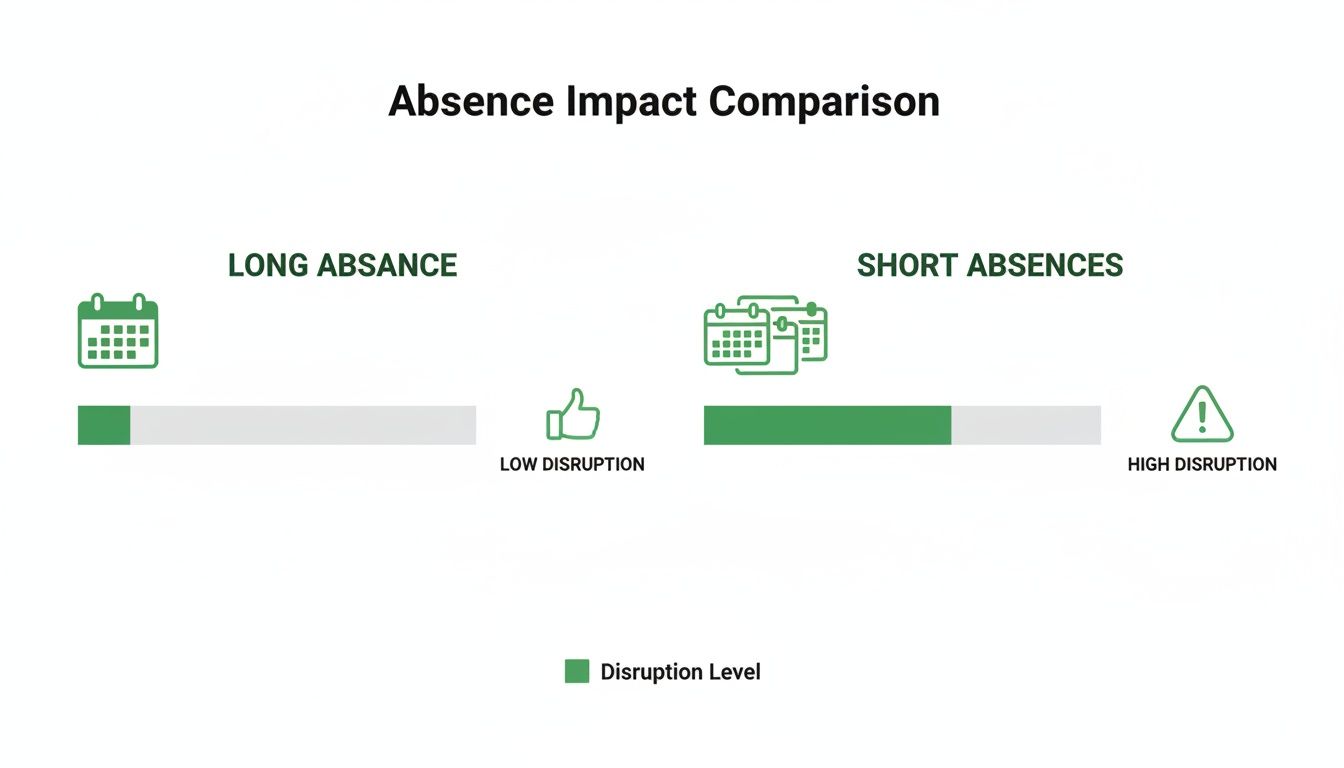
While a long absence can be managed and covered, it's the constant stop-start of frequent short absences that creates real operational headaches.
Manual Calculation vs Automated Systems
You could, of course, calculate these scores manually with a spreadsheet. But it doesn't take long for that to become a huge time-sink and a magnet for human error, especially as your team grows. Just trying to accurately track a 'rolling 52 weeks' for every single employee is a nightmare of a task.
An automated system like Leavetrack takes this pain away completely. It calculates scores in real-time, consistently applies your company's specific rules, and gives you instant, accurate data without you having to lift a finger.
This frees up your managers to focus on what actually matters: having supportive, meaningful conversations with their team members. To see more detailed worked examples, check out our guide on Bradford Factor calculations for UK HR. Using a proper tool ensures your absence management strategy is fair, accurate, and efficient.
Interpreting Scores and Setting Trigger Points
Calculating a Bradford Factor score is actually the easy bit. The real skill is knowing what to do with that number once you have it. On its own, a score is just data; it only becomes a useful management tool when you connect it to a clear, consistent, and fair framework of actions. This is where trigger points come in.
Think of trigger points not as tripwires for punishment, but as helpful signposts. They are pre-agreed score thresholds that prompt a specific response from a manager, guiding you on when it’s time to step in, ask questions, and offer support. This approach turns the Bradford Factor from a reactive measure into a proactive tool for managing absence constructively.
Without these triggers, you’re inviting inconsistency. One manager might see a score of 300 and do nothing, while another might launch into disciplinary action for the exact same score. This chaos quickly leads to confusion and accusations of unfair treatment. A well-defined system ensures everyone is treated the same way.
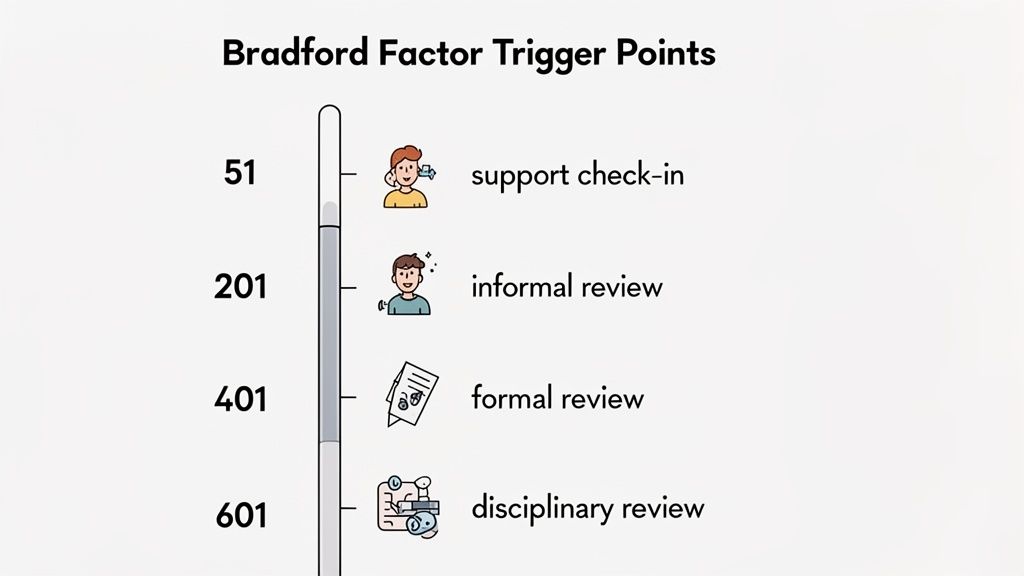
Common Trigger Point Frameworks
There’s no legally mandated, one-size-fits-all set of trigger points that every UK business must follow. The right thresholds for your company will depend on your industry, your culture, and how much disruption your operations can handle. That said, a common and effective framework is often built around escalating stages of intervention.
To give you a clearer idea, here is a sample framework showing how different score ranges can lead to specific, escalating actions. This helps ensure your response is always proportionate.
Example Bradford Factor Trigger Point Framework
| Score Range | Suggested Action | Purpose of Action |
|---|---|---|
| 51-125 | Informal chat during return-to-work | A supportive check-in to see if everything is okay and offer support. |
| 126-400 | Formal attendance review meeting | Discuss absence patterns, explore underlying reasons, and agree on an improvement plan. |
| 401-600 | First written warning | Formalises the need for significant and sustained improvement in attendance. |
| Over 601 | Final warning or consider dismissal | A serious step taken only after all other supportive measures have failed. |
This structured, tiered approach ensures that your actions always match the level of disruption being caused by the absences.
Customising Triggers for Your Organisation
The numbers in the table are just examples. It's vital to set thresholds that are realistic and make sense for your own business. A small creative agency might have a much higher tolerance for disruption than a busy manufacturing plant where a single empty spot on the production line causes immediate problems.
When setting your own trigger points, you need to think about:
- Your Operational Needs: How much disruption can your teams reasonably absorb before productivity and service quality take a hit?
- Your Company Culture: Do you want to foster a culture of high trust and flexibility, or one that prioritises rigid attendance? Your triggers must reflect this.
- Transparency and Communication: Whatever you decide, you must communicate it clearly to all staff. Put the trigger points in your employee handbook or absence policy so everyone understands the process from day one.
The most effective Bradford Factor policies are not rigid rules but flexible guidelines. A score should always be followed by a human conversation that considers individual circumstances, like known health conditions or personal difficulties.
Ultimately, the goal isn't to catch people out. It's to create a fair system that flags when support might be needed. For a deeper look into what different scores mean in practice, check out our guide on understanding your Bradford Factor score. Using these triggers thoughtfully helps managers tackle potential issues early, fostering a more supportive and productive work environment for everyone.
Navigating The Pros and Cons of The Bradford Factor
The Bradford Factor is a powerful HR tool, but like any instrument, its effectiveness depends entirely on how you use it. It's tempting to see it as a simple, objective formula, but it’s vital to understand both its real advantages and its serious limitations. Only by weighing these up can you apply it in a way that's fair to your people and good for the business.
On one hand, its greatest strength is objectivity. It provides a standardised, mathematical way to identify absence patterns that might otherwise fly under the radar. By applying the same formula (S² x D) to every employee, it removes managerial bias and gut feelings from the initial assessment, ensuring a consistent starting point for everyone.
This data-driven approach allows managers to quickly spot patterns of frequent, short-term absences that are often the most disruptive to team workflows. It turns a jumble of attendance records into a clear, comparable score.
The Clear Advantages of The Bradford Factor
When you implement it thoughtfully, the Bradford Factor offers several key benefits that can support a more organised and fair approach to absence management.
- Identifies Disruptive Patterns: It excels at highlighting the kind of frequent, unplanned absences that cause the most operational strain—something a simple count of total days missed would completely overlook.
- Promotes Consistency: By using a standard formula, it ensures all employees are measured by the same yardstick. This reduces the risk of perceived favouritism or inconsistent management.
- Acts as a Deterrent: When employees understand how the scoring works, it can discourage non-genuine sickness absences. They become aware that the frequency of absence is being monitored just as closely as the duration.
- Provides an Objective Starting Point: A high score isn't a verdict; it's a trigger. It’s a data point that justifies starting a supportive conversation with an employee to understand what's really going on.
Understanding The Significant Disadvantages
However, the formula's simplicity is also its biggest weakness. The Bradford Factor is fundamentally blind to context, and this is where the real risks lie. Used without care and human oversight, it can cause more problems than it solves.
The most critical drawback is its potential to unfairly penalise employees with genuine, recurring health issues.
A rigid application of the Bradford Factor can inadvertently discriminate against individuals with chronic illnesses, disabilities, or mental health conditions that may result in multiple, short-term absences. This not only damages trust but can also lead to serious legal challenges.
This lack of context is a major pitfall. The score doesn't know if an absence was due to a child's emergency, a flare-up of a known medical condition, or a simple cold. It treats all short-term absences the same, which is rarely a fair reflection of reality.
Furthermore, an over-reliance on the score can foster a negative culture of presenteeism. This is where people feel pressured to come to work while unwell just to avoid hitting a trigger point. A sick employee at their desk isn't just unproductive; they risk spreading illness to the rest of the team, potentially causing even more absence down the line. When navigating these challenges, it's crucial to evaluate the policy's impact on morale and the broader goal of fostering positive corporate wellbeing.
A balanced view reveals that the Bradford Factor should be seen as a diagnostic tool, not a disciplinary hammer. It’s an effective way to flag a pattern that needs human attention. The score itself should never be the final word; it should always be the beginning of a supportive, compassionate conversation that seeks to understand the story behind the numbers.
Legal and Ethical Considerations for UK Employers
Using the Bradford Factor isn’t as simple as plugging numbers into a formula and acting on the result. For any UK employer, its application is tangled in a complex web of legal duties and ethical responsibilities. If you get it wrong, even with the best intentions, you could face serious legal challenges, not to mention the damage to employee morale and your company’s reputation.
The most critical piece of legislation to keep in your sights is the Equality Act 2010. This act legally requires employers to make "reasonable adjustments" for employees with disabilities. A disability is defined as a physical or mental impairment that has a ‘substantial’ and ‘long-term’ negative effect on a person's ability to carry out normal day-to-day activities.
This has a direct and significant impact on how you use the Bradford Factor. Many chronic illnesses, recurring conditions, and mental health issues can be legally defined as disabilities. If an employee's absences are a direct result of their disability, applying the formula without any adjustments could easily be seen as discriminatory.
The Duty to Make Reasonable Adjustments
At its heart, the Equality Act is about making sure disabled employees aren't put at a disadvantage. When it comes to managing absence, this often means you must discount some, or even all, disability-related absences from any Bradford Factor calculation.
Imagine an employee has multiple sclerosis and experiences unpredictable flare-ups that require short periods off work. Their score could quickly rocket into a trigger zone. Taking disciplinary action based purely on that score, without considering the underlying medical condition, would almost certainly be unlawful. The key is to separate absences directly linked to a known disability from general sickness.
The Bradford Factor should be a mechanism to start supportive discussions, not a system for automatic punishment. Ignoring individual circumstances, especially a known disability, exposes your business to significant legal and financial risk.
Failing to make these adjustments can lead to expensive discrimination claims at an employment tribunal. The best practice is always to have a conversation with the employee first, to properly understand their needs and agree on what adjustments are fair and reasonable.
Consistency and the Risk of Unfair Dismissal
Beyond the crucial issue of disability discrimination, consistency is everything. Your absence policy, including how you use the Bradford Factor and what its trigger points are, must be applied fairly and consistently to every single employee. Picking and choosing when to enforce the rules is a fast track to claims of unfair treatment or even constructive dismissal.
If an employee can demonstrate they were disciplined for a high score while colleagues with similar scores faced no action, they could have a strong case for unfair dismissal. This is precisely why having a clearly documented policy, which has been shared with all staff, is completely non-negotiable.
This need for consistency also touches on data protection. Employee absence records, especially those containing details about their health, are classed as sensitive personal data under GDPR. You have a legal duty to ensure this information is stored securely, is only seen by those with a legitimate need to see it, and is used only for its intended purpose.
With mental health issues and other illnesses driving a recent rise in absences, the Bradford Factor is best used to open up proactive, supportive conversations rather than as a disciplinary tool. This approach aligns perfectly with Acas guidelines, which champion supportive management to avoid grievances related to conditions like epilepsy. Businesses that ignore these patterns risk creating a culture of presenteeism, where sick employees drag themselves into work out of fear, potentially spreading illness and being unproductive. You can find more insights on this topic by reading about avoiding grievances with absence management on iris.co.uk.
Ultimately, the Bradford Factor is a tool to identify patterns, not to judge people. Its real purpose is to flag potential issues that need a compassionate, fair, and human response.
How Leavetrack Automates Bradford Factor Management
Understanding the theory behind the Bradford Factor is one thing, but wrestling with it using clunky spreadsheets and manual reminders is a completely different beast. It doesn't take long for the whole process to become an administrative headache, bogged down by human error and inconsistency. This is where switching from manual tracking to an automated system completely changes the game.
Leavetrack is designed to remove all that friction and guesswork from absence management. Instead of you having to painstakingly update spreadsheets and calculate scores, our system does all the heavy lifting in the background. It automatically crunches the numbers to give you an up-to-the-minute Bradford Factor score for every single employee, ensuring the data you see is always accurate and reliable.
This constant, real-time calculation means managers are never caught working with outdated information. It eliminates the risk of miscalculations that can lead to unfair treatment and gives you a single source of truth for all absence data.
From Reactive To Proactive Management
One of the biggest wins from automation is making the shift from reactive problem-solving to proactive, supportive management. Leavetrack gives managers the tools they need for instant visibility and timely notifications, so nothing ever falls through the cracks.
Here are a few key features that make this happen:
- Automated Alerts: You can set your own custom trigger thresholds right inside Leavetrack. When an employee's score crosses one of these points, their manager gets an automatic notification, prompting a timely and supportive conversation before things escalate.
- The Digital Wall Planner: This central hub provides a simple, at-a-glance view of who is off and why across the entire company or within specific teams. It helps managers spot potential patterns or resourcing issues in seconds.
- Customisable Leave Types: You can create and assign different leave types to distinguish sickness from other absences. Crucially, this allows you to discount absences related to known disabilities, helping you meet your legal duties under the Equality Act 2010.
Here’s a snapshot of the Leavetrack dashboard, showing just how clear visibility helps managers stay on top of team absences.
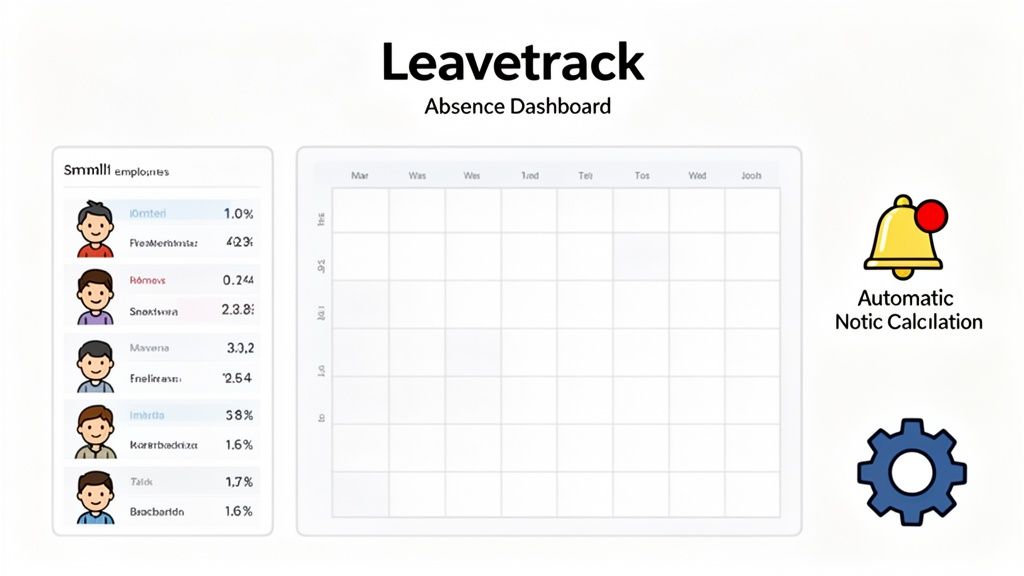
The clean interface pulls all the key information into one place, making it easy to see patterns and manage leave requests efficiently.
Making The Data Actionable And Fair
Automation isn't just about saving time; it's about helping managers make better, fairer decisions. With Leavetrack, every part of the process becomes simpler and far more consistent.
By automating Bradford Factor calculations, you free up managers to focus on what truly matters: having meaningful, supportive conversations with their team members. The system provides the objective data; the manager provides the human context and empathy.
Approvals are simplified, letting managers respond to requests with a single click via email or Slack, keeping workflows moving smoothly. When you need to dig into trends, instant Excel reports can be generated, giving you all the documentation needed for attendance reviews. For more on this, check out our overview of how absence management software can improve UK compliance.
Interestingly, UK data reveals that HR professionals themselves have the highest average Bradford Factor score at 113, a clear sign of just how disruptive frequent, short-term absences can be. This trend is a strong argument for a precise tool to monitor these patterns, especially as UK sick days have climbed to an average of 7.8 per person.
A system like Leavetrack helps centralise approvals and flag these patterns immediately. By taking the administrative pain out of the process, it empowers you to use the Bradford Factor as it was intended: as a fair, transparent, and genuinely supportive management tool.
Got Questions About the Bradford Factor?
Even once you get your head around the formula, a few practical questions always pop up when it comes to putting the Bradford Factor into practice. Let's tackle some of the most common ones to help you use this tool fairly and effectively.
Can We Use the Bradford Factor for Disciplinary Action?
In short, no. A Bradford Factor score should never be the one and only reason for disciplinary action. Think of it as a smoke detector – it’s an alert system, a trigger point that tells you it's time to have a supportive chat with an employee to find out what’s really going on.
UK employment law is very clear on this: employers must act reasonably. That means investigating the individual circumstances behind the absences before jumping to formal action. Relying solely on a number, without considering crucial context like a disability or a personal crisis, could easily lead to claims of unfair dismissal or discrimination.
What’s a Good or Bad Score?
There's no magic number here. What’s considered a "good" or "bad" score is entirely down to your company's own policy and what level of disruption you can manage. Most businesses set up a simple framework of trigger points to guide their response.
For example, a score below 50 might not need any action at all, while hitting over 200 could prompt an informal chat. A much higher score, perhaps over 500, would likely lead to a more formal attendance review meeting. The key is to define these thresholds clearly in your absence policy and, crucially, apply them consistently to everyone.
Should We Discount Absences Related to a Disability?
Yes, in most cases, you absolutely should. Under the Equality Act 2010, employers in the UK have a legal duty to make "reasonable adjustments" for employees with disabilities. Discounting some, or even all, absences linked to a known disability is often seen as exactly that – a reasonable adjustment.
If you don't, you could be seen as discriminating against an employee if they're put at a disadvantage by your policy simply because of their disability. The best approach is always to discuss this with the employee, handle each case with sensitivity, agree on a way forward, and make sure you document any adjustments you've made.
Ready to stop wrestling with spreadsheets and start managing absence the smart way? Leavetrack automates Bradford Factor calculations, sends timely alerts, and gives you the clear visibility you need to support your team. Discover a fairer, more efficient approach to absence management at https://leavetrackapp.com.