

What Is Delegation of Authority in the Workplace
Posted by Robin on 08 Nov, 2025 in
When someone talks about delegation of authority, what do they really mean? At its heart, it’s the strategic act of a manager trusting a team member not just with a task, but with the power to see it through. It's about transferring genuine decision-making power and responsibility, allowing employees to operate independently within a clear framework.
Effective delegation is about distributing control, not just handing off work.
Understanding Delegation of Authority

It’s easy for leaders to fall into the trap of thinking delegation is the same as just assigning tasks. But there’s a world of difference between the two. Task assignment is purely directive: "Please format this report by 3 PM." The manager keeps all the control, and the employee’s role is simply to execute. This gets the job done, sure, but it stunts growth and creates a bottleneck around the manager.
Delegation of authority, on the other hand, is all about empowerment.
Think of it like a master chef in a busy kitchen. They don't just tell their team to chop vegetables. They trust a sous chef to create an entire dish. The sous chef is given the authority to select ingredients, manage timings, and present the final plate. They own the outcome.
Delegation is not about abdicating responsibility; it's about building capability. It shifts the focus from a manager being the sole problem-solver to developing a team of problem-solvers.
This mind-set shift is crucial for any organisation that wants to scale. When leaders learn to delegate properly, they transform from being the primary ‘doers’ to becoming enablers. They give their team not just the work, but the autonomy needed to succeed with it.
Task Assignment vs True Delegation
Getting your head around the difference between these two concepts is a massive step in becoming a better manager. While both approaches get work off your plate, their long-term impact on your team couldn't be more different. One builds followers; the other develops future leaders.
Let's break down the key distinctions.
Delegation vs Task Assignment At a Glance
| Aspect | Task Assignment | Delegation of Authority |
|---|---|---|
| Primary Goal | Task completion. | Outcome ownership and employee development. |
| Control | Manager retains full control and makes all key decisions. | Employee has the authority to make decisions within a defined scope. |
| Employee Role | Follows specific instructions to execute a task. | Takes ownership of the result and has freedom in the approach. |
| Accountability | Accountable for completing the task as instructed. | Accountable for achieving the overall objective or result. |
| Skill Development | Offers limited skill development, focuses on execution. | Actively builds problem-solving and decision-making skills. |
Ultimately, assigning tasks is about short-term efficiency, while delegating authority is a long-term investment in your people and your organisation's future. It's how you build a resilient, capable team that can thrive even when you're not in the room.
Why Effective Delegation Is a Business Superpower
Think of delegation not just as a management trick, but as the engine for your company's growth and health. For any leader today, getting this right isn't just nice to have—it's absolutely essential for building a team that actually performs. When you delegate properly, you fundamentally change the dynamic of your business, shifting it from a rigid top-down command structure to a flexible network where everyone is empowered to contribute.
This shift brings real, tangible results. By trusting your team with ownership, projects move faster because decisions are made by the people closest to the action. It also sparks innovation. When employees have the freedom to tackle problems their own way, they often come up with creative solutions that a purely top-down approach would have missed.
Building a Resilient Organisation
One of the biggest wins from effective delegation is that it makes your entire organisation more resilient. When one manager holds all the decision-making power, they quickly become a bottleneck. Projects stall waiting for their sign-off, and if they're sick or on holiday, everything can grind to a halt. It's a fragile system built around one person.
When you spread that responsibility around, you break that dependency. It forces you to develop skills across the team, making sure multiple people understand key processes and can step up when needed. This isn't just about preventing delays; it's about building a stronger, more adaptable workforce that can handle unexpected curveballs without needing constant hand-holding. For smaller businesses, this is especially critical and is one of the key tips for managing a small business without a dedicated HR department.
The Consequences of Poor Delegation
On the flip side, failing to delegate properly comes with a heavy price. The most immediate fallout is manager burnout. Leaders who just can't let go of control inevitably get buried under a mountain of tasks, trying to juggle day-to-day operations with their bigger, strategic responsibilities.
This doesn't just hurt the manager; it stifles their entire team. Employees who are never given real responsibility don't get the chance to develop critical skills, which leads to boredom and disengagement. Their potential goes untapped, and the whole organisation misses out on what they could have brought to the table. And it's not just about internal delegation; looking outside the company can offer big wins too. You can learn more about the benefits of offshore outsourcing.
A leader's primary role is to create more leaders, not more followers. Failing to delegate is a failure to develop the next generation of talent within your organisation.
You can see this principle in action even at the highest levels of government. The UK Statistics Authority, for example, structures its operations around delegation to keep things efficient and accountable. The Authority Board hands off specific functions to various committees and individuals. The National Statistician, for instance, oversees more than 4,000 staff, a structure that allows for quick decisions while keeping responsibility crystal clear. You can learn more about this model by visiting the UK Statistics Authority Board.
The Three Pillars of Successful Delegation
If you think delegation is just about palming off a task, you're setting yourself up for a fall. Proper, effective delegation is a bit more structured than that. It’s built on three pillars that have to work together. Get the balance right, and the whole structure is solid. If one is shaky, the whole thing can come crashing down.
It’s like a three-legged stool. You wouldn’t trust it with one leg missing, would you? The same goes for delegation. Without Authority, Responsibility, and Accountability working in harmony, you're pretty much guaranteed to fail.
The diagram below, from Wikipedia's page on delegation, gives a simple visual of how authority usually flows down through a company.
You can see the classic chain of command, where each level passes authority down to the one below it. Let’s dig into the three pillars that make this work in practice.
The First Pillar: Authority
First up, you have to grant authority. This is the power you give someone to actually get the job done. It’s not just a thumbs-up to start working; it includes access to the right resources, the power to make key decisions, and the standing to direct others if needed.
A classic mistake is asking a project manager to lead a new initiative but tying their hands by denying them any say over the budget or final decisions on the team. That's not delegation; it's a recipe for frustration.
True authority means giving your team the tools and the power they need to do the job, not just the job itself. Without it, you’re just assigning a task with their hands tied behind their backs.
The Second Pillar: Responsibility
Next comes responsibility. This is the employee's end of the bargain—their obligation to see the task through to the best of their ability. While authority is given, responsibility is accepted. It's about taking psychological ownership of the task and understanding that you are now the one driving it forward.
This pillar is all about creating a clear sense of duty. When you delegate the creation of a monthly sales report, for example, the employee accepts the responsibility to gather the data, analyse it, and get it presented accurately and on time.
The Third Pillar: Accountability
The final, and arguably most crucial, pillar is accountability. This is the follow-through. It’s the requirement for the employee to answer for the outcome of their work, good or bad. It’s the bit that makes it all meaningful. Once the task is done, the employee needs to report back on the results and own them.
Accountability is what closes the loop. It ensures that while you, as the manager, are still ultimately answerable for your team's overall performance, the employee is directly answerable for the success or failure of that specific task. This final pillar is what builds trust over time and guarantees that valuable lessons are learned, whether from a massive win or an insightful misstep.
How to Delegate Work the Right Way
Knowing the theory of delegation is one thing, but actually putting it into practice? That’s a whole different ball game. Effective delegation isn't guesswork; it's a skill you build through a clear, structured process. When you have a solid roadmap, you can turn this leadership idea from a fuzzy concept into a powerful tool that builds trust, develops your team, and frees you up to focus on the bigger picture.
This isn't just about getting tasks off your plate. It's a deliberate cycle of defining what success looks like, empowering your people, and giving them the right amount of support. Get it right, and delegation quickly becomes one of the best ways to boost your team’s capability and overall productivity.
This infographic breaks down the essential pillars that hold up any successful delegation of authority.
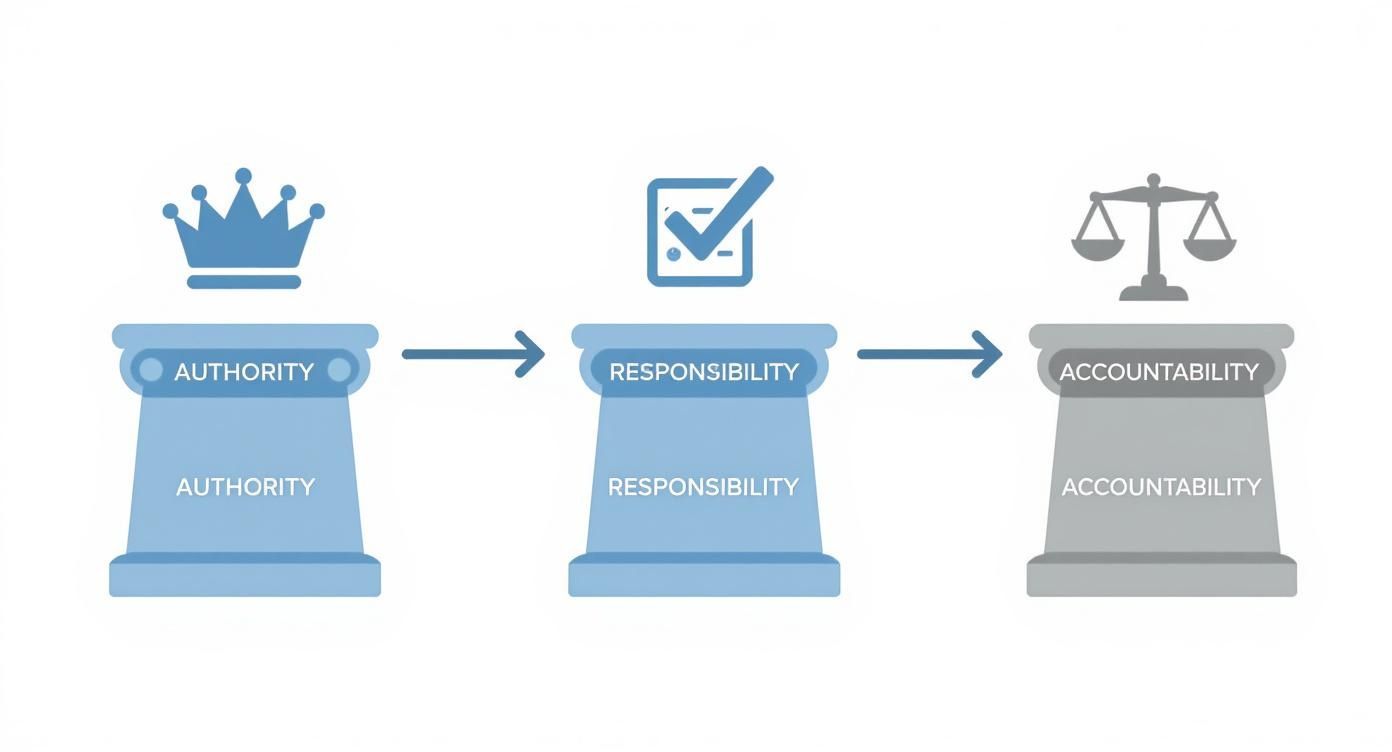
As you can see, it all comes down to balancing authority, responsibility, and accountability. If one of these is out of whack, the whole process can fall apart.
Define the Desired Outcome
First things first: you need to be crystal clear on what success looks like. Before you even think about who will do the work, you have to define the destination. Ambiguity is the enemy of effective delegation.
Start by writing down the specific result you need. Is it a finished report? A sorted-out customer issue? A newly documented process? Get precise about the standards, deadlines, and any constraints involved. This clarity ensures that you and your team member are aiming for the exact same target from day one.
Select the Right Person
With a clear outcome in mind, your next move is to pick the right person for the job. This isn't just about finding who has the most free time. Think of it as a strategic choice that balances what they can do now with their potential for growth.
Consider two key factors:
- Competence: Does this person have the skills and knowledge to get the job done, or can they realistically get there with a bit of support from you?
- Development: Will this task stretch them in a good way? Will it help them build new skills that benefit both them and the team in the long run?
Choosing the right person shows you trust their abilities and are invested in their career. It’s a massive step in becoming a better people manager and building a truly motivated team.
Communicate with Absolute Clarity
Once you’ve chosen someone, the handover is absolutely critical. Set aside some dedicated time to explain the task, providing all the necessary context and background. This is your chance to set clear expectations and field any initial questions.
The single biggest problem in communication is the illusion that it has taken place. This is especially true in delegation. Never assume; always confirm understanding.
During your chat, explicitly give them the authority they need to succeed. Be specific about the resources they can use, the decisions they’re free to make, and any budget they have control over. This conversation acts as a verbal contract, heading off any misunderstandings down the line. To really master this, it's worth digging into the practical steps of how to delegate tasks effectively.
Provide Support and Deliver Feedback
Now, your role shifts from director to coach. It can be tempting to jump in and micromanage, but you need to resist. Instead, set up regular, brief check-ins to see how things are going, offer guidance, and help clear any roadblocks they encounter. Be available to answer questions, but let them own the process.
Finally, always close the loop with feedback. Once the task is complete, sit down together to review the outcome. Acknowledge their effort, celebrate what went well, and talk through any challenges they faced. This final step not only reinforces accountability but also provides a valuable learning experience that makes the next time you delegate even more successful.
Common Delegation Mistakes to Avoid
Even with the best of intentions, knowing what delegation of authority is and actually putting it into practice are two very different things. It’s easy to stumble. So many managers trip over common hurdles that end up undermining the entire process, turning a powerful leadership tool into a source of frustration for everyone.
Recognising these pitfalls is the first step to sidestepping them entirely.
One of the most frequent errors is micromanagement. This is what happens when a manager hands over a task, but not the trust that should go with it. They hover, constantly check in, and dictate every small step, which completely strips the employee of any sense of ownership or autonomy.
The polar opposite is another classic mistake: the 'dump and run'. A manager offloads a task with barely any context or support and then vanishes. This leaves the employee stranded without clear instructions or resources, basically setting them up to fail and causing a huge amount of stress.
Setting Unclear Expectations
But perhaps the most damaging mistake of all is failing to set clear expectations from the get-go.
When the desired outcome, timeline, or quality standard is vague, employees are left guessing what success even looks like. This ambiguity is a fast track to misaligned results and wasted effort, which inevitably chips away at morale and damages the relationship between manager and employee.
Effective delegation demands clarity. A manager’s primary job is to define the destination clearly, not to map out every single step of the journey for their team.
To steer clear of these problems, make sure you don't fall into these three common traps:
- Delegating without authority: Giving someone responsibility for a task but no power to make decisions or get the resources they need is a recipe for disaster.
- Choosing the wrong person: Handing a complex project to an inexperienced team member without proper support can completely overwhelm them and crush their confidence.
- Providing no feedback: When you don't review the outcome and offer constructive feedback, a valuable learning opportunity is lost—for both of you.
Avoiding these mistakes is crucial all year round, but it becomes especially important when you're planning for staff absences. For more tips on this, our guide on preparing for an employee going on holiday provides some really practical advice. By navigating these common delegation challenges, you can build a more capable and resilient team.
Delegation of Authority in UK Governance

Delegation isn't just a tactic for the office; it's a fundamental principle that keeps the entire UK government running. Imagine Parliament as the ultimate board of directors for the country. It’s responsible for setting the big-picture laws and the general direction, but it can't possibly get bogged down in every tiny detail needed to govern a modern, complex society.
So, to actually get things done, Parliament uses a massive-scale version of what managers do every day: delegation of authority. It passes Acts of Parliament that outline broad goals, then grants government ministers the power to create the specific rules and regulations to make those laws work in the real world.
This is where we get something called delegated legislation.
A System of Checks and Balances
Handing over this much power is a big deal, so you need a solid system of checks and balances to make sure it isn't misused. The same ideas of accountability you'd apply in your team are mirrored at the very highest level of governance. This setup ensures that while ministers have the authority to act, they remain answerable to Parliament and, ultimately, the public.
Delegated legislation is the backbone of the UK's legislative process, allowing the government to cope with the sheer volume and intricacy of modern law-making. To put it in perspective, around 3,500 statutory instruments—a common form of this legislation—are made each year, though only about a third ever face parliamentary review. This system stops Parliament from getting completely gridlocked. For a deeper dive, you can read more about delegated legislation in the United Kingdom.
To keep things in check, there are a couple of key oversight mechanisms:
- Parliamentary Scrutiny: Special committees in both the House of Commons and the House of Lords go through proposed regulations. They check that they're fair, legal, and don't stray from the powers granted by the original Act.
- Judicial Review: The courts have the power to strike down delegated legislation if a minister has acted ultra vires—a legal term meaning they've gone beyond the powers Parliament gave them.
The UK Parliament has several procedures for scrutinising these powers. The two main ones are the affirmative and negative procedures, which determine the level of oversight required.
Types of Parliamentary Scrutiny for Delegated Legislation
| Procedure Type | Description | Typical Usage |
|---|---|---|
| Negative Procedure | The legislation becomes law automatically unless either House votes to reject it within a set timeframe (usually 40 days). This is the most common method. | Used for less controversial or more technical regulations where active approval isn't deemed necessary. |
| Affirmative Procedure | The legislation cannot become law unless it is actively approved by both Houses of Parliament through a vote. | Reserved for more significant powers, such as creating new criminal offences or imposing taxes. |
| Super-Affirmative Procedure | A more rigorous process that involves a higher level of scrutiny, including consultation with committees, before the final draft is presented for approval. | Used for particularly powerful or sensitive delegated powers that significantly impact individuals' rights. |
These mechanisms show that even at a national level, delegation relies on trust but is always backed up by robust oversight.
By looking at how delegation works on a national scale, we can see its true strategic value. It proves that trust, clear lines of authority, and strict accountability are universal principles for effective leadership, whether you're in a boardroom or in government.
This real-world example hammers home that delegation is so much more than just passing off tasks; it’s a fundamental tool for making complex systems work.
Got Questions About Delegation? We've Got Answers
Even with a solid grasp of the theory, putting delegation into practice throws up all sorts of tricky situations. Learning to navigate these moments is what turns a good manager into a great one. Let's tackle some of the most common questions that pop up.
What Tasks Should I Never Delegate?
Some things just have to stay on your plate. These aren't just tasks; they're core leadership functions that define your role. Handing them off can create confusion, undermine your authority, and destabilise the team.
Think twice before delegating these:
- Strategic Planning: The big-picture vision and direction for your team? That’s yours to own.
- Final Performance Reviews: You're the one who is ultimately accountable for assessing performance and delivering that formal feedback.
- Disciplinary Actions: Sensitive people issues and corrective action require your direct, careful handling.
- Crisis Management: When things go sideways, the team looks to you for a steady hand and clear leadership. You can't delegate that.
- Highly Confidential Tasks: Anything involving sensitive company information or personal employee data must be handled by you.
How Do I Delegate to Someone Who Is Already Busy?
This is a classic management challenge. Dropping another task on an already swamped team member can feel like you're just piling on, and it can easily backfire. The trick is to make it a conversation, not an assignment.
Start by acknowledging their heavy workload – show them you see how much they're already juggling. Explain why you’ve chosen them for this new responsibility, framing it as a genuine opportunity for them to grow.
Then, open up a discussion about their current priorities. Ask them, "Looking at your list, what can we push back, simplify, or even delegate to someone else to make space for this?" This turns you from a task-giver into a strategic partner, respecting their time and empowering them to manage their own plate.
Delegation isn't about simply adding more work. It’s about raising the level of work your team is doing, which often means rejigging priorities together.
What if a Delegated Task Isn't Done to My Standard?
It’s tempting to jump in, take back the reins, and fix it yourself. Resist that urge. Stepping in every time something isn't perfect teaches your employee that you’ll always be their safety net, which stops them from ever truly learning.
First, take a breath and assess the result objectively. Did it achieve the main goal, even if the method wasn't exactly how you'd have done it? Sometimes 'different' is just 'different', not 'worse'.
If the work genuinely missed the mark, this becomes a coaching moment. Provide specific, constructive feedback that focuses on the gap between the outcome and the goal, not on the person. Ask questions to understand their thinking, like, "Can you walk me through how you approached this?" or "What was the biggest hurdle you ran into?" This approach turns a miss into a valuable lesson, building their skills and your trust in them for the long haul.
Managing delegation is so much easier when you have the right tools in your corner. Leavetrack takes the headache out of absence management, letting you delegate approvals with total confidence because everyone has a clear view of team availability. See how Leavetrack can help your team.