
Bradford Factor Sickness: bradford factor sickness Insights for Absence Planning
Posted by Robin on 10 Jan, 2026 in
The Bradford Factor is a nifty HR formula that helps measure just how disruptive employee sickness can be. It’s built on one simple, but powerful, idea: frequent, short, unplanned absences are often a much bigger headache for a business than one single, long period of sick leave. This metric is all about helping managers spot patterns of Bradford Factor sickness that might otherwise fly under the radar.
What Is the Bradford Factor and Why Does It Matter?
Think about it like this. Imagine your company’s IT department has a single, planned server maintenance day. It’s on the calendar, teams can prepare, work offline, and generally adjust their schedules. It’s manageable.
Now, picture five completely separate, unexpected IT glitches popping up throughout the week. Each one takes the system down for an hour. The total downtime is actually less, but the constant interruption, the loss of momentum, and the sheer unpredictability of it all cause far more chaos.
That analogy is the Bradford Factor in a nutshell. It’s a tool designed to put a number on that exact kind of operational mess caused by frequent, sporadic absences. Instead of just adding up the total number of sick days, it gives a weighted score that shoots up with every separate instance of absence.
The Formula Behind the Disruption Score
The calculation itself is refreshingly simple, using a formula that hits frequency much harder than duration:
B = S² x D
Let's break that down:
- B is the final Bradford Factor score.
- S is the number of "spells" or separate instances of absence.
- D is the total number of days an employee was absent during that period.
The real magic is in squaring the number of spells (S multiplied by S). This little mathematical trick ensures that a pattern of repeated, short absences racks up a much higher score than one long, continuous absence, even if the total days off are identical. A higher score points to a bigger disruption. If you want to get into the nuts and bolts, you can start by understanding your Bradford Factor score in our practical guide.
A Tool Born from UK Public Services
The Bradford Factor isn't some new-fangled idea; it actually came out of the UK public services back in the 1980s and is now a common sight in British absence policies. Its statistical punch made it very attractive to large organisations wrestling with high absence rates. For instance, one major public sector employer with around 48,000 staff reported it managed to cut sickness absence by about 25% after bringing it in alongside other support measures. This history shows just how tied the metric is to UK efforts to manage sickness costs and keep things running smoothly.
The core principle is simple: it’s not just about how many days are lost, but how many times the business is unexpectedly disrupted. The Bradford Factor provides a numerical value to this disruption, turning an abstract problem into a measurable data point.
Ultimately, the goal isn't just to track numbers but to start better conversations. And beyond just tracking absence, it's worth looking at proactive strategies. Reviewing workplace wellness program examples can help foster a healthier workforce, shifting the focus from simply reacting to problems to building a more supportive and resilient company culture.
How To Calculate Bradford Factor Scores With Real Examples
Getting your head around the Bradford Factor calculation is pretty simple once you know the two key ingredients: the number of separate absences (or "spells") and the total number of days an employee was off sick.
The formula itself, B = S² x D, is deliberately designed to place a heavy weighting on frequent, short-term absences. Why? Because from an operational standpoint, it’s often the string of single sick days that causes the most chaos for team planning and productivity.
To work it out, you'll need to look at an employee's sickness record over a set timeframe, usually a rolling 52-week period. For each person, you need to find:
- Spells (S): This is just the number of separate times someone was off sick. One day off is one spell. A continuous week off is also just one spell.
- Days (D): This is the simple grand total of all the working days they missed due to sickness in that 52-week period.
Once you have those two numbers, you just square the number of spells (multiply it by itself) and then multiply that result by the total days. That final number is the Bradford Factor score – a single figure that tells a story about the level of disruption caused.
Two Scenarios, One Big Sickness Problem
To really see the Bradford Factor sickness formula in action, let's look at two employees, Maria and David. Both were off for a total of 10 days last year, but their absence patterns couldn't be more different.
Scenario 1: Maria's Single Long-Term Absence Maria had a minor operation and was signed off for two full weeks (10 working days) to recover. This was all one continuous period.
- Spells (S) = 1
- Total Days (D) = 10
- Calculation: (1 x 1) x 10 = 10
Maria’s score is incredibly low. While her absence was long, it was a single, predictable event that the business could plan around.
Scenario 2: David's Frequent Short-Term Absences David, on the other hand, had 10 separate sick days dotted throughout the year. Each was a single, unconnected day off.
- Spells (S) = 10
- Total Days (D) = 10
- Calculation: (10 x 10) x 10 = 1,000
David’s score is a whopping 100 times higher than Maria's, even though they were both absent for the exact same number of days. This is the formula doing exactly what it’s meant to do: it flags the unpredictable and highly disruptive pattern of frequent, unplanned time off.
This comparison makes it crystal clear: one long absence is far less disruptive to a business than lots of short, sharp, unpredictable ones.
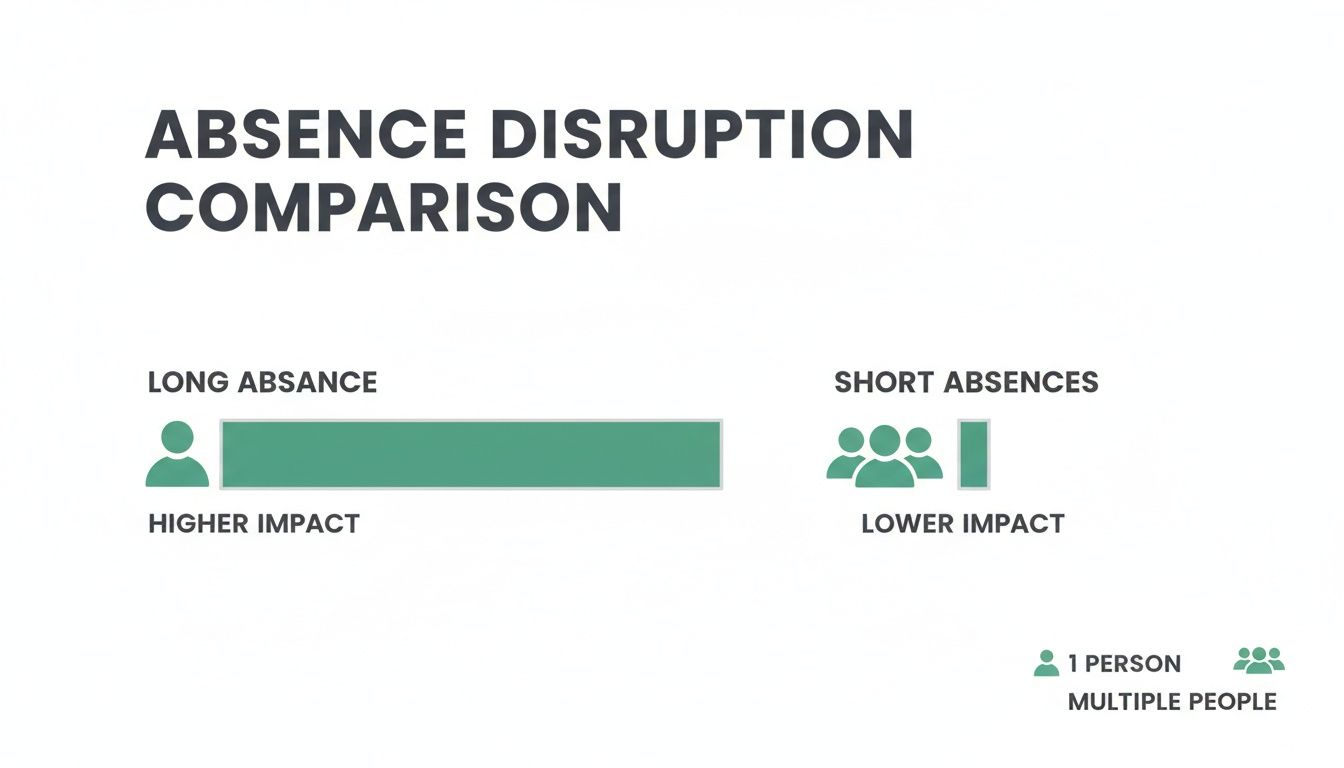
As the chart shows, the operational headache caused by frequent, short absences far outweighs that of a single, longer period of sickness.
Visualising Different Absence Patterns
Seeing various scenarios laid out side-by-side really drives home how quickly the scores can escalate. Keeping track of this manually can become a real chore, which is why so many businesses now rely on software to do the heavy lifting.
If you want to play around with the numbers yourself, checking out The Ultimate Bradford Score Calculator Guide is a great way to see how different patterns produce wildly different scores.
Take a look at the table below. It shows just how dramatically the score climbs with every extra spell of absence, even when the total days aren't that different.
Bradford Factor Score Calculation Examples
| Scenario | Absence Pattern | Spells (S) | Total Days (D) | Calculation (S² x D) | Bradford Score (B) |
|---|---|---|---|---|---|
| No Absence | No sick days taken. | 0 | 0 | (0 x 0) x 0 | 0 |
| Low Frequency | One spell of 5 days. | 1 | 5 | (1 x 1) x 5 | 5 |
| Moderate Frequency | Two spells of 3 days each. | 2 | 6 | (2 x 2) x 6 | 24 |
| Concerning Frequency | Four separate 1-day spells. | 4 | 4 | (4 x 4) x 4 | 64 |
| High Frequency | Six separate 2-day spells. | 6 | 12 | (6 x 6) x 12 | 432 |
It's plain to see that the score for six spells totalling 12 days (432) is massively higher than for four spells totalling 4 days (64). That exponential jump, all thanks to squaring the 'spells' number, is precisely what makes the Bradford Factor such a powerful tool for spotting potentially problematic attendance patterns.
Setting Fair Trigger Points and Interpreting Scores
A high Bradford Factor score is a signal, not a verdict. Once you've got a score in front of you, the real work begins: figuring out what that number actually means and deciding what, if anything, you should do about it. This is where setting clear, fair, and transparent 'trigger points' is absolutely essential for a successful Bradford Factor sickness policy.
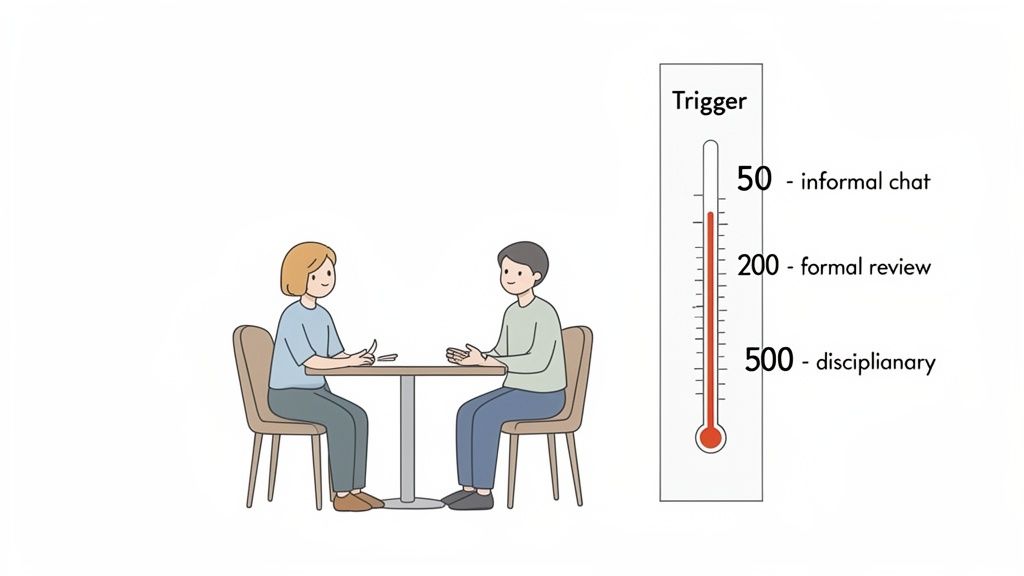
Think of these trigger points as a simple traffic light system for absence management. Green means low concern, amber suggests a bit of caution, and red signals that a conversation is needed. The aim is always to open up supportive discussions about potential underlying issues, not to jump straight into disciplinary action.
Establishing Your Trigger Point Scale
There’s no magic, one-size-fits-all set of trigger points. They need to be tailored to your organisation’s culture, size, and what it needs to run smoothly. That said, a common tiered approach is a great place to start.
A typical scale might look something like this:
- 50+ Points (Informal Chat): A manager has a friendly, informal chat with the employee. The goal here is just to check in, see if everything is okay, and gently mention the impact of frequent absences.
- 200+ Points (Formal Review): This could prompt a more formal meeting, like a return-to-work interview, where you can discuss the patterns. The conversation should still be supportive, focused on exploring reasons and finding solutions together.
- 500+ Points (Potential Disciplinary Action): At this level, the disruption is becoming significant. This score would usually start a formal review under the company's disciplinary procedure, but only after all other supportive options have been exhausted.
It's crucial to remember that these numbers are merely thresholds for conversation. A score of 201 doesn't automatically mean a warning; it means it's time to understand the story behind the number.
Communicating Your Policy Clearly
For any Bradford Factor policy to feel fair and be effective, it must be written down and communicated with absolute clarity. Your employees should never be surprised by a conversation about their score.
Your policy document needs to clearly outline:
- The 52-week rolling period you're using for calculations.
- The exact trigger points and what action each one kicks off.
- How you handle absences related to disabilities or other protected characteristics.
- The supportive nature of the process, with an emphasis on wellbeing.
This kind of proactive communication builds trust and makes sure everyone understands the rules of the game. It’s also vital to consider underlying issues that might be causing short-term absences, like common workplace stress. Implementing strategies for managing workplace stress can do wonders for employee wellbeing and help reduce those frequent absences before they become a problem.
The UK Context of Rising Sickness Absence
For UK managers, the Bradford Factor is a tool being used against a challenging backdrop of rising sickness and major cost pressures. Recent CIPD research reveals UK employees now take an average of 7.8 sickness days each year—a sharp increase from the pre-pandemic figure of 5.8 days.
This trend, combined with ONS data showing 2.8 million people are now economically inactive due to long-term sickness, is tightening the labour market and making every absence feel more disruptive. This context helps explain why organisations are turning to tools like Bradford scoring to pinpoint the kinds of absence patterns that have a disproportionate impact on their operations.
Navigating the Legal and Ethical Risks
Just using the Bradford Factor as a cold, mathematical tool without any human oversight is a recipe for disaster. While it’s great for spotting disruptive absence patterns, applying it rigidly can land your organisation in a legal and ethical minefield, especially when it comes to Bradford Factor sickness policies.
The numbers alone just don’t tell you the full story. Think about it. A high score could be down to a genuine underlying health issue, a disability, or even an employee struggling to juggle caring responsibilities. If you treat every high score the same, you’re opening the door to serious legal challenges that can hurt your bank balance and your reputation as a fair employer.
The Equality Act and Reasonable Adjustments
Here in the UK, the big one you need to worry about is the Equality Act 2010. This bit of legislation protects employees with disabilities from being treated unfairly. If an employee’s frequent short absences are directly linked to a disability you know about, taking disciplinary action based only on their Bradford Factor score could easily be seen as disability discrimination.
The law is clear: employers must make 'reasonable adjustments' for disabled employees. This isn't just a nice-to-have; it's a fundamental duty to make sure everyone has a level playing field.
What might this look like in practice?
- Discounting disability-related absences: You could agree to completely exclude any sick days directly caused by a recognised disability from the Bradford Factor calculation.
- Adjusting trigger points: It might be fair to set a higher trigger point for an employee who has a chronic condition that is known to cause intermittent flare-ups.
- Allowing time off for appointments: Absences for pre-planned medical appointments connected to a disability should be handled very differently from an unexpected sick day.
Ignoring this duty really isn't an option. An employment tribunal will take an extremely dim view of any failure to even consider reasonable adjustments. The key is to move away from a rigid, one-size-fits-all rulebook and towards a more flexible, individual approach.
A Bradford Factor score should never be the final word. It's a prompt to start a conversation, investigate the context, and fulfil your legal duty to support your employees. Blindly following the formula is a recipe for a discrimination claim.
The Ethical Dilemma of Presenteeism
Beyond the strict letter of the law, there’s a big ethical question mark hanging over the Bradford Factor. One of the major risks is that you end up creating a culture of 'presenteeism'—where people feel they have to drag themselves into work when they’re genuinely ill, just to avoid hitting a disciplinary trigger.
This is a classic lose-lose situation. An employee who is sick at work is less productive, more likely to make mistakes, and could end up spreading their illness to colleagues, which only causes more absence down the line. It completely undermines trust and can create a toxic environment where people’s health is sacrificed for the sake of a low score.
Evidence from UK unions highlights this exact problem. One review noted that when a large public-sector employer brought in Bradford scoring, they saw a 25% drop in headline sickness absence. Great, right? Not really. It also caused a huge spike in presenteeism, with staff coming to work unwell because they were scared of breaching the trigger points. You can read more about these findings on UNISON's website.
A Tool, Not a Tyrant
The only safe and effective way to use the Bradford Factor is as one part of a much bigger, human-focused approach to managing absence. The score should flag a potential issue, but what happens next has to be driven by empathy, proper investigation, and open communication.
When a manager sees a high score, their first step should always be a supportive, confidential chat to understand what’s going on. Is there an underlying health condition? Are they struggling with stress? Do they need support with caring duties? Building a fair absence and sickness policy is absolutely crucial for guiding these important conversations.
At the end of the day, the Bradford Factor is a powerful diagnostic tool, but it's a terrible decision-maker. It can tell you what is happening (a pattern of disruptive absence), but it can never explain the why. Relying on it as your sole reason for disciplinary action isn’t just ethically dodgy—it's a massive legal risk.
Automating Bradford Factor Tracking for Better Insights
Let's be honest, manually tracking absence spells and days in a spreadsheet is fine when you've only got a handful of employees. But as your team grows? That spreadsheet quickly becomes a monster. It's a time-consuming administrative headache, and worse, it's riddled with the risk of human error. Miscounting a single spell or day can completely throw a Bradford Factor sickness score off, leading to some really awkward, unfair conversations and inconsistent policy application.
This is exactly where technology can step in to create a fairer, more efficient system for everyone. Modern absence management software takes the manual grind off your plate entirely, freeing up HR managers and team leaders from the soul-destroying task of spreadsheet admin. Instead of spending hours cross-referencing calendars and updating cells, you can focus your energy where it actually matters: on having supportive, strategic conversations with your staff.
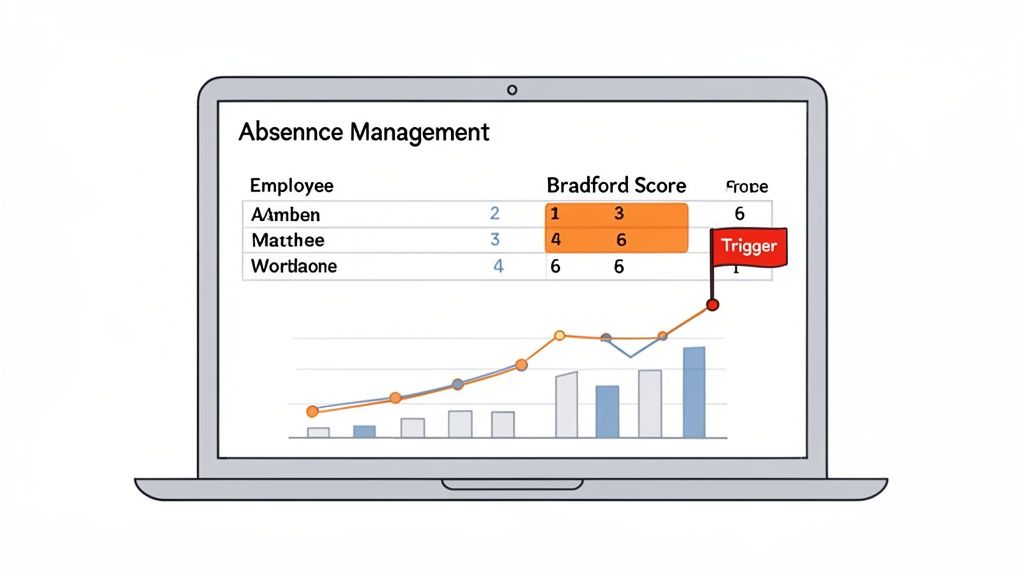
Think of these systems as a central hub for everything absence-related. When an employee reports a sickness, the system instantly logs it, calculates their updated score in real-time, and gives you a clear, at-a-glance view of attendance patterns across the entire organisation.
The Power of Real-Time Data and Alerts
The real game-changer with an automated system is its ability to be proactive. Instead of digging through records and discovering that an employee crossed a threshold weeks ago, the software can give you an immediate heads-up.
You can set your own custom trigger points right inside the system. For instance, you could configure it to:
- Send a discreet notification to a manager when an employee’s score hits 50.
- Automatically flag an individual for a formal review once their score goes past 200.
- Generate a quick report of all employees who are getting close to a critical threshold.
This real-time flagging ensures that interventions are timely and, crucially, consistent for everyone, removing any chance of bias or simple oversight. It transforms the Bradford Factor from a reactive reporting tool into a proactive management aid, helping you to address potential issues long before they escalate.
By automating the calculation and monitoring process, you ensure every employee is managed under the exact same rules. This consistency is the foundation of a fair and legally defensible absence management policy.
From Raw Numbers to Actionable Insights
Beyond just tracking individual scores, sophisticated absence management tools like Leavetrack give you powerful reporting features that help you see the bigger picture. A central dashboard can visualise trends, allowing you to spot patterns that would be completely invisible in a spreadsheet.
You might start to notice things like:
- A specific department has a consistently higher average Bradford score than the others.
- Short-term absences seem to spike during a particular time of year.
- There's a link between project deadlines and an increase in single-day sickness spells.
These are the kinds of insights that are invaluable. They let you move beyond simply reacting to individual absences and start asking strategic questions about workloads, team morale, or seasonal pressures. Technology, in this context, isn't just about saving time; it's about uncovering the data-driven stories that lead to a healthier, more productive, and more supportive workplace. It allows you to shift from policing absence to genuinely understanding and improving employee wellbeing.
Bradford Factor FAQs: Your Questions Answered
Even when you've got your head around the formula, putting a Bradford Factor sickness policy into action throws up some real-world questions for managers. It’s a tool that mixes hard data with the very human side of management, so knowing how to handle tricky situations is vital if you want to use it fairly.
Here are our answers to the most common queries that pop up. Think of these as practical pointers to keep you on track, using the score as a supportive management tool, not a blunt instrument.
Can I Use the Bradford Factor to Discipline an Employee?
This is the big one, and the answer is a hard no. You should never use a Bradford Factor score as the only reason for disciplinary action.
Think of the score as an alarm bell, not a judge's gavel. It’s a trigger to start a conversation, not a final verdict on someone's conduct.
If you rely rigidly on the number without digging into the context, you're walking into a legal minefield. It could easily lead to claims of unfair dismissal, particularly if the absences are tied to an underlying health issue or disability.
The score’s job is to kickstart a supportive chat and a fair investigation. Any disciplinary action has to come from the full picture you gather during that process, in line with your company policy—not just from a number spat out by a formula.
Should Absences Related to a Disability Count Towards the Score?
This question takes us straight into the territory of the Equality Act 2010, and it's a critical one. Including absences that are a direct result of an employee's known disability could be seen as discriminatory. As an employer, you have a legal duty to make 'reasonable adjustments' to ensure disabled employees aren't put at a disadvantage.
Discounting some or all disability-related absence from the Bradford Factor calculation is often considered a reasonable adjustment. So what does that look like in practice?
- Make Your Policy Clear: Your absence policy should spell out exactly how you handle disability-related absences.
- Talk to Your Employee: Have an open conversation to understand their needs and agree on what adjustments feel right.
- Write It Down: Keep a clear record of any agreed adjustments. This ensures everyone is on the same page and shows you're meeting your legal duties.
Ignoring this duty isn't an option. The best approach is to handle these situations with sensitivity, focusing on support instead of statistics.
What Is a Good Bradford Factor Score?
Honestly, there's no magic number that's universally "good" or "bad." A score's meaning is all down to the trigger points you set for your own organisation. Technically, a score of zero is perfect—it means no sickness absence at all. Many companies would see a score under 50 as nothing to worry about.
But getting fixated on a specific number is missing the point. The real value is in watching the trend and understanding what’s going on behind the score. An employee's score might jump up because of a short-term illness before settling back down again.
Instead of chasing a target, use the scoring system to apply your absence policy consistently for everyone. The aim is to spot disruptive patterns that might signal someone needs support, not to punish people for being genuinely ill.
How Do I Introduce a Bradford Factor Policy to My Team?
Bringing in any kind of new monitoring system needs careful handling. If you don't communicate it well, you risk creating anxiety and mistrust. When you roll out a Bradford Factor policy, explaining the 'why' is just as crucial as the 'how'.
Frame it as a tool to ensure fairness across the business and to help spot potential wellbeing issues early. It’s about managing disruption and offering a helping hand where it’s needed.
For a smooth rollout, follow these steps:
- Hold Team Meetings: Get everyone together to explain how the score works, what your trigger points are, and what happens when a trigger is hit (which should just be a simple, informal chat to start with).
- Provide a Written Guide: Give every employee a clear, easy-to-read policy document they can look back on.
- Train Your Managers: Make sure your managers are trained to apply the policy consistently and, most importantly, with empathy. They’re the ones having these conversations.
- Offer Reassurance: State clearly that genuine illness is understood and that the policy has safeguards, especially for those with disabilities or long-term conditions.
If you're open and proactive, you can position the policy as a fair and supportive part of your management toolkit, rather than something for your team to dread.
Managing sickness absence fairly is a must for any business, but doing it manually is a recipe for mistakes and inconsistency. With Leavetrack, you can automate Bradford Factor calculations, set custom trigger alerts, and get clear insights into absence patterns. It frees you up to focus on what really matters: supporting your team.
See how Leavetrack can transform your absence management. Visit https://leavetrackapp.com and start building a smarter, fairer system today.