

How Do I Work Out My Holiday Entitlement in the UK
Posted by Robin on 09 Dec, 2025 in
When you're trying to work out holiday entitlement, the magic number to remember is 5.6 weeks. This is the statutory minimum paid leave almost every worker in the UK is entitled to each year.
For someone working a typical five-day week, this works out to a straightforward 28 days of paid time off. Simple as that.
Understanding Your Core Holiday Entitlement

Before we get into the trickier calculations for part-time staff or people on irregular hours, it's vital to get a solid grasp of this foundation. It's the baseline that ensures everyone gets a fair amount of paid leave, no matter their working pattern.
The whole system is built on this universal right to 5.6 weeks of paid annual leave. For a standard five-day-a-week employee, the maths is simply 5 days × 5.6 weeks = 28 days. This same principle applies proportionally to different work schedules, making sure it’s fair across the board.
This legal floor is known as your statutory holiday entitlement. It’s the absolute minimum an employer has to provide. Of course, many companies offer a more generous package, and this is what we call contractual holiday entitlement.
Your employment contract is the first place you should look. It will spell out your total holiday allowance and, crucially, clarify if bank holidays are included in that total or are given on top of it. Always start with the contract to see what you're actually entitled to.
Statutory vs Contractual Entitlement
It’s so important to know the difference between what the law demands and what your employer has chosen to offer. They aren’t always the same thing, and getting it clear empowers you to make sure you're getting the right amount of leave.
- Statutory Entitlement: This is the non-negotiable legal minimum of 5.6 weeks. An employer cannot give you less. For a full-timer, this is also capped at 28 days—so even if you work six days a week, your statutory entitlement doesn't increase beyond that.
- Contractual Entitlement: This is any extra leave your employer gives you on top of the statutory minimum. For example, a company might offer 33 days of holiday (including bank holidays). That's made up of the 28 statutory days plus five extra contractual days.
This difference really matters when you start talking about carrying over leave or getting paid in lieu when you leave a job, as the rules can differ for statutory versus contractual days. For a deeper dive, you can learn more about how to work out your holiday entitlement in the UK.
What About Bank Holidays?
Bank holidays are a classic point of confusion. Here’s the deal: in the UK, there's no automatic legal right to have bank holidays off as paid leave.
Instead, your employer can choose to include the bank holidays as part of your 5.6 weeks statutory entitlement. If your contract says you get "28 days of holiday including bank holidays," it means that when a bank holiday comes around, one day is simply ticked off your 28-day total.
A more generous contract might say "28 days plus bank holidays," which is a much better deal.
This flexibility means you always have to go back to your contract. It’s the only document that holds the definitive answer on how your company handles public holidays. You can find more details in our complete guide on statutory holiday entitlement in the UK.
Calculating Holiday for Part-Time Workers
Just because you work part-time doesn’t mean you miss out on well-deserved time off. The law is quite clear on this: part-time workers must be treated no less favourably than their full-time colleagues. In simple terms, your holiday entitlement is just calculated on a proportional basis, often called 'pro-rata'.
It's a term that can sound a bit more official and complicated than it actually is. Really, it's just a way of scaling the standard 5.6 weeks of statutory leave to match the hours or days you actually work. This ensures everything is fair, whether you work three fixed days a week or a variety of shifts that change from one week to the next.
The trick is figuring out which calculation method best fits your specific work pattern. Let's walk through the most common scenarios with some practical examples you can use to check your own numbers.
For Those with Consistent Work Days
Let's start with the most straightforward setup: you work the exact same number of days every single week. If that's you, working out your holiday entitlement in days is beautifully simple.
The formula is just your number of work days per week multiplied by the statutory 5.6 weeks.
For instance, say you work a consistent three-day week. The calculation is as simple as:
3 days per week × 5.6 weeks = 16.8 days of paid holiday per year.
It’s pretty common for employers to round this up to the nearest half or full day, so you might see this written as 17 days in your contract. This method is perfect for anyone with a predictable weekly schedule, from two days a week up to four.
When Your Shifts and Hours Vary
But what happens if your work pattern isn't about fixed days, but about the number of hours you put in? This is a very common situation in sectors like retail, hospitality, and care, where you might work three shifts one week and four the next, all of varying lengths.
In this case, calculating your holiday in 'days' doesn't make much sense. A "day" could be a four-hour shift or a twelve-hour one. It’s far more accurate and fair to work out your entitlement in hours instead. This way, you're compensated correctly for the exact time you would have worked.
Let's break down how this works.
First, you need to know the weekly hours of a full-time employee at your company. A standard full-time week is often 37.5 hours. Their holiday entitlement in hours would be:
37.5 hours per week × 5.6 weeks = 210 hours of paid holiday per year.
Now, let's say you work an average of 20 hours per week. Your pro-rata entitlement is calculated like this:
20 hours per week × 5.6 weeks = 112 hours of paid holiday per year.
This hours-based method provides pinpoint accuracy. When you book a day off that would have been an 8-hour shift, you simply use 8 hours from your 112-hour pot. If it was a 4-hour shift, you only use 4 hours. This is crucial for making sure everyone gets their proper leave entitlement.
Practical Calculation Example
Let's bring this to life with a real-world scenario. Meet Alex, who works in a coffee shop on a part-time contract.
- Alex works three shifts a week, but they vary: one 8-hour shift, one 6-hour shift, and one 4-hour shift.
- This gives Alex a consistent weekly total of 18 hours.
- The full-time employees at the coffee shop work a 40-hour week.
To figure out Alex's holiday entitlement, we just use the hours-based formula:
18 hours per week × 5.6 weeks = 100.8 hours of annual leave.
When Alex wants to book a Tuesday off, which is normally his 8-hour shift, 8 hours are deducted from his 100.8-hour balance. This is so much fairer than deducting a full "day," which wouldn't accurately reflect the shorter shifts he also works. This approach ensures part-time workers aren't disadvantaged, which is a core principle of UK employment law.
For more detailed guidance, our complete article on how to calculate pro-rata holiday provides an even deeper dive into these calculations.
Navigating Holiday Pay for Irregular and Zero-Hours Work
Figuring out holiday entitlement can feel like a real puzzle when your hours aren't fixed. For anyone on a zero-hours contract or with a work pattern that changes from one week to the next, calculating holiday based on days just doesn't work. It might seem impossible, but it doesn't have to be a headache.
The trick is to stop thinking about a fixed allowance and start thinking about an average of what you’ve actually earned. UK law has a specific method for this, making sure your holiday pay is a fair reflection of your normal earnings, even if your "normal" is constantly changing.
The 52-Week Reference Period Explained
When your hours fluctuate, your holiday pay is calculated using an average from a 'reference period'. For any holiday year that started on or after 1st April 2020, this reference period is 52 weeks.
This whole system is designed to give a fair snapshot of your earnings, accounting for the natural peaks and troughs in your work schedule rather than just a flat hourly rate.
Here’s the breakdown of how it works:
- Your employer needs to look back over the last 52 weeks where you were actually paid for work.
- Crucially, they must skip over any weeks where you didn't work at all and therefore earned nothing.
- If needed, they can look as far back as 104 weeks to gather enough paid weeks to make up the 52-week average.
This process prevents a long spell without work—maybe between projects or during a quiet period—from unfairly dragging down your average weekly pay. It’s all about getting a true picture of what you would have typically earned.
Once your employer has the pay data from those 52 weeks, they simply add it all up and divide by 52. The figure they get is your average weekly pay, and that’s exactly what you should be paid for taking one week of holiday.
A Practical Example of the Reference Period
Let's say you're a delivery driver and your earnings change quite a bit depending on demand. Over the past year, you had four weeks where you didn't work at all because you were unwell.
To work out your holiday pay, your employer has to:
- Go back through the last 56 weeks of pay records (the most recent 52 plus the 4 weeks you were off).
- Ignore the four weeks where you earned £0.
- Use the remaining 52 weeks of pay data to find your average weekly earnings.
If your total earnings over those 52 paid weeks were £18,200, the calculation is straightforward:
£18,200 ÷ 52 weeks = £350 average weekly pay.
This means for every full week of holiday you take, you should be paid £350. It’s a method that ensures your pay reflects the reality of your work, not just a theoretical number.
The flowchart below helps to visualise the different paths for calculating part-time holiday, depending on whether the work pattern is consistent or varied.
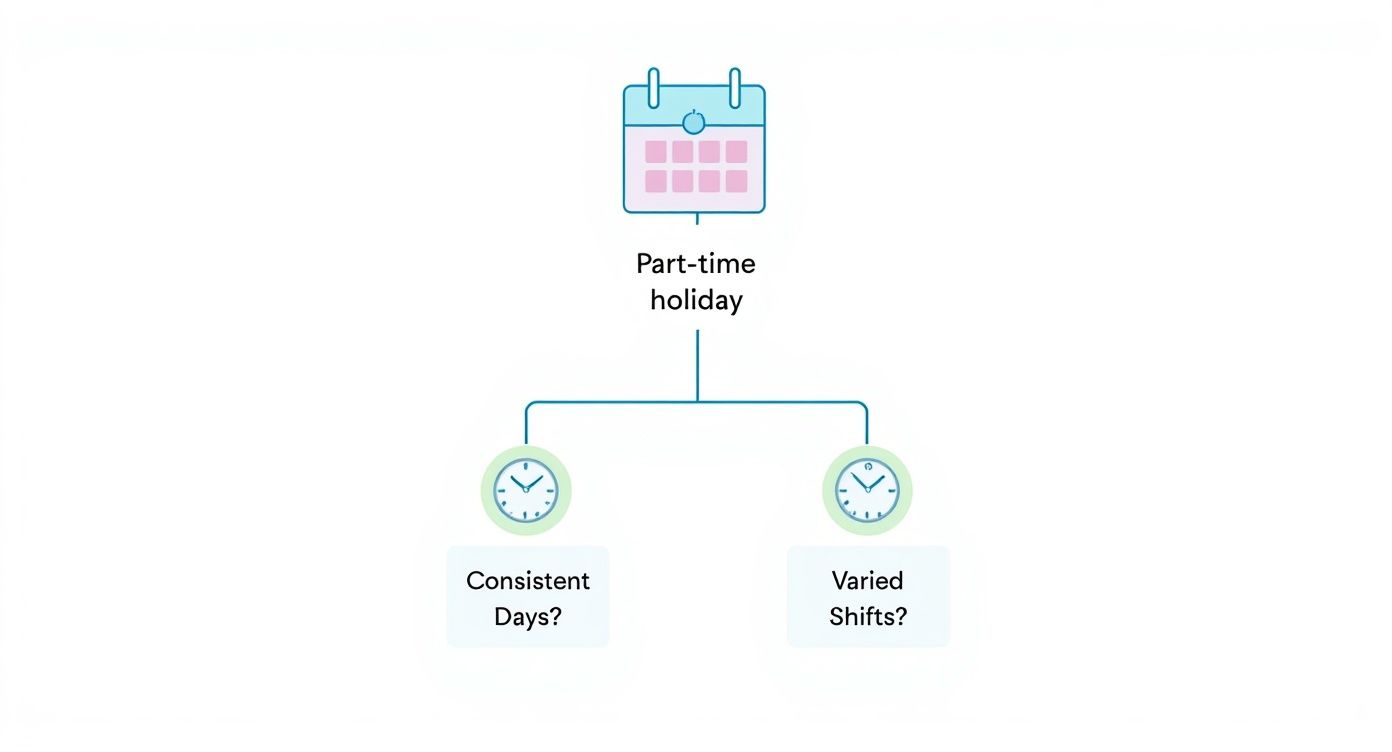
As you can see, the moment shifts become variable, the calculation moves away from a simple days-based approach and towards one based on hours or average pay.
To simplify things, here's a quick look at the main calculation methods for different work patterns.
Holiday Calculation Methods for Different Work Patterns
| Work Pattern | Primary Calculation Method | Key Consideration |
|---|---|---|
| Full-Time (Fixed Hours) | Days or Weeks | Based on the statutory 5.6 weeks, which is usually 28 days for a 5-day week. |
| Part-Time (Fixed Hours) | Pro-rata (Days) | Calculate the full-time equivalent and then pro-rata it based on days worked. |
| Irregular/Zero-Hours | 52-Week Average | Calculates average weekly pay based on the last 52 paid weeks. |
These methods ensure that no matter how someone works, their holiday entitlement is calculated fairly and in line with UK law.
Understanding the 12.07% Accrual Method
You’ve probably come across the 12.07% method for calculating holiday. For a long time, this was the go-to way to work out holiday for casual and zero-hours staff. While recent court rulings push for the 52-week average for holiday pay, the 12.07% figure is still a handy way to calculate holiday entitlement in hours.
Where does that number come from? A standard working year is 52 weeks, but statutory holiday is 5.6 weeks. That leaves an actual working year of 46.4 weeks (52 - 5.6).
The maths looks like this: (5.6 weeks holiday ÷ 46.4 working weeks) × 100 = 12.07%
In simple terms, for every hour you work, you earn 12.07% of that hour as paid holiday.
Imagine someone in hospitality on a zero-hours contract works 80 hours in one month. To see how much holiday they’ve earned, you’d do this calculation:
80 hours × 12.07% = 9.66 hours of holiday earned.
This gives you a really clear, transparent way to see your holiday pot growing with every shift you work. For a deeper dive into the specifics, our guide on zero-hour contract holiday entitlement is a great resource.
It's worth knowing that for leave years starting from 1st April 2024, the government has brought back rolled-up holiday pay for irregular-hours and part-year workers. This lets employers add a 12.07% uplift to each payslip to cover holiday pay, instead of paying it when the leave is actually taken. If they do this, it must be shown clearly as a separate item on your payslip.
Managing Holiday Accrual and Carry-Over Rules
Knowing your team’s total holiday allowance is a great starting point, but it's really only half the story. Just as crucial is understanding how that leave is earned throughout the year and what happens to any days left untaken. This is where holiday accrual and carry-over policies come into play.
Holiday entitlement isn’t just handed out in one big lump on day one. Instead, employees 'accrue' it, or build it up, over the course of the year. This is especially important to get right when someone joins your team, as their entitlement grows with each month they work.
How Holiday Accrual Works
For most employees on a standard contract, holiday accrual is a straightforward monthly calculation. You simply take their total annual entitlement and divide it by twelve to see what they earn each month.
Let’s imagine a new starter has an annual entitlement of 28 days. The calculation for their monthly accrual is pretty simple:
28 days ÷ 12 months = 2.33 days of holiday accrued per month.
This system keeps things fair if someone starts part-way through the year or leaves before it ends. Their holiday is calculated based on the actual time they’ve been with the company, preventing someone who joins in November from immediately trying to book a three-week Christmas holiday.
Remember, this accrual method kicks in from their very first day. After working for three months, that new starter will have earned roughly 7 days of holiday (2.33 x 3). That's the amount they are entitled to book at that point.
Getting to grips with accrual is the key to managing holiday requests, especially during an employee's first year.
Untangling Holiday Carry-Over Rules
So, what happens if an employee reaches the end of the holiday year with unused days? Can they roll them over? This is where carry-over rules get interesting, as they're a mix of legal minimums and your own company policy.
By law, employees must take at least four weeks of their statutory holiday (that’s 20 days for a full-timer) within the leave year it's earned. However, UK regulations do allow for up to 1.6 weeks (8 days for a full-time employee) to be carried over, but only if there's a formal agreement in place, like a clause in their employment contract.
Beyond that legal baseline, you have flexibility as an employer:
- You could offer a more generous carry-over policy for any contractual leave you provide on top of the statutory minimum.
- Alternatively, you might enforce a strict "use it or lose it" policy for any extra contractual days.
The employment contract or company handbook is your definitive guide here. It needs to spell out exactly how many days can be carried over and the deadline for using them in the new year.
This has become a hot topic recently. Between 2020 and 2023, the average number of holiday days taken by UK employees fell from around 38 to just 33.9 days—that's a drop of almost 12%. You can dig deeper into these annual leave trends in the UK to see the bigger picture.
Calculating Final Holiday Pay When Someone Leaves
When an employee's time at the company ends, they are legally entitled to be paid for any statutory holiday they've accrued but not taken. This calculation ensures nobody loses out on earned leave just because they're moving on.
First, you need to work out how much of the holiday year they’ve completed. For instance, if someone leaves exactly six months into the year, they've worked 50% of it.
This means they’re entitled to 50% of their total annual leave allowance. If their full entitlement was 28 days, they would have earned 14 days by their leaving date.
From that accrued total, you then subtract any holiday they’ve already taken that year.
Here’s a worked example:
- An employee leaves after 9 months (75% of the year).
- Their annual entitlement is 28 days.
- Holiday accrued: 28 days × 0.75 = 21 days.
- They’ve already taken 15 days of leave this year.
- Holiday to be paid in final salary: 21 accrued days - 15 taken days = 6 days.
You must pay them for those 6 days in their final payslip. On the flip side, if they've taken more holiday than they've accrued, you can legally deduct the difference from their last paycheque.
How Do Life Events Affect Holiday Entitlement?
Life throws all sorts of things at us, and big events are a natural part of anyone's career. But they can also create a bit of uncertainty around workplace rights. A question I see pop up all the time is: how do I work out my holiday entitlement when I’m off for a long time?
The good news is that your right to paid holiday is protected during these major moments. Whether you’re welcoming a new addition to the family or dealing with a period of illness, you won’t lose out on your leave.
So, if you're on maternity, paternity, adoption, or shared parental leave, your holiday entitlement keeps building up just as if you were still at your desk. This applies to your full statutory entitlement of 5.6 weeks and any extra contractual leave your company offers. It all continues to accrue for the entire time you're on leave.
Parental Leave and Holiday
By the time their parental leave ends, many people find they’ve got a hefty amount of holiday saved up. So, what’s the best way to use it? You’ve got a couple of common options, and it’s always smart to have a chat with your employer about it well in advance.
- Take it before your leave begins: You could use your accrued holiday to start your time off a little earlier.
- Add it to the end of your leave: This is a really popular choice. It lets you extend your time away from work while getting your normal pay, making the return to work feel a little less abrupt.
Planning is everything here. Your employer can’t just refuse your request without a good reason, but they do have to think about team resources. Getting the conversation started early helps everyone prepare and makes for a much smoother transition.
It's a common myth that holiday accrual simply stops during parental leave. Legally, your employment contract is still active, and that means your entitlement to paid time off is too. This is a fundamental protection for new parents in the UK.
Sickness Absence and Holiday Rules
What about if you’re on long-term sick leave? It works in a very similar way to parental leave. Your statutory holiday entitlement continues to accrue even when you're off sick. You can't be put at a disadvantage just because you’ve been unwell.
Interestingly, you can even choose to take paid holiday while you're off sick. Let’s say your statutory sick pay is quite low; you might prefer to receive your usual holiday pay instead for some of that time. You just need to give your employer the proper notice to book it.
A more frequent scenario, though, is being too ill to actually use your holiday entitlement during the leave year. If that happens, you are legally allowed to carry it over.
Here are the key rules for carrying over holiday due to sickness:
- You can carry over up to four weeks of your statutory holiday (that’s 20 days for a typical full-timer).
- This carried-over leave must then be used within 18 months from the end of the leave year it was accrued in.
This rule is there to make sure that illness doesn’t rob you of the proper rest and recovery that annual leave is for. The best advice is to always keep your employer in the loop about your situation and discuss your plans for using or carrying over any holiday to stay on the right side of company policy.
Common Questions About Holiday Pay and Entitlement
Even when you feel you have a solid grasp of the rules, certain real-world scenarios can throw you a curveball. The simple question "how do I work out my holiday entitlement?" often spirals into more complex queries about pay, overtime, and bank holidays.
Let's tackle some of the most common questions we see, with clear, straightforward answers.
Can My Employer Dictate When I Take My Holiday?
Yes, they can. A classic example is a company-wide shutdown over the Christmas period, where everyone is required to take annual leave.
However, your employer can't just spring this on you at the last minute. The rule is that they must give you notice that is at least double the length of the leave they're asking you to take. So, if they want you to take one week off, they need to tell you at least two weeks beforehand. This kind of arrangement should always be clearly spelled out in your employment contract or staff handbook.
Does Working Overtime Increase My Holiday Entitlement?
This is a really common point of confusion. While your allowance in days won't increase, your holiday pay absolutely should.
UK law is clear on this: for the first four weeks of statutory leave, your holiday pay has to reflect what you'd ‘normally’ earn. This calculation must include things like regular overtime, commission payments, and certain bonuses. To figure this out, your employer should use the 52-week reference period to calculate your average weekly pay. The remaining 1.6 weeks of statutory leave are typically paid at your basic rate, unless your contract offers something more generous.
A lot of people mistakenly think holiday pay is just their basic salary. If you consistently work overtime, check your payslips to make sure it's being factored into your pay for at least the first four weeks of your annual leave. It can make a significant difference.
Do I Get Paid for Bank Holidays if I Don't Normally Work That Day?
This one comes down entirely to what's written in your employment contract. Surprisingly, there's no automatic legal right to be paid for bank holidays.
This issue often trips up part-time workers, especially if a bank holiday Monday falls on their non-working day. To keep things fair and avoid potential discrimination claims, many employers will calculate a pro-rata bank holiday allowance for their part-time staff. This is then added to their total annual leave pot to be used whenever they like. It’s considered best practice, but it isn't a strict legal requirement.
Can I Get Paid for Holiday I Don't Take?
You can only be legally paid in lieu of your statutory 5.6 weeks of holiday when your employment is ending. This is often referred to as a "payment in lieu."
It's actually unlawful for an employer to 'buy back' this statutory holiday time while you're still employed. The rules are designed to make sure people get proper rest and time away from work. That said, if your contract gives you more holiday than the legal minimum (contractual leave), your employer might have a policy allowing you to sell back those extra days. When looking for comprehensive guides on calculating your time off, exploring easy steps for accurate time off tracking can be incredibly helpful.
Managing holiday entitlement, accruals, and approvals can quickly become a major administrative headache. Leavetrack replaces messy spreadsheets with a clear, simple online system. Your team gets instant visibility, managers can approve leave in one click, and you get peace of mind knowing all your records are accurate and in one place. Simplify your absence management by visiting Leavetrack.